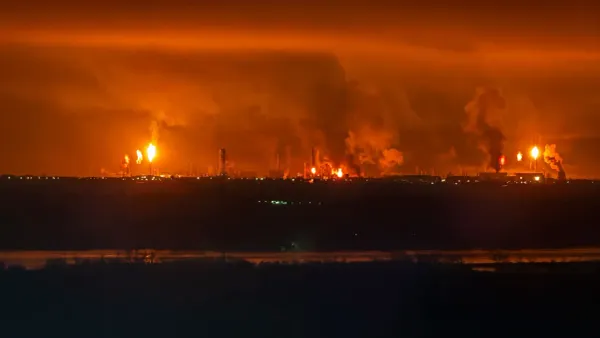
Russian missiles and drones stopped electricity generation at three thermal power plants owned by DTEK, Ukraine's largest private energy company, in a single night on 3 November, the company said.
Centrenergo, the state-owned operator of the Trypillia thermal power plant less than 30 km south of Kyiv, said Russian strikes on the plant on 9 November had extremely serious consequences. Russian strikes have damaged 800 pieces of energy equipment since September, Energy Minister Denys Shmyhal said on 30 October. Thermal plants produced more than 30 per cent of Ukraine's electricity before the full-scale invasion, and DTEK has lost three of the eight it ran to occupation or destruction, DTEK's figures show.
A Russian drone strike on a warehouse in Odesa supplying food to kindergartens and schools killed three people on 9 November, and drones set grain storage facilities in Odesa region on fire on 15 November. A source in Ukraine's Defence Intelligence said on 10 November that Russia was preparing strikes on grain elevators, vegetable oil plants, dairies, meat processors and poultry farms.
Jet-powered Russian drones are getting through to electricity substations because a speed limit on Starshield satellite terminals stops interceptor drones from catching them, President Volodymyr Zelenskyy said on 15 November. Ukrainian interceptor drones lose contact with their operators at 161 km/h, Zelenskyy said, and cannot keep up with the jet-powered Shaheds. "The protection of lives and Ukrainian energy infrastructure before winter depends on this," he wrote.
Russia sent 132 attack drones against Ukraine overnight into 15 November, 78 of them jet-powered, and air defences brought down 106, among them 61 of the jet-powered drones, the air force said. Drones hit 20 locations and struck energy facilities in Zaporizhzhia, Sumy, Odesa, Zhytomyr and Kirovohrad regions. Russian strikes killed four people and injured 69 across Ukraine over the day.
Russian forces are hitting Kyiv's bridges over the Dnipro with Iskander-M ballistic missiles fitted with seekers that correct their course in the last seconds of flight, Serhii Beskrestnov, Zelenskyy's adviser on radio technology, said on 9 November. On the night of 6 to 7 November Russia fired 36 ballistic missiles at Kyiv and the surrounding region and four were shot down. Six were aimed at the Northern Bridge and four hit it.
Russia plans to build 55 to 60 of the 9M723 missiles fired by Iskander launchers each month, Ukraine's Defence Intelligence estimates. Ukraine has received an average of about 12 Patriot interceptors a month from the U.S. this year, Zelenskyy said on 28 October, and its crews fire two on average to bring down one ballistic missile. The State Department cleared the sale of 500 PAC-3 MSE interceptors on 30 October, worth an estimated US$2.1 billion and paid for by Canada, Germany, Norway and a European Union loan. The missiles would be newly built and would arrive in 2030 at the earliest, diplomatic sources said.
Ukraine's request for a licence to build Patriot interceptors itself remained stalled at the Pentagon on 14 November, two sources in Washington said. Marco Rubio, the secretary of state, and Defence Secretary Pete Hegseth had agreed to it in October. Missiles that allies had already bought for Ukraine were still awaiting Hegseth's signature in late October.
Rubio said on 20 October that a shipment may have been held up while the U.S. weighed its priorities. "There has not been some deliberate political directive to go out and harm Ukraine," he said. Hegseth said the same day that U.S. forces needed interceptors too and that much of the press coverage of his department was untrue. Gen. Alexus Grynkewich, NATO's supreme allied commander in Europe, said on 30 October that he saw no delays in Patriot deliveries to Ukraine. SpaceX told Ukraine's Defence Ministry that it was imposing no restrictions on Starshield and that the problem was technical.
Ukrainian officials told The Telegraph, in a report published on 14 November, that the bridge strikes serve a Russian plan to divide Ukraine along the Dnipro, which runs south through Kyiv to the Black Sea. More than a third of Kyiv's roughly 3 million people live on the east bank. A Ukrainian official said Russia also intended to cut the flow of electricity from the west of the country to the east, leaving millions of people without power or heat through the winter. Russia's defence ministry said on 7 November that the Northern Bridge was being used to move weapons, military equipment and vehicles for Ukraine's armed forces.
Trypillia and the DTEK plants
DTEK said after the attack of 3 November that the destruction at its three plants was extensive. Dnipro Mayor Borys Filatov said a thermal power plant in the city's Samarskyi district had been hit that morning, and emergency outages were imposed in Kyiv and six regions. DTEK recorded 78 attacks on energy infrastructure over three days the following week.
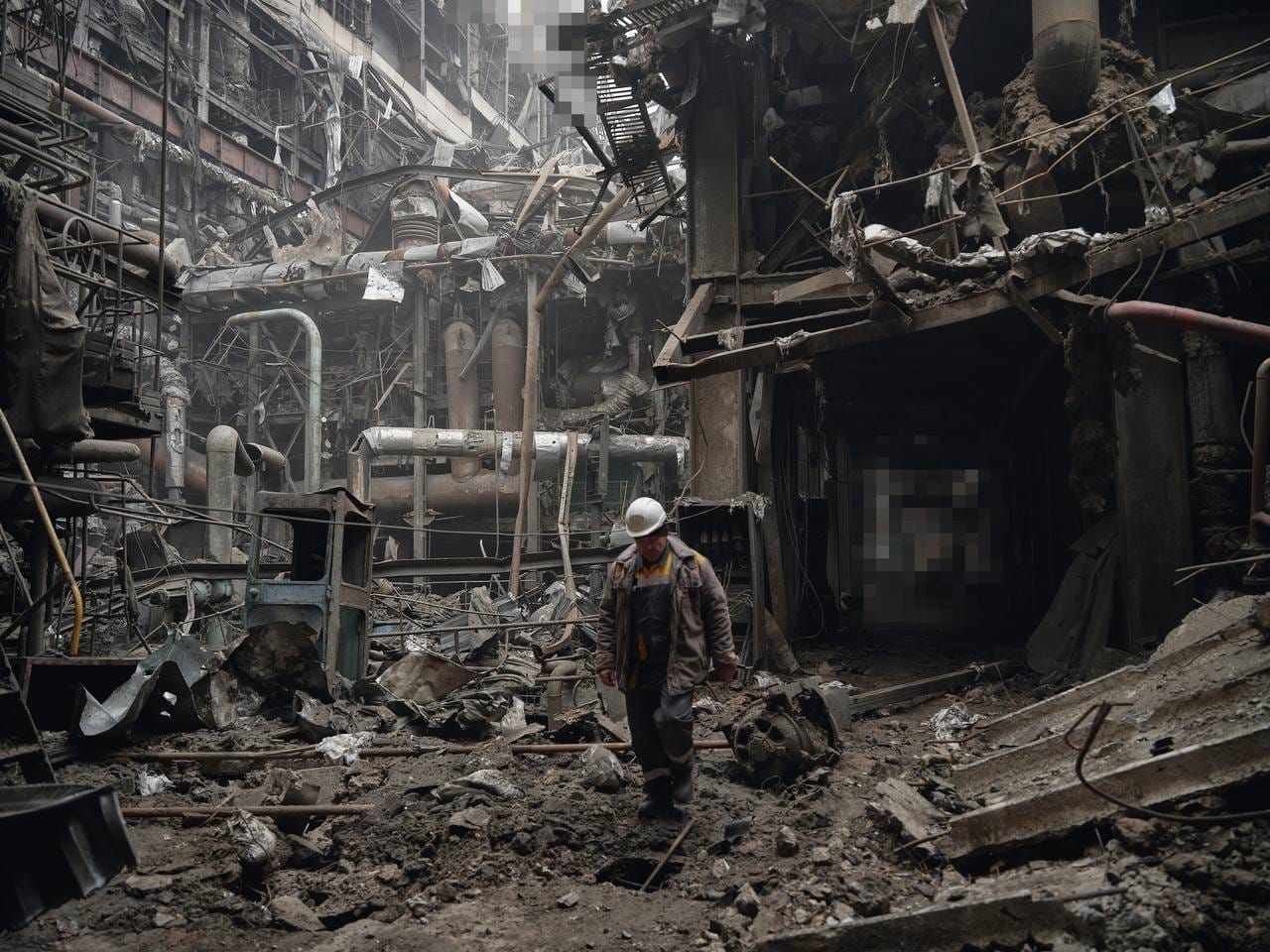
Ballistic missiles tore open the roof and walls of the turbine hall at one DTEK plant in November, according to Reuters, which did not name the plant for security reasons. Workers were clearing debris from its turbines and boilers by hand. DTEK workers have restarted the company's plants from scratch more than 70 times since 2022. Maxim Timchenko, DTEK's chief executive, said Ukraine had enough generating capacity for the winter. "The problem is about transmission," he said, adding that Russian strikes were aimed at lines carrying power from plants in the west and south to the centre and east.
Russian strikes destroyed Trypillia completely in April 2024, eliminating all of Centrenergo's generating capacity. The plant once supplied Kyiv, Zhytomyr and Cherkasy regions. Serhiy Isachenko, Centrenergo's chief executive, said protective structures built against drones were in place but that Russian forces could soon combine ballistic missiles and jet-powered drones against a single target. Russia's defence ministry said on 7 November that it had struck Trypillia and the Kyivska and Northern substations in Kyiv region.
Shmyhal forecast that Ukraine's generating capacity would reach 19.6 gigawatts by November after summer repairs, about half its level before the full-scale invasion. Central and eastern regions, Kyiv among them, face outages of up to 18 hours a day.
Warehouses in Odesa
Two women aged 35 and 36 and a man aged 47 were killed in the strike on the Odesa food warehouse on 9 November, and a fourth person was seriously injured, Odesa regional prosecutors said. Prosecutors opened a war crimes case. Oleh Kiper, head of the Odesa regional administration, said the strikes of 15 November set grain warehouses and a car dealership on fire.
The planned strikes would cover Ukrainian and foreign-owned food businesses, the Defence Intelligence source said. Their aim was to damage the economy, cut foreign currency earnings and push Ukrainian farm exports out of markets in Africa, the Middle East and Asia, the source said. Russian drones hit the Dnipro sunflower oil plant of Bunge, a U.S. company, on 5 January, spilling about 300 tonnes of vegetable oil into the streets.
Agriculture Minister Taras Vysotskyi said in September that about 90 per cent of the food logistics run by major retail chains had been destroyed. Russian territorial gains and strikes on silos and warehouses have cut Ukraine's grain storage capacity to 59 million tonnes, according to the UN Food and Agriculture Organization. Ukraine expects to harvest about 84 million tonnes of grain and oilseed in the 2026 to 2027 season.
Shaheds and the substations
Ukrainian interceptor drones lost their military satellite link at speed over Russian-occupied territory from 13 to 24 October and again from about 10 November. Starshield, the military version of SpaceX's Starlink network, cuts the link once a terminal passes 161 km/h, and Ukraine fits the terminals to the drones it sends after Russia's jet-powered Shaheds, which fly at roughly twice that speed. A Ukrainian official said the failure rate for affected missions rose from 10 per cent on the first day of the November cap to 50 per cent on the second and 100 per cent by 12 November.
Drones that cannot be stopped over occupied land have to be engaged at the next line of defence, which gives Russia more room to attack, Zelenskyy told journalists on 13 November. Ukrainian aircraft cannot operate near the front line, he had told European leaders in Dublin the day before, which leaves interceptor drones as the only defence there. Rubio had told him Starshield was under the control of the U.S. government more than of SpaceX, Zelenskyy said. Speaking to reporters in Kyiv on 14 November, he said SpaceX was not telling the truth and that the disruptions were politically motivated.
Zelenskyy said on 2 November that he had asked President Donald Trump three or four times to lift the limits so that Ukraine could find and strike Russian ballistic missile launchers before they fired. Trump expressed support but said the decision depended largely on SpaceX and Elon Musk, its owner, Zelenskyy said, and nothing had changed.
Two U.S. officials and a Western official told Reuters on 15 October that Pentagon leaders had been instructed from inside the White House to slow Starshield for Ukraine. Musk had proposed the limits to Trump and Trump agreed, four sources said. Trump denied giving the order. On 24 October, the day service returned, Musk accused the Ukrainian military of breaching SpaceX's terms of service by using the system for offensive drone strikes that kill people. SpaceX called reports that the restrictions had returned in November false.
Musk wrote on X that Starshield is owned and controlled by the U.S. government and that its speed and usage limits are set by the U.S. military and, in the end, the president. The Pentagon's inspector general turned down a request from members of Congress to investigate the October cap.
Senators Jeanne Shaheen and Chris Coons, both Democrats, wrote to Musk and SpaceX on 13 November demanding that they preserve records on the October and November restrictions and confirm by 30 November that they had done so. The senators asked who had authorised the restrictions, when and with what technical scope. Members of the Congressional Ukraine Caucus from both parties demanded a full explanation and immediate restoration of access the same day. Danish Prime Minister Mette Frederiksen said she was concerned by the disruptions and would raise them with the U.S. government.
Every Starshield terminal Ukraine operates runs under an agreement with the U.S. government that expires in 2027. On 22 October Ukraine's Defence Ministry signed a letter of intent with the Finnish companies ICEYE and Nokia to explore a satellite communications system that Ukraine would control itself.
The Dnipro line
Pavlo Palisa, deputy head of Zelenskyy's office, said in June 2025 that President Vladimir Putin wanted to occupy all of Ukraine east of the Dnipro. Zelenskyy said in his evening address on 9 November that Russia was trying to divide Ukraine along the river, after discussing the strikes on bridges and the power grid with Ursula von der Leyen, president of the European Commission. Trump said in a television interview broadcast on 8 November that Ukraine would probably end up a slightly different shape after the war. Dmitry Peskov, the Russian presidential spokesman, replied the next day that geographically Ukraine was already a different country.
Russia's attempts to split Ukraine's power system in two along the Dnipro began in December 2025, Maksym Beznosiuk, a research fellow at the GLOBSEC think tank, said. He described the method as what engineers call "islanding": cutting the grid into isolated sections that must run on their own and can no longer move power from working plants to the regions that need it. He said the aim reached beyond bringing the war into Ukrainian homes to the defence industry and the systems that keep cities running.
Before the full-scale invasion, regions east of the Dnipro generated more electricity than they consumed. Russia has since occupied the Zaporizhzhia nuclear power plant on the east bank, and its strikes have choked the transfer of power from west to east, according to an analysis published in January by iStories, a Russian investigative outlet.
The left-bank half of the city of Dnipro went five days without electricity in January, and supply on Kyiv's left bank was unstable. The Institute for the Study of War (ISW), a Washington research group, assessed on 3 March that Russia's winter campaign had failed to divide the grid in two or to halt Ukraine's arms factories.
Ukrenergo, the national grid operator, applied hourly outage schedules in most regions for the whole of 13 November, with two to four groups of household consumers cut off at once. At four groups, outages can last more than 12 hours, Ukrenergo said earlier in the month. Kyiv adjusted its tram, trolleybus and funicular services to the schedules. A damaged power line left about 50,000 consumers in Odesa region without electricity on 14 November.
Zaporizhzhia and the Northern Bridge
Russia fired 10 missiles at Zaporizhzhia on 13 November and hit a multi-storey residential building. Three people were killed in the region, one of them a child, and 62 were injured, eight of them children, Governor Ivan Fedorov said. Two apartment blocks were left uninhabitable. A rescuer from the Cobra emergency service was killed when a concrete slab fell on him as he cleared one of the damaged buildings. At about 3am the same day a drone hit the National Institute of Traumatology and Orthopaedics in Kyiv, blowing out more than 100 windows and injuring three patients.
On the Northern Bridge, Kyiv Mayor Vitali Klitschko said the strikes of 7 November tore up the roadway, trolleybus wires and power lines on the bridge, which closed in both directions. Zelenskyy blamed the shortage of Patriot interceptors for the losses and said Russia was preparing for three-way talks in Abu Dhabi by firing ballistic missiles at power and transport infrastructure.
The air force counted 172 drones that night, 137 of them jet-powered, and strikes at 24 locations. In Kyiv the attack damaged a five-storey apartment building in the Solomianskyi district and a kindergarten, and police said one person was killed in the surrounding region. Missiles hit substations in Kyiv region that connect the Rivne and Khmelnytskyi nuclear power plants, both west of the Dnipro, to the capital and central Ukraine, Zelenskyy wrote. Substations in Vinnytsia, Zhytomyr, Rivne, Kharkiv and Dnipropetrovsk regions were also damaged. Russia's defence ministry said its targets were military-industrial sites and energy and transport infrastructure.
The Southern Bridge
Ballistic missiles hit the Southern Bridge at about 2.30am on 27 October. The bridge closed to traffic and metro trains on the Green line stopped running between Osokorky and Chervonyi Khutir stations on the east bank. A 46-year-old woman was killed and 15 people were injured in the city that night, Kyiv's city military administration said.
Russian missiles fired at about 10pm on 26 October hit the campus of the State University of Trade and Economics in the Desnianskyi district on the east bank and injured five students and staff. Two second-year students were seriously injured outside a dormitory where more than 200 people lived, Anatolii Mazaraki, the rector, said. Russia's defence ministry said it had struck an enterprise in the capital that produced and stored long- and medium-range drones. Zelenskyy said there was no military facility nearby.
Yurii Ihnat, spokesman for Ukraine's air force, said Russia had fired 16 ballistic missiles in that attack, either Iskander-M or S-400 air defence missiles used against ground targets, and air defences brought down two. Repairs to the bridge deck would take time, he said, but "bridges are not as easy to destroy as some might think". Traffic resumed on 30 October in one lane each way with a weight limit, and metro trains were still not crossing.
Russia began attacking Kyiv's Dnipro crossings on 1 October with jet-powered drones, which closed the Southern Bridge and restricted the Paton and Metro bridges. Russia's defence ministry said it had struck an automobile and railway bridge used to move Ukrainian troops and supplies, and after a drone hit the Northern Bridge on 3 October it said the crossing carried troops and military cargo. On 3 October Russia's foreign ministry said mass retaliatory strikes on Kyiv and other cities would continue and urged foreign nationals and diplomats to leave Ukraine.
Weeks of drone attacks preceded the switch to ballistic missiles against the largest bridges, and some residents now cross the river on foot. A senior Ukrainian official said in October that the bridge strikes appeared to follow an order by Putin in September to scrap constraints on Russia's air campaign. Ihnat said on 27 October that Russian forces had concentrated their missile strikes on the capital over the previous two weeks and were spreading ballistic launches across several waves a night.
Infrastructure Minister Mykola Kalashnyk told parliament on 30 October that the government planned 21 alternative river crossings, with work already under way in Kyiv and the first expected to open early in 2027. Klitschko said on 27 October that the city would put Hr1 billion (about US$22 million) into temporary crossings over the Dnipro and their access roads.
The seekers
Iskander-M missiles now carry either an optical seeker or a more expensive radar seeker that scans the ground during the final descent, Beskrestnov said. Ukraine jams satellite navigation across the country during air raid alerts, and an Iskander steering by its inertial system alone could not hit a target to within a metre or so, he said. "Unfortunately, the enemy is striking bridges with great accuracy," Beskrestnov said. Ukraine's Defence Intelligence lists both devices for the 9M723 in its War&Sanctions database, the 9E436 optical correlation seeker and the 9B918 active radar seeker.
An Iskander-M follows a ballistic arc, and an onboard computer guides only its early flight, Mauro Gilli, a professor of military strategy and technology, said. Gravity carries the warhead through the last stage, leaving an error that seekers scanning the ground seconds before detonation can now correct, he said, and the same correction may let the missile get past Ukrainian electronic jamming. Gilli said the change could solve some of the most serious tactical problems Russia has faced since the start of the war.
Gilli said the strikes had not brought down Kyiv's bridges and were unlikely to. They had halted traffic, paralysed public transport and caused jams lasting several hours, he said. Mykhailo Liuksikov, editor-in-chief of the Ukrainian military news site Militarnyi, said the change to the Iskanders more likely involved improved decoys, which make air defence radars show several targets in place of one.
Iskander-M missiles can exceed six times the speed of sound, and defenders in Kyiv sometimes have two to three minutes to respond. A Patriot PAC-3 interceptor reaches about 30 km against ballistic targets. Ukraine's Defence Ministry said in June that its forces were bringing down 89 per cent of Russian cruise missiles and 40 per cent of ballistic missiles. The air force stopped publishing detailed figures for ballistic interceptions on 12 August, citing security.
Each Iskander-M carries a warhead of about half a tonne, enough to bring down a quarter to half of a typical apartment block. Russia first fired an upgraded 9M723-2, also called the Iskander-1000, at Kyiv in the summer, Defence Intelligence said in August. An enlarged engine gives it a range of up to 550 km, against 390 km for the earlier 9M723-1. Launch crews can therefore fire from further inside Russia, where launchers are harder for Ukraine to find and destroy before they fire.
Defence Intelligence has identified 140 components in the 9M723 and traced them to 35 companies. About a quarter are made in Russia and 63 are U.S.-made. Only five of the 43 components in the unit that processes flight data for the guidance system were made in Russia.
Russia plans to build up to 700 9M723 missiles in 2026, the same number as in 2025, and more than 480 RM-48U missiles for its S-300 and S-400 systems, up from about 200 planned for 2025, Defence Intelligence estimates. Within the first 19 days of July Russia launched more ballistic missiles than its estimated monthly output.
Zelenskyy said in July that Russia used 30 to 40 ballistic missiles in each large strike and carried out three to five such strikes a month. Ukraine's General Staff said its Neptune missiles struck the Proton plant in Oryol, which makes inverters for the 9M723, on 7 November. Two days later it said it had struck the Morozov plant near St Petersburg, which makes solid propellant charges for Iskander-M missiles, damaging three production workshops.
Five hundred missiles after 2030
The State Department's approval of 30 October is a notification to Congress of a possible foreign military sale, not a signed contract. It covers 500 PAC-3 MSE interceptors with spare parts and logistics support, and Lockheed Martin is the principal contractor. The department said no U.S. funds were involved and that the sale would not affect U.S. defence readiness. A PAC-3 MSE takes about 24 months from order to delivery and draws on parts from about 400 companies that converge on a single Lockheed Martin plant in Camden, Arkansas.
Zelenskyy said deliveries could begin only in a few years and asked for 100 interceptors a month from existing stocks this winter. He wrote late on 30 October that the U.S. should find a solution for the months when Ukraine needed the interceptors most. He asked allies to release missiles from their own stocks this winter and replace them later from new production. Russia had struck Ukraine's energy system more than 30 times in the last two weeks of October, he said. Ukraine's Defence Ministry asked the Pentagon to bring the delivery date forward, possibly by handing over missiles from the U.S. arsenal and backfilling them with new ones, a person familiar with the request said.
Hegseth's signature
Allies buy U.S.-made weapons for Ukraine under NATO's Prioritized Ukraine Requirements List (PURL) or pass on missiles from their own stocks. Either way the Pentagon must approve the transfer, because the U.S. authorises any onward transfer of its weapons. The Trump administration had not approved several such transfers, a U.S. official and three people familiar with the matter told The Washington Post on 19 October. Hegseth had left the requests unsigned while approving other assistance, U.S. officials said.
Only a couple of Patriot interceptors remained after 10 delivered on 7 October were used up in attacks on Kyiv, a Ukrainian official said. Overnight into 14 October ballistic missiles struck two plants supplying power and heating to the capital, and three women were killed in a residential building. A senior Ukrainian official and two military officers said Hegseth had the contracts on his desk and was not signing them. Zelenskyy wrote on 19 October that blocking deliveries of air defence missiles while Russia received sanctions relief was a denial of reality on the part of Ukraine's partners.
A U.S. government official said Ukraine's claims were not true. A NATO official said support through PURL continued to flow, air defence included, and a second NATO official said some shipments could be delayed but political motives were unlikely. About 95 per cent of the Patriot interceptors reaching Ukraine arrive through PURL, Ukraine's defence ministry said in July. Contributions from 29 countries reached US$6.7 billion in the programme's first year, and Zelenskyy put its requirement for 2026 alone at US$15 billion.
"We haven't changed our posture in any way toward the Ukrainians," Hegseth told reporters in Eau Claire, Wisconsin, on 20 October. He said U.S. stockpiles had been drawn down under the previous administration. Rubio said interceptors were probably the most sought-after product in the defence market and that when a country did not receive them from the U.S., it was because the U.S. had its own needs.
Hegseth had declined in Singapore on 30 May to say whether the U.S. would send Ukraine more Patriot interceptors, pointing instead to an overhaul of U.S. weapons production, and called Ukraine's membership of NATO unrealistic. Matthew Whitaker, the U.S. ambassador to NATO, said in September that the main constraint was production capacity and that demand exceeded supply.
Zelenskyy said on 26 October that Ukraine had waited nearly a month for Hegseth's signature and that he had told his defence minister, foreign minister and army commander-in-chief to raise the delay with the U.S. government again. The next day Defence Minister Yevhen Khmara asked Britain, France, Germany, Italy and Poland to give Ukraine 10 per cent of their Patriot and IRIS-T interceptor stocks in exchange for missiles already contracted for later delivery.
The Iran war and the July request
The U.S. war on Iran began on 28 February. The U.S. held between 2,200 and 2,330 of its most advanced Patriot interceptors before it began and between 759 and 827 by July, the Center for Strategic and International Studies (CSIS) in Washington estimated. U.S. and allied forces fired nearly 1,300 PAC-3 interceptors at Iranian drones and missiles in 16 days, more than twice the roughly 600 Ukraine received in four years. Lockheed Martin produced 620 PAC-3 MSE interceptors in 2025 and plans to reach 2,000 a year by 2030. CSIS put U.S. stocks of THAAD interceptors, a second missile-defence system, at 234 to 278 in July, down from 452.
Gen. Randy George, the Army chief of staff, wrote in a planning order in late December 2025 that the Army was critically short of missile-defence munitions and that Patriot stocks would stay low until 2030. Hegseth removed George in April. Sean Parnell, the Pentagon's chief spokesman, said claims of U.S. munitions shortages were false, and Hegseth called reports in early August that Patriot and THAAD stocks had been depleted fake news.
Zelenskyy asked Trump in the Oval Office on 28 July for an emergency winter package of 300 Patriot interceptors, and Trump turned him down, people familiar with the meeting said. Trump said U.S. stocks were short and that the missiles were needed to protect U.S. facilities and allies in the Middle East during the Iran war, they said. Asked about the interceptors on 7 August, Trump said Joe Biden had given Zelenskyy US$300 billion in ammunition and denied that the U.S. military faced shortages.
Russia fired 27 ballistic missiles, eight cruise missiles and 185 drones at Ukraine overnight into 1 August, three days after the Oval Office meeting, most of them at Kyiv. Air defences brought down one of the ballistic missiles. At least nine people were killed and 30 injured in the capital. Zelenskyy said the missiles got through because the stockpiles were spent and that the shortfall encouraged further Russian strikes.
At the NATO summit in Ankara on 7 and 8 July, Trump had told Zelenskyy that the U.S. would let Ukraine produce Patriot interceptors itself. At a Cabinet meeting at Camp David on 31 July Trump said the U.S. had not agreed to it and that countries receiving such technology could one day turn on the U.S.
Ukrainian negotiators had first proposed licensed Patriot production to Lloyd Austin, then defence secretary, and Jake Sullivan, then national security adviser, in the last months of the Biden administration and were turned down, two Ukrainian officials said. Whitaker said on 3 August that PAC-3 exports were tightly controlled, that only U.S. manufacturers were allowed to build them and that no long-term production deal would be ready before winter. Zelenskyy said in September that Trump had approved the licences, though building production lines could take years.
Warnings that did not come
U.S. intelligence normally alerts Ukraine to Russian ballistic launches before air raid sirens sound. Russian ballistic missiles struck Kyiv on 12 and 13 October with no advance warning from partners, and sirens sounded only after the attacks began. Zelenskyy said on 14 October that the Trump administration had told Ukraine that intelligence sharing could be suspended unless its forces stopped attacking Russian oil refineries.
U.S. officials blamed bad weather, and Rubio cited a software malfunction in Ukraine's early-warning system. Trump said the U.S. was still sharing intelligence. Zelenskyy said in a television interview published on 18 October that the sharing had been interrupted and was now unblocked. Russian missiles hit Kyiv that evening before the sirens sounded.
Russia attacked Kyiv in two waves overnight into 19 October. No warning arrived before the first, at about 11pm, and information came before the second, at about 3am, with little time to act, Ihnat said. A 21-year-old woman was killed and eight people were injured in the city. Zelenskyy said on 20 October that the warnings had been restored after a 45-minute call that morning with Rubio, in which they discussed intelligence, Starlink and interceptors. Scott Bessent, the Treasury secretary, said on 18 October that Ukraine received U.S. help that Russia did not, citing intelligence sharing and U.S. munitions sold to other countries for Ukraine.
Diesel, refineries and the Graham Act
Trump announced on 9 October that Putin had agreed to supply Russian diesel to U.S. and world markets, and the Treasury authorised transactions in Russian diesel until 7 April 2027. Zelenskyy called the deal unfair. The next day Trump told reporters at the White House that Ukraine needed a new leader who could make a deal, and that he had told Zelenskyy to strike what he wanted in Russia but not refineries. Kirill Dmitriev, Putin's envoy for economic cooperation, called Trump's words historic.
Trump said on 12 October that Putin wanted a deal more than Zelenskyy did. In a television interview aired on 16 October he called Ukraine's resumed refinery strikes a disgrace and said he was not a big fan of Zelenskyy. "Zelenskyy is not a good guy for us to deal with," Trump said, adding that any settlement would be reached without him. He called Zelenskyy P.T. Barnum and said missiles given to Ukraine under Biden had been sold on the open market.
Late on 16 October Trump signed an order waiving nearly all the new sanctions and tariffs in the Lindsey O. Graham Sanctioning Russia and Iran Act, two days before they were due to take effect. Trump had signed the law on 18 September after the Senate passed it by 86 votes to 11 and the House by 262 to 159. The waived measures included tariffs of up to 500 per cent on Russian goods and penalties on the largest buyers of Russian oil and gas. Trump certified to Congress that the waiver served U.S. national interests.
Twelve senators had written to Trump on 13 October urging him to rescind the diesel agreement and carry out the law. On 15 October Representatives Michael McCaul, a Texas Republican, and Jim Costa, a California Democrat, sent a similar letter with 20 colleagues. The first Russian diesel cargo under the deal, 40,000 tonnes loaded at the Baltic port of Primorsk on 22 October, was due in New York on 7 November, four days after the U.S. midterm elections. Zelenskyy said on 18 October that he had proposed sparing Russian diesel plants in return for Patriot missiles, and that the U.S. government wanted the strikes halted without agreeing to supply the interceptors. He linked the pressure to the midterms.
Zelenskyy offered a bipartisan group of U.S. senators and members of the House on 19 October a 30-day halt to refinery strikes. In return he asked for U.S. help with Patriot interceptors over the same period. On 19 October Trump told reporters that Zelenskyy did not know what he was talking about, should get somebody else to negotiate and that a million more people would be alive had Ukraine followed his advice.
Jared Kushner, Trump's son-in-law and envoy, again pressed for an end to the refinery strikes at talks in Oslo on 20 October. Zelenskyy said on 2 November that Ukraine would halt the strikes if Russia stopped attacking its energy system or the U.S. supplied Patriot missiles.
Pressure in 2025
Trump first called Zelenskyy a dictator without elections in a post on 19 February 2025. Zelenskyy's five-year term ended in 2024, and Ukrainian law bars elections under the martial law in force since February 2022. Nine days later Trump and Vice President JD Vance berated Zelenskyy in the Oval Office. Trump told him he did not have the cards and was gambling with World War III. "Have you said thank you once?" Vance asked.
The administration suspended military aid to Ukraine on 3 March 2025 and paused intelligence sharing days later. Michael Waltz, then the national security adviser, said the U.S. had taken a step back and was reviewing every aspect of the relationship. Maxar, the U.S. satellite imaging company, said Ukraine's access to its imagery was affected. A Ukrainian member of parliament said the pause would make Russian missile attacks harder to counter. The U.S. lifted both suspensions on 11 March 2025 after talks in Jeddah, Saudi Arabia, at which Ukraine accepted a U.S. proposal for a 30-day ceasefire.
In early July 2025 the administration halted shipments that included Patriot interceptors on their way to Ukraine. Trump then promised to send 10 interceptors at once, fewer than the paused shipment held, and pressed Germany to sell Ukraine a Patriot battery of its own.
Europe's interceptors
Kaja Kallas, the European Union's foreign policy chief, said after a meeting of EU defence ministers in September that no member state had pledged Patriot interceptors from its stockpile. "Interceptors are in short supply everywhere," she said, and asked governments to look again at missiles close to expiry. EU member states agreed the same month to release €3.2 billion from the Ukraine Support Loan for Patriot interceptors. Denmark announced DKK 4.8 billion (about US$720 million) in military aid on 10 November, when Zelenskyy met the prime ministers of Denmark, Sweden, Norway and Finland in Copenhagen to discuss air defence.
Speakers at an EU presidency conference at Dublin Castle in early November said 2026 had been the deadliest year for Ukrainian civilians since the full-scale invasion began. Russia had attacked a Ukrainian city or the energy system every day between July and mid-October, Jana Kobzova of the European Council on Foreign Relations told the conference.
Ukraine and nine European countries began developing an interceptor system called FREYJA around the FP-7X missile made by Fire Point, a Ukrainian company. Zelenskyy said on 11 November that 11 countries had joined and that he hoped to test it this winter.
Forty European states, Ukraine among them, signed a declaration in Dublin on 12 November stating that talks on European security could begin only after Russia's war on Ukraine ended. EU leaders met in the city the next day to discuss a package of Patriot interceptors for Ukraine. Delegations from Ukraine, Russia and the U.S. had met in Abu Dhabi on 10 and 11 November and agreed a prisoner exchange. A mutual halt to strikes on energy facilities had been on the agenda.
The law on bridges
Russia and Ukraine are both parties to Additional Protocol I to the Geneva Conventions. Under its Article 52(2), an object is a lawful military target only if its nature, location, purpose or use makes an effective contribution to military action and its destruction offers a definite military advantage. Russia's defence ministry has described the Kyiv bridges it acknowledged striking in those terms, as routes for Ukrainian troops and weapons. Article 51 of the protocol prohibits attacks expected to cause civilian harm excessive in relation to the anticipated military advantage, and the Southern Bridge carries a metro line used by residents of the east bank.
The UN Independent International Commission of Inquiry on Ukraine told the General Assembly on 26 October that Russia's attacks on the energy system followed a state policy of depriving civilians of electricity and the services that depend on it. It found that Russian authorities had committed war crimes and crimes against humanity, drawing on testimony from 255 people in nine regions. The commission said Russia had refused it access to examine the effects of Ukrainian strikes on energy facilities in Russia and in occupied territory.
Klitschko said on 27 October that structural engineers and municipal bridge inspection crews were measuring the damage to the Southern Bridge's road and rail deck. Ihnat said the same day that specialists examining the impact sites would establish which of the two missile types had struck it.