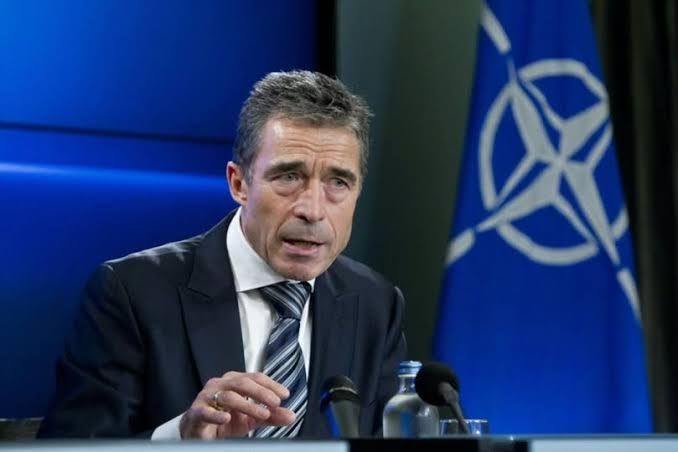
Anders Fogh Rasmussen, a former secretary-general of the North Atlantic Treaty Organization, has called on Britain and France to send troops to Ukraine now, without waiting for Russia to agree to a ceasefire.
Rasmussen led NATO from 2009 to 2014 after eight years as Denmark's prime minister. He told The Telegraph in an interview published on 11 November that the coalition the two governments lead had become "more now a coalition of the waiting". British and French troops guarding Ukraine's cities would show Vladimir Putin, the Russian president, that he could not deter Europe, he said. They would also free Ukrainian soldiers for the front line. He used the same phrase in May 2025, when he said preparations for a European force were moving too slowly.
Russian aircraft dropped at least nine guided bombs, some weighing three tonnes, on the village of Komyshuvakha in the Zaporizhzhia region on 2 November. The first hit a former school where residents collected humanitarian aid every Monday, and a second struck the shelter beneath it.
Two rescuers who had come to the site, Denys Konovalenko and Oleksii Sushchevskyi, both 44, were killed. Ukrainian authorities put the death toll at no fewer than 55 by 8 November, six police officers among them, and about 50 people were still listed as missing.
Volker Türk, the UN High Commissioner for Human Rights, said on 2 October that his office had verified 15,280 civilians killed or injured in Ukraine in the first eight months of 2026. The average was more than 400 a week, 55 per cent more than in the same period of 2025. Russian glide bombs accounted for nearly 2,500 of those casualties in the Donetsk, Kharkiv, Sumy and Zaporizhzhia regions, an increase of 62 per cent.
Russian, Ukrainian and U.S. negotiators met in Abu Dhabi on 10 and 11 November for the first time in that format since February. Officials from Britain, France, Germany, Italy, NATO and the EU met the Ukrainian delegation separately and took no part in the trilateral sessions after the Russian government objected. Vladimir Medinsky, Putin's aide and head of the Russian delegation, told reporters afterwards that the talks had been trilateral and that the Europeans could wait in the hotel lobby. The one agreement announced was a prisoner exchange, which Jared Kushner, the U.S. envoy, said would be the largest of the war. Its size was to be settled the following day.
Davyd Arakhamia, who leads the governing Servant of the People faction in Ukraine's parliament, said the Russian delegation had arrived with strict instructions and that the round had been one of the most difficult. Russian attacks killed nine people and injured 39 across Ukraine in the 24 hours to 11 November, regional officials said, and two Russian cruise missiles crossed into the airspace of Moldova.
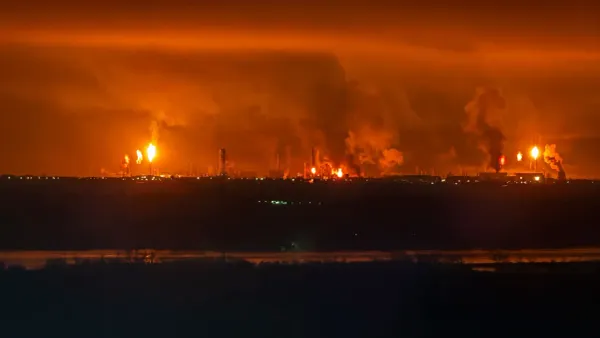
Russia launched more than 2,300 attack drones and 1,590 glide bombs at Ukraine in the week to 15 November, Volodymyr Zelenskyy, the Ukrainian president, said. A strike on an energy facility in the Odesa region that day left about 41,000 families without power. Overnight into 16 November, Russian drones killed one person and injured 10 in Dnipro, and a drone strike in the Zaporizhzhia region killed a woman.
The force rehearsing in Poland
Leaders and officials from 35 countries met in Paris on 6 January and committed themselves to politically and legally binding security guarantees for Ukraine, to take effect once a ceasefire holds. Ukraine, Britain and France signed a separate declaration of intent on deploying a multinational force. Keir Starmer, then the British prime minister, said the two countries would set up military hubs across Ukraine after a ceasefire. Emmanuel Macron, the French president, said the force would be stationed far from the line of contact. Maria Zakharova, the Russian foreign ministry spokeswoman, said days later that any Western forces in Ukraine would be legitimate targets.
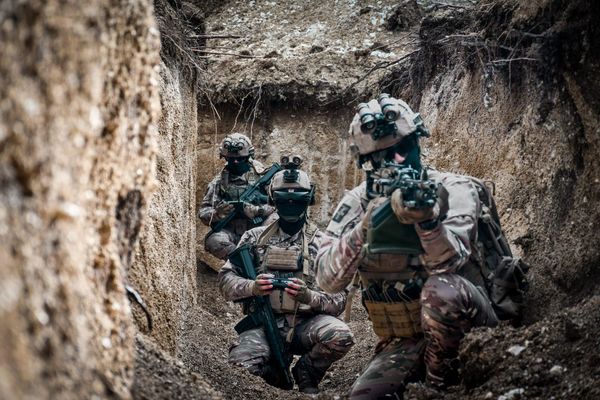
About 2,800 troops from 10 European countries began rehearsing that deployment on 9 November in south-east Poland, around the town of Nowa Deba, roughly 100 kilometres west of the Ukrainian border. France sent 1,100 and Britain 300. The exercise runs until 22 November. The British and French governments said in a joint statement on 3 November that the Multinational Force Ukraine had no offensive mission and would deploy only after a ceasefire. Starmer left office on 20 July and was succeeded by Andy Burnham.
A deployment before a ceasefire would be lawful as long as the Ukrainian government requested it, Rasmussen said. Article 51 of the United Nations Charter recognises the right of collective self-defence when a state is attacked. Putin told U.S. envoys at the Kremlin on 12 November that Western troops sent to Ukraine even after a peace deal would restart the war.
Rasmussen's five measures
Under the five-point plan Rasmussen set out in the interview, British and French troops would act as a reassurance force protecting Ukraine's population centres. Germany, Spain and Greece would empty their stocks of Patriot interceptors to defend Ukraine against Russian ballistic missiles, and NATO would extend its integrated air and missile defence over western Ukraine. The EU would confiscate more than €200 billion in frozen Russian assets for Ukraine's defence budget. The coalition would be cut back to the countries prepared to go to war with Russia if it attacked Ukraine after a ceasefire.
Putin had no incentive to negotiate while he believed he could win on the battlefield, Rasmussen said, so Europe had to raise the pressure on Russia to change his calculation. He said President Donald Trump had sided with Putin, which gave European governments a particular responsibility to help Ukraine.
In November 2025 Rasmussen proposed a missile and drone shield based on NATO territory bordering Ukraine. He has worked with the Ukrainian government before. In 2022 he drew up the Kyiv Security Compact, a set of proposed guarantees for Ukraine, with Ukrainian officials.
The Patriot stocks
Boris Pistorius, the German defence minister, said in remarks published on 7 November that Germany had exhausted its capacity to send Patriot systems and interceptors to Ukraine. Anything it handed over now could not be replaced for the time being and would leave gaps in Germany's own air defence, he said. "More is not possible right now," he said. Germany had already transferred more than a third of its Patriot capability to Ukraine, Pistorius said in January.
Germany faced no threat itself and should deliver its Patriot systems immediately, Rasmussen said, though Poland might be in a different position. Russia fired at least 61 ballistic missiles at Ukraine in December 2025 and January 2026, Defense Express, a Ukrainian military analysis group, estimated. U.S. planning assumes two interceptors for each incoming ballistic missile.
The U.S. State Department approved on 30 October a possible US$2.1 billion sale to Ukraine of 500 PAC-3 MSE interceptors, the most advanced Patriot missile. Zelenskyy has asked the U.S. government for an emergency package to cover a single month and said Ukraine would pay for it.
The frozen assets
About €210 billion in Russian sovereign assets is immobilised in the EU, most of it at Euroclear, the securities depository in Brussels. The European Commission proposed in December 2025 to lend Ukraine money raised against those assets, to be repaid only if Russia paid compensation. Bart De Wever, the Belgian prime minister, refused unless other member states shared the risk of Russian legal claims against Belgium and Euroclear.
EU leaders agreed on 18 December 2025 to lend Ukraine €90 billion for 2026 and 2027 through joint EU borrowing. Hungary, Slovakia and the Czech Republic opted out. The leaders kept the Russian assets frozen until Russia compensates Ukraine and reserved the right to use them to repay the loan. Friedrich Merz, the German chancellor, has told António Costa, the president of the European Council, that Germany will not back the EU's 2028 to 2034 budget unless every member state commits to financing Ukraine after 2027. EU leaders are due to discuss Ukraine's needs for 2027 at a summit in Brussels on 26 and 27 November.
Talks with Russia
Rasmussen dealt with the Russian government as NATO secretary-general when Russia seized Crimea in 2014. He said European governments were right to reopen channels to Russia but should keep ceasefire talks separate from talks on Europe's future security, because Putin would use the second to seek limits on the military strength of Ukraine and NATO. NATO could still give Russia a security guarantee, he said, since its members had no plans to attack it.
Kushner wrote on 13 November that Russia and Ukraine had agreed to include European partners in the next round of talks. Merz has invited the leaders of the coalition to Berlin on 19 November for a summit Germany will host with France and Britain.