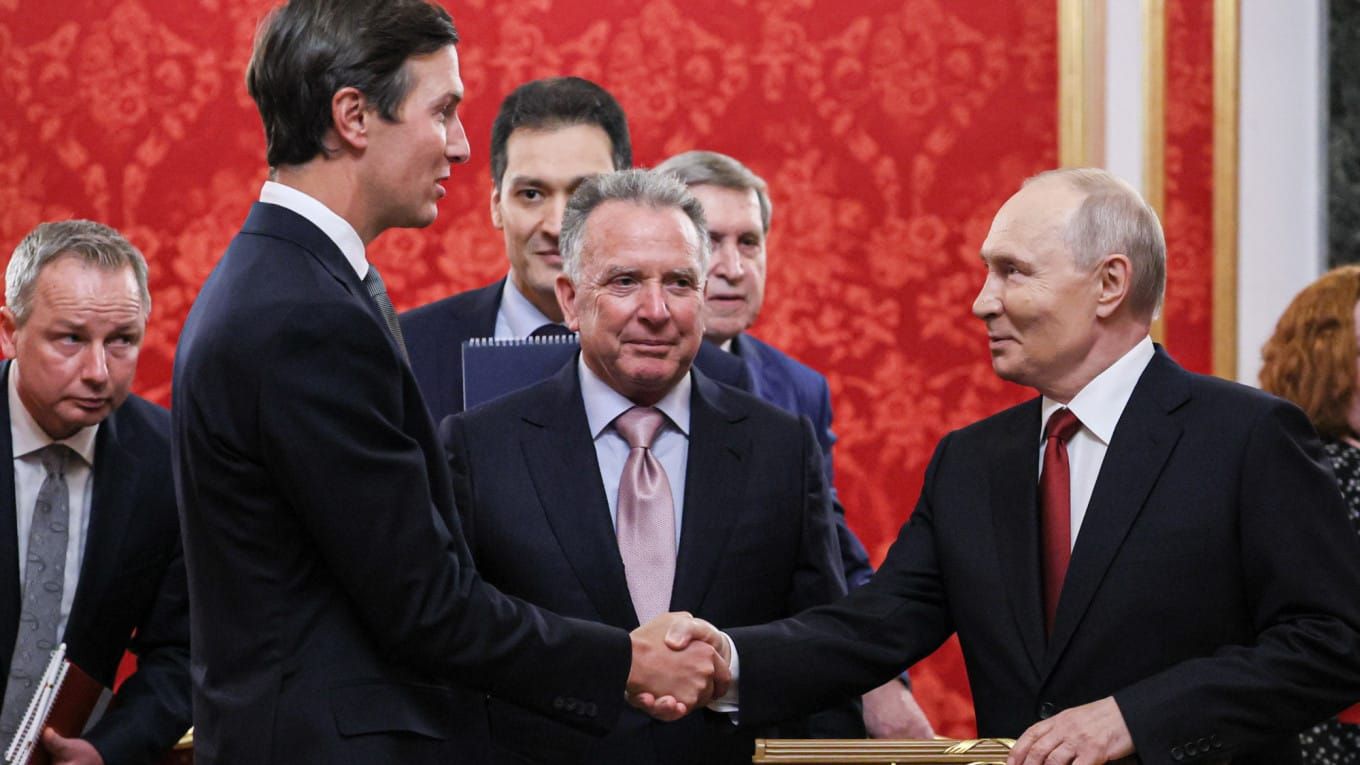
U.S. envoys Steve Witkoff and Jared Kushner proposed restarting Russian pipeline gas sales to Europe through Ukraine while the war continues, routed through a U.S. intermediary, U.S., European and Ukrainian officials told the Wall Street Journal on 2 November.
Witkoff and Kushner raised the idea during visits to Moscow and Kyiv in September as the basis for a winter energy ceasefire. People who attended the discussions said the arrangement would get around European restrictions on Russian gas and could open a profitable business for USian investors. A senior U.S. official said the White House had proposed that Russia's earnings be paid into an escrow account in a third country so the Russian government could not spend them on the war.
European Union law requires all Russian gas imports to end by autumn 2027, and EU Energy Commissioner Dan Jorgensen said in October that the ban would stand even after a peace agreement. Europe goes into winter with less gas in storage for the time of year than at any point since records began in 2011, and the U.S. war on Iran has kept Qatari liquefied natural gas inside the Persian Gulf.
A U.S. official said negotiators had discussed a range of economic proposals and that any economic agreement would form part of a full peace deal. The official said Europeans had shown interest in a proposal that would sharply cut gas prices across the continent.
The proposal
Witkoff and Kushner landed in Moscow on 5 September, where Kirill Dmitriev, Vladimir Putin's envoy for foreign investment, greeted them on the runway. They met Putin at the Kremlin the same day with Dmitriev and presidential aide Yuri Ushakov, then flew to Kyiv on 6 September for their first visit to the Ukrainian capital.
Gas under the plan would run from the Urengoy fields in western Siberia through the Soviet-built pipeline network that crosses Ukraine into Slovakia and on to Austria and Germany. Ukraine would earn transit fees, which its budget badly needs. U.S. negotiators judged that a return to the European market would give Putin a strong reason to accept a ceasefire on energy targets.
White House officials put the scheme to European leaders as a way to lower energy prices before winter. The U.S. administration also regards an eventual reopening of the Nord Stream pipelines under the Baltic Sea as a possible part of a wider settlement covering both the war and Russia's long-running dispute with the European members of NATO.
A senior U.S. official said former German Chancellor Angela Merkel's error had been to build Nord Stream 2 before negotiating a security arrangement the Russian government could accept.
In his first term Trump attacked Merkel repeatedly over Nord Stream 2. At a NATO summit in July 2018 he said the pipeline would make Germany "captive to Russia", and in December 2019 he signed sanctions on the companies building it into law.
The Kremlin response
Kremlin spokesman Dmitry Peskov said on 2 November that the situation on the ground showed the plans could not be carried out at present. "We will see what happens in the future," he said.
Peskov said any sales would depend on demand from buyers and the willingness and capacity of sellers. He said the European market was acceptable to Russia but that the world's centres of economic growth lay in what he called the collective South.
The Russian government has so far rejected U.S. efforts to agree a wider energy ceasefire. Talks between U.S., Russian and Ukrainian delegations are due in Abu Dhabi in the first half of November. Peskov said on 23 October that the talks would be trilateral, and Ukrainian President Volodymyr Zelensky said on 28 October that he expected a technical-level meeting between 6 and 10 November.
The refinery strikes
Trump said in mid-October that Russia and Ukraine had agreed an energy ceasefire, without setting out its terms. Zelensky first said the announcement was news to him, then said Ukraine was ready to halt strikes if Russia did the same. Ukraine stopped attacking Russian refineries for three days at Trump's request while Russian missiles and drones kept hitting Ukrainian power infrastructure and residential districts of Kyiv.
Russian Deputy Prime Minister Alexander Novak said on 14 October that Ukrainian forces had struck refineries in the Saratov and Ryazan regions. Zelensky said the pause was over. "The block is out. We're done," he said. Peskov said Ukraine had never observed a moratorium.
Zelensky said U.S. officials had told Ukraine that intelligence sharing could be cut off if Ukraine kept up the strikes. Trump said the U.S. had not stopped sharing intelligence with Ukraine.
After strikes on the Ryazan refinery on 15 October and an industrial site in Surgut on 16 October, no Ukrainian attack on a Russian refinery was reported for nearly two weeks. Ukrainian long-range drones turned to Russian steelworks instead. The U.S. moved its effort towards a broader peace agreement and set the gas plan aside.
Ukrainian drones have struck Russian oil infrastructure on five consecutive nights since 30 October, when they set fire to the Rosneft refinery at Novokuybyshevsk in Samara region. The Bashneft-Novoil refinery in Ufa was hit on 31 October, Lukoil's Nizhegorodnefteorgsintez refinery at Kstovo in Nizhny Novgorod region on 1 November and the Transneft pumping and dispatch station at Samara, a central hub of the Russian oil pipeline network, on 2 November. Zelensky said Ukrainian units had been more careful during the lull but had never received an order to spare refineries.
Yaroslavl Governor Mikhail Yevrayev said 124 drones attacked the Slavneft-YANOS refinery in Yaroslavl overnight on 3 November, damaging its infrastructure and wounding two workers, who were taken to hospital with shrapnel injuries. He said the raid was larger than the attacks on the plant on 6 August and 17 September, when Russian authorities reported 93 and 65 drones shot down.
Slavneft-YANOS processes about 15 million tonnes of oil a year and ranks among Russia's five largest refineries. It is the main refining asset of Slavneft, which Rosneft and Gazprom jointly control. Fires broke out at the plant after drone attacks at least 10 times in 2026, according to a count by the independent outlet The Insider.
Authorities closed the M-8 highway out of Yaroslavl towards Moscow during the raid, and drone debris broke windows in apartment blocks and private houses. Moscow Mayor Sergei Sobyanin said 493 drones flew towards the Moscow region between 20:30 on 2 November and 07:30 on 3 November, and that 187 were brought down on the approach to the capital.
The diesel deal
Trump said on 9 October, after a phone call with Putin, that Russia would supply diesel to the U.S. and world markets. He said Russia would export 300,000 tonnes at once, 500,000 tonnes in November and 1 million tonnes after that.
Russia lifted its own ban on diesel exports, which it had imposed after Ukrainian drone strikes caused domestic fuel shortages. The U.S. Treasury authorised transactions in Russian diesel until 7 April 2027.
The Malta-flagged tanker Agioi Fanendes loaded 40,000 tonnes of ultra-low sulphur diesel at the Baltic port of Primorsk on 22 October and was due in New York on 7 November, four days after the U.S. midterm elections. The cargo is the first Russian diesel bound for the U.S. since July 2023, according to ship-tracking data.
The pipelines
Russia and Germany opened Nord Stream 1 in 2011 to bypass the Ukrainian network. Nord Stream 1 stopped deliveries in August 2022, and Nord Stream 2 never entered service. Underwater explosions in September 2022 badly damaged both, and German investigators have attributed the sabotage to a Ukrainian team. The Ukrainian government has denied involvement. Restarting either line would take considerable time even if the political and regulatory obstacles were removed.
Russian gas kept flowing through Ukraine in limited volumes for nearly three years of full-scale war. Transit stopped on 1 January 2025, when the contract between Gazprom and Ukraine's Naftogaz expired and the Ukrainian government declined to renew it. The route, with its connections to Slovakia and the Baumgarten hub outside Vienna, could restart almost immediately.
Russia now supplies 11 per cent of Europe's gas, down from 45 per cent on the eve of the 2022 invasion. U.S. liquefied natural gas meets 30 per cent of European consumption. Russian gas still reaches the EU by tanker as LNG and through the TurkStream pipeline system, which supplies Hungary and Slovakia. The Council of the EU put Russian gas at about 13 per cent of EU imports in 2025, worth more than €15 billion a year.
The winter
The U.S.-Israeli war on Iran began on 28 February 2026. Qatari LNG shipments remain stuck inside the Persian Gulf, and energy prices have stayed high even as more oil tankers pass through the Strait of Hormuz.
Jorgensen told EU energy ministers in Dublin on 29 September that the bloc had paid €100 billion more for energy this year without receiving a single additional molecule. European Commission President Ursula von der Leyen had earlier put the cost of the war to the EU at almost €500 million a day.
EU gas storage stood at 28 per cent of capacity on 1 April, the lowest level at the start of an injection season in four years, the EU Agency for the Cooperation of Energy Regulators said. Storage reached 74.89 per cent on 28 October, 14.79 percentage points below the five-year average for the date and down from 82.8 per cent a year earlier, according to industry data. EU rules require member states to fill storage to 90 per cent at some point between 1 October and 1 December.
Alternative for Germany, the far-right party that leads the opposition in the Bundestag, has made the return of cheap Russian gas a central campaign promise.
Diplomats said European governments would find it easier to change position if the Ukrainian government endorsed the gas sales as part of a ceasefire that spared Ukrainian cities blackouts. A collapse of power in Kyiv, Kharkiv and other cities this winter could push a new wave of refugees west.
Ukraine had run out of Patriot interceptors by mid-October, with the U.S. restricting supplies during a global shortage caused by the Iran war. Trump turned down a request from Zelensky for 300 more interceptors, citing depleted U.S. stocks. The Center for Strategic and International Studies estimated that the U.S. held between 2,200 and 2,330 of the most advanced Patriot interceptors before the Iran war began, and between 759 and 827 by July.
The EU ban
EU member states formally adopted the regulation phasing out Russian pipeline gas and LNG on 26 January 2026. The European Parliament and member states passed it as trade legislation by qualified majority, which denied Hungary and Slovakia the veto they would have held over a sanctions measure. Both governments opposed it, and Slovak Foreign Minister Juraj Blanár said Slovakia would ask the EU Court of Justice to annul it.
Imports under short-term contracts concluded before 17 June 2025 were banned from 25 April 2026 for LNG and 17 June 2026 for pipeline gas. Long-term LNG contracts end on 1 January 2027. Long-term pipeline contracts end on 30 September 2027, a date that can move to 1 November 2027 if storage levels require it.
Member states must verify the country where gas was produced before authorising any import, and importers of Russian gas must file information at least one month before delivery. The regulation turns on the gas's origin, so Russian gas resold by a U.S. company would still be Russian gas under EU law.
Jorgensen called the ban a point of no return in December 2025 and said the EU would not buy Russian gas again even in peacetime. In October he told the Hungarian news site 444.hu that the ban should be permanent, replying to Hungarian Prime Minister Péter Magyar's suggestion that EU countries could resume purchases once the war ended. "I certainly would not trust Russia," he said.
A senior Nordic official said buying Russian gas again would betray everything European governments stood for. A senior official from a major European country compared the proposal to Neville Chamberlain’s appeasement of Hitler at Munich in 1938, when Britain and France agreed to let Nazi Germany seize Czechoslovakia’s Sudetenland.
The White House has not released the escrow proposal or said which U.S. company would handle the gas sales and which investors would profit. As of 4 November, Ukraine had not publicly agreed to resume transporting Russian gas.