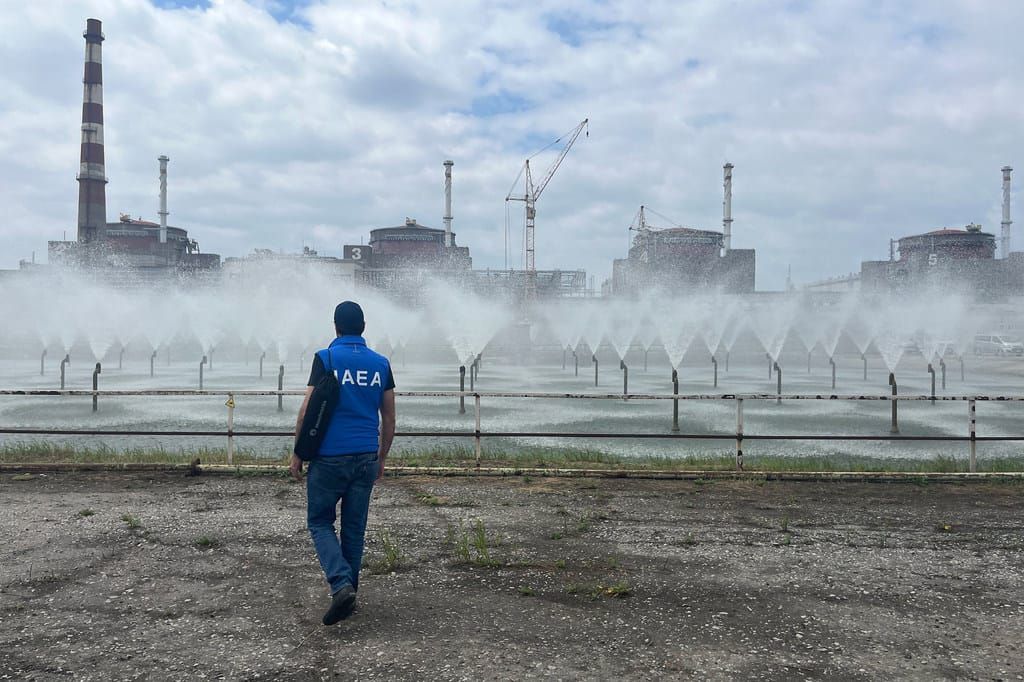
The Zaporizhzhia nuclear power plant lost its last connection to Ukraine's grid early on 8 November and ran its cooling and safety systems on diesel generators for about 15 hours until the line was restored.
Energoatom, Ukraine's state nuclear operator, said the 330-kilovolt Ferosplavna-1 line tripped at 02:36 Kyiv time and that an automatic attempt to reconnect it failed. The company said the line was switched back on at 17:41 the same day and that the plant was again drawing power from the Ukrainian grid. Energoatom counted 16 complete blackouts at the plant since January. The company said that running in blackout mode created a direct risk that the systems which cool the nuclear fuel could fail if the generators broke down or ran out of fuel, which could lead to a radiation accident.
The International Atomic Energy Agency (IAEA), which keeps a team at the Russian-occupied site, said the outage was the plant's 27th complete loss of off-site power during the war. Rafael Grossi, the agency's director general, said the event was "underlining the continued precarious nuclear safety situation". The agency said it did not yet know where the line had failed or why.
Yevgenia Yashina, communications director for the plant's Russian-installed management, said the line had been cut by its protection system after damage. She said an inspection would establish where the fault lay, whether it could be repaired and how long that would take. She said Ukrainian attacks were preventing regular deliveries of diesel to the site. Energoatom attributed the repeated blackouts to the occupation, which began when Russian forces seized the plant in the first days of March 2022. The IAEA has kept a permanent team at the site since September 2022.
Six reactors at Enerhodar, on the southern bank of the Dnipro, make up Europe's largest nuclear power station. Their fuel still gives off heat years after shutdown and needs pumped water to stay cool. When the grid connection fails, the pumps run on diesel generators, and the generators run on whatever fuel is stored on site. The IAEA said on 6 November that it had not been told of any diesel delivery to the plant since March, and that fuel was still being consumed, though more slowly than usual. During the outage the agency said the plant had enough fuel to run a limited number of generators for about two weeks.
Fifteen hours on diesel
The plant's Russian-installed management announced the loss of power on its channel on the Russian messaging service MAX on the morning of 8 November. It said the reserve diesel generators had started normally and were supplying the equipment needed to keep the units safe, and that radiation levels at the site were within normal limits. Yashina said the IAEA team at the plant had been informed.
Around midday Kyiv time the IAEA published its first statement on the outage. It confirmed late that evening that power had been restored. The summer outage had been the plant's 26th complete loss of off-site power, so the 8 November failure was the first since power returned in September.
Ukraine's air force said Russia launched 317 long-range attack drones at Ukraine overnight into 9 November, 105 of them jet-powered, along with Banderol cruise missiles. Attacks over the previous day injured 28 people across the country, regional administrations said.
Ferosplavna-1 runs from the Ukrainian-held northern bank of the Dnipro and reaches the nuclear plant through the switchyard of the neighbouring Zaporizhzhia thermal power plant, which is also under Russian control. The IAEA said on 3 October that drone attacks had damaged transformers at the thermal plant. Alexei Likhachev, the head of Russia's state nuclear corporation Rosatom, said a local ceasefire took effect around the site on 15 October so that the equipment at the thermal plant could be repaired.
On 20 August the line went down and stayed down until 7 September, leaving the plant on diesel for 18 days. The IAEA said at the time that the fault had been preliminarily located on the northern bank of the river and that a manual attempt to reconnect the line had failed. Repairs were carried out under an IAEA-brokered local ceasefire.
The longest outage of the war ran for 30 days, from 23 September to 23 October 2025, and ended only after the IAEA brokered local ceasefires for repairs to both lines. Ferosplavna-1 itself was out of service from 7 May 2025 until 8 November 2025, when crews reconnected it after fixing a damaged cable between two pylons about three kilometres from the site. A separate outage in June this year kept the generators running for 15 hours, and the plant was without power for about 90 minutes on 14 April and about an hour on 26 April.
The diesel reserve
Each of the plant's six VVER-1000 reactors can generate 1,000 megawatts. None has generated power since 11 September 2022, and Russia's occupation has taken 6,000 megawatts of capacity out of Ukraine's grid. All six are in cold shutdown, a state in which the reactor core sits below boiling point and needs far less cooling than an operating unit, though it still needs some.
The site has 20 emergency diesel generators. When grid power fails, all available generators start automatically, and the operators then return some to standby. During one outage this summer, seven were left running. Keeping the rest in reserve saves fuel during long outages. The IAEA team checked fuel levels in most of the generators' tanks on 24 August, four days into the summer outage. On 28 August the plant told the agency it had enough fuel for about 10 more days. Grossi said then that without restored grid power or new fuel deliveries, the plant could face a total loss of power within about 10 days.
Over the summer the plant raised the water level in the spent fuel pools of all six units, and the IAEA team watched the work being done. More water above the stored fuel gives operators more time before it could start to boil if cooling stopped and the diesel ran out. The plant told the IAEA that its last delivery of diesel to the on-site fuel store took place in March 2026.
In its update of 30 October, the IAEA said its team had checked the generators again and the plant had reported that their daily-use tanks were full. The agency said reserves across the site remained low after nearly three weeks of generator use in August and September, and that regular testing of the generators kept consuming fuel. Grossi said that building up the stocks before winter was necessary for nuclear safety and that the agency was working to arrange a transfer of diesel to the site.
From 10 lines to one
Before the full-scale invasion the plant had 10 off-site power lines, four at 750 kilovolts and six at 330 kilovolts. By 8 November only Ferosplavna-1 was available.
The main 750-kilovolt Dniprovska line has been disconnected since 24 March 2026. Repair crews fixed the line itself in June under the sixth local ceasefire the IAEA had negotiated. It could not be switched back on because of damage at its substation, which lies more than 100 kilometres north-west of the plant on Ukrainian-held ground. Ukraine told the IAEA that a fire had broken out at the Dniprovska 750-kilovolt substation on 22 May because of military activity. IAEA staff who visited it later observed severe damage to its main equipment.
Inspections found further damage at the substation and on the line near and above the Dnipro, the IAEA said on 30 October. In its update of 6 November the agency said the substation had been targeted in two recent attacks. It did not say who carried them out. The agency is negotiating a ninth local ceasefire with the Russian and Ukrainian governments so that both the line and the substation can be repaired.
Likhachev said in February that five of the ceasefires had been needed in six months to carry out repairs near the plant. The arrangements have usually required mine clearance before crews can reach damaged pylons, some of which carry the line up to 100 metres above the river.
Rosatom's licences
Rosatom has been preparing to restart the plant under Russian regulation. Rostekhnadzor, the Russian nuclear regulator, issued a 10-year operating licence for unit 1 in December 2025 and for unit 2 on 18 February 2026. Yuriy Chernichuk, the Russian-installed plant director, said Rosatom planned to obtain a licence for unit 6 in 2026 and for units 3, 4 and 5 in 2027. Likhachev said on 8 November that the plant would sooner or later be brought to full capacity. He has said Rosatom will carry out its restart plan only once military risks have been removed.
The Ukrainian government regards the plant as Ukrainian property held under illegal occupation and has called on its allies to press for its return to Energoatom. Ukraine's foreign minister, Andrii Sybiha, discussed what he called Russia's militarisation of the site with Grossi in Warsaw on 13 October.
The plant's staff
Most of the plant's workers live in Enerhodar, the city beside the site, and travel to work on plant buses. Likhachev said in February that the situation in Enerhodar remained unsettled and that the city frequently lost power. Drones have repeatedly hit the plant's transport workshop and the vehicles that serve it.
A driver was killed when a drone struck the transport workshop near the site on 27 April. Rosatom said it was the first time a plant employee had been killed at work. In August a drone exploded at a bus stop used by plant personnel, killing one person and injuring 15, according to the IAEA. On 29 October the agency said it had been told that a welder from the plant's central repair workshop had been killed in a drone attack. It did not say where the drone struck or which side launched it. Grossi said any attack on the staff of a nuclear plant was unacceptable and called for maximum military restraint.
On 30 May a drone hit the turbine building beside unit 6, the plant said. The IAEA team found damage to a metal hatch several levels up the building, debris and burned remains of optical fibre on the ground, and said its observations were consistent with a drone strike. It was the first drone attack inside the site perimeter since April 2024, the agency said. Likhachev said a Ukrainian drone controlled by fibre-optic cable had caused the blast and that it could not have been accidental. Ukraine's armed forces denied striking unit 6 and called the Russian account propaganda.
The plant's Russian-installed management said on 3 November that a drone had hit a moving civilian car, killing two people, one of them a woman who worked at the plant. Mikhail Ulyanov, Russia's permanent representative to the international organisations in Vienna, blamed Ukraine's armed forces and wrote that they were "literally hunting the civilian personnel of the station". The IAEA's statement of 6 November referred to drone attacks affecting plant staff and the towns where they live. It did not attribute them.
Strikes on the substations
Russia's defence ministry said it carried out 12 massed and group strikes on Ukraine between 31 October and 6 November. Zelensky said the attack of 3 November was aimed mainly at the energy sector, including power stations and substations.
Russia directed three drones at a substation that the Khmelnytskyi nuclear power plant in western Ukraine depends on for stable operation during an attack on 3 November, said Denys Shmyhal, Ukraine's first deputy prime minister and energy minister. He said Russia fired 289 drones and 76 missiles that night, and that Ukraine had reported the strike on the substation to the IAEA. Shmyhal called it a serious escalation and said it threatened nuclear safety across Europe. He briefed ambassadors of the G7 countries and the EU on the attack the same day.
Russia's defence ministry said the 3 November strike hit energy facilities in the Vinnytsia, Dnipropetrovsk and Kharkiv regions that supplied power to defence plants and the Ukrainian army. It said the 1,800-megawatt Ladyzhyn thermal power plant in Vinnytsia Oblast was among the targets.
President Volodymyr Zelensky said on the evening of 6 November that Ukrainian intelligence showed Russia preparing a new attack on the energy system, the bridges across the Dnipro and civilian infrastructure. That night Russia fired 36 ballistic missiles at Kyiv and the surrounding region, Zelensky said. Ukraine's air force counted 172 long-range drones, 137 of them jet-powered, and said air defences brought down 149 of the drones and four missiles. Drones struck 24 locations and falling debris was recorded at 10 more. Among the targets was a substation in Kyiv Oblast that connects the Rivne and Khmelnytskyi nuclear plants to the capital and the central regions, Zelensky said. Substations were also damaged in Vinnytsia, Zhytomyr, Rivne, Kharkiv and Dnipropetrovsk oblasts.
Russia's defence ministry said on the morning of 7 November that its forces had used precision ground-launched weapons and long-range drones to hit defence industry, energy and transport sites in Kyiv and the surrounding region that served Ukraine's armed forces. It named the Northern Bridge over the Dnipro among the targets and described it as a logistics artery.
Substations are where the voltage of electricity is transformed and controlled as it moves between power plants, transmission lines and consumers. A nuclear plant's output leaves through them, and the outside power its safety systems need in an emergency comes in through them. Ukraine's three operating nuclear plants, Khmelnytskyi, Rivne and South Ukraine, depend on the grid to run safely. Their safety systems draw power from it, and when lines are lost the grid operator can order the reactors to cut output.
The IAEA said on 6 November that several of the plants had lost off-site lines after recent substation strikes, although every site except Zaporizhzhia still had more than one. Grid instability had forced one nuclear facility to suspend safety-related work and another to cut its output without planning to, the agency said. Grossi said conditions at the operating plants must not be allowed to slide to those at Zaporizhzhia.
An IAEA team visited 19 substations that matter to the safety of Ukraine's nuclear plants between 10 and 24 October. It was the agency's ninth substation mission since September 2024 and its largest. On 27 October the IAEA was told that the Slavutych substation, one of those assessed, had been attacked and had lost all its 330-kilovolt lines. Security conditions had prevented the team from visiting it during the mission. The agency's December 2025 assessment found Ukraine's grid in its worst condition since substation monitoring began. Grossi listed reliable off-site power as one of seven indispensable pillars of nuclear safety in wartime when he set them out in March 2022, weeks after the invasion began.
Shmyhal said on 30 October that Russia had carried out more than 350 attacks on Ukraine's energy infrastructure since September, damaging more than 800 pieces of equipment. Ukraine's military intelligence agency said in January that the Russian government was considering options for striking the substations that serve Ukraine's nuclear plants. Sybiha asked on 20 January for an urgent meeting of the IAEA Board of Governors after strikes that day cut external power to the Chornobyl site. The board later adopted a resolution recognising that Russia's attacks on Ukraine's energy infrastructure had direct consequences for nuclear safety and security.
Article 56
Ukraine and Russia are both parties to Additional Protocol I to the Geneva Conventions, and neither has entered a reservation to its Article 56. The article bars attacks on dams, dykes and nuclear electrical generating stations, even when they are military objectives, if the attack may release dangerous forces and cause severe losses among civilians. The same protection covers other military objectives at or near those installations. Article 85 makes an attack on such installations, launched in the knowledge that it will cause excessive civilian loss, a grave breach of the protocol.
Article 56 names generating stations, and international law scholars disagree over whether a plant that has been shut down for more than four years still falls within it. The protocol's stated purpose, to protect civilians from the release of dangerous forces, applies whether or not the reactors are producing power.
Substations are not covered by Article 56. Strikes on them fall under the protocol's general rules, which permit attacks only on military objectives, prohibit attacks expected to cause civilian harm excessive in relation to the military advantage anticipated, and require precautions to spare civilians. Article 54 separately prohibits attacks on objects indispensable to the survival of the civilian population and lists drinking water installations among them. The International Committee of the Red Cross regards a duty to take particular care when attacking dams, dykes and nuclear plants, and installations near them, as a rule of customary law binding on all parties to any armed conflict.
Kyiv's power, water and heat
Russia's attack on 3 November was its largest on Ukraine's energy infrastructure this year and damaged the Kyiv regional energy hub. Vitalii Zaichenko, the chief executive of Ukrenergo, said it included one of the largest waves of ballistic missiles fired at the country's infrastructure. Ukrenergo, the national grid operator, imposed emergency power cuts in Kyiv and the surrounding region. Kyivvodokanal, the city's water and sewage utility, lost power at major facilities, and water was cut across the city for more than 24 hours.
Vitali Klitschko, the mayor of Kyiv, said after the attack that the city faced a real risk of a blackout that would take out power, water and heating together. He said on 4 November that water pressure had stabilised and Kyivvodokanal said all its water and sewage pumping stations were working normally. On 5 November emergency power cuts hit the utility again and water failed in every district of the city. Voltage fluctuations disrupted the metro the same day, three days after a power failure had partly halted it on 2 November. Kyivvodokanal told residents they could collect drinking water from public pumps.
The first snow fell on Kyiv on 6 November. A strike that day on an energy facility in Zhytomyr reduced the power reaching the capital and the pressure in its water mains, and Kyivvodokanal moved pumping stations to generators where it could, Klitschko said. Pressure returned to normal on both banks of the Dnipro by the evening of 7 November, the utility said. Klitschko said on 6 November that the city had enough generators to keep the sewage system running but not enough to power apartment buildings.
Russia's attack of 24 January caused the city's worst disruption last winter. Shmyhal said more than 800,000 Kyiv households were without power. Klitschko said 600 buildings in the north-eastern district of Troieshchyna had lost power, water and heat. Russia has struck Kyiv's two largest combined heat and power plants, TPP-5 in Vydubychi and TPP-6 in Troieshchyna, nearly 50 times this year, Klitschko has said.
After the strikes of 7 to 8 November, Ukrenergo ordered emergency outages in Kyiv, Kyiv Oblast and Dnipro on 8 November. The order suspended the hourly schedules that DTEK, the private company that distributes power in the capital, had published for the city's 60 consumer groups. In Dnipropetrovsk Oblast, strikes on the regional grid left more than 600,000 people without electricity, and hospitals and other infrastructure switched to backup generators. Chernihiv, north-east of Kyiv, lost all power on 7 November.
Kyiv began reconnecting buildings to central heating on 2 November. Klitschko said about 45 per cent were connected by 5 November and 60 per cent by 7 November. The city has set up heating points in the districts worst affected by outages, where residents can warm up, charge phones and get hot tea. It is building 13 backup heating plants that it plans to finish by the end of the year.
The government allocated 10 more generators to Kyivvodokanal on 5 November, paid for from the state reserve fund, and the city said they could power only parts of the system. Kyivvodokanal already had 103 generators ranging from 15 kilowatts to one megawatt. Its sewage network is fully covered by backup power, but its water supply is not, the utility has said.
Zelensky and Klitschko
Zelensky said on 6 November that Kyiv faced the most serious utility disruptions in the country and blamed both the Russian campaign and the city's failure to carry out its decisions on preparing for the heating season. Klitschko, who has a long-running public dispute with the president, said the government had failed for nearly six months to approve Kyiv's energy resilience plan. He wrote that the government's "constant manipulation and lies" about the capital were damaging.
Police searched the offices of Kyivteploenergo, the city's municipal heating company, and the homes of several of its employees on 6 November. The company said the searches might amount to political pressure and that documents needed for the city's resilience projects could be seized, and the Kyiv City State Administration backed its account. The Kyiv city prosecutor's office said no searches had taken place at the company's premises and that no documents needed for the resilience plan had been taken.
Klitschko told parliament on 14 October that the city had installed almost 700 generators, 70 mobile boiler units and three diesel power plants at its heat and water facilities, along with a backup water intake. He said 480 generators had gone to hospitals and 285 high-capacity units to schools. Zelensky set up a government team for Kyiv's winter preparations, saying the mayor could not manage alone, and has said decisions will be taken in line with the law if the city's plans are not carried out.
Chupyra
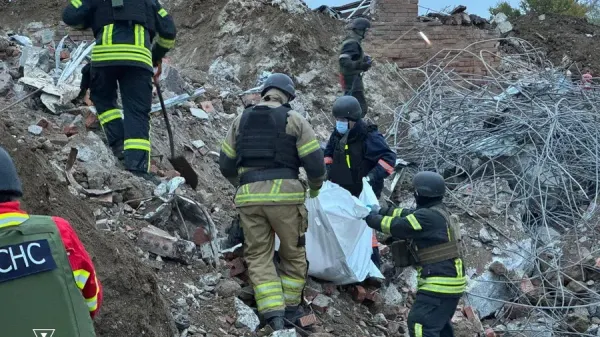
Three people died of carbon monoxide poisoning on 8 November in the village of Chupyra, in the Bila Tserkva district of Kyiv Oblast, the State Emergency Service said. The service received the call at about 09:20 Kyiv time. The dead were a man, a woman and a teenage girl. A teenage boy from the same house was taken to a children's hospital. The service said its preliminary finding was that a generator had been run in the basement rather than outdoors.
Ukraine's emergency service did not say whether the house had lost mains power. Its rules require generators to be run only in the open air, at least six metres from walls and windows, and it advises households to fit carbon monoxide alarms. The gas has no colour, smell or taste and can kill even at low concentrations, the service said. Generators have come back into wide use in Kyiv Oblast as households try to keep lights, heating and water pumps running through daily outages. A woman was poisoned by carbon monoxide in Kirovohrad Oblast on the same day, the service said.
On 22 January a married couple and their 11-year-old daughter were found dead in a townhouse in Bilohorodka, in Kyiv Oblast's Bucha district, and a four-year-old boy was taken to hospital in a critical condition. Six people in the region were poisoned that night. Over the weekend of 7 and 8 February the State Emergency Service recorded nine carbon monoxide incidents in eight regions, with four dead and 25 injured, 15 of them children. It said the most common cause was a generator placed indoors or too close to a window.
Kyiv's bridges
Russian ballistic missiles struck Kyiv in three waves overnight on 6 to 7 November, starting at about 23:00 Kyiv time. Six were fired at the Northern Bridge, also known as the Pivnichnyi Bridge, and four hit it, Zelensky said. Klitschko said the strikes damaged the road surface, the trolleybus wires and a power line on the bridge, and the blast damaged five lorries. The bridge was closed in both directions. Five people were injured in the capital, among them a 14-year-old girl, and two were taken to hospital. One person was killed and two injured elsewhere in Kyiv Oblast, the regional police said.
In the capital, fire broke out in a non-residential area of the Sviatoshynskyi district and debris fell on a private house in the Darnytskyi district, Klitschko said. A two-storey building on the grounds of a kindergarten was destroyed.
The Northern and Southern bridges carry tens of thousands of people across the Dnipro every day between Kyiv's right and left banks. Russia has been striking bridges over the river since early October, and on several occasions damage and air raid alerts have halted road and rail traffic and left people crossing on foot. Zelensky said on 7 November that Russia was striking bridges along the Dnipro from Kyiv to Zaporizhzhia. Traffic on the Northern Bridge began to be restored on 8 November with restrictions on drivers. Two Kyiv City Express commuter trains stopped on 7 November when power failed in the overhead wires.
Zelensky wrote on 7 November that "due to a shortage of Patriot missile systems, there have been significant strikes" on energy and logistics infrastructure. He said he had spoken to Prime Minister Serhii Koretskyi and the interior minister, Ihor Vyhivskyi, and that the government did not have enough transport in reserve for the capital.
On 8 November Zelensky instructed Koretskyi to present a programme of free travel on Kyiv's surface public transport and to build up a reserve of buses. He said the measures were meant to keep people moving if Russian strikes shut the metro or the bridges, and that the number of vehicles needed and changes to traffic in parts of the city were being worked out. Dmytro Lytvyn, a presidential adviser, said details could be presented the following day. No start date, eligibility rules or route list had been published by the evening of 9 November.
Ukraine's General Staff said on 17 October that it had hit a railway bridge over the Unecha River in Russia's Bryansk region to disrupt deliveries of ammunition, fuel and equipment to Russian forces. In July it reported a strike on a road bridge across the Henichesk Strait in occupied Kherson Oblast that it said Russian troops used for military supplies.
Zaporizhzhia Oblast
Russian forces carried out 725 attacks on 53 settlements in Zaporizhzhia Oblast in the 24 hours to the morning of 8 November, said Ivan Fedorov, co-chair of the regional defence council. Drones accounted for 561 of the attacks and aircraft for 26. Artillery fired 135 times and multiple-launch rocket systems three times. One person was injured in the city of Zaporizhzhia and residents filed 61 reports of damage to homes, cars and infrastructure. The State Emergency Service said drone debris set a fire in the city on 7 November and that firefighters put out blazes in its suburbs, including on the roof of a residential building.
On 1 November Fedorov had counted 496 attacks on 14 settlements. Most of the oblast's population, including the regional capital, remains under Ukrainian control, while Russian forces hold the south of the oblast, including Enerhodar and the nuclear plant.
Rescuers in Zaporizhzhia Oblast were still searching on 7 November for people buried in the Russian bombing of an aid distribution point in Komyshuvakha on 2 November. Russian aircraft hit the village's Dzherelo gymnasium as residents gathered for their weekly bread and food parcels, then struck the underground shelter beneath it with a three-tonne FAB-3000 bomb, according to Defence Intelligence of Ukraine. The State Emergency Service put the death toll at 55 on 7 November. The dead include four police officers who were directing residents into the shelter, two State Emergency Service rescuers and a military medic. Rescuers can work in the crater for only 15 to 20 minutes at a time because of Russian drones overhead.
Defence Intelligence of Ukraine has named a Russian colonel and six Su-34 pilots it says planned and flew the strike, without publishing the evidence behind the identifications. Russia's defence ministry said it had hit Ukrainian military units in the area and gave no evidence.
UN monitors recorded more civilians killed or injured in Ukraine in the first eight months of 2026 than in the whole of 2025, Rosemary DiCarlo, the UN under-secretary-general for political and peacebuilding affairs, told the Security Council. Andriy Melnyk, Ukraine's ambassador to the UN, told the council in October that UN monitors had confirmed 2,222 civilians killed and more than 13,000 injured in Ukraine in 2026. The UN Security Council was due to meet again in New York on 9 November at Ukraine's request to discuss Russian attacks on civilians and infrastructure, with support from Latvia, Denmark, France, Greece and the U.K.
Abu Dhabi
Delegations from Ukraine, Russia and the U.S. are due to meet in Abu Dhabi on 10 and 11 November. Steve Witkoff, the U.S. special envoy, said the talks would cover post-war security agreements, de-escalation, humanitarian measures and ending the war, and he and Jared Kushner are expected to lead the U.S. side. President Vladimir Putin agreed to the round after meeting Witkoff in St Petersburg in October.
The three governments last met together in February, after rounds in Abu Dhabi on 23 and 24 January and 4 and 5 February, before the U.S. and Israel went to war with Iran. Witkoff said the new round would build on progress made in meetings in Kyiv, Oslo and St Petersburg. Zelensky had said the talks could go ahead on 10 November unless escalation in the Middle East got in the way. Witkoff said U.S. negotiators would also meet representatives of France, Germany, the U.K., the EU and NATO in Brussels to discuss security guarantees for Ukraine and the post-war security of Europe.
Zelensky said on 7 November that Russia was preparing for the talks by launching ballistic missiles at Ukraine's infrastructure. After his meeting with Witkoff, Putin repeated Russia's claim to the Donbas, which the Ukrainian government rejects. Sergei Lavrov, Russia's foreign minister, said the Russian position on the war was unchanged. He cited continuing sanctions and U.S. arms supplies to Ukraine, including the approval of a sale of 500 Patriot PAC-3 interceptors, as unresolved issues between the two governments.
Likhachev said on 13 March that Russia was ready to consider an international or even multilateral arrangement for using the plant's electricity. Ukraine's foreign ministry has called for the plant to be returned to the control of Energoatom, its Ukrainian operator.
The IAEA has asked both governments to agree its ninth local ceasefire around the Zaporizhzhia plant. Repairs under that truce would target the Dniprovska substation and the 750-kilovolt line, which together would give the plant a second connection to the grid.