Ukrainian-built drones have struck 11 Russian oil refineries since 30 October, on flights of up to nearly 3,000 km, and President Volodymyr Zelenskyy said on 15 November that Ukraine had neutralised more than 55 per cent of Russia's refining capacity. Ukraine has one refinery of its own, at Kremenchuk, which Russian strikes badly damaged long ago, and Russian missiles and drones kept hitting its power grid through the U.S.-brokered talks in Abu Dhabi. The refineries Ukraine has hit fuel Russia's army and earn the oil revenue that pays for the invasion, and their loss has put Russia's petrol market back under rationing.
Zelenskyy gave the figure in his evening address, citing a report by Major General Mykhailo Drapatyi, after a fortnight in which drones also hit the Baltic port of Ust-Luga and twice struck Transneft's largest pipeline hub. Ukraine's Defence Ministry had put the share at 51 per cent on 4 October, drawing on analysts from the intelligence services and the General Staff. Sergey Vakulenko, a former Gazprom Neft analyst now at the Carnegie Russia Eurasia Center in Berlin, wrote on 13 November that the refineries attacked in the current wave make about 55 per cent of Russia's commercial petrol.
Rosneft, the state oil company, began limiting fuel sales at its filling stations in every Russian region by 9 November, and drivers in Karelia and Buryatia were held to 30 litres of petrol a visit in the cities. Russia's petrol stocks would last about a week of national consumption, Vakulenko estimated.
Zelenskyy calls the campaign Ukraine's long-range sanctions and describes it as an answer to Russian attacks on Ukraine's power grid. The strikes are "a fitting response to Russia's refusal to de-escalate," he said in the same address. Dmitry Peskov, the Russian presidential spokesman, said on 15 October that the strikes ran counter to U.S. peace efforts.
Nizhnekamsk and the south, 15 and 16 November
Drones hit the TAIF-NK refinery in Nizhnekamsk overnight into 15 November and damaged its only primary processing unit, the ELOU-AVT-7, Ukraine's General Staff said. The same raid set fire to Nizhnekamskneftekhim, a Sibur petrochemical complex that makes synthetic rubber and plastics, more than 1,000 km from Ukraine. Every day the plants stand idle means fewer tyres for the lorries that carry ammunition to the front, the General Staff said. Radmir Belyaev, mayor of Nizhnekamsk, said industrial sites and an apartment building were damaged and several people were injured.
Russia's defence ministry said its air defences brought down 1,336 Ukrainian drones overnight into 16 November, one of the largest totals of the year, over the Moscow region, Crimea, Krasnodar Krai and the Black and Azov seas. Fires broke out at four production sites in Azov, in Rostov region, and three men were injured, Governor Yuri Slyusar said. Witness footage showed an oil depot and a gas distribution station burning, the independent Russian channel Astra reported.
Krasnodar Krai's emergency headquarters said a fire had broken out at an enterprise in the village of Ilsky and that falling debris had injured three people in Seversky district, among them a child. The village is home to the Ilsky refinery, one of the five largest in southern Russia, which processes about 6.6 million tonnes of crude a year and which the General Staff says supplies the Russian armed forces. Ukraine had not confirmed a strike on the plant by the morning of 16 November.
Volgograd and Samara
Drones hit Lukoil's Volgograd refinery, the largest in southern Russia, on the night of 12 to 13 November and damaged four primary processing units, a hydrotreatment unit, six storage tanks and a loading rack, the General Staff said. Andrei Bocharov, governor of Volgograd region, said four workers were killed and two taken to hospital. Queues formed at the city's filling stations that morning and petrol prices at chain stations rose by 50 kopecks overnight.
Hours later drones returned to the Samara linear production and dispatch station near Prosvet, which they had first hit on 2 November. Vyacheslav Fedorishchev, governor of Samara region, said four people were killed at an industrial facility, without naming it.
Transneft's station is where crude from Western Siberia, Tatarstan, Orenburg region and Kazakhstan is blended into Urals, Russia's main export grade. Its 71 tanks hold more than 1.6 million cubic metres of oil, and the blend goes on to the Druzhba pipeline and the Black Sea port of Novorossiysk. Urals makes up as much as half of Russia's oil exports, the General Staff says, and the station also supplies the Russian armed forces.
The refineries that supply Moscow
The campaign opened on 30 October, when drones set fire to Rosneft's Novokuibyshevsk refinery in Samara region, which processes about 8.8 million tonnes of crude a year. Bashneft's refining complex in Ufa was hit the next night.
On 1 November drones struck NORSI, Lukoil's refinery at Kstovo and Russia's second-largest petrol producer. Fire Point, the Ukrainian company that builds the FP-1 long-range drone, said its drones hit the plant.
Yaroslavl Governor Mikhail Yevrayev said 124 drones attacked the Slavneft-YANOS refinery on the night of 2 to 3 November and damaged its infrastructure. Two nights later drones started fires at Rosneft's Ryazan refinery, which supplies Moscow and accounts for 5 per cent of Russia's refining capacity.
Krasnodar Krai's emergency headquarters confirmed a fire in the settlement of Afipsky on 6 November, the seventh attack this year on the Afipsky refinery. On 7 November drones hit the Saratov refinery's only AVT-6 primary unit, two fuel hydrotreaters and a 10,000 cubic metre tank, and processing stopped, the General Staff said.
Kirishi, Ust-Luga and Omsk
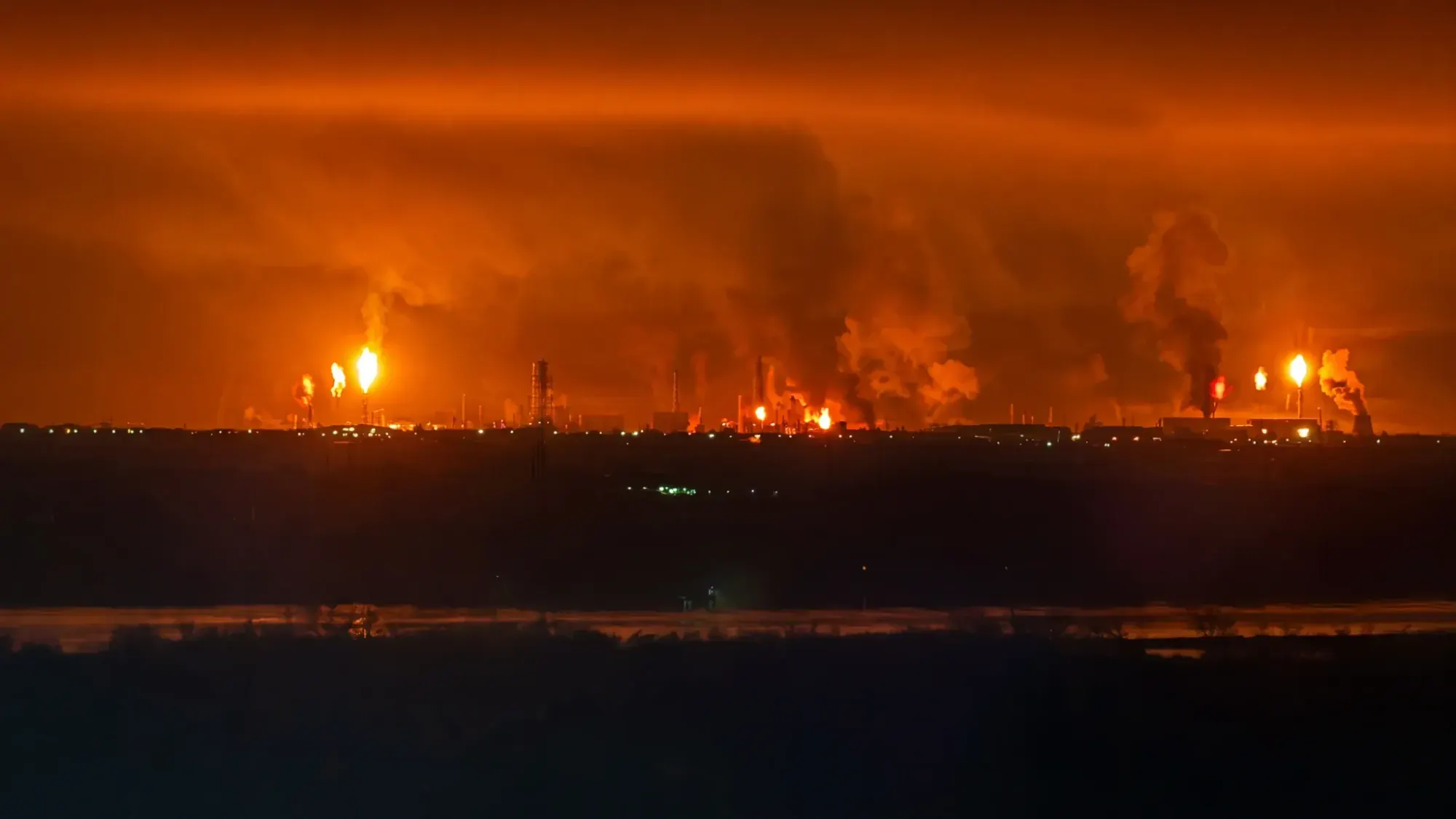
Drones set fire to Kirishinefteorgsintez, Russia's second-largest refinery and the source of more than 6 per cent of its refined oil, on 9 November. A woman in Vsevolozhsk was killed when debris fell on her house, said Alexander Drozdenko, governor of Leningrad region.
Overnight into 11 November drones hit Ust-Luga, Russia's largest Baltic port and a loading point for the shadow fleet of tankers that carries Russian oil past Western sanctions. Five tanks holding 150,000 cubic metres of petroleum products caught fire, and the Security Service of Ukraine said the same operation hit the Naro-Fominsk, a Baltic Fleet ship armed with Kalibr cruise missiles.
Ukraine's Special Operations Forces attacked Gazprom Neft's Omsk refinery, Russia's largest, on the afternoon of 11 November, for the third time since July. The drones flew nearly 3,000 km, the farthest any Ukrainian drone has travelled to strike a Russian refinery, and stayed over the city for more than eight hours.
Rationing and imports
Russia's fuel market was already short of supply when the November strikes began. Petrol output fell to about 70 per cent of domestic demand by the end of August, and Deputy Prime Minister Alexander Novak said in July that the government had banned petrol exports until the end of 2026. Rosneft's November limits followed the lifting of restrictions in 15 regions weeks earlier.
Ukraine's Defence Intelligence said on 5 November that, as of the end of September, strikes had halted 15 of Russia's 38 major refineries and cut output at 12 more, and that replacing damaged equipment would cost more than $20 billion. Russia was importing 500,000 to 600,000 tonnes of fuel a month, much of it at nearly twice the usual price, the agency said.
The International Energy Agency (IEA) found that a Russian refinery had been hit on average once every three days in the first eight months of the year. It cut its forecast for Russian refinery throughput to 4 million barrels a day for the rest of 2026 and for 2027. Vakulenko wrote in 2024 and 2025 that refinery strikes were an inconvenience Russia could absorb and that only a sharp rise in their intensity, frequency and scope would cause serious disruption. "Apparently, in November 2026, this threshold was crossed," he wrote.
The budget and the damper
Russia's federal budget collected 971 billion roubles ($11.7 billion) in oil taxes in October, against 452 billion roubles in September, Finance Ministry data show. A quarterly tax payment accounted for much of the rise, and export prices climbed after the U.S. war with Iran curtailed shipments through the Strait of Hormuz.
Oil companies took back more than half of that money. They received 415 billion roubles under the fuel damper, a subsidy that compensates refiners for selling at home below export prices, and 140 billion in reverse excise payments. Oil and gas revenue for January to September was about 17 per cent lower than a year earlier.
Crude that Russian refineries cannot process can still be sold abroad at world prices, and October oil and gas revenue was expected to run about 10 per cent above the level of a year earlier. Three of the attacks since 30 October, one on Ust-Luga and two on the Samara station, hit infrastructure that moves oil and products out of Russia to foreign buyers.
Long-range sanctions
More than 90 per cent of Ukraine's deep strikes on Russian territory were carried out with Ukrainian-made long-range weapons, Zelenskyy said in October 2025. Fire Point's FP-1 drones and the Flamingo cruise missile are built in Ukraine.
The U.S. Treasury authorised transactions in Russian diesel until 7 April 2027 after President Donald Trump announced on 9 October that Russia would export 300,000 tonnes at once and 500,000 tonnes in November. The first cargo, 40,000 tonnes loaded at Primorsk on 22 October, was due in New York on 7 November.
Ukraine's General Staff says the refineries it strikes supply the Russian armed forces and that the attacks are an exercise of Ukraine's right of self-defence under Article 51 of the UN Charter. Alyona Getmanchuk, Ukraine's ambassador to NATO, told a conference on Ukrainian defence that Ukraine had run short of Western interceptors and was relying increasingly on what officials call proactive defence, The Wall Street Journal reported on 3 November. Air defence relieves the symptoms of Russian attacks, she said, but "you need to target the source of the pain."
Russia hit six large substations in Vinnytsia, Kirovohrad, Zhytomyr and Cherkasy regions overnight into 11 November, Prime Minister Serhiy Koretskyi said,. Zelenskyy offered in October to observe an energy ceasefire if Russia did the same, and Peskov rejected his proposal for a full 60-day truce. Ukraine suspended refinery strikes for the first 72 hours of the truce Trump announced, while Russia kept attacking Ukraine's power system, Zelenskyy said.
The legal test
Russia and Ukraine are both parties to Additional Protocol I to the Geneva Conventions. Under its Article 52(2), an object is a lawful military target if it makes an effective contribution to military action and its destruction offers a definite military advantage. The Parliamentary Assembly of the Council of Europe resolved in April 2024 that Russian oil refineries can be considered legitimate targets under international humanitarian law.
Lieutenant Colonel W. Casey Biggerstaff, an assistant professor at the U.S. Military Academy at West Point, wrote in July that refineries supplying Russian forces almost certainly qualify. For export terminals, he wrote, the answer turns on whether a facility has an identifiable link to military operations. The UN human rights office has documented Russia's attacks on Ukraine's power system as likely violations of international humanitarian law.
The October pause
Ukraine struck no Russian refinery between 15 and 30 October, The Wall Street Journal reported, as U.S. officials pressed it to stop before the midterm elections on 3 November. "All he's doing is making the world oil price higher," Trump told Newsmax in an interview aired on 15 October. Energy analysts mostly attribute the rise in world fuel prices to the U.S. war with Iran, the Journal reported, and Trump lifted U.S. sanctions on Russian diesel in October.
Delegations from Ukraine, Russia and the U.S. met in Abu Dhabi on 10 and 11 November and agreed a large prisoner exchange but no ceasefire. A mutual halt to strikes on energy facilities was on the agenda. Under the outline, Russia would stop attacking Ukraine's power system and Ukraine would stop attacking Russian oil, Arkady Mil-Man of the Institute for National Security Studies in Tel Aviv wrote before the round. Zelenskyy has said Ukraine would stop striking refineries if Russia stopped attacking Ukraine's energy system or the U.S. supplied Patriot air defence missiles.
Ukraine offered Russia an energy truce on equal terms in October, and the Russian government turned down a 60-day halt. Russia has 38 major refineries, and Ukrainian drones hit all five of the largest between 30 October and 11 November, the General Staff said. Raids of that scope repeated every two to three weeks over several months would create a fundamentally new reality for the Russian economy, Vakulenko wrote. Ukrainian drones were back over Tatarstan and southern Russia on 15 and 16 November, two and three days after they set the Volgograd refinery alight.