Ukraine's military intelligence agency has named a Russian colonel and six pilots it says planned and flew the 2 November bombing of an aid point and shelter in Komyshuvakha, which killed 55 people.
Defence Intelligence of Ukraine, known as HUR, said on 7 November that Colonel Fyodor Zubakov, head of the fire destruction group at the headquarters of Russia's Dnepr Group of Forces, planned the strike. It named the pilots as Captain Sergei Yeliseyev, Captain Dmitry Zverev, Senior Lieutenant Rodion Plotnikov, Senior Lieutenant Nikita Ignatyev, Senior Lieutenant Maxim Sokolenko and Lieutenant Vadim Perekhrest. HUR published names, ranks and units but no flight records, intercepts or other material showing how it tied each man to the sortie, and the identifications have not been independently confirmed.
Ukraine's State Emergency Service put the death toll at 55 on 7 November, up from 18 in the first official count on 2 November. The strike is the deadliest Russian attack on Zaporizhzhia Oblast since February 2022, according to the Kyiv Independent. HUR estimated that about 30 more people may lie under the collapsed shelter. Regional and central government estimates put about 80 people inside when it was hit, and attendance at earlier Monday distributions suggested there could have been 100 or more.
Russia's defence ministry did not mention Komyshuvakha in its summary of strikes for 2 November, which listed attacks in the Vinnytsia, Dnipropetrovsk, Odesa and Kharkiv regions. The ministry later said it had hit Ukrainian military units in the area, killing up to 25 service members and destroying 15 vehicles and an electronic warfare station, and gave no evidence. A soldier in Ukraine's International Legion who has served in Komyshuvakha since late 2024 told the Kyiv Independent that military personnel had not used the school for a long time. The Russian government denies deliberately targeting civilians.
The UN Security Council is due to meet in New York on 9 November at the request of Ukraine, backed by Latvia, Denmark, France, Greece and the U.K., to discuss Russian attacks on civilians and critical infrastructure.
Tactical Aviation Group No. 5
HUR said the four Su-34 fighter-bombers belonged to Tactical Aviation Group No. 5 of the Special Combat Group of the General Staff Aviation Reserve. The group was formed from aircrews of the 11th Composite Aviation Regiment, military unit 77978, which belongs to the 4th Composite Aviation Division. Crews also came from the 559th Bomber Aviation Regiment of the 1st Composite Aviation Division. Both divisions sit under the 4th Air and Air Defence Forces Army.
The Su-34 seats two crew side by side, so the six names cover three of the four aircraft HUR says took part. Russia still has more than 100 Su-34s in service, HUR has said, and the type is the main carrier of the glide bombs Russian forces drop on front-line towns in southern and eastern Ukraine. Russia first dropped a FAB-3000 fitted with a glide and guidance kit in June 2024, on the village of Lyptsi in Kharkiv Oblast. Ilya Tumanov, a Su-34 navigator who writes the pro-war Fighterbomber channel, wrote at the time that the bomb destroyed everything within 230 metres and that its fragments stayed lethal at 1,240 metres.
The Dzherelo gymnasium and its shelter
Two guided bombs hit the Dzherelo gymnasium at 09:45 on 2 November, destroying its sports hall and an adjoining utility building where residents had gathered to collect aid, HUR said. About an hour later a FAB-3000 struck the underground shelter beneath the school, which served as a heating point and public refuge for residents, emergency crews and police, and the structure collapsed. HUR said six further strikes followed. Mykhailo Semikin, acting head of the Zaporizhzhia Regional Military Administration, said Russian aircraft carried out at least nine strikes, beginning with FAB-500 bombs before switching to FAB-3000s, and that the collapse set off a fire underground.
A FAB-3000 weighs three tonnes and carries about 1,400 kilograms of explosive. Colonel Vladyslav Voloshyn of Ukraine's armed forces said the bomb was built to penetrate shelters, had a lethal radius of up to 100 metres and had been used against the bunkers of the Azovstal steelworks in Mariupol in 2022.
The underground school opened in October 2025 as the 13th such facility in Zaporizhzhia Oblast and doubled as the village's resilience centre. Children studied there more than seven metres below ground until February. A regional order on 9 June gave families 30 days to evacuate their children, and the last 11 left that month. Aid, mostly bread and grocery parcels, was handed out at the building every Monday. HUR said Russian forces had flown reconnaissance over the village and knew the distribution schedule. President Volodymyr Zelensky said: "The Russians knew exactly what they were striking."
Ukraine's National Police released body-camera footage on 5 November from an officer helping move residents to safety. A warning of incoming guided bombs comes over the police radio, officers order people into the shelter and residents file down the stairs before the ceiling comes down. The officer who wore the camera was killed, the police said.
Buzhenko, Balanda, Romanov and Biesiedin
Four police officers died in the shelter while directing residents into it, the National Police said. Major Mykhailo Buzhenko was a neighbourhood officer with 21 years' service. Major Mykola Balanda was a criminal police detective with 23 years. Captains Mykhailo Romanov and Dmytro Biesiedin were community officers in the same unit who had each served more than 10 years. Three of the four had been forced from their homes by the Russian occupation of part of the oblast, the police said.
The State Emergency Service lost two rescuers, Denys Konovalenko and Oleksii Sushchevskyi, both 44. A military medic who went to help the wounded after the first strike was also killed.
Olha Tverdenko, who ran the local administrative services office, travelled to Komyshuvakha every Monday to sort and hand out the bread and food parcels. Tetiana Ivanivna, head of the village's humanitarian aid point, was killed, as was Nataliia Karapetian, a mother of three who worked at the resilience centre. Her husband, Yurii Karapetian, heads the Komyshuvakha community. He said the first bombs drove people underground before the shelter itself was hit. It was "a shelter that was supposed to protect our people", he told Ukrinform.
A 22-year-old woman pulled from the rubble was in critical condition with burns covering 81 per cent of her body, Semikin said. Police have since traced seven people first listed as missing, among them Olha, 56, who was found unharmed on 5 November.
Recovery under drone fire
Semikin listed 27 people as missing on the evening of 2 November. He gave 58 on the evening of 3 November and 53 on 6 November, as relatives reported people they could not reach and others were found alive.
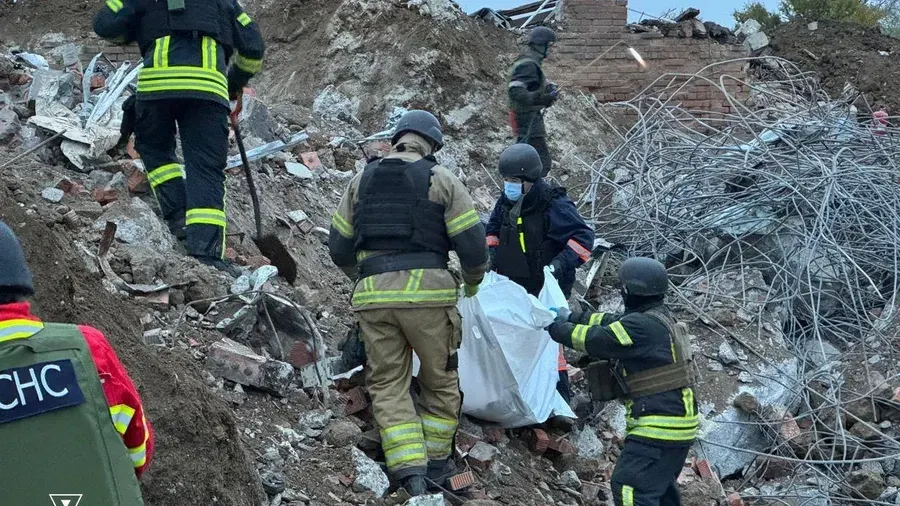
Rescuers can work in the crater for only 15 to 20 minutes at a stretch because of Russian drones and the threat of further bombing. By 4 November police had identified 12 of the bodies recovered. Specialists from the regional unit that traces people missing in special circumstances are taking DNA samples from relatives because some remains cannot be recognised, the National Police said.
The Zaporizhzhia regional budget is paying for funerals, and gives 20,000 hryvnias (about US$440) to people with moderate injuries and up to 50,000 hryvnias (about US$1,100) to the severely injured. The oblast observed three days of mourning from 3 to 5 November.
Two police majors from the Orikhiv station, Oleh Dubetskyi and Serhii Berezhko, were badly wounded near Komyshuvakha on 1 November, the day before the bombing, when a Russian drone hit their patrol car. Both died in hospital on 4 November, said Artem Kysko, head of the National Police in Zaporizhzhia Oblast.
A village of about 500
Komyshuvakha had about 5,000 residents before the full-scale invasion and lies about 20 kilometres from the front line, according to the Zaporizhzhia Investigation Centre. It has been treated as a front-line settlement since November 2025. Oleksandr Kovalenko, spokesman for the regional military administration, said about 500 people remain, most of them over 50, and that more than 60 per cent of homes and commercial buildings have been destroyed. The wider community of 30 settlements has about 2,500 residents, down from more than 12,500 before 2022, he said.
Police have evacuated 166 people from the village this year, including 77 elderly residents and 33 with limited mobility. No mandatory evacuation has been ordered for adults. Kovalenko said the destruction of the aid centre left no clear way to supply the residents who stay, and declined to describe the new arrangements, citing security. A Russian drone strike during an aid distribution in the village on 15 June wounded four people, Ivan Fedorov, then head of the regional military administration, said.
HUR said on 3 November that Russian forces had made a precision strike in September on an underground aid distribution centre in Balabyne, in the Kushuhum community. It said the centre was similar to the one in Komyshuvakha. Aid stores elsewhere have been hit through 2026. Matthias Schmale, the UN humanitarian coordinator in Ukraine, said on 15 September that Russian strikes had destroyed 10 UN warehouses this year and that the UN was considering moving supplies into underground bunkers.
The Oleshky ceasefire and the Security Council
The bombing came a day after a six-day local ceasefire around Russian-occupied Oleshky, in neighbouring Kherson Oblast, expired on 1 November. The truce let hundreds of civilians leave the besieged town and was the first arrangement of its kind since 2022. Zelensky had said trilateral talks between Ukraine, Russia and the U.S. could open in Abu Dhabi on 10 November.
Baiba Braže, Latvia's foreign minister, called an emergency meeting of the Security Council on 3 November over the attack. Latvia holds the council's rotating presidency for November, the first time it has done so. Israel's foreign ministry condemned the strike on 5 November. Zelensky said on 2 November that most of the dead were civilians who had come for aid and people who arrived to help them after the first bombs. On 4 November he said the rest of the world had reacted very little.
Article 438 and the Okhmatdyt case
Deliberate attacks on civilians and civilian objects are war crimes under Article 438 of Ukraine's Criminal Code and Article 8 of the Rome Statute of the International Criminal Court. Ukraine became a full state party to the court on 1 January 2025. Article 25 of the statute makes individuals who order or carry out such attacks criminally responsible. Article 28 extends liability to military commanders who knew or should have known of crimes by forces under their effective control and failed to prevent them.
The Security Service of Ukraine and the Office of the Prosecutor General said on 5 November that three more Russian air force commanders had been served notices of suspicion in absentia under Article 438. The case concerns the Kh-101 cruise missile, launched from a Tu-95MS bomber, that hit the Okhmatdyt children's hospital in Kyiv on 8 July 2024. Six officers have now been charged over that strike, from the leadership of Long-Range Aviation down to the command of a bomber regiment.
The prosecutor general's office said in October 2025 that 1,012 people had been served notices of suspicion under Article 438 and 202 Russian servicemen convicted, 19 of them in person. HUR said it was still working to identify the two crew members of the fourth Su-34.