
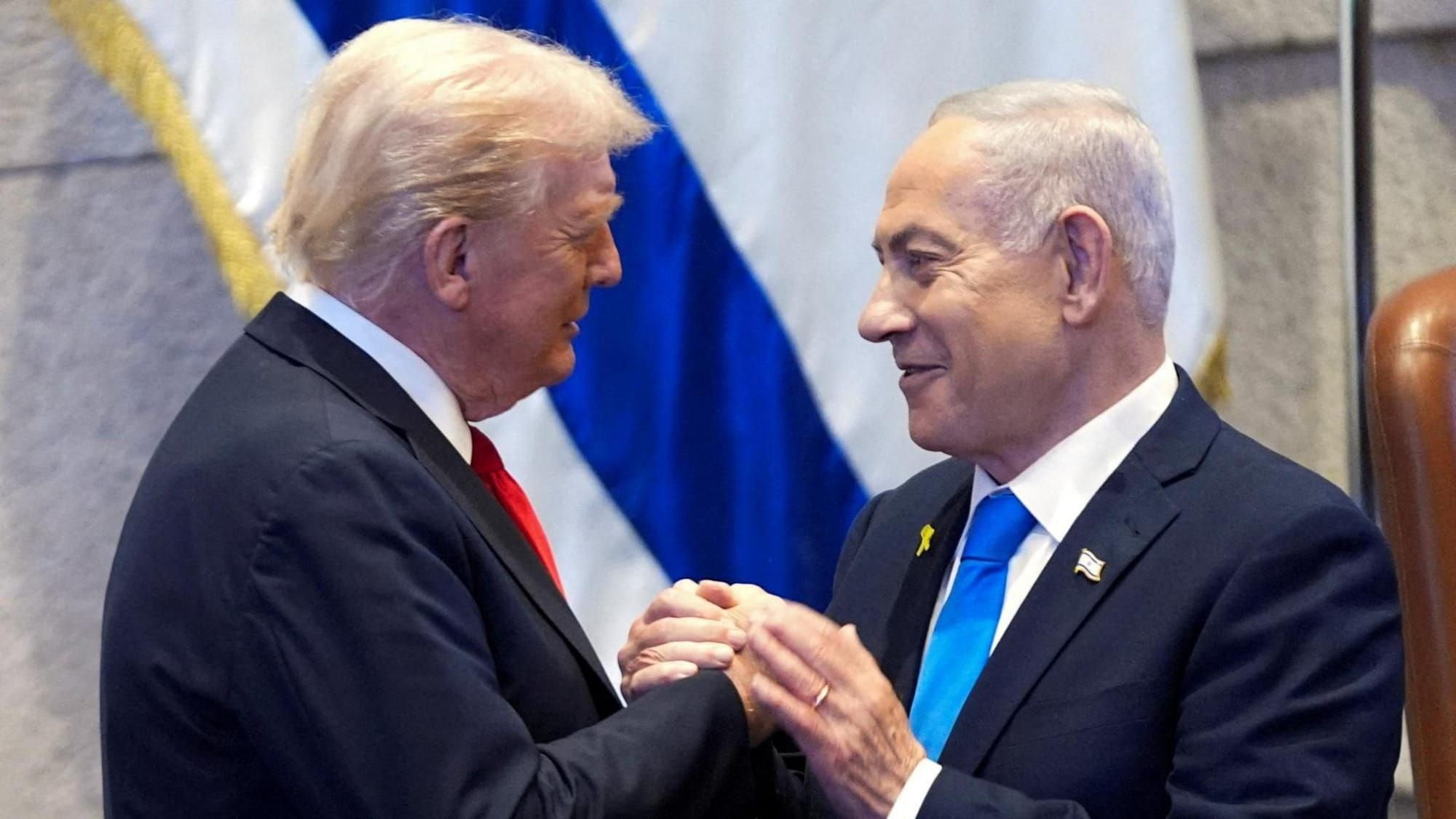
U.S. President Donald Trump said on 3 November that he and Israeli Prime Minister Benjamin Netanyahu had agreed to end roughly US$4 billion in annual U.S. aid to Israel when 2026 ends.
Trump made the claim in a phone interview with Fox and Friends as polls opened in the U.S. midterm elections, telling the programme "we made a deal months ago that we're stopping". He said Israel no longer needed the money and that Democratic candidates, among them Michigan Senate candidate Abdul El-Sayed, were using the payments as a talking point against Republicans.
A 10-year memorandum of understanding signed in 2016 governs the aid Trump described. It provides US$3.8 billion a year, made up of US$3.3 billion in Foreign Military Financing and US$500 million for joint missile-defence programmes, and runs until September 2028.
Netanyahu, on trial since May 2020 on charges of bribery, fraud and breach of trust, spent the weekend before the announcement urging Trump to resume bombing Iran. U.S. stocks of the Patriot and THAAD interceptors that shield U.S. bases and Israel from Iranian missiles stand at a fraction of their pre-war levels, and the Pentagon has removed two senior generals linked to warnings and reporting about that shortage.
The claim
Trump said the idea came from Netanyahu. He quoted the Israeli leader as saying it would be appropriate for Israel to stop receiving aid because it had become a point of contention among Democrats.
Trump also said in the interview that the two men had been discussing it for a couple of years, a different timeline from a deal struck months ago. Pressed by the hosts on whether he meant weapons or cash, he said it could be considered military aid, cash or barter, and that Israel was free to buy U.S. weapons.
Netanyahu's office did not immediately comment. A spokesman for the prime minister said he knew nothing about the remarks and would check for details. Neither government has published a document recording an agreement, and Trump did not say how payments committed through 2028 would be stopped.
The trial and the pardon
Israel's attorney general indicted Netanyahu in 2019 in three cases accusing him of trading official favours with wealthy supporters, and he became the first sitting Israeli prime minister to testify as a criminal defendant. He denies the charges and calls the prosecution a witch hunt. His testimony has been postponed repeatedly on security and diplomatic grounds, including during the Iran war.
Trump urged Israeli President Isaac Herzog to pardon Netanyahu in a speech to the Knesset in October 2025, then sent Herzog a formal letter on 12 November 2025 calling the case a political and unjustified prosecution. Netanyahu filed a pardon request on 30 November 2025, citing Trump's intervention and admitting no guilt. Herzog postponed a decision in April 2026 and sought a mediated plea arrangement instead.
The International Criminal Court issued an arrest warrant for Netanyahu in November 2024 on charges of war crimes and crimes against humanity in Gaza. Trump endorsed Netanyahu in the final days of the Israeli campaign.
Netanyahu's record on aid
Netanyahu has spent most of 2026 arguing for an end to the aid on a longer timetable. He said in January that he hoped to taper it off over the next decade, told CBS in May that he wanted to begin drawing the US$3.8 billion down to zero and wrote to a U.S. congressman in June that Israel should move from aid recipient to partner. The two governments opened formal talks on a replacement memorandum in May.
On 23 October, four days before Israel's election, Netanyahu told the business broadcaster Channel 10 that U.S. military aid would end "because America has changed". He said he had ordered preparations for possible banking sanctions against Israel, including an alternative financial system built on digital currency or blockchain. Published accounts of the interview record him naming no U.S. party, future administration or replacement partner.
Opposition leader Yair Lapid said the remarks amounted to an admission that another Netanyahu term would cost Israel its U.S. aid and bring sanctions that would cause irreparable damage to the economy.
USian support for the aid has fallen since the Gaza war began in October 2023. A Quinnipiac University poll in June found 48 per cent of voters and 66 per cent of Democrats believed the U.S. was too supportive of Israel, against 16 per cent and 20 per cent in 2017. Nearly half of House Democrats backed an amendment to cut off the aid in July, which the chamber defeated.
The Iran war
Netanyahu pressed Trump for a joint strike on Iran before Israel's 27 October election and Trump declined, according to two U.S. officials and an Israeli security source. Netanyahu's office called that account fake news.
Netanyahu then urged Trump in a phone call on 31 October to resume the war immediately after the midterm elections, according to Israeli and U.S. sources briefed on the call. Trump wanted to give indirect negotiations with the Iranian government more time, the sources said. Trump told reporters on 1 November the call had been very good and that they had discussed Iran.
Two regional officials and a third person said on 2 November that Netanyahu was working with senior U.S. officials to persuade Trump to order a quick but extensive air campaign. The AP reported that a return to full-scale war could help Netanyahu form an emergency government after his bloc fell to 53 seats in the 120-seat Knesset, with Gadi Eisenkot's opposition bloc on 48 and Arab-led parties on 19.
Secretary of State Marco Rubio said of Trump: "He hasn't made a decision." Netanyahu wants strikes on Iran's underground nuclear site at Pickaxe Mountain. A single U.S. fighter jet struck a surface-to-air missile launcher on Qeshm Island overnight into 3 November after Iran said it had shot down a U.S. MQ-9 Reaper drone, U.S. officials said.
Netanyahu has told U.S. officials that Eisenkot would be his best partner if hostilities with Iran resumed, The Washington Post reported. Eisenkot said on 2 November that he would not sit in a Netanyahu government even if Trump asked him to.
The interceptors
Gen. Randy George, the Army chief of staff, warned in late December 2025 that the Army was critically short of missile-defence munitions and that Patriot and THAAD stocks would stay strategically low until 2030, CBS News reported, citing multiple U.S. officials. The warning appeared in the Pentagon's annual Global Force Management Allocation Plan, an order the defence secretary approves. The war on Iran began two months later, on 28 February.
Defence Secretary Pete Hegseth removed George in April 2026, with the war under way. No reason for the removal has been made public, and George declined to comment. Sean Parnell, the Pentagon's chief spokesman, said "claims of U.S. munitions shortages are false".
Analysts at the Center for Strategic and International Studies estimated on 27 July that the U.S. had 759 to 827 Patriot interceptors left, about a third of its pre-war stock, and 234 to 278 THAAD interceptors, down from 452. A Pentagon inventory assessment described in August put the military's use at nearly 80 per cent of its THAAD interceptors and about half of its Patriots. Hegseth disputed the figures.
CSIS had earlier calculated that fewer than 500 replacement Patriots were due in fiscal 2026 and no THAAD deliveries at all, with new THAAD orders taking about four years and five months to arrive. Its analysts concluded the remaining stock could cover the Iran war but would leave the U.S. exposed in any second high-intensity conflict for several years.
The generals
The Pentagon subjected some of the military's highest-ranking officers to polygraph tests this year in a leak investigation over reporting on low munitions stockpiles tied to the Iran war. On 28 October Hegseth fired Lt. Gen. Brett Sylvia, director of strategy, plans and policy on the Joint Staff, the post that shapes how the Iran war feeds into long-term military planning.
A Pentagon official said Sylvia had leaked classified information about the Iran and Ukraine wars, had failed polygraph tests and had been referred to the Justice Department. An internal investigation report obtained by Axios said Sylvia admitted on video to sharing classified information with two reporters, and a separate legal analysis alleged that he discussed munitions stockpiles. The report names him as a source for The Wall Street Journal and The New York Times.
Two other Pentagon sources said the leak accusations were untrue, and Sylvia has denied sharing classified or sensitive information. He did not respond to requests for comment. Several lawyers said the Pentagon's public release of his polygraph results may have breached the Privacy Act of 1974.
More than 20 generals, admirals and civilian defence leaders have been fired or have left since Hegseth took office in January 2025, most without public explanation. Hegseth fired Lt. Gen. Jeffrey Kruse, director of the Defense Intelligence Agency, in 2025, weeks after a leaked DIA assessment found that U.S. strikes had set back Iran's nuclear programme by only months, contradicting Trump's claim that the sites were destroyed.