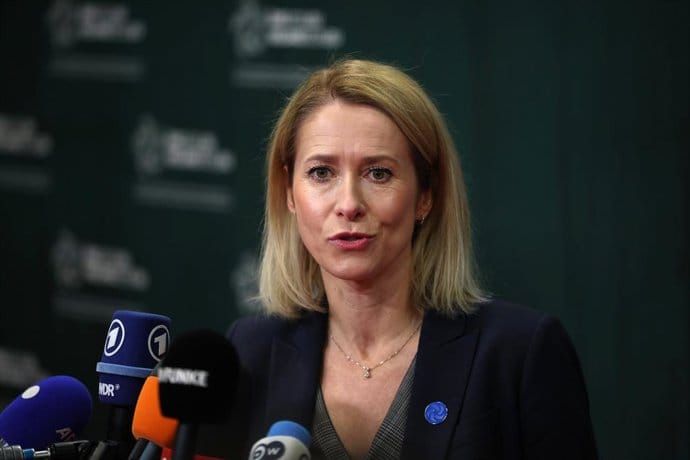
Kaja Kallas, the EU's foreign policy chief, said on 13 November that Russia was pressing Europe to renegotiate its security order first to avoid the question of halting its invasion of Ukraine.
Russian negotiators in Abu Dhabi had refused two days earlier to discuss a ceasefire or territory and turned instead to the security demands Russia sent the U.S. government in December 2021, according to people familiar with the talks. Sergei Lavrov, the Russian foreign minister, said on 10 November, as the round opened, that Russia could not accept an immediate ceasefire without knowing what would follow. It would be wiser to settle the outlines of Europe's security architecture first, he said.
Kallas spoke to reporters in Dublin as EU leaders arrived for an informal summit. By taking up what the Russian government was asking of Europe, she said, "we actually walk into the traps that Russia is setting us". A ceasefire had to come first, then a peace agreement and only after that a wider discussion of European security, because a ceasefire would show whether the Russian government had any will for peace. "We have one aggressor and one victim, and the aggressor does not have security concerns," she said.
Kallas's charge that the Russian government wants to delay a ceasefire is her assessment of its intent. Lavrov's order of business and the delegation's refusal to discuss a ceasefire are Russian positions stated in the talks and in public.
The Russian Foreign Ministry says Western governments rejected a draft Russia-NATO agreement it proposed in 2009 as well as the 2021 drafts. Lavrov offered NATO and EU countries a written non-aggression guarantee in October 2025, and Vladislav Maslennikov, head of the ministry's European department, said that no Western government had replied.
Russia's stated demands
Sergei Ryabkov, the deputy foreign minister, said on 12 November that Russian negotiators had gone back to the "ideas and approaches" of the 2021 drafts, without saying which provisions he meant. Ryabkov had said in March 2022, three weeks after the invasion, that the proposals were no longer valid because the situation had changed.
Yury Ushakov, Putin's foreign policy aide, has called for NATO to return to the positions it held before 1997. Putin told U.S. envoys in the Kremlin on 12 November that Western troops sent to Ukraine after a peace deal would restart the war. Alexei Drobinin, head of foreign policy planning at the Russian Foreign Ministry, offered on 11 November to sign non-aggression pacts with individual NATO members.
Russia handed the two draft treaties to the U.S. government on 15 December 2021 and published them two days later, as its forces massed on Ukraine's borders. Article 4 of the draft agreement with NATO bound Russia and the states that were alliance members on 27 May 1997. None of them would station forces or weapons on the territory of any other European state beyond those already there on that date. Article 6 committed NATO to no further enlargement, Ukraine included. Sixteen of NATO's 32 members joined after 1997, among them Poland, Finland and the three Baltic states, all of which border Russia or its exclave of Kaliningrad.
Russia's drafts also barred allied military activity in Ukraine, the South Caucasus and Central Asia, limited intermediate-range missiles and required U.S. nuclear weapons stationed abroad to return home. "NATO posed no threat to Russia in 2021," Kallas said in Warsaw on 6 November. Ryabkov, Ushakov, Putin and Drobinin did not mention those clauses in the statements reported since the round.
The Finland and Baltic report
Unofficial proposals attributed to Putin's circle, carried in German press reports, would have Finland leave NATO and NATO bases removed from the Baltic states. Dmitry Peskov, Putin's spokesman, denied on 13 November that Russian negotiators had demanded Finland's exit. Antti Häkkänen, Finland's defence minister, called the reported demands "absolutely outrageous", and Elina Valtonen, its foreign minister, said Finland's membership was for Finland and the alliance alone to decide.
Drobinin's offer to individual members
Drobinin set out three models for a new European security order at a conference in Moscow. One was a collective defence alliance or bilateral mutual assistance treaties of the kind Russia has with Belarus and North Korea. Another was a political commitment by each side not to help the other's adversaries in a war, modelled on Russia's pact with Iran. The third was bilateral non-aggression pacts, which he said in a recorded speech could be signed with individual NATO members that would then receive additional individual security guarantees from Russia. He named no member state, and no government has said it is negotiating such a pact.
Article 5 of the North Atlantic Treaty treats an armed attack on one member as an attack on all, and leaves each ally to take the action it deems necessary in response. Article 8 commits each member not to enter any international engagement that conflicts with the treaty. A pact promising not to attack Russia would not, on its face, conflict with either article.
NATO takes its decisions by consensus, so any one of the 32 governments can delay or block a decision on deployments, exercises or a response to an attack. Drobinin's guarantees would run between Russia and one government at a time, outside the alliance's own structures.
The Soviet Union signed non-aggression treaties with Lithuania in September 1926, with Finland and Latvia in January and February 1932, with Estonia in May 1932 and with Poland in July 1932, according to the League of Nations Treaty Series. It invaded Poland on 17 September 1939 and Finland on 30 November 1939, and occupied Lithuania, Latvia and Estonia in June 1940.
Kallas told reporters in Warsaw that "we already have a European security architecture in place". Russia "keeps breaking the treaties that underpin it", she said, and "Putin does not have a veto over European security." Kristen Michal, the Estonian prime minister, said on 13 November that Russia was using the question of a new security architecture to distract Europeans.
Europe's counter-list
Kallas said in Dublin that because Russia was presenting its maximum demands, she had drawn up European maximum demands with the bloc's foreign ministers. "If they start from maximum, we should start from maximum as well," she said. If one side starts from maximum and the other asks for nothing, "you can guess where this negotiation is ending". Kallas's paper, titled "European Core Interests in Ensuring a Comprehensive, Just and Lasting Peace and Continent's Security", went to member governments in February.
Russia would have to accept any cap on its armed forces that a settlement imposed on Ukraine's, the paper says. It calls for Russian troops to leave Belarus, Georgia, Armenia and Moldova's breakaway Transnistria region and for Russian nuclear weapons to be removed from Belarus. Russia would pay reparations to Ukraine and compensation to European states and companies, accept no blanket amnesty for war crimes, return deported civilians and children and hold free elections under international supervision. Ukraine's justice ministry had confirmed 20,610 children deported or forcibly transferred by Russia by September, Volodymyr Zelenskyy, the Ukrainian president, said on 5 November.
EU ambassadors took it up on 17 February as a discussion paper for member states and not a negotiating mandate, and Kallas presented it to foreign ministers on 23 February. Some European diplomats dismissed the demands as too extreme, and Kallas said in March that she would keep pushing for them.
What the U.S. has put on the table
Jared Kushner, President Donald Trump's son-in-law, wrote on X on 5 November that Trump had discussed a broader European security architecture with several European leaders that day. The U.S. was exploring permanent security consultations, reliable crisis communications, greater military transparency, reciprocal measures to reduce the risk of escalation and a lasting arrangement for European security, he wrote. NATO would remain central, no country would hold a veto over another's choices, and consultations would continue with Ukraine, NATO, the EU and European partners while the U.S. engaged Russia in the peace talks.
Kushner wants talks on a ceasefire and on European security to run in parallel, with the NATO-Russia Council, suspended in 2014, as a model, an official familiar with the negotiations said. Putin responded with enthusiasm to the idea at a meeting with Steve Witkoff, the U.S. special envoy, in St Petersburg on 21 October, which Kushner joined by video link.
The U.S. asked Russia to prepare a new proposal on European security, two people familiar with the talks said on 11 November. The U.S. had told European governments it would not agree to a security arrangement with Russia unless Europe and Ukraine supported it, and would give Russia no veto over European security, one of them said.
Who sent the envoys
Witkoff holds the title of special envoy for peace missions. Trump said in February that he would give Kushner the same title, and the White House later said the role would not be an official one. Kushner described the objectives of 5 November as building on Trump's own talks with European leaders and on meetings in Brussels with Ukraine, NATO and European partners on 4 and 5 November. The White House has not published the terms of the envoys' mandate on European security.
Three alliance diplomats said that NATO allies had not been informed of the U.S. plans in advance. Björn Seibert, chief adviser to European Commission President Ursula von der Leyen, briefed EU ambassadors after national security advisers discussed the proposals, two EU diplomats said. One NATO official said it was "a bit obscure what Kushner meant". Diplomats feared the U.S. government would tie the talks to its review of U.S. troop levels in Europe due in December.
European foreign ministers pressed Marco Rubio, the U.S. secretary of state, for a say in any deal at a G7 meeting in Paris on 9 and 10 November. "Europe belongs at this table," Johann Wadephul, the German foreign minister, said after talks with Rubio. The EU could not "just send any person that has no institutional role", Kallas said in Dublin, contrasting its institutions with the U.S. envoys. She welcomed Kushner's acknowledgment that Europeans must take part in carrying out any deal and said she hoped Europe would be "really influencing the outcome of these negotiations". Zelenskyy said in Dublin on 12 November that he found it odd that the U.S. was negotiating a new European security order with Russia.
Who can commit Europe
Article 18 of the Treaty on European Union gives Kallas the EU's foreign and security policy brief. The high representative conducts that policy and carries it out as mandated by the Council of the EU. "I know that the Russians don't want me," Kallas said when asked about the Russian government's opposition to her taking part. "It's not up to them to say." All the member states had agreed that she represents Europe in foreign and security policy, she said, and "I'm representing 27". Russia has listed her as wanted since 2024.
Article 15 of the same treaty gives António Costa, the president of the European Council, the EU's external representation in foreign and security policy at his level, without prejudice to the high representative's powers. Foreign and security policy decisions are taken unanimously unless the treaty provides otherwise. A government can abstain without blocking a decision, and the Council can act by qualified majority on measures implementing a position already agreed, although any government can halt such a vote for vital reasons of national policy. Sanctions need a unanimous political decision before the restrictive measures themselves are adopted by qualified majority, so a single government can stop new sanctions or block the renewal of existing ones.
Costa announced after the Dublin summit that Europe would be represented at the talks by the EU's institutions and the E5 group of Britain, France, Germany, Italy and Poland. Britain is outside the EU, and the four EU members in the group cannot commit the other 23. National security advisers from the EU and the five governments will represent Europe at the next round, and no leader has been named to represent Europe at the political level. Several leaders backed Costa for that role and others wanted one for Kallas.
Security guarantees for Ukraine would be handled by the coalition of countries backing it, in close coordination with NATO, Costa said. Paula Pinho, the European Commission's chief spokesperson, said on 6 November that the EU would decide its own security matters.
Witkoff told Russian state television on 12 November that European representatives would join the next round of talks, and Ushakov did not confirm it. Kushner wrote on 13 November that Russia and Ukraine had both agreed to include European partners, so that the round could take up post-war European security alongside territory. No wider European arrangement would be finalised without addressing Ukraine's security concerns, he wrote.