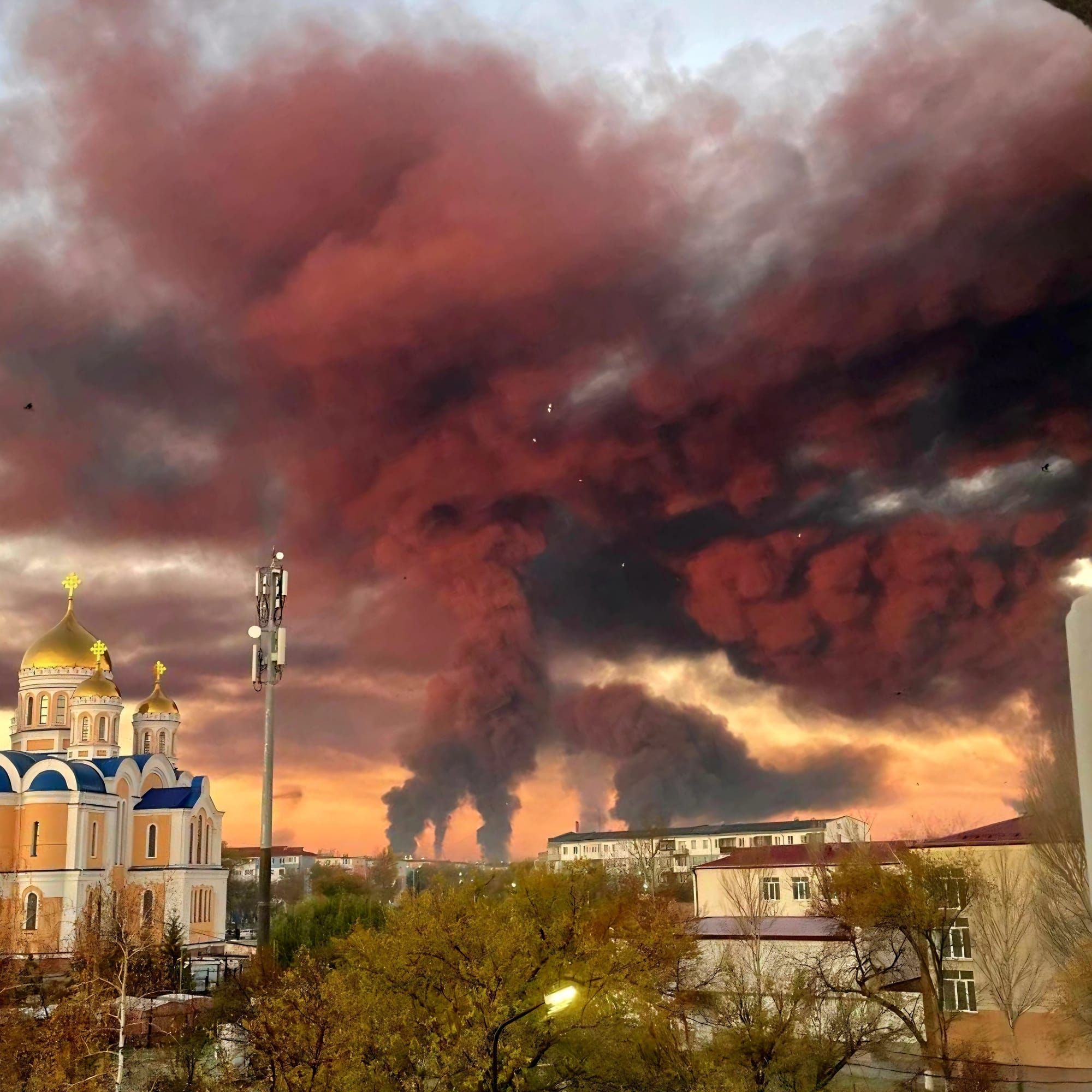
Ukrainian forces struck Rosneft's Novokuibyshevsk oil refinery in Russia's Samara region before dawn on 30 October with FP-1 drones, their manufacturer said, the first Ukrainian hit on a Russian refinery since 15 October.
Fire Point, the Ukrainian company that builds the FP-1, said its drones scored several hits across the plant, including on a unit that hydrotreats diesel fuel. Footage posted by the monitoring channel Exilenova+ showed at least 11 separate fires on the site, and European Copernicus Sentinel satellite imagery published by Reuters showed smoke drifting from the refinery. Samara's governor, Vyacheslav Fedorishchev, said only that air defences and mobile fire groups were working against a drone attack on the region.
Ukraine had paused its refinery campaign early in the week of 19 October after weeks of pressure from Donald Trump and his envoys before the U.S. midterm elections on 3 November, the Wall Street Journal reported on 29 October. European allies had advised President Volodymyr Zelenskyy to hold off until after the vote to ease tension with Trump, senior European officials told the paper. Throughout the pause, Russian forces kept hitting Ukrainian power plants and cities, and on 29 October a Russian jet-powered drone killed 15 people on a platform at Dnipro's railway station.
The refinery
Novokuibyshevsk sits on the Volga about 1,000 km from Ukraine's border and has belonged to Rosneft, Russia's state oil company, since 2007. It can process about 8.3 million tonnes of crude a year, industry sources told Reuters, and in 2024 it processed 5.74 million tonnes and produced 1.64 million tonnes of diesel. It also makes jet fuel for the Russian Aerospace Forces, the air arm that drops glide bombs on Ukrainian cities and front-line positions.
Ukrainian drones have hit the plant repeatedly in 2026. After an attack on 18 April, Novokuibyshevsk stopped both of its primary crude units, AVT-11 and AVT-9, two industry sources told Reuters, and the larger unit, which handles about 80 per cent of the plant's throughput, needed more than a month of repairs. Ukraine's General Staff confirmed a strike that set the refinery on fire on 22 August.
Residents reported explosions and air defence fire in Novokuibyshevsk on the morning of 30 October, and flights at Samara's airport were delayed. Fire Point announced the strike on Telegram with a post saying the refinery was welcoming guests from Ukraine.
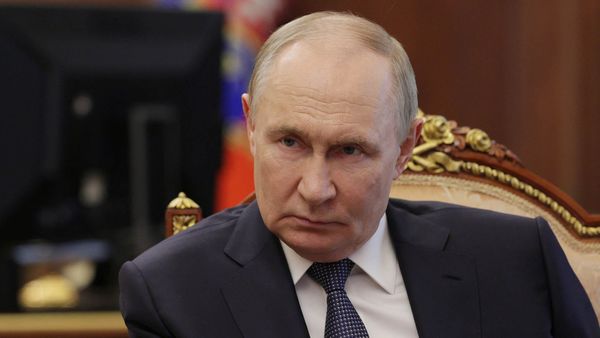
Yuri Ushakov, Vladimir Putin's foreign policy aide, told the Russian state television journalist Pavel Zarubin on 30 October that Trump had been insistent about refinery strikes and that the Ukrainian government ignored him. "Once again they disobeyed," Ushakov said.
The pause
Ukrainian units that carry out long-range strikes were told in mid-October that the campaign against refineries was effectively on hold once missions already under way were complete, two military officials told the Journal. People with knowledge of the operations said the pause was expected to last until after the midterms, possibly deeper into November.
Yevhen Khmara, Ukraine's defence minister, told Zelenskyy that the military had been holding back from refinery strikes because of the delicate diplomatic situation with the U.S., a person familiar with the conversation told the Journal. Zelenskyy accepted that but said the military remained free to change course, the person said.
Zelenskyy told reporters in Kyiv on 27 October, "Our guys tried to be a little more careful during these days." He said units had no order against hitting refineries and that drone crews were striking other kinds of targets inside Russia.
Ukraine's last refinery strike before the pause came on 15 October, when drones hit Rosneft's Ryazan refinery hours after Zelenskyy told the Financial Times that an earlier three-day pause was over. Ryazan's governor said a fire broke out on its grounds. On 16 October drones struck Gazprom's gas condensate plant near Surgut in Western Siberia, more than 2,000 km from Ukraine, which has a design capacity of 12 million tonnes of raw material a year.
A large drone attack on St Petersburg on 18 October set fire to the city's oil terminal and the Ruchyi oil depot. Governor Alexander Beglov said one person was killed and 15 were injured, and Fire Point said FP-1 drones hit the terminal.
Robert Brovdi, commander of Ukraine's Unmanned Systems Forces, said drones of its 14th Regiment hit the Nikolskoye pumping station on the Druzhba pipeline in Russia's Tambov region on 20 October. Tambov's governor, Yevgeny Pervyshov, said a fire broke out at an enterprise in the Michurinsky district. Ukraine did not hit Russian oil infrastructure again until Novokuibyshevsk, according to the Journal.
The Oslo meeting
Jared Kushner, Trump's envoy, pressed Zelenskyy to stop the refinery strikes at a meeting in Oslo on 20 October, two U.S. officials told the Journal. Jonas Gahr Støre, Norway's prime minister, hosted the talks with Finland's president, Alexander Stubb. Steve Witkoff, Trump's special envoy, attended in person, and Kushner joined by video because he had the flu, the Norwegian government and Ukrainska Pravda reported.
Kushner told Zelenskyy that he and Witkoff were spending a great deal of time, energy and jet fuel on mediating with the Russian government, and that a 30-day pause on refinery strikes would be a way for Ukraine to show gratitude, one of the U.S. officials told the Journal. The official described the conversation as "very tough."
Witkoff and Kushner rebuked Zelenskyy in the meeting over public remarks that had angered Trump, the New York Times reported. Witkoff travelled on from Oslo to St Petersburg to meet Russian leaders and present ideas from the talks.
Senior European officials told the Journal that Ukraine's European allies had advised Zelenskyy to heed the political sensitivity of energy prices before the midterms. One said some of Ukraine's strongest European backers, worried by the exchanges between Trump and Zelenskyy and by the Starlink disruption, urged him to wait until after the vote.
Starlink
SpaceX's Starshield service, the military version of Starlink used by Ukraine's armed forces, began cutting out above about 160 km/h overnight into 14 October. Ukrainian interceptor drones flown against Russia's jet-powered attack drones lost their link, and Zelenskyy said on 19 October that equipment along the front stopped working at 130 to 161 km/h. Russia's jet drones fly at more than 400 km/h, he said. The cap also halted Ukrainian drone strikes on Russian army supply lines, the Journal reported.
Two U.S. officials and a Western official told Reuters that the order to restrict the service came from inside the White House, and the Telegraph reported that Elon Musk proposed it to Trump. Musk wrote that the U.S. government controls Starshield, and Trump said on 16 October that the U.S. government was not involved. Nine senators asked the Defence Department's inspector general on 15 October to establish who directed the restriction.
Trump called Musk on 21 October and asked him to restore Ukraine's service, the Journal reported, and said the next day that Musk had done so. Khmara said on 24 October that the ministry was recording speeds above 400 km/h and that the connection was stable.
U.S. officials told the Journal that restoring Starlink was never conditional on a pause in refinery strikes. Some Ukrainian officials said the government was under heavy pressure to give Trump a win while it needed the White House to restore the service, and one military official said Starlink and the refineries had become two parts of one story.
The diesel licence
Trump spoke to Putin on 9 October and said Russia would supply more than 300,000 tonnes of diesel immediately, 500,000 tonnes in November and 1 million tonnes after that. The Treasury's Office of Foreign Assets Control issued a licence the same day permitting the sale, delivery and import of Russian diesel until 7 April 2027.
Russia has banned its own diesel exports since July because Ukrainian strikes on its refineries left it short of fuel at home, and the International Energy Agency estimates Russian diesel output has fallen by about 30 per cent. Trump wrote that lower prices for farmers, ranchers and truckers were his top priority. Energy experts mostly attribute high global fuel prices to the U.S.-Israeli war with Iran that began in February, according to the Journal.
Trump said on 10 October that Zelenskyy "better damn well stop" hitting Russian refineries, blamed him for the continuing war and said Ukraine should get a new leader who could make a deal. On 16 October he signed an order waiving new sanctions and tariffs required by the Lindsey O. Graham Sanctioning Russia and Iran Act of 2026, which Congress passed to cut Russia's oil and gas revenue.
Trump announced an energy ceasefire between Russia and Ukraine on 11 October, and Ukraine held off striking Russian energy sites for three days. Zelenskyy said on 13 October that Russian forces had hit energy facilities and critical infrastructure in 19 Ukrainian regions over the first two days of that truce.
Zelenskyy told the Financial Times on 15 October that U.S. officials had said intelligence sharing would stop if Ukraine kept hitting refineries, and that Ukraine received no U.S. warnings of Russian ballistic missile launches during the three-day pause. Trump said the U.S. had not stopped sharing intelligence with Ukraine.
Ukraine's terms
Zelenskyy told Trump in recent weeks that Ukraine would need something in return for halting the refinery strikes, the Journal reported. His first choice was a mutual energy ceasefire under which Russia would stop hitting Ukrainian power plants. His alternatives were Patriot missiles to protect the grid or permission to use Starlink inside Russia so that drones could destroy the launchers that fire missiles at Ukrainian cities.
Senators Roger Wicker and Kevin Cramer put the Starlink option to Zelenskyy in Kyiv on 9 October, offering coverage about 300 km into Russia in exchange for a 100-day halt to strikes on Russian energy facilities, the Journal reported on 16 October. Zelenskyy signalled he would accept, people familiar with the talks said.
Ukraine received 24 Patriot interceptors from the U.S. over 90 days against a need of about 350 a month, Zelenskyy said on 26 October, and had waited nearly a month for Pete Hegseth, head of the U.S. Department of Defense, to approve missiles for its Patriot and NASAMS systems. Khmara asked the UK, France, Germany, Italy and Poland on 27 October for 10 per cent of their Patriot and IRIS-T interceptor stocks in exchange for missiles already contracted for later delivery.
Russia's strikes on Ukraine
A Russian jet-powered drone hit a platform at Dnipro's central station on the morning of 29 October, where train No. 866 to Zaporizhzhia was standing beside a commuter train, according to Ukrzaliznytsia, the state railway, and Ukrainian officials. Ukraine's Air Force said it brought down three jet drones in the daytime attack and a fourth got through.
Fifteen people had died by 30 October, when a 40-year-old man succumbed to his injuries in hospital, Ukrainska Pravda reported. Eleven of the 14 injured remained in hospitals in Dnipro, six of them in serious condition, among them an 11-year-old boy.
Five of the dead worked for Ukrzaliznytsia: Yevhenii Kryvko, Viktoriia Nosikova, Kateryna Borysova, Yana Shpakova and Ruslan Dil. The company said they were killed while helping evacuate passengers. Shpakova, 32, ran the station's children's area, and Dil, 48, was changing trains at Dnipro on his way to Zaporizhzhia.
Zelenskyy said many people had stayed on the platform despite the air alert, and that the strike showed the U.S. and Europe needed to act decisively against Russian escalation. Russian strikes the same day killed two 15-year-old girls in central Chernihiv, hit by a drone-launched Banderol cruise missile, and Russian attacks cut power to more than 350,000 consumers in Dnipro and nearby settlements, regional officials said.
Russia fired 16 ballistic missiles and more than 280 drones at Ukraine on the night of 26 October, Zelenskyy said. Missiles hit the campus of the State University of Trade and Economics in Kyiv and injured five students and staff, and a second wave at about 03:00 struck the Pivdennyi Bridge over the Dnipro.
The UN Independent International Commission of Inquiry on Ukraine told the UN General Assembly on 26 October that Russian attacks on Ukraine's energy system followed a state policy of depriving civilians of electricity and amounted to war crimes and crimes against humanity. Zelenskyy said on 15 October that Russian strikes had killed more than 100 Ukrainian civilians in the previous week.
A commander of one Ukrainian battalion on the eastern front told the Journal that soldiers and officers had agreed over the past two weeks to take down every U.S. flag and insignia in the unit.
Who ordered the pause and whether it has ended
Fire Point, a private manufacturer, announced the Novokuibyshevsk strike on 30 October. A General Staff statement naming the unit that carried it out, or the instruction given to long-range units in mid-October that the Journal's sources described, would establish whether the pause was ordered or left to commanders and whether refinery targeting has formally resumed.
U.S. and Norwegian notes of the Oslo meeting would record Kushner's words on a 30-day pause. The Defence Department and SpaceX hold the technical directives that capped Starshield on 14 October and lifted the cap by 24 October, which the nine senators asked the inspector general to preserve.
Treasury's diesel licence runs until 7 April 2027, and Russia and Ukraine are due to meet U.S. envoys next month to restart talks. U.S. voters go to the polls on 3 November, the date Ukraine's European allies had asked Zelenskyy to wait for before hitting Russian refineries again.