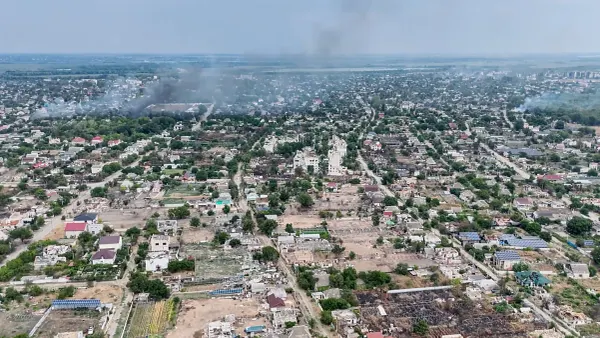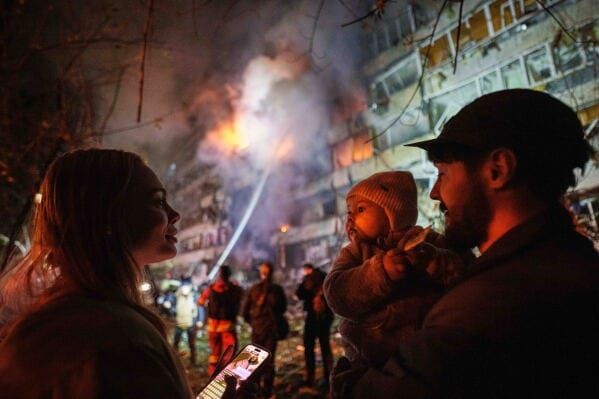
Russian ballistic missiles struck the State University of Trade and Economics campus in Kyiv's Desnianskyi district at about 22:00 on 26 October, injuring five students and staff, President Volodymyr Zelenskyy said.
Hours earlier, the UN Independent International Commission of Inquiry on Ukraine told the UN General Assembly that Russian authorities had committed war crimes and crimes against humanity through deliberate attacks on Ukraine's energy system. Interfax-Ukraine published the findings at 18:05 that evening.
Russian strikes on the city that night killed one person and injured 15, according to the State Emergency Service. That afternoon Zelenskyy had said Ukraine had waited nearly a month for Pete Hegseth, head of the U.S. Department of Defense, to sign off on missiles for its Patriot and NASAMS air defences.
The campus
The university stands on Kyoto Street on the left bank of the Dnipro, beside Kyoto Park and Lisova metro station, and teaches more than 15,000 students across six faculties, according to Kyiv Post. The Ukrainian Air Force warned of ballistic missiles launched from Russia's Bryansk region at about 22:00, and residents heard explosions soon after, according to the Ukrainian news site Focus.
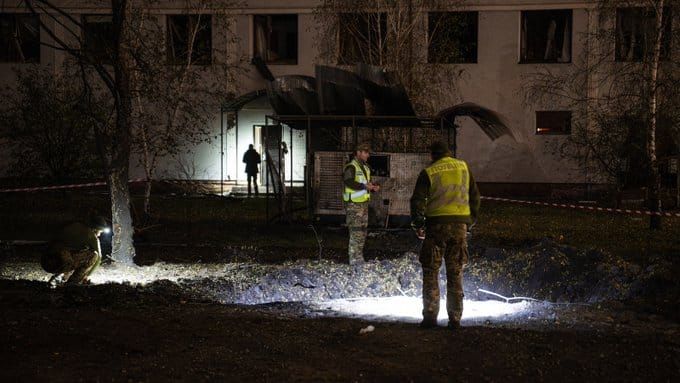
Kyiv Mayor Vitali Klitschko wrote on Telegram that a missile landed near a university dormitory in the Desnianskyi district and blew out its windows. A 20-year-old woman was taken to hospital, he wrote.
By 23:11 Klitschko counted one dead and eight injured across the city, seven of them in hospital and three in serious condition.
The university wrote on Telegram on the morning of 27 October that the strike damaged its academic buildings, its dormitories and the campus grounds and injured five people. Video from the site shows a crater 3 to 4 metres across on the path between dormitories, 5 to 10 metres from the buildings, according to Focus.
Anatolii Mazaraki, the university's rector, told Hromadske that two second-year students, a young man and a young woman, were seriously injured outside near the dormitory. The young man faces a second operation in a neurosurgery ward, he said.
Other residents were in the shelter when the missiles hit, Mazaraki said. More than 200 people lived in the dormitory, among them postgraduate students and teachers.
Telegram channels posted overnight that students had been killed, a claim Klitschko did not confirm. Mazaraki said every report of deaths on the campus was untrue and called the reports "fake".
The casualties
Rescuers found the body of the person killed in the basement of a three-storey non-residential building that the strike partly destroyed in the Dniprovskyi district, according to the State Emergency Service.
In the Desnianskyi district around the campus, 12 people were injured, five of them students and staff of the university, Zelenskyy wrote on Telegram on 27 October.
A paramedic and an emergency medical technician were injured when their ambulance came under fire in the same district, Klitschko said. A strike near Lisova station set a car on fire, and the Kyiv City Military Administration said a school building in the district was damaged.
In the Dniprovskyi district the blast wave blew out windows in the intensive care unit of one medical facility and damaged windows at a second, Klitschko wrote. Staff and patients at both were unhurt, he wrote.
The bridge
A second wave of ballistic missiles hit the city at about 03:00 on 27 October, according to Focus. Zelenskyy wrote that Russian forces launched ballistic missiles again while emergency services were still helping people at the first sites.
Russian forces fired several ballistic missiles at the Pivdennyi Bridge, which carries road traffic and part of the green metro line across the Dnipro, said Yurii Ihnat, spokesperson for the Ukrainian Air Force. Repairing the damaged deck "will take time", he said on television.
Ihnat said Russian forces had concentrated missile strikes on the capital over the previous two weeks and now spread ballistic launches across several waves a night, alongside drones.
Kyiv Metro split the green line into two sections, Syrets to Vydubychi and Osokorky to Chervonyi Khutir, and police closed the bridge and diverted traffic, according to the Kyiv City Military Administration. Klitschko said ballistic missiles also hit an administrative building in the Podilskyi district and non-residential buildings at two other sites.
The missiles
Russia began the attack at 18:00 on 26 October with Iskander-M ballistic missiles or S-400 missiles fired from Bryansk region and 280 drones, the Ukrainian Air Force said. By 09:00 on 27 October air defences had brought down two ballistic missiles and 255 drones, and the Air Force counted impacts at 25 locations.
Zelenskyy put the night's total at 16 ballistic missiles and more than 280 drones, with strikes in the Kyiv, Vinnytsia, Zaporizhzhia, Dnipropetrovsk, Kharkiv, Odesa, Chernihiv, Sumy, Donetsk, Kherson and Chernivtsi regions. Ihnat said specialists at the impact sites would determine which of the two missile types Russia used.
Russia's Defence Ministry wrote on Telegram that its forces struck "an industrial enterprise producing and storing long- and medium-range unmanned aerial vehicles" in the capital, along with transport infrastructure.
Zelenskyy wrote that the missiles hit crowded areas with no military facility nearby and described the attack as a strike on the city and its infrastructure.
The interceptors
Zelenskyy said after a call with his defence minister, foreign minister and army commander-in-chief on 26 October that Ukraine had waited nearly a month for Hegseth's signature on missiles for its Patriot and NASAMS systems. He said he had told officials to raise the matter with the U.S. government again.
Some of the missiles come from allied countries and need Hegseth's approval because the U.S. must authorise any re-transfer of its weapons, a U.S. official and three people familiar with the matter said on 19 October, according to Euromaidan Press. U.S. officials said Hegseth had neither rejected the requests nor taken the steps needed to approve them, according to Interfax-Ukraine.
Ukraine received 24 Patriot interceptors from the U.S. over 90 days against a need of about 350 a month, Zelenskyy said on 26 October. On the morning after the campus strike he wrote that "artificial and prolonged delays" in interceptor deliveries were directly helping Russia's strike campaign.
Defence Minister Yevhen Khmara asked the UK, France, Germany, Italy and Poland on 27 October to give Ukraine 10 per cent of their Patriot and IRIS-T interceptor stocks in exchange for missiles already contracted for later delivery.
Earlier strikes on universities
A Russian attack on Kyiv overnight on 6 July damaged an academic building and a dormitory of the Taras Shevchenko National University of Kyiv at the VDNH exhibition grounds. Valerii Kopiika, its acting rector, said every student and staff member was unhurt.
A Russian drone struck the National University of Food Technologies in central Kyiv during classes on 2 September, the second day of the academic year, while 160 students were in its shelter, Zelenskyy said.
On 13 October a Russian drone set fire to a building of the Rivne State Humanitarian University and injured administrative staff, Education Minister Andrii Butenko said. The building can no longer be used for teaching, he said.
The UN findings
The commission, which the UN Human Rights Council mandated to investigate violations of international humanitarian law in Russia's war on Ukraine, found that the attacks on the energy system followed a state policy of depriving civilians of electricity and the services that depend on it.
The commission drew on testimony from 255 people in nine regions, Kyiv among them. Erik Møse, its chair, said the attacks had "again intensified" as a new cold season set in.
The commission also examined Ukrainian strikes on energy facilities in Russia and in occupied territory. It said the Russian government refused it access to investigate their effects and left its requests for information unanswered.
The law
Rules 1 and 7 of the International Committee of the Red Cross study of customary international humanitarian law require every party to a conflict to direct attacks only at military objectives, and an object whose status is in doubt is presumed civilian.
Article 8(2)(b)(ix) of the Rome Statute of the International Criminal Court makes it a war crime to intentionally direct attacks against buildings dedicated to education, provided they are not military objectives.
The Russian Defence Ministry's identification of the drone enterprise it says it struck, with its location, set against the position of the crater between the dormitories, would show whether any military objective lay near the campus. The fragments Air Force specialists are examining would establish the missile type, and the Air Force's tracking data for the 22:00 wave would show the flight path and impact point of each missile that reached Kyiv.