France is rehearsing a troop deployment to Ukraine that the Russian government has threatened to attack, while its army prepares for a possible war with Russia within three or four years.
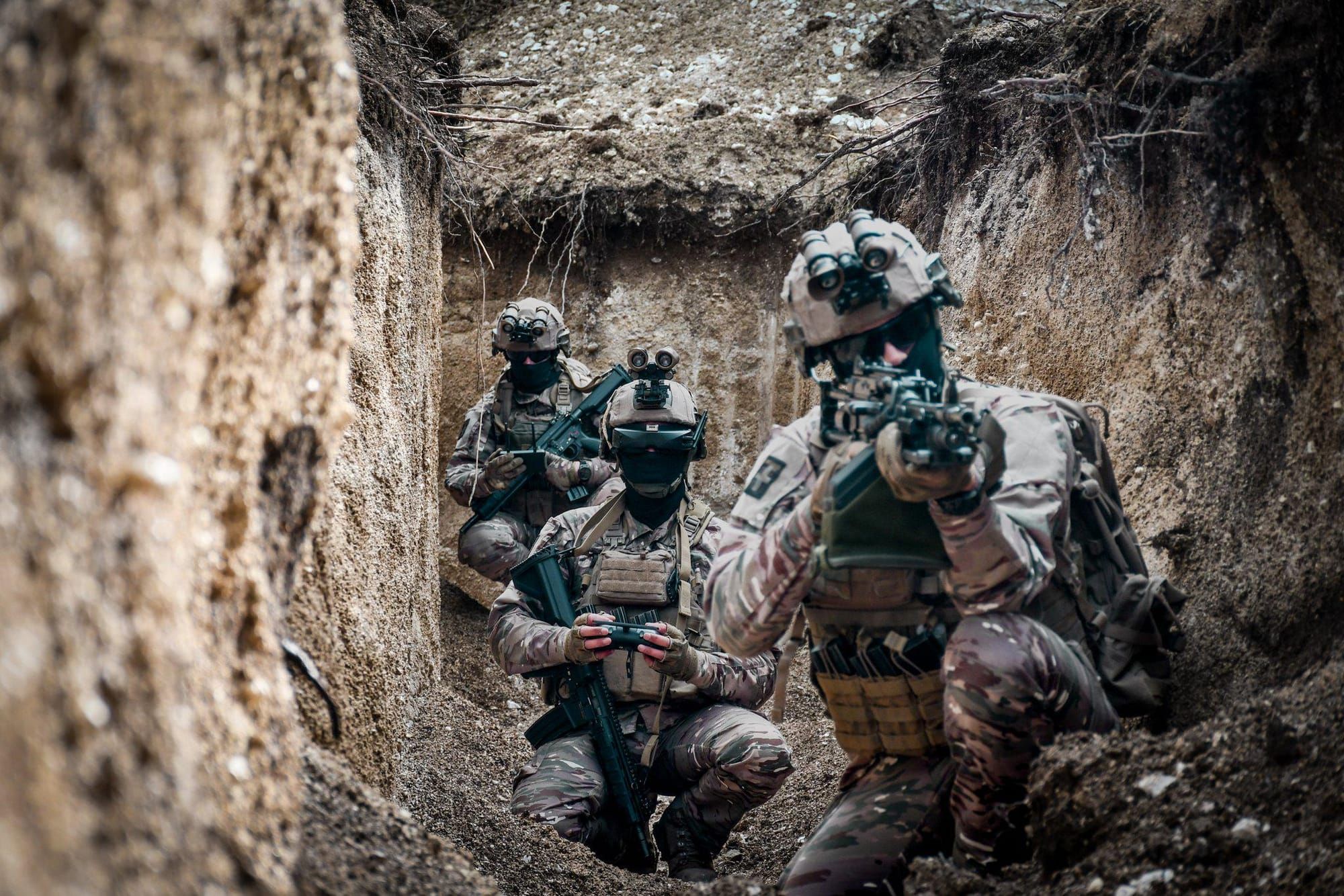
About 1,100 French soldiers, the largest national contingent, are training around Nowa Dęba in south-eastern Poland, about 100 kilometres west of the Ukrainian border, in Exercise Koalicja. The drill runs from 9 to 22 November and involves about 2,800 troops from 11 countries, with elements in the airspace over Romania and in the western Black Sea. It is a rehearsal on NATO territory. No coalition troops have entered Ukraine, and the force would deploy only after the fighting stops and at the Ukrainian government's request, the British Ministry of Defence said.
No signed text says what France or its partners would do if Russian forces fired on those troops. The Multinational Force Ukraine has published neither its size nor its rules of engagement, and the U.S. has not signed the pledge of support made in its name. General Fabien Mandon, the French chief of the defence staff, has ordered the armed forces to be ready for a clash with Russia within three or four years. The same army, air force and missile stocks would have to supply, protect and reinforce any French contingent in Ukraine. Budget documents, parliamentary hearings and the defence ministry's inventory figures show a French military better funded than in 2022 but no larger, with most of its new ammunition, drones and air defence due towards the end of the decade.
Maria Zakharova, the Russian Foreign Ministry spokeswoman, said on 7 November that any foreign contingent deployed to Ukraine would be treated as "legitimate targets". Sergei Shoigu, the secretary of Russia's Security Council, said on 9 November that the exercise was offensive in character. Vladimir Putin, the Russian president, told U.S. envoys at the Kremlin on 12 November that Western troops sent to Ukraine after a peace deal would restart the war. Lieutenant General Tom Bateman of the British Army, who commands the force, said it would provide reassurance and help rebuild Ukraine's armed forces. "It is not designed for offensive operations," he said.
Exercise Koalicja at Nowa Dęba
Belgium, Estonia, Germany, Lithuania, the Netherlands, Poland, Spain and Sweden have also sent troops. Turkey is running a naval element from Istanbul to rehearse clearing mines in the Black Sea, and Turkish troops are not part of the land drill. General Armel Dirou of France runs the exercise with Bateman. The coalition behind the force numbers about 35 countries, and 24 have made military commitments to it, according to the British Ministry of Defence.
Only light equipment and no armoured vehicles have been sent, to show that the force has no offensive purpose. France's contribution includes a French Army drone unit with about 50 short-range unmanned aircraft and systems to counter enemy drones. Britain has sent 300 personnel, Royal Air Force Typhoon jets and a Voyager refuelling aircraft. The force's headquarters rotates between Paris and London.
Bateman's force is not a NATO operation, a peacekeeping mission or a ceasefire monitoring mission, he said. Its stated tasks are to help regenerate Ukraine's armed forces, help reopen Ukrainian airspace and clear mines from the Black Sea. A separate mechanism led by the U.S. would monitor any ceasefire, and U.S. officials said in January that it would probably rely on drones, sensors and satellites without USian troops.
United Nations peacekeeping forces deploy with the consent of both sides and stand between them. The coalition force would deploy at Ukraine's request alone, against Russia's stated opposition, to strengthen one side's army. Western governments say it could defend itself.
The January texts and the USian pledge
Emmanuel Macron, the French president, and Keir Starmer, then the British prime minister, signed a declaration of intent with Volodymyr Zelenskyy, the Ukrainian president, in Paris on 6 January. Starmer left office on 20 July and was succeeded by Andy Burnham. The declaration's operative clauses say the signatories "intend" to act, and it provides for a later international agreement. It gives the force the right to use the necessary means, including force, to carry out its mission in coordination with Ukraine's armed forces. It sets out deterrence operations in the air, on land and at sea and protected facilities for weapons, equipment and strategic reserves.
The declaration does not say what the signatories would do if the force came under attack. It refers to deterring unnamed third countries without naming Russia, and the binding agreement it anticipates has not been published.
Coalition members signed a separate statement the same day, the Paris Declaration. It says the force will be European-led with U.S. participation, including intelligence and logistics, and "a US commitment to support the force in case of attack". It commits the coalition to finalise binding commitments on how it would support Ukraine after any future Russian armed attack, which may include military capabilities, intelligence, logistics, diplomacy and sanctions. It sets no deadline.
The U.S. did not sign the declaration. Politico reported in January that a U.S. pledge to support the force if attacked had been taken out of an earlier draft. Without a USian signature, the published pledge is a statement by the coalition about the U.S. and not an undertaking by the U.S. government. The Centre for Eastern Studies, a Polish government think tank, wrote on 8 January that the absence of U.S. signatures cast doubt on the verbal assurances given by Steve Witkoff and Jared Kushner, the U.S. envoys at the Paris summit.
The British government said in August 2025 that it could number between 10,000 and 30,000 troops. Macron said in January that France could deploy several thousand soldiers after the war.
Germany and Poland have ruled out ground troops in Ukraine, and Giorgia Meloni, the Italian prime minister, ruled out Italian troops after the Paris summit. Friedrich Merz, the German chancellor, said Germany could station forces on NATO territory next to Ukraine after a ceasefire. Poland would oversee logistical support, according to the Centre for Eastern Studies. France and Britain are the two governments that have signed a text committing their own ground troops to Ukraine.
Boris Pistorius, the German defence minister, said on 7 November that Germany had exhausted its capacity to send Patriot systems and interceptors to Ukraine and that anything more would leave gaps in German air defence. Germany had already transferred more than a third of its Patriot capability, he said in January. An air defence umbrella over the coalition's bases would draw on the same scarce European interceptors and would not automatically cover the roads, airfields and depots the force used.
The Élysée's verdict on U.S. mediation
Macron's advisers have accused the U.S. government of abandoning Ukraine and pressing it to accept terms it cannot accept. "They are doing something that is both very simple and very vulgar," a member of Macron's entourage told France Inter, describing the USian role in the talks. The U.S. was maximising the chances of the stronger side and minimising those of the weaker one, pushing Ukraine towards unacceptable conditions, the adviser said, and had moved from no longer supporting Ukraine to working to sink it. Macron's entourage gave the same account to TF1-LCI, which reported that the advisers described the USians as claiming to be mediators.
Zelenskyy told reporters on 13 November that U.S. negotiators had asked, for the first time, whether Ukraine would withdraw from the Donbas if it joined NATO. Macron said over the weekend that Ukraine had its full place in NATO, according to TF1-LCI.
Macron wants Ukraine to keep the means to defend itself and to strike Russian territory, his entourage said. He is pressing allies to send Ukraine more counter-drone systems, interceptor missiles and weapons able to strike deep inside Russia. Those requests will be on the table at the coalition summit in Berlin on 19 November, where more than 20 heads of state and government are expected.
France's armed forces in November 2026
The Ministry of the Armed Forces counted 201,016 military personnel and 264,720 staff in total in its figures for 2026, with 111,585 in the army. The army is organised into two divisions and seven combined-arms brigades under a corps headquarters created on 1 January 2026. Its deployable land force numbers 77,000 combatants, and about 9,100 soldiers are kept on alert.
The army aims by 2027 to deploy a division of 19,000 soldiers and 7,000 vehicles within 30 days, a task that took six months before the current reforms, the defence ministry said. It met its 2025 milestone of deploying a combined-arms brigade in 10 days, the Royal United Services Institute, a British think tank, reported in March 2026. After 2027 the corps headquarters is meant to command up to 60,000 French and allied troops. The institute also wrote that the army still lacks mass after decades of post-Cold War cuts.
The ministry lists 225 Leclerc main battle tanks, 75 Caesar self-propelled howitzers and 6,603 armoured vehicles of all types. The army plans to field 200 modernised Leclerc tanks and more than 100 Caesar guns by 2030, according to a National Assembly defence committee report, which said 200 tanks equal one armoured brigade.
France had about 48,600 reservists in its first-line reserve on 31 October 2025 and plans to reach 80,000 by 2030, a defence official told the National Assembly. A voluntary national military service began in 2026 with a goal of 3,000 recruits that year, 10,000 by 2030 and 50,000 by 2036. France has no peacetime conscription, and mobilisation beyond the active force would rest on those reservists and volunteers. Mandon told a congress of French mayors on 19 November 2025 that the country must be ready to "accept losing its children" in a war.
The air force ended 2025 with 184 combat aircraft: 112 Rafales, 50 Mirage 2000D ground-attack jets and 22 Mirage 2000-5F interceptors, according to figures presented to parliament. The navy flies about 41 carrier-capable Rafale Marine jets. The air force expects one new Rafale in 2026 and two in 2027. General Jérôme Bellanger, the air force chief of staff, told parliament that Russia could expand its combat fleet to 1,500 aircraft by 2030.
Suppression of enemy air defences, the destruction or jamming of surface-to-air missile sites so that aircraft can operate overhead, is a capability the revised law funds for later. A Senate committee summary said the extra credits would pay for Stratus RS missiles for the Rafale's future F5 standard, designed to destroy enemy ground-based air defences. The F5 standard is not yet in service.
The navy keeps 15 first-rank frigates, a number a National Assembly defence committee rapporteur called tight for its missions. France operates four ballistic-missile submarines on a rotation that keeps one on patrol at all times, and five nuclear-powered attack submarines. The Charles de Gaulle is France's only aircraft carrier, so France has none at sea when it is in maintenance. Its successor, named France Libre by Macron on 18 March 2026, is due in service in 2038.
France's long-range ground-based air and missile defence rests on the Franco-Italian SAMP/T system and its Aster interceptors. The first SAMP/T NG, the new-generation version, was delivered to the air force's test centre in April 2026, and a further order brought the planned French total to 12 sections. The two older SAMP/T systems France is lending Ukraine come from its own inventory and return only when Ukraine's new systems arrive. The SAMP/T NG needs the Aster 30 B1NT interceptor, and missile output sets the pace at which either country can field it.
What €36 billion buys and when it arrives
French defence spending, excluding pensions, was €32.2 billion in 2017. It reached €57.1 billion in 2026 and is set at €63.3 billion in 2027, according to National Assembly figures. Parliament updated the military programming law for 2024 to 2030 on 16 August 2026, adding €36 billion over 2026 to 2030 and bringing the total to €435.7 billion. A Senate committee proposed raising the extra money to €50 billion, and the government kept the lower figure.
The annex to the revised law states that the extra money goes to the capabilities most needed in the short term "without initiating any change of format". The number of tanks, frigates and combat aircraft the forces are built around stays the same. The current law sets a target of 187 Rafale and Mirage combat aircraft for the air force, against 405 under the programming law for 1997 to 2002, according to the French Institute of International Relations.
Ammunition spending rises by €8.5 billion to €24.5 billion over the period, according to a National Assembly defence committee report. By 2030 the revised law raises planned deliveries above the original target by up to 400 per cent for loitering munitions, 240 per cent for air-to-ground weapons and 190 per cent for 155mm artillery shells. Air defence, counter-drone systems, electronic warfare, space, long-range strike and nuclear deterrence are among the 14 areas listed in the annex. Orders notified in 2026 should exceed the €38 billion of 2025, including €6 billion for ammunition, and will allow an order for 26 new-generation rocket launchers, the Senate committee said.
Mandon told senators that €2.4 billion would go on ammunition in 2026 and that the most complex weapons take three years to build, so they would arrive within the period he has set for readiness. He told the National Assembly's defence committee on 22 October 2025 that Russia might be tempted to continue the war on the European continent.
KNDS France made two Caesar howitzers a month before the full-scale invasion, six a month in 2024 and eight a month in 2025, and planned 12 a month by 2026, according to the company's figures. Monthly deliveries of 155mm shells rose from 1,000 in January 2023 to 3,000 in January 2024, Sébastien Lecornu, then the armed forces minister, said. KNDS doubled shell output at its La Chapelle-Saint-Ursin plant and set a target of 100,000 a year. A single factory, at Tarbes, made all of France's hollow shell bodies.
Russian factories produced about 3.4 million howitzer rounds in 2025, within roughly seven million artillery, mortar and rocket rounds in total, the Estonian Foreign Intelligence Service estimated. Russia has also acquired an estimated five to seven million rounds from Iran and North Korea since 2023, the service said. A French output of 100,000 shells a year would equal about 3 per cent of Russia's annual howitzer production. European, British and Ukrainian production together was projected to reach 2.8 to 3 million 155mm shells a year by 2026.
Merz and Macron announced in June 2026 that the Franco-German Future Combat Air System, the planned successor to the Rafale, had been abandoned. Andrius Kubilius, the European commissioner for defence, said replacing the military assets the U.S. supplies in Europe would cost Europeans about €500 billion. The Paris Declaration relies on USian intelligence and logistics for the Ukraine force. The Council of the EU approved financial assistance for France under Security Action for Europe, a €150 billion EU loan programme for joint procurement, on 10 April 2026.
France's nuclear deterrent and the limits of its reach
Macron announced on 2 March 2026, at the Île Longue submarine base in Brittany, that France would increase its stock of nuclear warheads for the first time since at least 1992. "I have decided to increase the numbers of warheads of our arsenal," he said. France holds fewer than 300 and will stop publishing the total. It delivers them by submarine-launched ballistic missiles and Rafale aircraft, and the weapons for the Charles de Gaulle are kept ashore in normal times but could be embarked at short notice, according to the Federation of American Scientists.
Macron's forward deterrence posture allows French nuclear-capable aircraft to be deployed temporarily to allied countries, with no sharing of decisions on their use. Ten countries have joined, Finland becoming the 10th on 14 September: Belgium, Denmark, Finland, Germany, Greece, the Netherlands, Norway, Poland, Sweden and the UK. Ukraine is not among them.
Forward deterrence creates no formal nuclear guarantee of the kind the U.S. extends through NATO, Héloïse Fayet of the French Institute of International Relations wrote in March. The definition of the vital interests French nuclear weapons protect, and the decision to use them, rest with the president alone. French nuclear weapons would be used only if an attack on a European ally had strategic consequences for French vital interests, the Royal United Services Institute wrote. Neither of the January texts nor the published accounts of the March speech extends that cover to a multinational force inside Ukraine.
The European army question
Kubilius called in January 2026 for a standing European force of about 100,000 troops, recalling that Macron and Angela Merkel had spoken of a European army a decade earlier. Kaja Kallas, the EU's foreign policy chief, said on 2 February that a European army alongside NATO would be "extremely dangerous" because it would blur chains of command in a crisis. Mark Rutte, the NATO secretary general, also rejected calls for a separate European army that month.
No European army exists, and none has been approved. EU defence policy is industrial and financial. The ReArm Europe plan, renamed Readiness 2030, was presented in March 2025 with a stated potential to unlock nearly €800 billion of defence spending. Its loan programme, Security Action for Europe, was adopted on 27 May 2025 and is helping 19 member states buy equipment jointly, the European Commission said in July 2026. EU leaders said on 19 June 2026 that Europe's defence readiness must be decisively increased by 2030.
NATO's integrated command remains the structure through which most European armies would fight. Of the 27 EU member states, 23 are NATO members whose forces are already assigned to NATO plans, Kallas said. Lithuanian leaders said in April that forces would have to be taken out of NATO plans to serve under a European command, duplicating NATO.
The Ukraine force is a coalition of individual governments led by France and Britain, which left the EU in 2020. Turkey runs its naval element, and the U.S. is asked to provide intelligence and logistics. Its legal basis is a declaration among three governments, with a fuller agreement still to be negotiated.
France brings a nuclear arsenal, an aircraft carrier and recent expeditionary experience in Africa and the Middle East, along with a defence industry that builds fighters, warships and missiles. The abandonment of the Future Combat Air System ended the main Franco-German effort to build a combat aircraft together. A European force would need a common command, common rules on when to fight, common funding and parliamentary consent in each member state.
France and Russia compared
Putin ordered in September 2024 that the Russian military be expanded to 1.5 million active-duty personnel, and Russia recruited 417,000 people in 2025, according to the U.S. Congressional Research Service. Russia has about 1,200 combat aircraft, the International Institute for Strategic Studies estimated in its 2026 Military Balance. Its nuclear stockpile is estimated at about 4,400 warheads, the Federation of American Scientists reported in May 2026, against fewer than 300 French warheads.
U.S. officials estimate that Russia has lost more than 3,000 tanks in Ukraine, more than its pre-war active tank fleet, and most Russian ground forces are tied down there. Russia's artillery ammunition output in 2025 was more than 17 times the 2021 level, the Estonian Foreign Intelligence Service said in its 2026 report. The service assessed that Russia had no intention of attacking Estonia or any NATO member in the coming year and was stockpiling for possible future conflicts.
France would fight alongside 31 allies in any war under NATO. In Ukraine, a French contingent of several thousand troops would stand with British forces outside NATO's protection, facing an army that has fought a high-intensity war since February 2022.
Contingencies for a direct confrontation with Russia
Russian fire on French troops in Ukraine
Article 5 of the North Atlantic Treaty applies to an armed attack on the territory of member states in Europe or North America, as defined in Article 6. Ukraine is not a member, so an attack on French soldiers in Ukraine would not oblige any other NATO ally to respond. French troops could defend themselves under the right to use force set out in the January declaration. A decision to go further and fight Russia as a state would be the French president's. Under the French constitution, the government must inform parliament of a foreign intervention within three days, and parliament must authorise it if it lasts beyond four months.
Reinforcements would travel through Poland, which has offered logistics but no troops for Ukraine. Air defence would draw on the same SAMP/T and Aster stocks France is already sharing with Ukraine, at a time when Germany says it has no more Patriots to give.
A Russian attack on a NATO member
Article 5 commits each ally to take such action as it deems necessary, including the use of armed force. NATO describes this as an individual obligation, with each ally deciding what is necessary. France would be bound to act and free to choose how. French troops are already in two frontline states. France leads the NATO battlegroup in Romania, deployed on 28 February 2022 in what the defence ministry describes as a reaction to Russia's aggression against Ukraine. It also rotates about 200 soldiers through the British-led battlegroup in Estonia.
Thomas Gassilloud, a former chairman of the National Assembly defence committee, said French troops on the eastern flank carry the weight of a nuclear power behind them. The army's target of a 19,000-strong division within 30 days by 2027 is built for this contingency, with its European division assigned to deter Russia under a land command for Europe set up in Lille in October 2024.
A prolonged conventional war
French forces rehearsed a high-intensity war from 8 February to 30 April 2026 in Orion 26, the largest French exercise since the Cold War. Up to 12,500 troops, 1,800 vehicles, 140 aircraft and 1,200 drones took part, the defence ministry said. The armed forces health service planned for more than 300 wounded in a single phase. It said evacuating a casualty in Ukraine can take 12 to 24 hours because drones make the ground between the front and the hospitals dangerous to cross.
In a war lasting months, France would have to replace its shells, its 184 air force combat jets and its 15 frigates as they were destroyed or worn out, from production lines still being expanded. On its own, France could provide nuclear deterrence, a carrier group, submarines, cruise missiles, a deployable division and fighters. It would depend on allies for mass, much of its airborne surveillance and intelligence, ammunition in volume and, until the Rafale F5 enters service, the suppression of enemy air defences.
Nuclear threats during a conventional war
Russia revised its nuclear doctrine in November 2024, widening the circumstances in which it says it might use nuclear weapons. The U.S. Defense Intelligence Agency assessed in 2025 that Russia was very unlikely to use them in the war unless its leadership judged the regime faced an existential threat. French doctrine reserves nuclear use for threats to vital interests that the president alone defines, and France has not said publicly which circumstances meet that test.
Domestic politics and the 2027 election
Macron cannot stand in the presidential election in April 2027. The National Rally leads the polls, and its potential candidates have expressed scepticism about forward deterrence, according to the Polish Institute of International Affairs. Marine Le Pen said in May 2026 that France should leave NATO's integrated command. Jordan Bardella, the party's president and a potential candidate, said in March that he would not take France out of the command in wartime.
Bardella has opposed sending French soldiers to Ukraine. "I am opposed to sending troops and French soldiers to Ukraine," he said at the Eurosatory arms fair in Paris in June 2024. His group in the European Parliament voted in February 2026 against the €90 billion EU loan to Ukraine. Most groups in the National Assembly, including the National Rally, backed higher defence spending in May 2026. Macron's entourage called Le Pen's position on Ukraine antipatriotic and unrealistic and said she would isolate France in Europe if she were elected and ended support for Ukraine.
A deployment to Ukraine would be ordered by the president and could be ended by a successor. Parliament controls it through the annual budget and the constitutional rule on interventions lasting longer than four months.
Ukraine's defence and French assistance
Ukraine's armed forces have fought Russia's full-scale invasion for more than four and a half years. The Paris Declaration names them as the first line of defence and deterrence after a ceasefire, and any foreign deployment requires a request from the Ukrainian government. Since 2022 France has supplied Caesar self-propelled howitzers, AMX-10RC armoured reconnaissance vehicles, SCALP-EG cruise missiles, AASM guided bombs and Mirage 2000-5 fighters.
Macron and Zelenskyy agreed a defence roadmap in Paris on 13 July 2026. Ukraine placed a firm order for 16 Rafale jets, which Macron said would begin operating in Ukrainian airspace in 2028 or 2029. Training of Ukrainian pilots and mechanics in France is due to begin in 2026, and the first four aircraft are to be transferred once it is complete. France granted Ukraine licences to produce SCALP cruise missiles, AASM guided bombs and Aster interceptors, with SCALP and AASM production authorised before the end of 2026.
Ukraine ordered four SAMP/T NG systems, financed through the EU's Ukraine Support Loan for 2026 and 2027, with modules to be deployed from 2027, the Ukrainian president's office said. France agreed to lend two existing SAMP/T systems before the end of 2026, to be returned when the new ones arrive. France and Italy agreed to speed up deliveries of Aster 30 interceptors by October 2026, and France signed a further contract for radars and interceptors on 22 September. Ukraine has said it needs about 25 systems of the SAMP/T type to protect the country from Russian ballistic missiles. The Rafales will not fly over Ukraine before 2028, the end of the period Mandon set in October 2025 for French readiness.
Berlin and Brussels
Jared Kushner wrote on 13 November that Russia and Ukraine had agreed to include European partners in the next round of talks, and EU leaders named a six-member negotiating team the same day. The Berlin summit, hosted by Germany, France and Britain, falls three days before Koalicja ends. EU leaders meet in Brussels on 26 and 27 November to discuss Ukraine's needs for 2027.