The UN Commission of Inquiry on Ukraine cited Vladimir Putin's own instructions in concluding that Russia's attacks on the power system are war crimes and crimes against humanity. Russian strikes have hit the bridge carrying Kyiv's green metro line on at least four days this month.
The UN Commission of Inquiry on Ukraine concluded on 26 October that Russia's attacks on Ukraine's energy system are war crimes and crimes against humanity, citing Russian President Vladimir Putin's order to prepare "massive strikes".
Shortly before 05:04 the next morning, Russian ballistic missiles hit Kyiv's Pivdennyi Bridge and the metro infrastructure it carries across the Dnipro, Kyiv Mayor Vitali Klitschko wrote. Russian drones and missiles had already struck the bridge on 1, 2 and 22 October.
The commission presented its report to the Third Committee of the UN General Assembly in New York. Its findings cover the power grid; the bridge strikes fall outside them, and Russia's Defence Ministry said its 27 October targets in Kyiv included transport infrastructure.
The findings
The commission concluded that Russian authorities committed the war crime of intentionally directing attacks against civilian objects, under Article 8(2)(b)(ii) of the Rome Statute. It found the attacks also amount to the crime against humanity of other inhumane acts, under Article 7(1)(k), carried out under a state policy of depriving civilians of essential energy services.
Russian commanders knew the heating plants they targeted in large cities were indispensable to civilians, and the attacks intensified as winter began, the commission found. Erik Møse, its chair and a former Norwegian judge, said the attacks were "widespread and systematic, carried out with intent".
The report draws on accounts from 255 people in Kyiv and eight other regions who lived through the 2025 to 2026 winter, as well as Ukrainian officials, doctors and civic groups. Thermal generation fell by 70 per cent in the worst-hit areas, according to Ukrainian authorities, and temperatures dropped to minus 21 degrees Celsius.
Older people stayed in unheated flats during air raid alerts because a power cut could trap them in a lift, and hospital patients lost life-support devices, the commission found.
The statements of intent
Putin said on 10 October 2022, the day of the first large-scale attack on the grid, that the strikes were launched at the Defence Ministry's proposal under a General Staff plan, according to the report.
The Defence Ministry posted "In winter you will freeze" on its Telegram channel on 14 August 2026, the report states. On 1 September Putin said Russian forces had been instructed to prepare and carry out massive strikes on Ukraine's energy system.
The Defence Ministry and Valery Gerasimov, chief of the Russian General Staff, gave regular public updates that referred to the General Staff's plan, according to the report.
The International Criminal Court issued arrest warrants for Gerasimov and Sergei Shoigu, then Russia's defence minister, on 25 June 2024 over missile strikes on Ukraine's energy system from October 2022 to at least 9 March 2023. The court alleges the war crime of directing attacks at civilian objects and the crime against humanity of inhumane acts.
The bridge
Russian drones hit near the supports of the Pivdennyi Bridge at about 11:30 on 1 October while cars and a metro train were crossing, according to the Kyiv Independent. Overnight into 2 October another strike damaged a support, the road surface and the concrete structure that protects the metro line, and a fourth drone hit the bridge during the evening rush hour that day.
The bridge carries 100,000 to 110,000 cars a day, according to 2019 district figures, and a large share of all traffic between Kyiv's two banks. Russian forces struck the Pivdennyi and Pivnichnyi bridges seven times between 1 and 4 October, the Institute for the Study of War wrote.
Russia's Defence Ministry said on 4 October it was intensifying strikes on infrastructure in Kyiv and the surrounding region, framing the escalation as a response to Ukrainian strikes on Russian civilian targets. The Institute for the Study of War called that framing unfounded.
Overnight on 21 to 22 October, Russian forces fired 21 ballistic missiles at Kyiv in three waves, President Volodymyr Zelenskyy said. The strikes damaged metro infrastructure on the bridge and split the green line in two, and a separate strike in the Pecherskyi district damaged an ambulance station and six ambulances, Klitschko said.
The night of 26 October
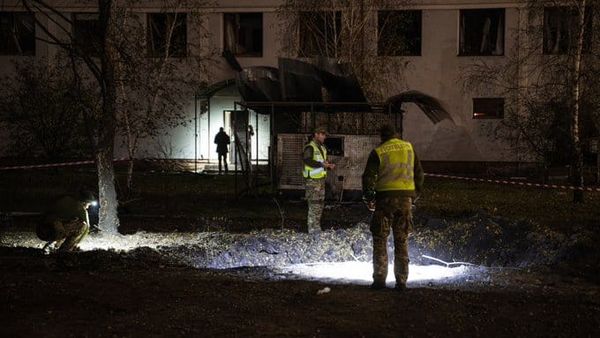
The first wave on 26 October came at about 22:00 and hit the campus of the State University of Trade and Economics, Kyoto Park and the area around Lisova metro station in the Desnianskyi district. An ambulance crew responding to a call came under fire and two medics were injured, Klitschko wrote.
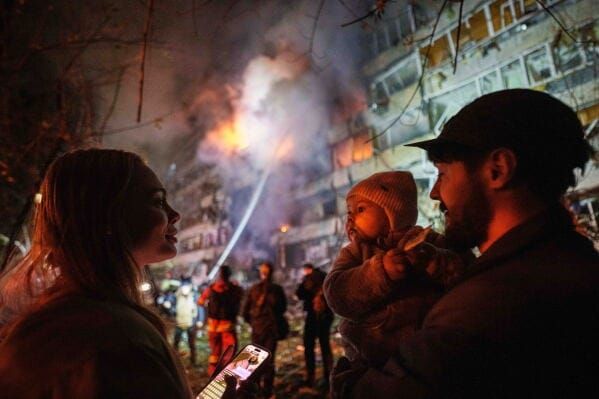
The strikes killed a 46-year-old woman and injured 15 people, according to the Kyiv City Prosecutor's Office and the State Emergency Service. A three-storey building in the Dniprovskyi district partly collapsed, and the blast blew out windows in an intensive care unit and damaged a burns centre.
Russia fired 16 ballistic missiles at Ukraine overnight and air defences brought down two, according to Zelenskyy and the Ukrainian Air Force. Zelenskyy wrote that no military facility stood near the sites hit in the Desnianskyi district.
Russia's Defence Ministry said it struck an enterprise in Kyiv that produced and stored long- and medium-range drones, along with transport infrastructure. Yurii Ihnat, spokesperson for the Ukrainian Air Force, said Russian forces fired several ballistic missiles at the bridge and that repairing its deck would take time.
The Russian response
Russia's mission to the UN said the Russian government does not recognise the commission's mandate and called its findings based on "falsified data", according to the Associated Press. The Russian government says its forces strike only military or military-related targets.
The commission also examined Ukrainian attacks on energy facilities in Russia and in Russian-occupied Ukraine, including a drone campaign against Crimea's power system from July to September 2026. It said it could not investigate their effects because the Russian government denied it access and left its requests unanswered, and it made no legal finding on them.
The law
Under the customary rules compiled by the International Committee of the Red Cross, an object is a military objective only if its nature, location, purpose or use makes an effective contribution to military action and its destruction offers a definite military advantage. Article 8(2)(b)(ii) of the Rome Statute, which the commission applied to the grid, makes it a war crime to intentionally direct attacks against civilian objects.
The General Staff plan Putin cited in 2022 and the orders behind his 1 September instruction would show who selected the grid targets. The Defence Ministry's target designations for the Pivdennyi Bridge strikes on 1, 2, 22 and 27 October would show what military use, if any, Russian commanders attributed to the bridge when they ordered the attacks.