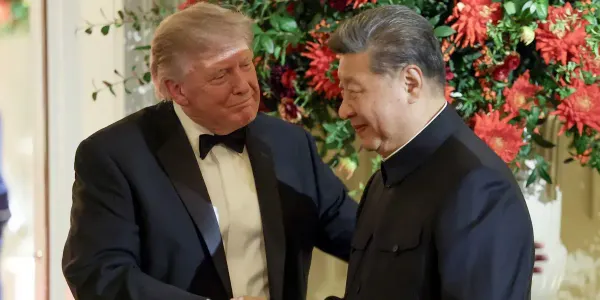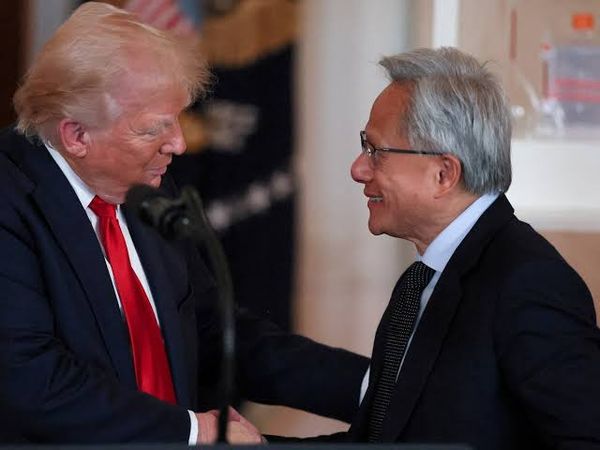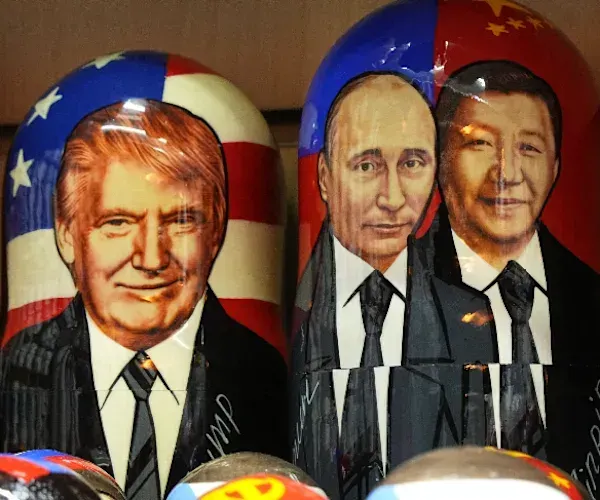
Donald Trump, Vladimir Putin and Xi Jinping meet in Shenzhen on 19 November with no Ukrainian present, after Putin's aide said a settlement of the war in Ukraine would be discussed there.
Yuri Ushakov, Putin's foreign policy aide, said on 12 November that the "whole complex of issues" around a settlement would be discussed when Putin and Trump met. The White House says Ukraine is not on the agenda of the three-way meeting, which it says will cover nuclear arms and the U.S. war with Iran. A senior U.S. official told reporters that China was "not really a part of that track". Trump said on 19 October that he would meet Putin and Xi "not so much for Ukraine, because Russia, frankly, has been fine on Ukraine".
In the parts of Ukraine Russia holds, occupation authorities have listed about 25,000 Mariupol homes for confiscation, auctioned a gold deposit and begun drafting Ukrainian men. A UN commission of inquiry, the UN human rights office, European security experts and Human Rights Watch have documented the deportation of Ukrainian children and the forcing of Russian citizenship on residents. They have also recorded the conversion of schools to a Russian military curriculum and the transfer of homes to municipalities and Russian settlers. Russian auction records and decrees signed by Putin show mines, farmland and a nuclear power plant passing to Russian companies and state bodies.
Point 21 of the 28-point U.S. peace draft of November 2025, which Trump's envoys wrote with Kirill Dmitriev, Putin's sanctioned economic envoy, would have recognised Crimea, Donetsk and Luhansk as de facto Russian, including by the U.S. Point 14 would have given the U.S. half the profits from a US$100 billion reconstruction fund built from frozen Russian money. The U.S. threatened in November 2025 to cut intelligence and weapons to Ukraine unless it accepted the draft, two people familiar with the matter told Reuters.
China, which hosts the meeting, buys Russian crude at more than 10 per cent below what it pays other suppliers. Its foreign minister told the EU in 2025 that China could not accept a Russian defeat.
Vladimir Medinsky, the Putin aide who led Russia's delegation at U.S.-brokered talks in Abu Dhabi on 10 and 11 November, said the two sides had moved closer to peace there. Dmitry Peskov, Putin's spokesman, rejected a U.S.-proposed truce on energy strikes in October. "Russia needs peace, not a ceasefire," he said. The Russian government says it evacuated Ukrainian children from the fighting for their safety.
A senior U.S. official said in November 2025 that the U.S. had not threatened to withhold intelligence. John Ratcliffe, the CIA director, had confirmed on 5 March 2025 that Trump paused intelligence sharing and weapons deliveries to Ukraine after an Oval Office confrontation with Zelenskyy. Mike Waltz, then the national security adviser, said the pause would last until a date for talks with Russia was set. In November 2025 Trump confirmed the Thanksgiving deadline himself, and a senior European diplomat confirmed both the deadline and the threat to cut support.
The White House says Trump and his team have done more than anyone to bring both sides together. The U.S. has suspended its own military and financial aid to Ukraine. Trump has agreed to the meeting in Shenzhen, where Putin's aide says the war will be discussed, without a Ukrainian present. Kaja Kallas, the EU's foreign policy chief, said on 13 November: "We have one aggressor and one victim, and the aggressor does not have security concerns."
Medinsky in Abu Dhabi
Putin set out his terms in a speech on 14 June 2024. Ukraine would withdraw from all of Donetsk, Luhansk, Zaporizhzhia and Kherson regions, including cities Russian troops have never entered, abandon its bid to join NATO and accept demilitarisation and "denazification". Sergei Lavrov, the foreign minister, said on 11 November that Russia still held to them. The Institute for the Study of War, a U.S. research group, reads the last demand as a call to replace Ukraine's government with a pro-Russian one.
Medinsky told reporters after the second day in Abu Dhabi that "every inch of our land will be returned to Russia". He ruled out any exchange of territory and said the security zone Russian forces have cut into Ukraine along the border since August 2024 would keep expanding. The institute said his remarks pointed to buffer zones in northern Sumy and Kharkiv regions, beyond the five regions Russia claims. Putin told Steve Witkoff, Trump's special envoy, and Jared Kushner, Trump's son-in-law, in the Kremlin on 12 November that Russia's state border was the only meaningful dividing line with Ukraine.
Lavrov said on 10 November that Europe's security order should be settled before the war. Russia's delegation in Abu Dhabi set out again the draft treaties Putin sent the U.S. government in December 2021, which demanded a NATO withdrawal from the states that joined after 1997.
Peskov said on 30 October that preparing for talks implied no commitment to limit military operations. Russia's delegation told the Ukrainians in Abu Dhabi that it had no mandate to discuss halting strikes on the power grid, Volodymyr Zelenskyy, Ukraine's president, said. Russian forces launched more than 2,300 attack drones, 1,590 glide bombs and 15 missiles at Ukraine in the week to 15 November, he said. On 2 November Russian aircraft dropped guided bombs on a school in Komyshuvakha, in Zaporizhzhia region, where humanitarian aid was being handed out, and killed 55 people, Ukraine's emergency service said.
Russia's draft budget for 2027 allocates 17.1 trillion roubles (about US$203 billion) to defence, roughly 35 per cent of federal spending and 27 per cent more than the government had planned for that year. Spending on education, health and social policy falls against earlier plans.
The heads of five European intelligence services, speaking anonymously, told Reuters in February that Russia was not seeking a peace agreement and had used its talks with the U.S. to pursue sanctions relief and business deals. Andrii Sybiha, Ukraine's foreign minister, wrote on 15 November that the only realistic subject of a deal with Putin was a fair ceasefire along the current front line. Russia had spent four years and eight months trying to take the village of Mala Tokmachka, he wrote.
Russian passports and draft notices at 16
Russia had issued 3.5 million Russian passports to residents of occupied eastern Ukraine by March 2025, according to government figures cited by Human Rights Watch. A decree Putin signed in April 2023 classed residents who refused Russian citizenship as foreigners liable to deportation. A second decree, signed on 20 March 2025, gave Ukrainians in Russia and the occupied regions until 10 September 2025 to obtain Russian papers or leave. Access to medical care, pensions, employment and property depends on a Russian passport, the UN human rights office found in its periodic reports.
More than 582,000 Ukrainian children studied in nearly 2,000 schools teaching the Russian curriculum in occupied areas in the 2025 to 2026 school year, according to Save Ukraine, a Ukrainian charity. Russia has replaced Ukrainian-language teaching and runs a compulsory course for grades eight to 11 that includes weapons handling and drone operation, an expert mission of the Organization for Security and Co-operation in Europe (OSCE) found on 9 July. The mission was set up under the OSCE's Moscow Mechanism at the request of 41 member states.
Boys in the occupied regions receive pre-conscription notices from the age of 16 and are conscripted at 18, the OSCE mission found. It concluded that the indoctrination and militarisation of children may amount to the crime against humanity of persecution.
Ukrainian men aged 18 to 30 who had Russian citizenship imposed on them are treated as eligible for conscription under Russian law, the UN human rights office said in March. Russia began conscripting all year round in 2026. Luka, an 18-year-old brought out of occupied territory in early November, had been made to attend a Russian-run school where pupils were openly recruited, Mykola Kuleba, the founder of Save Ukraine, said. Luka received a Russian draft notice on his 18th birthday despite serious health problems.
20,610 children
Ukraine's justice ministry had confirmed 20,610 children deported or forcibly transferred by September. The figure is the Ukrainian government's own count. The UN commission of inquiry verified 1,205 cases from five regions and told the Human Rights Council on 12 March that 80 per cent of those children had not been returned. Russian authorities placed them with families or institutions in 21 Russian regions and in occupied areas, gave them Russian citizenship, listed them on adoption databases and withheld their whereabouts from their parents. The commission found that the deportations and enforced disappearances were crimes against humanity carried out under a policy set at the highest level of the Russian state.
The International Criminal Court issued arrest warrants in March 2023 for Putin and Maria Lvova-Belova, his commissioner for children's rights, over the unlawful deportation and transfer of Ukrainian children. Researchers at the Yale School of Public Health's Humanitarian Research Lab identified 210 sites in Russia and occupied Ukraine to which Ukrainian children had been taken, and found military training at 39 of them. Zelenskyy said on 5 November that deported children who had since turned 18 were being put into the Russian army.
Ownerless homes in Mariupol
The Russian-installed administration in Mariupol adopted a regional law on "ownerless property" in March 2024, which let it declare flats ownerless without the owner's involvement. Putin signed a federal law in December 2025 extending the power across the occupied regions without a court ruling. It offers compensation only to Russian citizens. The deadline for owners to register their property under Russian law was brought forward from 1 January 2028 to 1 July 2026.
Between the summer of 2023 and April 2026 more than 45,000 Mariupol addresses appeared on the occupation administration's lists, which after duplicates were removed covered more than 24,000 properties, Novyny Donbasu, a Ukrainian outlet, found by comparing the published lists. By the end of May, 5,306 had been registered by decree and 4,336 entered in the register of ownerless property.
A Ukrainian citizen who wants to keep a home needs a permit from a commission set up by Denis Pushilin, the head of the Russian-installed administration in Donetsk region, which cannot be obtained from outside occupied territory. Pushilin urged residents in December 2025 to report neighbours who had not re-registered their homes. In one rebuilt block at 31 Kazantsev Street, 199 of 216 apartments were declared ownerless.
Russian-installed courts ruled that the absence of Russian registration alone justified seizure, even when owners were identifiable, had paid their utility bills or had tenants living in the flat, Human Rights Watch found after reviewing hundreds of judgments. Owners who try to return must pass "filtration" at Sheremetyevo airport in Moscow, and most are refused entry and banned for 20 to 50 years, the group found. "It's like they announce them ownerless while still admitting they have owners," a displaced Mariupol resident told the group.
Pushilin has signed orders allocating Mariupol land to construction companies without auction. Russians who move to the occupied regions are offered a one-off payment of 2 million roubles (about US$26,500) and subsidised mortgages, and doctors and teachers are given housing under federal programmes. The New Lines Institute, a U.S. research group, set out the incentives in a report published in May.
Tkachev's farms and the Bobrykivske auction
Agrocomplex, the farming company of Alexander Tkachev, a former Russian agriculture minister and governor of Krasnodar region, took over about 160,000 hectares in occupied Donetsk and Luhansk regions. The land belonged to HarvEast, Agroton and Nibulon, three Ukrainian companies, which described the seizures to The Wall Street Journal in December 2022. An official of the Russian-installed administration in Luhansk told the newspaper that no land had been expropriated. The EU, Britain and Australia sanctioned Tkachev in 2014 over Crimea. Ukraine's foreign intelligence service said in April 2025 that a Tkachev-linked farm company in Donetsk region had stopped operating, citing uncertain land titles.
The Russian-installed administration in Zaporizhzhia region set up a State Grain Operator in 2022, which took over seized storage sites and bought grain from farmers at prices it set. Russia took more than 2 million tonnes of grain from occupied territory in 2025 and sent nearly 40 per cent of it to Egypt, Sybiha said in January. Twelve vessels carrying wheat left occupied Mariupol between 1 January and 8 June 2026, according to Rosselkhoznadzor, Russia's agricultural regulator.
Occupation authorities sold the rights to the Bobrykivske gold deposit in Luhansk region for US$9.7 million to Alchevskpromgroup, a company controlled by the Russian mining group Polyanka, which had worked mainly in Russia's Far East. Auction documents reviewed by Reuters put the gold in the ground at about 1.64 tonnes, worth nearly US$260 million at the market price in March.
Andrej Karpinski, executive chairman of Korab Resources, the Australian company that held the site before 2014, said satellite images showed work had probably begun. Oleksii Kharchenko, head of Ukraine's military administration for Luhansk region, said the deposit's main reserves were exhausted in the 19th century. Dozens of other assets, including mines, quarries and farmland, have been put up for online auction.
Occupation authorities began leasing state coal mines in Donetsk and Luhansk regions to private Russian companies in 2024. Donskie Ugli Trade House received as many as 10 mines and four coal enrichment plants in Luhansk region. In August 2024, 90 per cent of the company was handed to Oleg Knyazev, a former deputy head of Astrakhan's regional government. Three Don Coal mines closed in March 2026, and about 1,200 miners lost their jobs with wages unpaid since December.
Russian forces took the village of Shevchenko in Donetsk region by the end of June 2025, and with it a lithium deposit that also holds caesium, tantalum and beryllium. Russia had already taken the Kruta Balka lithium deposit in Zaporizhzhia region, which left two of Ukraine's four known lithium fields under Russian control. Rostekhnadzor, Russia's nuclear regulator, has issued 10-year operating licences for two reactors at the Zaporizhzhia nuclear power plant, which supplied about a fifth of Ukraine's electricity before the invasion. Rosatom, the state nuclear company, plans to apply for three more by the end of 2026.
Witkoff, Ushakov and the Lukoil sale
Witkoff advised Ushakov in a telephone call on 14 October 2025 on how Putin should pitch a peace plan to Trump, according to a recording reviewed by Bloomberg. He told Ushakov that Putin should call Trump before Zelenskyy's White House visit that week and congratulate him on the Gaza ceasefire, and told Ushakov he had assured Trump that Russia had always wanted a peace deal. A deal would need "Donetsk and maybe a land swap somewhere", Witkoff said. Ushakov said his calls with Witkoff were confidential and should not have been leaked, and Trump called Witkoff's conduct a standard thing for a negotiator. Putin and Trump spoke on 16 October 2025, a day before Zelenskyy reached Washington.
The 28-point draft appeared five weeks later. Trump said Ukraine had until Thanksgiving, 27 November 2025, to accept it, and two people familiar with the matter told Reuters that the U.S. had threatened to cut intelligence sharing and weapons supplies if it refused. Zelenskyy told Ukrainians in a video address on 21 November that they faced a choice between the 28 points and the hardest winter of the war. After meeting Putin near St Petersburg on 21 October 2026, Witkoff called him a humanitarian.
Point 21 would also have frozen Kherson and Zaporizhzhia regions along the line of contact, and Ukraine would have withdrawn from the part of Donetsk region it still holds. Point 19 would have restarted the Zaporizhzhia plant under UN nuclear agency supervision with its electricity split equally between Russia and Ukraine.
The frozen Russian money left over after the reconstruction fund would have gone into a joint U.S.-Russian investment vehicle under point 14. The draft offered an amnesty for acts committed during the war. Point 24 provided for the return of detained civilians and children and for family reunification.
The Shevchenko lithium, the Mariupol homes, the Agrocomplex farmland, the Bobrykivske gold and the Don Coal mines all lie in Donetsk and Luhansk regions, which point 21 would have recognised as Russian. Kruta Balka and the nuclear plant lie behind the line the draft would have frozen. U.S. and Ukrainian negotiators revised the draft in Geneva on 23 November 2025, and Zelenskyy said afterwards that the provisions most damaging to Ukraine had been removed.
The U.S. and Ukraine signed a minerals agreement on 30 April 2025 that set up a jointly managed reconstruction investment fund, with the U.S. holding first claim on profits paid into it. Ukraine's economy ministry said the agreement covered mineral resources in occupied and unoccupied territory alike.
Putin had offered in February 2025 to work with U.S. companies on rare earth metals in Ukraine's occupied regions, which he called historic Russian lands that had returned to Russia. Witkoff said in late 2025 that he saw Russia, Ukraine and the U.S. becoming business partners, and spoke of Russia's vast land and resources. Dmitriev, who remains under U.S. Treasury sanctions, entered the White House on 5 November under waivers issued for the visit.
Putin asked Witkoff and Kushner at the Kremlin on 5 September to help broker the sale of the international assets of Lukoil, Russia's largest private oil company, which the U.S. sanctioned in October 2025, according to The New York Times. The group closest to buying them is led by Todd Boehly, a billionaire investor who has given US$2 million to Trump's political causes.
The group includes the Emirati companies International Holding Company and Al Hail Holding and the U.S. International Development Finance Corporation, and a fund controlled by Sheikh Tahnoon bin Zayed Al Nahyan, the Emirati national security adviser, would be a major investor. Tahnoon has financial ties to Kushner's private equity firm and to World Liberty Financial, the cryptocurrency company the Trump family founded with Witkoff. A spokesperson for Witkoff said he had no conflict of interest and no financial stake.
A bank acting for the Boehly group bought frozen Lukoil shares from about 10 U.S. and British funds at 30 cents on the dollar, people familiar with the sale told Reuters on 3 November. The group plans to swap the shares for the foreign assets. The Treasury licence that allows sale negotiations expires on 21 November.
The International Development Finance Corporation is a U.S. government agency, which makes the U.S. government itself a member of the group closest to buying Lukoil's foreign holdings. World Liberty Financial generated US$799 million for Trump in 2025, according to the Times.
Trump wants European governments to buy U.S. weapons for Ukraine at full price. Emmanuel Macron, the French president, said in Dublin on 12 November that European governments now carried Ukraine's support.
Trump blamed Ukrainian drone strikes on Russian oil refineries for the rise in U.S. fuel prices before the 3 November midterm elections, although Reuters reported in October that the rise mainly reflected the U.S. war with Iran. SpaceX, whose Starshield service Ukraine uses to guide interceptor drones, again cut off Ukrainian devices moving faster than 161 kilometres an hour while Witkoff and Kushner were in the Kremlin on 12 November, Zelenskyy said. Elon Musk, SpaceX's chief executive, said in October that restrictions on Starshield were set by the U.S. government.
Trump said in a television interview broadcast on 8 November that Ukraine would probably end up a different shape. Peskov said the next day that Ukraine was already a different country geographically.
Discounted crude and Chinese base stations
Wang Yi, China's foreign minister, told Kallas in July 2025 that China could not accept a Russian defeat in Ukraine. The U.S. would then turn its full attention to China, he said, according to people present at the meeting who spoke to the South China Morning Post. Wang denied that China gave Russia financial or military support.
China bought 21.8 million tonnes of Russian crude in January and February, about 41 per cent more than a year earlier and more than a fifth of its crude imports. Chinese customs data show China paying well over 10 per cent less for Russian crude than for oil from other suppliers, the Bank of Finland's institute for emerging economies wrote in August.
Trade between the two countries reached 1.63 trillion yuan (about US$234 billion) in 2025 and grew by more than 20 per cent in the first half of 2026. For gas through the proposed Power of Siberia 2 pipeline, China has offered about US$50 per 1,000 cubic metres, which an analysis by bne IntelliNews put at less than half the price the project needs to be viable.
At least 17 Chinese companies operate in the occupied regions, and almost 6,000 Chinese-made mobile phone base stations have been installed there, according to the Eastern Human Rights Group, a Ukrainian monitor. Yuan is sold in 79 banks across the occupied areas, the group found. It has opposed putting Ukraine on the Shenzhen agenda, people familiar with the preparations told Reuters, and pressed for a scripted meeting with a statement agreed in advance, people familiar with the talks told The Wall Street Journal. Its foreign ministry has said it is in contact with the other parties about the meeting.
Minab, the boat strikes and the ICC
Russia rejects the jurisdiction of the International Criminal Court. The U.S. Treasury added the court itself to its sanctions list on 9 October 2026, and Marco Rubio, the secretary of state, said in July that the administration would dismantle it. U.S. Tomahawk missiles struck a school in Minab, Iran, on 28 February and killed 156 people, 120 of them pupils, according to Minab's prosecutor. A UN fact-finding mission found on 17 September reasonable grounds to believe the U.S. had committed the war crime of an indiscriminate attack. Pete Hegseth, the defence secretary, said every military action cited in an impeachment resolution against him, including the Minab strike, was lawful.
Volker Türk, the UN high commissioner for human rights, said in October 2025 that U.S. strikes on boats it accuses of carrying drugs violate international human rights law and amount to extrajudicial killings. In their first year the strikes in the Caribbean and the eastern Pacific killed 223 people in 67 attacks, according to an Associated Press count. Anna Kelly, the White House deputy press secretary, said Trump had acted in line with the laws of armed conflict.
Hague and Geneva rules
Article 46 of the Hague Regulations of 1907 bars an occupying power from confiscating private property, and Article 55 makes it only the administrator of public property such as mines and forests, bound to safeguard its capital. Article 49 of the Fourth Geneva Convention prohibits forcible transfers and deportations from occupied territory, and Article 51 forbids compelling its residents to serve in the occupier's forces. Unlawful deportation and transfer is a grave breach of the convention and a war crime under the Rome Statute of the International Criminal Court, which Ukraine joined on 1 January 2025.
Putin signed the 2023 and 2025 citizenship decrees and the December 2025 property law and faces an ICC warrant over the children. Lvova-Belova faces a warrant on the same charges. Pushilin set up the commission that decides whether Ukrainians may keep their homes in Donetsk region. Evgeny Solntsev, the Russian-installed prime minister of the region, told the St Petersburg International Economic Forum in 2025 that the administration had identified 20,000 to 30,000 ownerless apartments and houses in Mariupol.
The Miami G20 and the Lukoil licence
Ushakov said in October that whether Putin attends the G20 summit Trump hosts in Miami in December depends on what happens in Shenzhen. The Treasury licence for the Lukoil negotiations runs out two days after the meeting, and EU leaders meet on 26 and 27 November, when the European Commission is due to present a 22nd package of sanctions on Russia.
Mariupol owners who left the city had until 1 July to register their homes under Russian law, through a commission they cannot reach from outside occupied territory. Under point 21 of the U.S. draft, the city would lie in territory the U.S. recognised as Russian. Russia's negotiators put its December 2021 draft treaty back on the table in Abu Dhabi. It would bar the states that were NATO members on 27 May 1997 from stationing forces anywhere else in Europe beyond those deployed there on that date. Of NATO's 32 members, 16 joined after 1997.