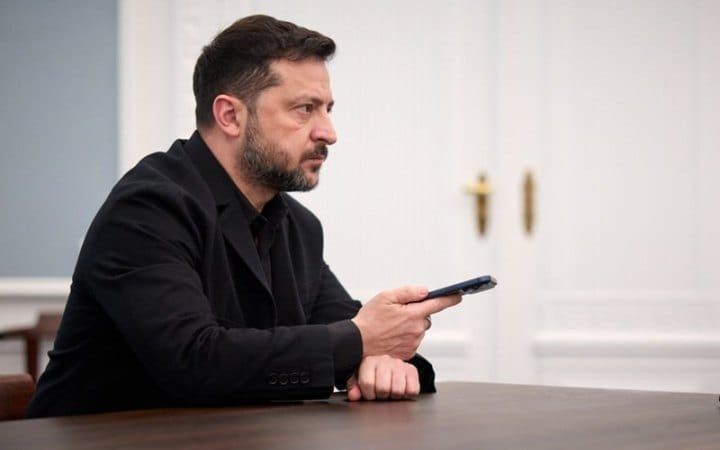
President Volodymyr Zelenskyy said on 13 November that US negotiators had asked whether Ukraine would withdraw from the territory it still controls in Donbas in exchange for NATO membership.
"I have said repeatedly: Ukraine will not retreat and will not surrender its territory to terrorists," Zelenskyy told reporters in remarks his office released on 14 November. "The Americans asked: 'If Ukraine joins NATO, will Ukraine withdraw from Donbas?' This was the first time."
The Ukrainian-held part of Donetsk region includes Kramatorsk and Sloviansk, cities Russia's army has failed to capture since the full-scale invasion began in February 2022. Russia demands all of Donetsk and Luhansk regions as a condition of ending the war. Zelenskyy said any arrangement would involve no recognition of occupied Ukrainian territory as Russian.
Marco Rubio, the U.S. secretary of state, told European counterparts privately at a G20 foreign ministers' meeting in Atlanta that NATO membership for Ukraine was unrealistic in the near term and unacceptable to Putin, three European officials told Radio Free Europe/Radio Liberty. Pete Hegseth, who heads the Pentagon, told allies in Brussels in February 2025 that the U.S. did not consider membership a realistic outcome of a negotiated settlement. Any guarantee should be backed by European and other non-U.S. troops, he said, and Europe should provide the overwhelming share of future aid to Ukraine. The 28-point U.S. peace draft of November 2025 would have written a ban on membership into Ukraine's constitution. Russia demands that Ukraine stay out of the alliance permanently.
The White House, the State Department and NATO did not immediately respond to requests for comment from news organisations on 14 November. Admission requires the consent of all 32 NATO members. Zelenskyy said the exchange remained under discussion and that no concrete proposal existed. "We need specifics, which do not yet exist," he said. "That is why I believe NATO is back on the agenda. But you have also heard Putin's signals, and this is an extremely difficult conversation," he said.
Zelenskyy's conditions
Ukraine is negotiating with its partners for written security guarantees from NATO and the EU and for an army with an agreed number of troops, weapons and financing for a fixed period, Zelenskyy said. It also wants a reconstruction programme, which he called the Prosperity Plan, backed by money from identified sources.
Zelenskyy said he would not decide on a membership offer alone. "If there is such a proposal, I, as president, will enter into an open dialogue with society," he said. He would tell Ukrainians where the partners stood and how they proposed to proceed, he said. Ukraine would not write neutrality into its constitution.
Zelenskyy has demanded since December 2025 that any U.S. guarantee be ratified by Congress. Ukraine gave up the nuclear weapons it inherited from the Soviet Union under the 1994 Budapest Memorandum in exchange for security assurances from Russia, Britain and the U.S. Russia annexed Crimea 20 years later. "No one wants a repeat of the Budapest Memorandum," Zelenskyy's office said after he met U.S. senators in Munich on 14 February.
On 22 October, at a press conference with Petteri Orpo, the Finnish prime minister, Zelenskyy said Ukraine wanted three forms of protection: NATO membership, bilateral U.S. guarantees modelled on Article 5 and a European-led coalition backed by the U.S. "We are discussing not the Budapest Memorandum, not a piece of paper," he said of the U.S. guarantees.
What the U.S. has committed to
U.S. negotiators are offering guarantees that resemble NATO's Articles 4 and 5, which provide for consultation and collective defence, Zelenskyy said. They described the guarantees as bilateral and compared them to U.S. arrangements with Israel and some Middle Eastern states, where U.S. bases are protected by air defences. "If you provide us with this 'something similar' to NATO, will there be American soldiers on our soil?" he said he asked. "Their answer to that is: 'No.'"
Zelenskyy said on 25 January that a U.S. guarantees document was ready to be signed. It was still unsigned on 10 February, when Matthew Whitaker, the U.S. ambassador to NATO, linked the delay to unresolved territorial questions, the Ukrainian outlet Razom reported. Zelenskyy said that month that the U.S. government was pressing Ukraine to cede territory before any guarantee was given. "They don't trust anybody because we had Budapest Memorandum," he said of Ukrainians asked to make concessions.
Rubio said on 9 November that any guarantee for Ukraine "has to be something Russia agrees to as well". On 10 November the U.S. joined the EU, Britain, France, Germany, Italy, NATO and Ukraine in a statement that any agreement must respect Ukraine's sovereignty and territorial integrity.
NATO's leaders said at their Bucharest summit in 2008 that Ukraine would become a member, and in their Washington declaration of July 2024 that it was on an irreversible path to full membership. The declaration agreed at The Hague in June 2025, the first summit of Donald Trump's second term, contained no language on Ukrainian membership, and no meeting of the NATO-Ukraine Council was held. Mark Rutte, NATO's secretary general, said afterwards that the commitment made in Washington still stood.
U.S. officials have denied tying guarantees to a withdrawal from Donbas. Anna Kelly, the deputy White House press secretary, said in January that reports making guarantees conditional on leaving Donbas were false. In March, after Zelenskyy said U.S. guarantees depended on a withdrawal, Rubio called the claim a lie.
Donbas in U.S. proposals
Zelenskyy said the membership question followed an earlier U.S. proposal to trade Donbas for security. When he asked whether that meant NATO, U.S. negotiators told him it meant something similar to NATO but not membership, he told the Danish broadcaster DR in an interview reported on 10 November. "Nobody believes that Putin will stop if we leave Donbas. He will pause. And then he will come back in a year, two or five years," he said, according to a Ukrainian translation of the interview.
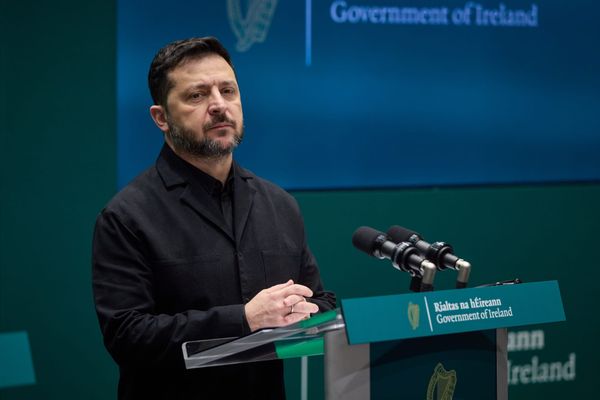
In Dublin on 11 November, Zelenskyy said U.S. negotiators believed Ukraine had to leave Donbas for the war to end. Rubio said on 22 October that the war was about Donbas, a single region of Ukraine, and in early October that Russia's demand for full control of Donbas was blocking any negotiated end to it.
Steve Witkoff, the U.S. special envoy, and Jared Kushner, Trump's son-in-law, wrote the first version of the 28-point draft with Kirill Dmitriev, Putin's investment envoy, in Miami from 24 to 26 October 2025, Axios reported, citing a U.S. official and Dmitriev. The draft would have required Ukraine to withdraw from the part of Donetsk region it controlled and cap its army at 600,000 troops. Crimea, Luhansk and Donetsk would have been recognised as de facto Russian, including by the U.S.
Putin's terms
Putin told Witkoff and Kushner at the Kremlin on 12 November that Russia could accept "only one dividing line", the state border, according to a transcript of his opening remarks. Russia wrote the four Ukrainian regions it claimed to annex into its constitution in October 2022. Foreign troops on Ukrainian soil would be a legitimate target and the war would immediately resume, Putin said.
Putin also proposed a humanitarian mission in Kostiantynivka, a Donetsk region city that Ukrainian forces still hold and that he said in July Russia had captured. Yuri Ushakov, Putin's foreign policy aide, said the two U.S. envoys supported the proposal and that territorial questions remained the hardest to resolve.
Russian negotiators at the U.S.-brokered talks in Abu Dhabi on 10 and 11 November demanded that NATO withdraw its forces from the countries that joined after 1997, RBC-Ukraine reported, citing participants. The demand covers Poland, the three Baltic states and Finland, all of which border Russia. Alexey Drobinin, a senior Russian diplomat, said on 11 November that Russia could sign non-aggression pacts with individual NATO members. Vladimir Medinsky, the Putin aide who led Russia's delegation, said a new European security structure had been a central subject of the talks. Rubio told the European officials in Atlanta that Russian control of all of Donbas would not satisfy Russia's territorial ambitions.