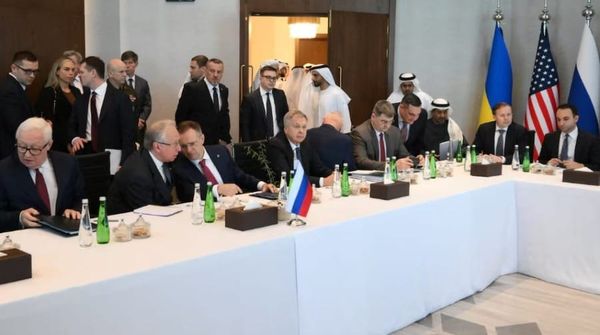
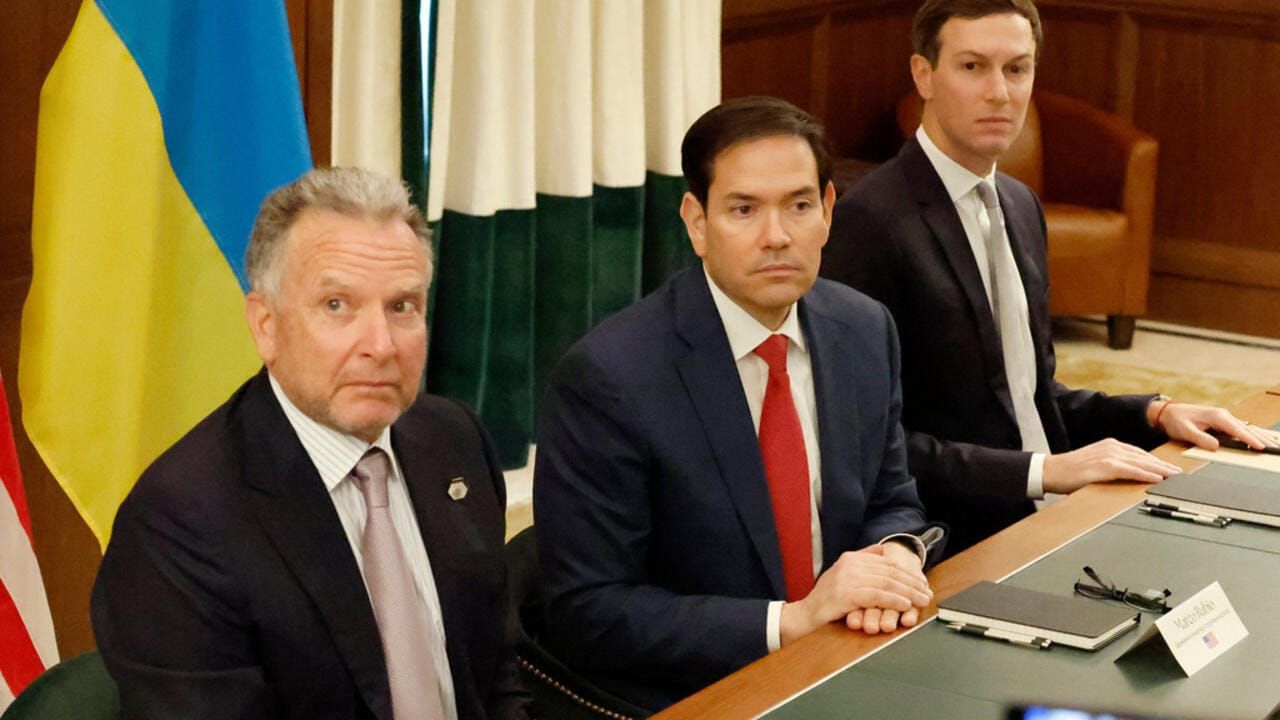
Marco Rubio, the U.S. secretary of state, said on 9 November that any security guarantee for Ukraine must be acceptable to Russia, which invaded in 2022 and occupies about a fifth of the country.
"It has to be something Russia agrees to as well," Rubio said a day before U.S. envoys sat down with Russian and Ukrainian negotiators in Abu Dhabi. Ukraine wants the guarantees to deter a further Russian invasion, and Rubio's condition gives Russia a say in their terms. Sergei Lavrov, the Russian foreign minister, said in August 2025 that the Russian government would not agree to collective guarantees for Ukraine drawn up without it and wanted China included in any arrangement.
The Abu Dhabi talks ended on 11 November with a prisoner exchange agreed and no ceasefire. Steve Witkoff and Jared Kushner, the U.S. envoys, fly to Moscow on 12 November to meet President Vladimir Putin and will then brief President Volodymyr Zelensky in Dublin. Russia's terms for ending the war are a Ukrainian withdrawal from parts of four regions its forces have never fully captured, a permanent end to Ukraine's NATO bid and limits on Ukraine's armed forces. A U.S. draft of November 2025 asked Ukraine to give up the rest of Donetsk region and shrink its army. U.S. officials have since offered Russia sanctions relief in stages and a return to the NATO-Russia Council.
Published drafts, a leaked call transcript and officials' statements show U.S. envoys working out peace terms with a Russian envoy and advising a senior Putin aide on how to approach President Donald Trump. They also show U.S. negotiators pressing Ukraine to hand over territory. No document or official account published so far shows an undisclosed agreement between the two governments on Ukraine's future. Kushner wrote on 10 November that the U.S. was working for a sovereign and secure Ukraine. Witkoff and the European governments that met U.S. and Ukrainian negotiators in Abu Dhabi said in a joint statement on 10 November that any arrangement must respect Ukraine's sovereignty, territorial integrity and independent decision-making. Trump described Witkoff's dealings with the Russian side in October 2025 as standard negotiation.
Rubio's condition
U.S. negotiators asked the Russian government to accept guarantees for Ukraine modelled on Articles 4 and 5 of the North Atlantic Treaty, a U.S. official told reporters on a background call on 9 November. Article 4 provides for consultations when a member is threatened. Article 5 treats an attack on one member as an attack on all. The official said the guarantees would be close to NATO membership and that any U.S. commitment was for Trump and Zelensky to decide. Russia has not said publicly whether it would accept them.
Under the 1994 Budapest Memorandum Ukraine gave up the nuclear arsenal it inherited from the Soviet Union in return for promises from the U.S., Britain and Russia to respect its borders. Russia annexed Crimea 20 years later. Zelensky said on 23 October that any U.S. guarantee would need approval from Congress to avoid a repeat.
John Herbst, a former U.S. ambassador to Ukraine now at the Atlantic Council, called devising guarantees that satisfy both sides "an impossible task". The Russian government does not want serious guarantees for Ukraine and Ukraine needs them to survive, he said.
The 28-point U.S. draft of November 2025 attached conditions to the guarantees. The U.S. would receive compensation for providing them, and Ukraine would lose them if it attacked Russia. A U.S. official confirmed the draft was genuine. Army Secretary Dan Driscoll delivered it to Zelensky in Kyiv on 20 November 2025.
The land Russian forces have not taken
U.S. negotiators asked Ukraine whether it would give up Donbas in exchange for security guarantees, Zelensky told Danish television in an interview published on 10 November. He was told the guarantees would resemble NATO membership without being NATO. The U.S. side wanted a clear answer on Donbas, he said, which was also Putin's goal. "Nobody trusts Putin to stop if we leave Donbas," he said.
The U.S. draft of November 2025 required Ukrainian forces to withdraw from the part of Donetsk region they controlled. The area would become a demilitarised buffer zone recognised as Russian territory, and Crimea, Luhansk and Donetsk would be recognised as de facto Russian, including by the U.S. Front lines in Zaporizhzhia and Kherson regions would be frozen. In December 2025 U.S. negotiators told Ukraine it must withdraw from Donetsk region under any deal, an official familiar with the talks said.
Ukrainian forces hold Sloviansk, Kramatorsk, Druzhkivka and positions in Kostiantynivka, the fortified belt that has stopped Russian forces in northern Donetsk region since 2014. About 78,300 civilians remained in the Kramatorsk and Sloviansk communities in August, according to the Donetsk regional military administration. Russian forces lost more ground than they took across Ukraine in October, a net loss of 27.29 square kilometres, the Institute for the Study of War, a Washington research group, reported. They mounted 0.4 attacks a day towards Kramatorsk that month. Russian forces have not captured Sloviansk or Kramatorsk at any point since the full-scale invasion began in February 2022.
Trump said in a television interview broadcast on 8 November that Ukraine would "end up with a little bit different shape". Dmitry Peskov, the Russian presidential spokesman, said the next day: "From a geographical point of view, it is already a different country." In September 2025 Trump had written that Ukraine could win back all its land with European support.
U.S. officials said before the Abu Dhabi round that territorial and security arrangements would be negotiated together and finalised together, and that both governments had privately shown a little flexibility on territory. Zelensky proposed in January a free economic zone in the Ukrainian-held part of Donetsk region, under Ukrainian control. He wants a ceasefire on the current front line first. Lavrov said on 10 November that Russia would not agree to an immediate ceasefire without knowing what would follow.
Russia's list
Russian negotiators in Abu Dhabi set out the proposals Putin sent to Joe Biden, then U.S. president, in December 2021, sources in the talks said. Those draft treaties sought an end to NATO enlargement, a smaller allied military presence in the states that joined NATO after 1997 and limits on military cooperation with former Soviet states outside the alliance, Ukraine among them. The Russian side blamed the war on the Biden administration's refusal to accept them. U.S. negotiators used the first day to ask why the Russian government believed it needed further security guarantees, according to accounts of the session.
Yury Ushakov, Putin's foreign policy aide, has called for NATO to return to its positions before 1997, when it began admitting former Warsaw Pact states. A source in the Russian delegation said that the aim in Abu Dhabi was a new security system for the continent, with the Ukraine settlement one part of it.
The November 2025 draft capped Ukraine's armed forces at 600,000 personnel, against 800,000 to 850,000 at the time, according to a Ukrainian official. Ukraine would write into its constitution that it would never join NATO, NATO would bar it in its own rules and no NATO troops would be stationed in Ukraine. Presidential elections would be held within 100 days. The draft also provided an amnesty for acts committed during the war.
Kushner set out the current U.S. aims on 5 November. He proposed permanent security consultations, a crisis communications channel, greater military transparency and reciprocal measures to reduce the risk of escalation between Russia and Europe. He wrote that each country would keep authority over its own alliances, that no country would have a veto over another's choices and that NATO would remain central to Europe's defence. His post did not mention Russia's invasion of Ukraine. The Russian government regards NATO forces in eastern Europe as an escalation in themselves. U.S. officials briefing reporters on 10 November said sanctions on Russia could be lifted in phases and floated reviving the NATO-Russia Council, suspended since 2022.
An unconfirmed outline of a U.S. plan published on 22 October offered Russia business with U.S. companies alongside sanctions relief, and Ukraine the prospect of EU membership in exchange for abandoning its NATO bid. Putin and Witkoff discussed large joint economic projects at their meeting near St Petersburg on 21 October, Ushakov said.
Drafting with Dmitriev
Witkoff and Kushner drafted the first version of the 28-point plan with Kirill Dmitriev, Putin's special envoy for economic cooperation, a U.S. official said. They met him over three days in Miami from 24 to 26 October 2025. Dmitriev said "we feel the Russian position is really being heard." Rustem Umerov, then secretary of Ukraine's National Security and Defence Council and now head of its delegation, was briefed on the plan in Miami weeks later. European governments were not involved in drafting it.
Witkoff spoke to Ushakov by telephone on 14 October 2025. In a transcript of the call published by Bloomberg, which said it had reviewed a recording, Witkoff proposed that Putin call Trump, congratulate him on the Gaza ceasefire and offer a similar peace plan for Ukraine. He wanted the call to take place before Zelensky's visit to the White House that week. He told Ushakov he believed Russia "has always wanted a peace deal". Putin called Trump on 16 October 2025. Trump met Zelensky on 17 October and said afterwards that the two armies should stop where they were.
Ushakov did not dispute the recording's authenticity and said it had not been leaked by the Russian side. The White House did not dispute the transcript. Trump said Witkoff had to sell a deal to both sides. Don Bacon, a Republican congressman from Nebraska, said the transcript showed Witkoff favoured the Russians. "He should be fired," Bacon wrote. In a separate recorded call, Ushakov argued to Dmitriev that Russia should ask for the maximum in its submissions to the White House.
Dmitriev visited the White House on 5 November. He remains under U.S. Treasury sanctions, and a U.S. official said waivers had been issued for the visit. Afterwards Trump told reporters that a big agreement could be close and would cover all of Europe and more than Ukraine. Witkoff called Putin a humanitarian after their ninth meeting on 21 October, at which Russia released Stephen Hubbard, a retired U.S. teacher.
U.S. aid and the oil waiver
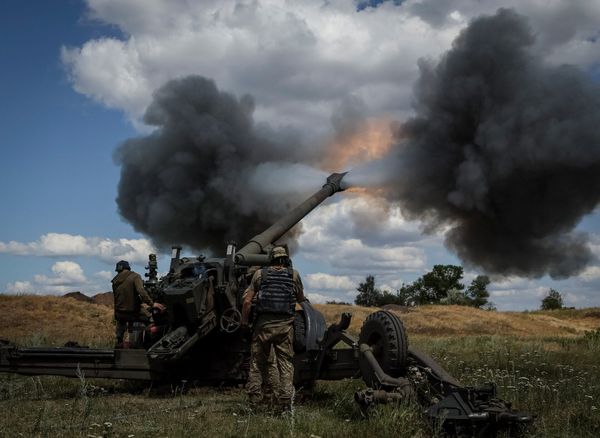
The U.S. has suspended its own military and financial aid to Ukraine. Trump wants European governments to buy U.S. weapons for it at full price. Russian forces fired 36 ballistic missiles at Ukraine on 6 November and Ukrainian air defences intercepted four, Zelensky said, citing a shortage of interceptors for U.S.-made Patriot systems.
In October Trump granted a waiver allowing Russian oil and diesel to reach world markets, after an agreement with Putin on diesel supplies on 9 October. He has pressed Zelensky to stop drone strikes on Russian oil refineries, which the Ukrainian government says have put more than half of Russia's refining capacity out of action.
European governments outside the talks
Witkoff announced the Abu Dhabi round on 2 November with three delegations, the U.S., Russian and Ukrainian. National security advisers from Britain, France, Germany and Italy and officials from NATO, the European Commission and the European Council met the U.S. and Ukrainian teams before and after the sessions. None sat with the Russian delegation, which had no contact with European representatives, Peskov said. Maria Zakharova, the Russian foreign ministry spokeswoman, wrote on 7 November that Europeans had nothing to do at the table. Lavrov said European leaders were trying to buy time for Ukraine and should stay at their hotel.
Lifting EU sanctions on Russia and admitting Ukraine to the EU both require the agreement of all 27 member states. Kaja Kallas, the EU's high representative for foreign affairs, said on 6 November that any agreement the EU was not party to "we are not going to implement either". Giorgia Meloni, the Italian prime minister, wrote to António Costa, president of the European Council, on 5 November that without a single EU representative "we risk condemning Europe to irrelevance". Radosław Sikorski, the Polish foreign minister, said Poland did not want Western European governments dealing with Russia over the heads of Eastern Europeans.
U.S. officials have said Europe must be at the table to end the war, and Kushner wrote on 9 November that a lasting settlement would require direct engagement between Russia and the European governments. No European government has sat with the Russian delegation in any of the four U.S.-brokered rounds.
Strikes while the delegations met
Russia launched 162 drones and an Iskander-M ballistic missile at Ukraine overnight into 10 November, the day the talks opened, Ukraine's air force said. Overnight into 11 November it launched 163 drones and cruise and air-launched missiles. Serhiy Koretskyi, the Ukrainian prime minister, said six large power substations were hit in Vinnytsia, Kirovohrad, Zhytomyr and Cherkasy regions. Russian attacks killed nine people and injured at least 39 across Ukraine in the 24 hours to the morning of 10 November, regional administrations said. Drones killed two municipal refuse workers in Kramatorsk on 9 and 10 November.
Russian strikes hit the Trypillia thermal power plant south of Kyiv on 9 November, and a glide bomb struck an aid distribution centre near the front in Zaporizhzhia region the previous week, killing at least 55 people. UN monitors verified 2,570 civilians killed in Ukraine from January to September, 59 per cent more than in the same period of 2025. Ukrainian drones set fire to the Baltic port of Ust-Luga overnight into 11 November, injuring three workers, and killed two people in Smolensk region, Russian regional governors said.
Moscow before Dublin
Kushner said after the second session that the two sides had agreed "the biggest humanitarian release of prisoners" and that the number of prisoners would be agreed on 12 November. Putin and Zelensky had little trust or goodwill between them, he said, and the Russian government wanted more progress before the two men met. He and Witkoff would report to Putin first and then brief Zelensky in Dublin.
After U.S. and Ukrainian negotiators revised the 28-point plan in Geneva on 23 November 2025, Witkoff and Kushner took it to Putin in Moscow on 2 December. Ushakov said afterwards that the envoys had promised to return to Washington and had not promised to go to Kyiv. Witkoff and Kushner met Zelensky and European leaders in Oslo on 20 October, the day before Witkoff saw Putin.
EU leaders meet in Dublin on 13 November, with the question of who speaks for the bloc in the negotiations on the agenda. Zelensky said Europe had to settle its role by the end of November and that he hoped for a decision at a meeting of the coalition of the willing in Germany on 19 November.