A United States document sent to NATO members asks whether each has publicly supported US foreign policy and what restrictions it places on US military use of its bases.
Copies went first to allied representatives in the United States and then to NATO headquarters in Brussels, according to Bloomberg, which said it had seen the text. Answers feed a review of the US military presence in Europe that is due to finish by December and that US officials have said will cut both troop numbers and the assets earmarked for the alliance in a crisis.
Each country is asked what "restrictions" it has placed on US forces using its bases, whether it spends money with US arms firms and whether it has "publicly opposed regulations" that "inhibit" contracts with those firms. One question asks whether the country "has shown alignment with the US approach to 'strong, clear, and quiet'".
Allies have treated the document as an attempt to force ideological alignment in exchange for US protection. Reaction among members was extremely negative.
What the treaty says
Article 5 of the North Atlantic Treaty binds each party, when an ally is attacked, to take "such action as it deems necessary, including the use of armed force", to restore and maintain security in the North Atlantic area. Article 3 obliges members to maintain and develop, separately and jointly, their individual and collective capacity to resist armed attack. Article 4 provides for consultation whenever a member judges its territorial integrity, political independence or security to be threatened.
Neither Article 3 nor Article 5 mentions public support for another member's foreign policy, base access for another member's out-of-area campaigns or procurement from another member's arms firms. The treaty was signed in Washington on 4 April 1949 by 12 states, and the accession protocols agreed since then have brought in 20 more without adding conditions of that kind.
Article 1 binds every member to settle international disputes by peaceful means and to refrain in its international relations from the threat or use of force in any manner inconsistent with the purposes of the United Nations.
Poland invoked Article 4 in September 2025, after Russian drones crossed its airspace during an attack on Ukraine and Polish forces shot several of them down. No ally invoked it before the US campaigns against Iran and Venezuela this year, and the US did not seek alliance consultation on either.
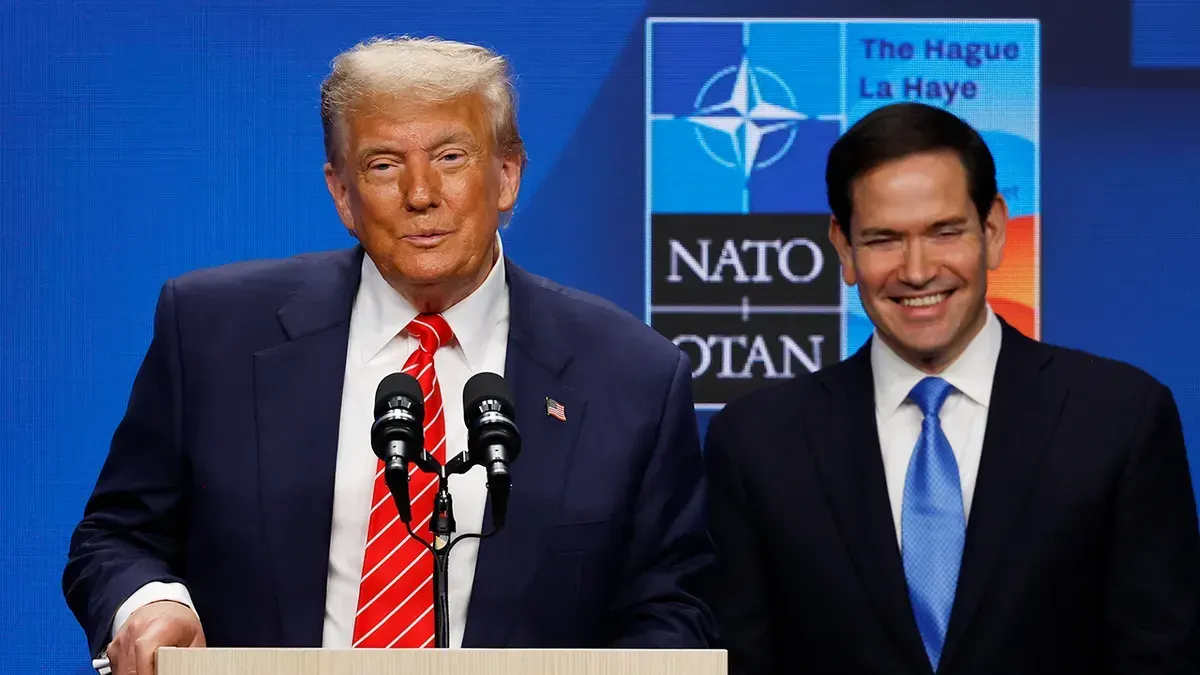
Leaders of all 32 members, Trump among them, signed the Ankara summit declaration on 8 July at the Beştepe Presidential Complex, five weeks before the document began circulating. Its opening line reaffirmed an "ironclad commitment to our collective defence under Article 5" and to the transatlantic bond. The same text named Russia a long-term threat to Euro-Atlantic security and stability and committed €70 billion in further support to Ukraine, with at least equivalent sums pledged for 2027.
The phrase
Pete Hegseth used the words the document quotes at the Shangri-La Dialogue in Singapore on 30 May, in a speech about the Pacific rather than Europe. "Our focus is strong, quiet, and clear. Strong, quiet, clear," he said, before describing clarity about US intentions, priorities and ability to deliver on the administration's goals as a model Asian partners prefer and have long followed.
The transcript published by the Department of War gives the order as "strong, quiet, and clear", not the "strong, clear, and quiet" that the document puts to allies. Hegseth repeated the three words several times in the address, using them as shorthand for how the administration handles alliances in Asia.
Asian partners do not want constant escalation or rhetorical theatrics, Hegseth said in the same passage, which promised leadership "confident enough to speak and walk softly while carrying a big stick".
The review
Hegseth announced the review at NATO headquarters in Brussels on 18 June. "Make no mistake about it, this will be a real review," he said. "America cannot care for or pay more for Europe's defense than our allies." It would take up to six months and could take less, he said.
Allies that withheld overflight rights and base access during the Iran campaign drew a direct attack in the same speech. "It's shameful," Hegseth said. "These allies, they put America's sons and daughters, our sons and daughters, at risk by denying them the predictable access facing overflight that never should have been in question at all." NATO 2.0, an era of freeriding, had ended, he said.
Elbridge Colby, the under secretary of war for policy, wrote on 29 July that the review had formally begun and that it aims to push NATO fast and irreversibly toward Europe taking primary responsibility for its conventional defence. He said the assessment would rest on strategic rigour, a strong empirical baseline and a clear sense of the geopolitical and military realities.
General Alexus Grynkewich, who commands US European Command and serves as Supreme Allied Commander Europe, leads the assessment. Base access and overflight rights during US operations are among the criteria, alongside which countries align with US priorities. US officials have described the goal as restoring NATO's character as a warfighting organisation, a project they call NATO 3.0, and have named 2027 as a possible date for simultaneous conflict with China and Russia.
What has already gone
About 80,000 US troops are stationed in Europe, according to US European Command figures published on 1 May. The number passed 100,000 after the full-scale Russian invasion of Ukraine in 2022. Germany hosts roughly 36,000 of the current total.
Rotational US brigade presence in Romania ended in October 2025, the first of the reductions taken under the same review process. The Romanian defence ministry disclosed the decision on 29 October 2025.
The US said on 1 May it would pull about 5,000 troops out of Germany over six to 12 months, about 14 per cent of its force there, and redeploy others without replacement. Allison Hart, a NATO spokesperson, said at the time that the alliance was working with the US to understand the details of the decision.
Trump announced on 22 May that he would send 5,000 troops to Poland, reversing the cancelled deployment of the 2nd Armoured Brigade Combat Team, 1st Cavalry Division, roughly 4,000 soldiers whose move had been called off a week earlier. Bloomberg reported the pledge on 21 May. He wrote on Truth Social that the decision followed Poland's "successful election" of President Karol Nawrocki, whom he "was proud to endorse". Nawrocki had been elected almost a year earlier and inaugurated the previous August.
Sean Parnell, chief press secretary at the Department of War, called the earlier cancellation a "temporary delay" tied to cutting brigade combat teams in Europe from four to three, and said Poland had shown "both the ability and resolve to defend itself".
Fighter aircraft committed to the alliance fall from about 150 F-16s and F-15Es to about 100, and maritime surveillance aircraft from 26 to 15, according to a New York Times report that European officials confirmed on 12 June. Eight aerial refuelling aircraft are being withdrawn entirely. One of two bomber task force groups, one missile-capable submarine, an aircraft carrier and several warships are moving to other regions. European air forces operate no strategic bombers of their own. Nations should focus on capabilities they can acquire, field, scale and sustain quickly, Grynkewich said as the cuts were confirmed.
Allison Hart, a NATO spokesperson, said the change strengthened the alliance's defence plans by reducing over-dependence on one ally and reflected a broader shift already under way among members.
The statutory floor
Congress set a floor under the US presence in Europe in the National Defense Authorization Act for fiscal year 2026, which the Senate passed on 17 December 2025. The law bars US troop numbers on the continent falling below 76,000 unless the Department of War first certifies to Congress that any reduction was made in consultation with NATO allies, and supplies independent assessments of the effect on US national security, alliance readiness and deterrence of Russia.
About 4,000 troops separate the current figure of 80,000 from that floor.
The same law bars the US relinquishing the post of Supreme Allied Commander Europe without an equivalent certification, and bars the use of funds to remove major defence equipment from the continent. Section 1268 sets a separate floor of 28,500 personnel for US Forces Korea, a provision the administration opposed as a limit on the president's authority as commander in chief.
Roger Wicker and Mike Rogers, who chair the Senate and House armed services committees, issued a joint statement on 29 October 2025 opposing the Romania reduction. "We strongly oppose the decision not to maintain the rotational U.S. brigade in Romania and the Pentagon's process for its ongoing force posture review that may result in further drawdowns of U.S. forces from Eastern Europe," they said.
Romania has spent more than 2 per cent of GDP on its military for many years and has pledged to reach 5 per cent, the two chairmen said. They asked the department to explain the effect on NATO deterrence and to confirm that the two armoured brigades in Poland would remain in place. On 19 March they had set out what Congress expected in the way of interagency coordination before any major change to force structure.
The 2026 act authorised $400 million for the Ukraine Security Assistance Initiative, against roughly $14 billion Congress approved in 2024, and $175 million for the Baltic Security Initiative, which supports Estonian, Latvian and Lithuanian purchases of US defence systems.
Bases, Iran and Venezuela
The question on public support names initiatives in the Middle East and the Western Hemisphere, the two theatres where US forces have acted this year without alliance consultation.
US and Israeli forces launched the campaign against Iran on 28 February. Spain refused in early March to let the US use bases on Spanish soil for strikes. Trump threatened on 3 March to cut off all trade with Spain over its position, and the European Commission said it was ready to defend EU interests in response. Spain closed its airspace on 30 March to US aircraft involved in the war. US aircraft left Spanish bases.
Trump told Rutte at a meeting in Washington on 8 April that he was seriously considering withdrawal from NATO and called the alliance a paper tiger. "Ukraine wasn't our problem, yet we were there for them, but they weren't there for us," he said. Keir Starmer, whose naval capabilities Trump attacked in the same remarks, called NATO the most effective military alliance. Article 13 of the treaty lets a member leave one year after giving notice to the US government, which holds the treaty as depositary. No member has done so.
The document asks whether countries have imposed such bans and whether they are "willing to reduce or eliminate any such restrictions".
US forces captured Nicolás Maduro in Venezuela on 3 and 4 January. Marc Weller, who directs the international law programme at Chatham House, wrote on 4 January that the capture and the attacks that accompanied it had no justification in international law. There is "no UN Security Council mandate that might authorize force", he wrote, and only a kinetic assault with military or similar means qualifies as a trigger for self-defence, which the importation of drugs does not. The UN secretary-general said the rules of international law had not been met and called the operation a "dangerous precedent".
The House of Commons Library published a research briefing on the capture for members of the UK parliament, setting out the competing legal arguments and the international reaction.
Article 1 of the North Atlantic Treaty binds members to refrain from the threat or use of force inconsistent with the purposes of the UN Charter. The document asks allies to record public support for two campaigns that legal scholars have placed outside it.
Arms contracts and made in Europe
The procurement question names "made in Europe" policies and asks each country whether it has spoken out against them and, "if not, would they be willing to do so". Two EU laws carry the rules that phrase covers, and both set the same ceiling on non-European content.
Security Action for Europe is the larger of them. The Council of the EU adopted it on 27 May 2025 and it entered into force on 29 May 2025, making up to €150 billion in loans available for joint procurement. Contracts financed under it must keep component costs originating outside the EU, Ukraine and the EEA and EFTA states below 35 per cent.
Ukraine and the EEA and EFTA states take part on equal terms with member states. Canada concluded a bilateral agreement in June 2026. EU acceding, candidate and potential candidate countries qualify, as do states holding a security and defence partnership with the Union: Albania, India, Japan, Moldova, North Macedonia, South Korea and the United Kingdom. The US holds no such partnership.
The European Commission approved 18 member states for funding between 11 February and 10 April 2026, after assessing the national defence investment plans each submitted. Loans are disbursed against those plans, so a government that campaigned to unpick the 35 per cent rule would be campaigning against the terms of money it has already been allocated.
The European Defence Industry Programme carries the same ceiling on a far smaller budget. The Council gave it final approval on 8 December 2025, after political agreement in October, and it runs to €1.5 billion across 2025 to 2027, of which €300 million goes to a Ukraine support instrument. At least 65 per cent of the components in a funded project must originate in the EU or an associated country, and no component may be sourced from a non-associated country whose interests conflict with those of the Union or its member states.
The European Commission proposed the 65 per cent figure in March 2024. The industry and defence committees of the European Parliament voted on 24 April 2025 to raise it to 70 per cent, by 70 votes to 46 with eight abstentions, on a position steered by Raphaël Glucksmann and Marie-Agnes Strack-Zimmermann. Member states that feared a higher ratio would shut them out of EU money pushed back, and the threshold stayed where the Commission had set it.
Components sourced outside the EU, Ukraine and the EEA and EFTA states may make up 35 per cent of the cost of any contract financed under either law, so US suppliers are not shut out of them. Full participation runs through a security and defence partnership of the kind Albania, India, Japan, Moldova, North Macedonia, South Korea and the United Kingdom have signed and the US has not sought.
EU states account for 23 of NATO's 32 members and are bound by both laws. The document asks them whether they have "publicly opposed regulations" that "inhibit" contracts with US firms and, "if not, would they be willing to do so", inviting governments to campaign against measures their own ministers adopted in Council.
Spending receipts
European allies and Canada raised defence spending by 19.6 per cent in real terms in 2025, NATO's annual report said on 27 March. Their spending reached $574 billion, or 2.33 per cent of their combined GDP. Alliance spending as a whole reached 2.77 per cent of GDP, a real increase of 6.19 per cent on 2024. The US spent 3.19 per cent of GDP, a real-terms fall of 1.38 per cent.
All 32 members met or exceeded the 2 per cent of GDP guideline, against three in 2014. Three allies reached 3.5 per cent. Europe and Canada more than doubled their defence spending between 2014 and 2025, a real increase of 106 per cent.
The document still asks for documentation showing compliance with spending targets and with the push for Europe to replace US assets.
Mark Rutte, the NATO secretary-general, defended the review to reporters in July. "It is, I think, bringing NATO closer together," he said. "And having a review regularly, I think, is only wise." Members have committed to investing 5 per cent of GDP a year in defence by 2035, including 3.5 per cent for core defence and the capability goals agreed in 2025, Rutte said in March.
Elections
Trump's team has tried to boost right-wing forces in Germany and Hungary, Bloomberg wrote. Vice-President JD Vance campaigned alongside Viktor Orbán in Hungary days before the parliamentary election.
Orbán lost that election on 12 April to Péter Magyar, ending 16 years in office, and was re-elected leader of Fidesz on 13 June.
Friedrich Merz said on 3 May that he remained convinced "that the Americans are the most important partner for us in the North Atlantic Alliance", and that the withdrawal had "no connection" to disputes over Iran. Trump had said the German chancellor "doesn't know what he is talking about" after Merz criticised the Iran campaign, and had then threatened to withdraw soldiers. Boris Pistorius, the German defence minister, said on 4 May that the cuts were foreseeable and that Europeans must assume more responsibility for their own security.
What comes next
US officials are due to meet allies at NATO headquarters later this month to discuss the review, which the administration expects to conclude by December.
Members of the European Parliament can put written questions to the European Commission and the High Representative on whether governments have been asked to lobby against laws the Union adopted. National parliaments in the EU states that belong to NATO can require their defence ministries to disclose whether they answered the questionnaire and how. Congress can demand the certification the 2026 act requires before US troop numbers in Europe fall below 76,000.
No allied government had confirmed receiving the document on the record by 15 August.