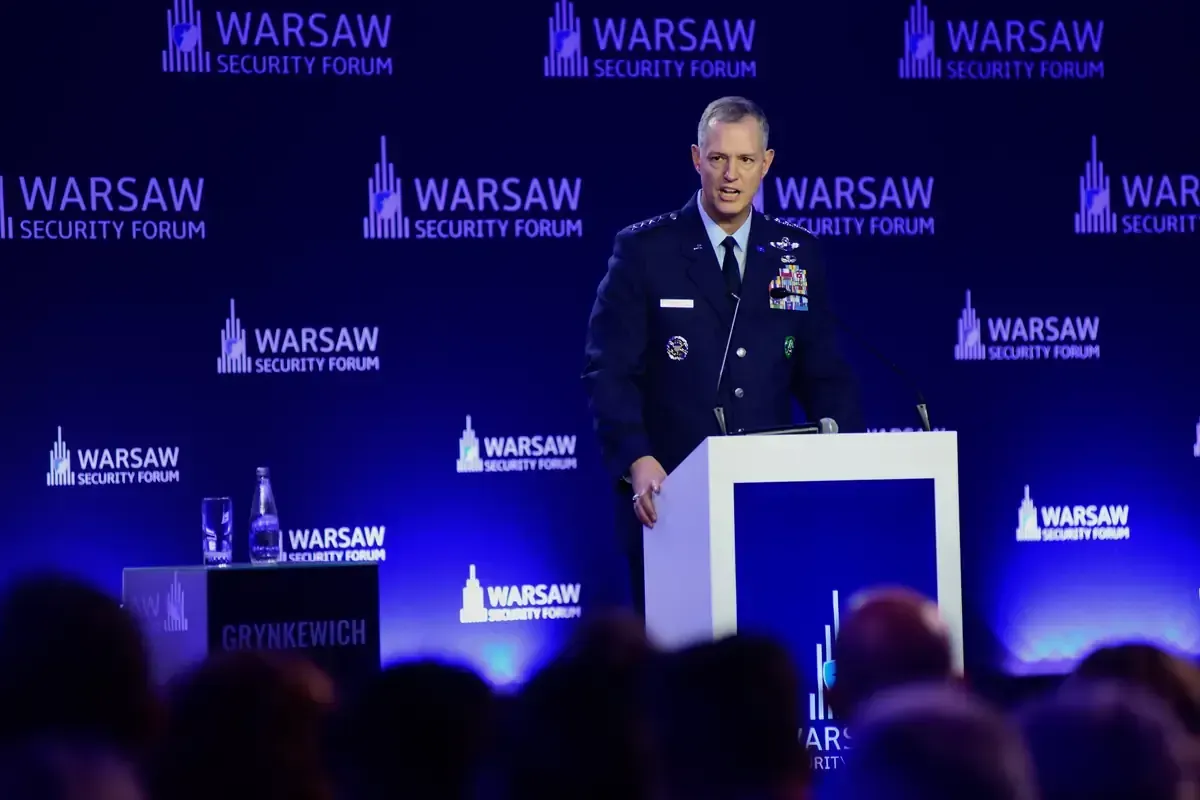
NATO's supreme allied commander Europe, Gen. Alexus Grynkewich, said on 12 October that the alliance would block any attack on its territory, blunt any further advance and break the attacking forces if the assault continued.
Theory of Victory: How Do We Achieve Military Success Against Russia in Deterrence and Defence?
— Anonymous (@YourAnonCentral) November 9, 2026
Gen. Alexus Gregory Grynkewich - Supreme Allied Commander Europe, NATO https://t.co/DH7u38z9m3 pic.twitter.com/vbMcq9iH6Z
Grynkewich, a U.S. Air Force general who also heads U.S. European Command, set out what he called his theory of victory at the Warsaw Security Forum, a two-day conference run by the Casimir Pulaski Foundation. He said a classified version was finalised about three months before the speech and sits within the alliance strategy for deterrence and defence of the Euro-Atlantic area, which all 32 allies agreed. He told the audience he did not assess conflict as imminent or inevitable. In a television interview the previous day he put the risk of a major Russian attack on a NATO member as relatively low.
Katarzyna Pisarska, the forum's chair, asked him why he had gone public. Grynkewich tied the decision to sabotage and arson across the alliance, which he said had left its populations nervous. He said he wanted to tell the alliance's 1 billion citizens that its commanders knew what they would do, and to warn anyone considering an attack. "If attacked, we are ready to fight tonight, but we are not complacent," he said.
Denmark's Defence Intelligence Service said on 24 September there was a low but growing risk that Russia would launch a limited military attack on one or more NATO countries on its border. Thomas Ahrenkiel, its head, said the aim would be to divide NATO rather than take over a country. Germany accused Russia in September of plotting to attack a Ukrainian aircraft with an explosives-laden drone at Leipzig/Halle airport, and Estonian officials blamed Russia for a fire at a defence company.
Block, blunt and break
Land forces on the eastern flank would move first to dominate any enemy breakthrough at the point of contact, Grynkewich said. Through manoeuvre they would fix enemy formations, stop them seizing allied territory and destroy the advancing troops. Air and naval forces, working with space and cyber units, would quickly secure air and maritime superiority over the battle area and bring mass and precision to bear.
Sensors, autonomous systems and forces from every domain would deny the attacker momentum if the attack went on, with coordinated effects reaching down to tactical units. Should the adversary press on or commit reserves, NATO would go after everything that supplies, sustains or controls the attacking force. He said the alliance would layer expensive precision munitions with a large mass of cheaper, scalable weapons until enemy formations were cut off from resupply and their commanders could no longer control them.
Grynkewich credited intelligence collection from multiple sources and algorithmic analysis of the resulting data with giving the alliance what he called decision advantage. He said NATO was unlikely to be caught by surprise and would see an attack coming in time to move forces into position.
Escalation
NATO would defeat the forces used against it on the battlefield and go no further, Grynkewich said, citing Clausewitz's idea of forcing an offensive to culminate. Because the alliance would strike only the system attacking it, he said, it would have no reason to escalate, and the moral, political and strategic burden of escalating would rest with the aggressor alone. He said threats of escalation, or escalation itself, would bind allies together. He described the alliance's ability to deliver effects at scale as an implicit warning that it could match any enemy move up the escalation ladder.
Sergei Lavrov, the Russian foreign minister, said at the close of the UN General Assembly in New York on 26 September that the Russian government had no intention of fighting Europe. He said European spending on arms production could become a self-fulfilling prophecy.
Two theatres and the stockpiles
Pisarska asked whether the concept allowed for a war in Europe while U.S. forces were committed in the Asia-Pacific. Grynkewich said it did. He said the overlap of the war in Ukraine with conflict in the Middle East had shown planners where the alliance's warfighting system would come under strain. Planners responded by pairing high-end precision weapons with large quantities of affordable ones.
Pisarska said Ukraine could not find Patriot interceptors to buy even when it had the money. Grynkewich said he had examined stockpiles across the alliance, was comfortable with what was available and expected them to improve. He told defence industry representatives in the room that they had to be able to keep production going through a long war as well as deliver the first batch.
About 95 per cent of the Patriot interceptors reaching Ukraine, including PAC-3 missiles, arrive through the Prioritized Ukraine Requirements List (PURL), under which allies pay for U.S.-made weapons, Ukraine's defence ministry said on 23 July. Contributions from 29 countries had reached US$6.7 billion in the programme's first year. President Volodymyr Zelensky put the programme's requirement for 2026 alone at US$15 billion.
Sabotage and Ukraine
Grynkewich said a country hit by sabotage should publicly attribute the attack once it had met its legal requirements, to show the Russian government that its networks were less deniable than it believed. Because one main aim of the campaign was to break Western support for Ukraine, he said, allies should answer each incident by raising their PURL contributions or donating air-defence interceptors. He also asked allies to coordinate their responses and messaging so that the Russian government received one consistent account of the alliance's red lines.
Grynkewich said the front line in Ukraine had largely stabilised during 2026. Russian strikes on energy infrastructure were intended to break the will of Ukrainian civilians and would make for a hard winter, he said, but would probably fail.
Article 5 and U.S. troops
Pisarska said what worried her and many in the room was that political leaders might hesitate to give the orders and decide that a war was not theirs. Grynkewich said it did not keep him awake. He cited the Ankara summit declaration of 8 July, in which leaders of all 32 allies reaffirmed their "ironclad commitment" to collective defence under Article 5. He said he had been in the room and shared President Donald Trump's view that there was a lot of love among the leaders.
Pisarska asked whether U.S. troops would be among the ground forces stopping an attack. Grynkewich said deployments were a political decision. He pointed to U.S. troops already in Poland and along the eastern flank, and to his own nomination by Trump and confirmation by the Senate, as evidence of U.S. commitment to the alliance.
Simon Diggins, a former British Army colonel and defence attaché in Kabul, wrote on 15 October that the concept was coherent but rested on political foundations in doubt. He questioned whether the U.S. would keep its forces in Europe, whether European governments would fund their own defence and whether every member backed the plan as fully as Grynkewich said. Trump avoided a direct answer after the Ankara summit when asked whether the U.S. would come to the defence of allies, the International Centre for Defence and Security in Tallinn wrote on 14 July.
The Kaliningrad warning
Grynkewich used the same October visit to warn Prime Minister Donald Tusk that events could escalate as early as this autumn, Tusk said on 3 November. Tusk said NATO's commander and allied intelligence services had warned that armed groups could cross from Russia's Kaliningrad exclave in the first half of November. Police, border guards and counterterrorism units were sent to the north-eastern provinces of Warmia-Masuria and Podlaskie from 2 November.
Border guards saw a group near the town of Sępopol on the Russian border just after midnight on 3 November. The group went back into Kaliningrad without crossing, and Tusk said its intent could not be confirmed. The allied warning runs to 15 November.