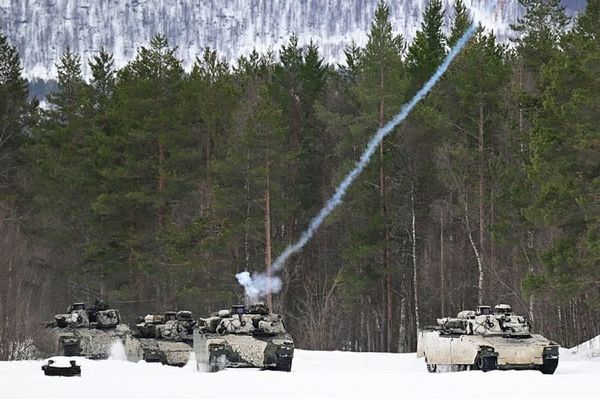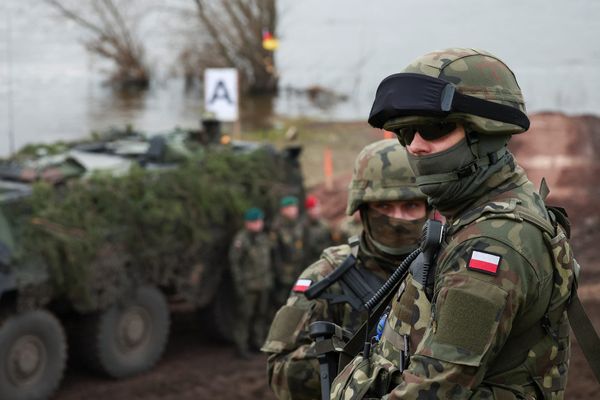

NATO's military commanders are planning to answer any Russian attack on the alliance with precision strikes on military bases, supply depots and arms factories deep inside Russia, The Wall Street Journal reported on 3 November.
Senior officers and officials from across the alliance met at Supreme Headquarters Allied Powers Europe in Mons, Belgium, on 17 June for NATO's first Deep Strike Symposium. U.S. Air Force General Alexus Grynkewich, the Supreme Allied Commander Europe, hosted the talks and a wargame on a subject few of the participants would have raised in public until recently.
For decades NATO planned to defend its European territory by slowing an invading force at the border. Its commanders now hold that a Russian offensive can be stopped only by destroying the forces, logistics and industry that sustain it, including targets on Russian soil, and the planning excludes any move to nuclear weapons.
European manufacturers have announced at least 48 low-cost cruise missile projects among 20 companies, according to a count by Fabian Hoffmann, a missile researcher at the Norwegian Institute for Defence Studies. Many will never produce a weapon and the rest will need years. The U.S. government cancelled the deployment of its own long-range missile battalion to Germany in May.
The symposium
SHAPE brought together senior NATO commanders, senior defence industry executives and military representatives of allied nations, several of them chiefs of defence. The agenda covered deep precision strike requirements and capabilities from NATO, national and industry perspectives.
Admiral Giuseppe Cavo Dragone, chair of the NATO Military Committee, opened the meeting. "Deep strike is a vivid reality of modern war," he said, and told the audience that the alliance had to treat it across every military domain and urgently deal with capability gaps where they existed.
Admiral Pierre Vandier, the Supreme Allied Commander Transformation, said the NATO Defence Planning Process was the alliance's means of steering allies toward the right weapons for deep strike and deterrence by denial. "Deep precision strike is like a bow and a quiver of arrows," he said.
SHAPE defined deterrence by denial as making clear that any attack on NATO would fail and was therefore not worth attempting. The wargame run alongside the talks tested how the alliance would reach targets far behind a Russian front line.
Definitions of "deep" range from about 160 kilometres to several hundred kilometres behind the front. In a war, NATO's long-range missiles, rockets and drones would be used against remote airfields and army compounds as well as industrial plants, critical infrastructure and resource bases thousands of kilometres from the alliance's borders.
NATO leaders meeting in Ankara on 7 and 8 July committed in their summit declaration to deliver capability targets in deep precision strike, alongside integrated air and missile defence, uncrewed systems and intelligence. The declaration also committed the allies to an interoperable transatlantic warfighting cloud for sharing targeting data.
The theory of victory
Grynkewich made the doctrine public at the Warsaw Security Forum on 12 October in a speech titled "Theory of Victory: How Do We Achieve Military Success Against Russia in Deterrence and Defense?" All 32 allies had approved a classified version about three months earlier, he said, after months in which the strategy was discussed only at the top of NATO's Military Committee.
The general, who also commands U.S. European Command, set out three stages. NATO forces would block the initial attack, blunt it if it persisted and, if required, break the enemy's forces and the military system arrayed against the alliance.
If the attacker pressed on or committed reserves, NATO's response would reach beyond the units crossing the border to the advancing force and "anything and everything that supports, sustains or controls that force," he said, using kinetic and non-kinetic means across land, air, sea, space and cyberspace.
NATO was not seeking to impose a strategic defeat on its adversary and did not need to, he said, and would stop an attack and deny the attacker the ability to seize and hold allied territory.
NATO was ready to fight that night if attacked, he told the forum, while adding that he did not assess a war with Russia to be imminent or inevitable and that the front line in Ukraine had largely stabilised. Allies could take comfort from NATO's ability to deliver mass effects and from the implied warning that it could match any enemy move up the escalation ladder, he said.
The speech committed the alliance to investing in high-end and affordable long-range precision strike weapons, sensor networks and a warfighting cloud, so that NATO could leave any attacking force unable to continue. On 16 October he told interviewers that each of his predecessors as SACEUR had held a theory of victory of their own.
He did not name Russia as the adversary. Asked why NATO had published the doctrine, he pointed to the sabotage and arson cases across Europe that European governments have blamed on Russia and said they had unsettled allied populations.
The classified plan includes an "autonomous zone" on the eastern flank in which drones and ground robots would slow a Russian advance while limiting NATO casualties, the Journal reported in October. Long-range missiles would strike Russian command posts and air defences in the Kaliningrad region, near St Petersburg and in Belarus to break Russian control of the air.
The U.S. Army's V Corps and other NATO ground forces would then counterattack while NATO aircraft struck Russian reinforcements moving toward the battlefield. A cloud-based system would share classified targeting data instantly, and some of its elements were tested during the U.S. war against Iran.
NATO's Steadfast Duel command-post exercise, which ran for 10 days around the Warsaw speech, involved more than 20,000 personnel and simulated 1 million allied troops repelling an army of similar size from the east. Other allied exercises have rehearsed ground-launched missile strikes on enemy command posts.
The targets
NATO's plans cover enemy troops crossing a border and the military bases, supply depots and industrial facilities behind the front line, including on Russian territory. Planners describe the approach as hitting the archer instead of shielding against the arrows.
Major General Ireneusz Nowak, a Polish F-16 pilot who became Operational Commander of the Polish Armed Forces on 2 June, told the Journal that the lesson Ukraine had taught NATO was that "defense also means striking back." Poland would want to hit the Russian defence industrial base in a war, he said, and NATO had to treat deep precision strike as a form of deterrence.
Had Ukraine possessed deep-strike weapons early in the war, Nowak said, the fighting would not have settled into trench battles like those of the First World War. He has more than 3,500 hours on military jets and is the officer who decides whether Polish forces shoot down Russian drones crossing into Polish airspace.
Poland's chief of the general staff, General Wiesław Kukula, and Nowak told a Warsaw defence conference in May that Poland was developing its own capacity to strike deep into enemy territory. The targets named were drone production plants, supply logistics and the centres where drone operators train. "I think we will see the first results in at least two years," Kukula said.
Factories are fixed and relatively easy to locate, but their owners can disperse production to several hidden sites, as Ukraine has done with its own plants. Missile launchers are small and keep moving, and new targets appear as a war goes on, which is why commanders want large stockpiles.
Hoffmann said the war in Ukraine showed the danger of entering a high-intensity conflict against an adversary with deep arsenals of long-range strike weapons while lacking them yourself.
The precedent
Both sides in the Second World War relied on manned bombers to hit targets far behind the front, and a U.S. bombing mission struck Nazi-controlled oil fields deep inside Romania. Germany fired the first long-range military rockets, the V1 and V2, at Britain and at the Belgian port of Antwerp, an Allied supply hub after D-Day.
None of those weapons was reliably precise. Ballistic missiles grew more accurate during the Cold War but remained large and complex to launch, and deep precision strike first appeared in the 1991 Gulf War, when the U.S. fired hundreds of Tomahawk cruise missiles, which fly level on small jet engines.
The Tomahawk entered service in 1983 and flies at about 885 kilometres an hour with a 450-kilogram warhead. The Atacms rocket entered service in 1991 and is fired from the U.S. Army's Himars trucks.
Cruise missile arsenals have grown since 1991 on every side, precision rockets have been added and the line between drones and missiles has blurred. Ukraine's Flamingo is 12 to 14 metres long with a warhead of about 1,150 kilograms, according to its maker, while Russia's Banderol carries 50 kilograms.
The targeting chain
Three of the eight implementation groups in the European Long-range Strike Approach, known as ELSA, cover the equipment that finds targets and opens a route to them: airborne early warning aircraft, long-range suppression of enemy air defences and a common Euro Multi Missile Launcher.
Denmark, Finland, France, Germany, Poland, Spain, Sweden and Turkey signed letters of intent at the Ankara summit for a Crewed Airborne Early Warning High Visibility Project. The European Policy Centre wrote in May that Europe needed a complete system of sensors, targeting and command, and that buying missiles alone would leave the gap open.
The Ankara declaration commits all 32 allies to build the interoperable warfighting cloud at the centre of the classified plan and to adopt artificial intelligence models.
The Ukrainian campaign
Ukraine's armed forces and security services have struck Russian oil refineries, plants making rocket fuel and explosives, drone factories, ammunition depots and, from October, commercial data centres.
Drones set fire to a Yandex data centre in Sasovo, in Ryazan region, on 8 October, halting work at the site. A second Yandex data centre in Kaluga lost several modules the following night, the company said, and the same raid hit a plant in Tver region that produces fuel components for Russia's Kh-101 cruise missiles.
Russia had fired Kh-101 missiles at the Ukrainian town of Pryluky two days before the Tver strike, President Volodymyr Zelensky said. The Tver plant also makes ferrocene derivatives used as burn catalysts in solid-fuel rocket motors, and the British government sanctioned it in September 2025.
Ukraine's General Staff said on 31 October that drone units and Neptune coastal missile batteries had struck the Kamensky plant, which produces solid rocket fuel for Uragan, Smerch and Tornado-S multiple rocket launchers and for air-launched weapons.
The FP-5 Flamingo, a ground-launched cruise missile built by the Ukrainian company Fire Point, has a range of up to 3,000 kilometres and a warhead of more than a tonne, according to the company. Ukraine has used it against rocket-fuel producers, drone-battery plants, oil refineries and data centres.
The Flamingo's first documented combat use was a strike on a Federal Security Service post in occupied Crimea on 30 August 2025. Ukrainian forces fired at least four at the Kapustin Yar test range in Astrakhan region in January 2026, a site from which Russia launches its Oreshnik intermediate-range ballistic missile.
A Flamingo hit the Votkinsk plant in Udmurtia, which builds Iskander-M and Topol-M missiles, on the night of 20 to 21 February. On 5 May a Flamingo struck the VNIIR-Progress plant in Cheboksary, but only one of the six missiles launched in that attack reached its target.
Ukrainian drones struck the Omsk refinery in western Siberia, Russia's largest, on 6 July, about 2,500 kilometres from Ukraine, and hit its ELOU-AVT-11 primary crude processing unit, the General Staff said. The refinery stopped work after the attack and was struck again on 8 October.
Ukrainian drones struck Russian oil refineries at least 194 times in the first half of 2026, reaching a record monthly pace in May, a Financial Times analysis found. Before the Omsk strike, Omsk and the Angarsk refinery in Irkutsk region were the only two of Russia's 10 largest refineries that Ukrainian drones had not reached.
Fire Point's chief executive, Iryna Terekh, said in June that the company's FP-1 and FP-2 drones carried out about 60 per cent of Ukraine's deep strike missions inside Russia. Fire Point is among the Ukrainian armed forces' largest contractors.
The Kyiv Independent reported in 2025, citing five sources, that Ukraine's National Anti-Corruption Bureau was investigating whether Fire Point had inflated the cost of components or the number of drones it delivered. Fire Point confirmed an investigation existed and denied the accusations, and the bureau said it was not investigating the Flamingo missile itself.
Fire Point co-founder Denys Shtilerman later published a letter from the bureau confirming that the company and its founders had not been notified of suspicion in the drone procurement case.
Alyona Getmanchuk, Ukraine's ambassador to NATO, told a conference on Ukrainian defence that Ukraine had run short of Western interceptors and was relying increasingly on what officials call proactive defence. Air defence relieves the symptoms of Russian attacks, she said, but "you need to target the source of the pain."
U.S. forces used deep strikes against Iran this year. U.S. and Israeli strikes that began on 28 February killed Supreme Leader Ali Khamenei. A ceasefire agreed in April collapsed in July, and U.S. forces struck a surface-to-air missile launcher on Qeshm Island overnight into 3 November.
The Russian air campaign
Russia launched more than 4,000 jet-powered attack drones, 4,740 piston-engine Shahed, Gerbera and Parodiya drones and nearly 360 Banderol and Dan-T drone-launched cruise missiles against Ukraine in October, Colonel Yurii Ihnat, head of communications for Ukraine's Air Force Command, said on 2 November. Russian forces also fired about 150 ballistic missiles and 80 cruise and air-launched missiles over the month, he said.
Ukraine's General Staff counted 6,473 Shahed-type long-range drones in October and said about 66 per cent of the jet-powered drones and 89 per cent of the piston-engine ones had been intercepted. Over the summer Ukrainian forces stopped between half and three fifths of the jet drones.
Ukraine's air defences intercepted more than 8,000 Russian drones and missiles in October and neutralised more than 43,000 smaller tactical drones, the Ukrainian defence ministry said on 4 November.
Ukraine's military intelligence agency, HUR, said on 4 November that Russia held up to 700 ballistic missiles and several thousand cruise missiles. HUR estimated that Russia keeps about 115 Iskander-M missiles in stock and produces about 65 a month.
Russia's jet-powered Geran-4 has a range of about 850 kilometres and the Geran-5, in service since January 2026, about 950 kilometres, according to the International Institute for Strategic Studies. The Banderol, a hybrid of cruise missile and attack drone, entered service in April 2025 with a range of about 500 kilometres.
The Institute for the Study of War assessed in its October review that Putin's own theory of victory in Ukraine rests on the long-range strike campaign, which it said aims to make civilian life untenable and cut the Ukrainian economy off from Europe. Russia fired an Oreshnik missile from Kapustin Yar at infrastructure near Lviv in January 2026, the same month Ukrainian Flamingos struck the range.
Russian strikes on 17 October hit more than 15 power facilities, and a salvo on 27 October combined 16 missiles with about 280 drones. Grynkewich said in Warsaw that Russia's long-range campaign against Ukraine's energy system would probably not break the will of Ukrainian civilians.
The U.S. withdrawal
President Joe Biden and Chancellor Olaf Scholz agreed at the NATO summit in Washington in July 2024 that U.S. forces would begin deploying long-range missiles to Germany in 2026. The deployment was to include Tomahawk cruise missiles, SM-6 missiles and the Long-Range Hypersonic Weapon, the first U.S. ground-based intermediate-range missiles in Europe since the Cold War.
The Biden administration presented the deployment as an answer to Russia's stationing of nuclear-capable Iskander missiles in Kaliningrad, which put Berlin within range. The U.S. Army stood up the 3rd Battalion, 12th Field Artillery Regiment at Fort Drum, New York, for the mission in October 2025.
Chancellor Friedrich Merz publicly criticised the U.S.-Israeli war against Iran in the spring. President Donald Trump wrote on social media on 29 April that the U.S. was reviewing a possible reduction of its troops in Germany, and Pentagon spokesman Sean Parnell confirmed on 1 May that 5,000 troops would leave the country over six to 12 months.
Defense Secretary Pete Hegseth decided that the missile battalion, about 500 soldiers, would not deploy to Germany, CNN reported on 14 May. The Pentagon also cancelled the rotation of a 4,700-strong armoured brigade combat team to Poland, the Baltic states and Romania.
Republican Representative Don Bacon of Nebraska said the move was a "slap in the face to Poland" at a House Armed Services Committee hearing on 15 May, where members of both parties criticised the cancellation. General Christopher LaNeve, the acting Army chief of staff, confirmed the brigade cancellation at the hearing but would not confirm the missile battalion's.
The Long-Range Hypersonic Weapon that the battalion was to bring to Germany reached initial operating capability at the end of April. A sister Tomahawk battery test-fired a missile at a target 600 kilometres away during an exercise in the Philippines on 5 May.
Defence Minister Boris Pistorius said on 12 May that Germany had asked to buy Tomahawk missiles from the U.S. about 18 months earlier and was still awaiting approval. The request covered three Typhon launchers and up to 400 Tomahawk Block V missiles.
Trump and Merz reached an agreement in principle on the purchase at the Ankara summit. A German defence ministry planning document earmarks nearly €3.4 billion for Typhon launchers and Tomahawk missiles and aims to bring the system into service by the end of the decade, subject to the 2027 budget and parliamentary approval.
A defence ministry spokesperson said the procurement of the Typhon system with Tomahawk missiles "remains intended." U.S. Tomahawk deliveries to Germany have become uncertain after heavy use of the missile in the war against Iran.
The 12 European countries that launched a new deep strike funding initiative in Ankara said they recognised the need to increase their deep precision strike capabilities, including in response to recent U.S. force adjustments.
The European arsenal
European NATO members hold small stocks of air-launched cruise missiles. The Anglo-French Storm Shadow and Scalp, in service since 2002, have a range of more than 250 kilometres according to MBDA, and the German-Swedish Taurus, in service since 2005, reaches more than 500 kilometres according to Saab.
Germany signed a contract on 18 December 2025 with Taurus Systems, the joint venture of MBDA and Saab, to prepare serial production of an upgraded Taurus Neo in Germany, with a planned purchase reported at 600 missiles worth €2.1 billion.
The U.S. Army's Precision Strike Missile, which entered service in 2026, reaches about 500 kilometres, against about 300 kilometres for the longest-range Atacms variant. The Tomahawk flies about 2,500 kilometres.
France, Germany, Italy and Poland launched ELSA on the sidelines of the NATO summit in Washington in July 2024. Sweden and the United Kingdom joined later that year, giving the group six members.
The six defence ministers signed a letter of intent on 12 February 2026 to harmonise and speed up the development and procurement of long-range one-way effectors, the category that includes Ukraine's attack drones. On 18 June they agreed to split ELSA into eight implementation groups, each led by a single nation that carries its own costs.
Three of the groups cover ground-launched strike in range bands of 300 to 500 kilometres, 500 to 2,000 kilometres and beyond 2,000 kilometres. The others cover low-cost one-way effectors, airborne early warning, suppression of enemy air defences at long range, air-launched long-range strike and the Euro Multi Missile Launcher.
Prime Minister Keir Starmer convened about a dozen European allies in Ankara on 8 July to launch the Deep Precision Strike Capability Investment Initiative. The 12 members will spend more than $50 billion, or £37 billion, over 10 years on weapons designed to hit targets at least 300 kilometres away and in some cases more than 2,000 kilometres away, the British government said.
Britain has committed £3 billion to deep precision strike by 2030 in its Defence Investment Plan. The sum includes £770 million over four years for Trinity House, a programme with Germany to speed development of stealth and hypersonic weapons with a range of more than 2,000 kilometres, due in service in the 2030s.
Britain is also investing £1.4 billion over four years in Stratus, the successor to Storm Shadow developed with France and Italy, in stealthy and high-speed versions. Defence Secretary Dan Jarvis said the new weapons would let British forces hit targets hundreds of kilometres away with great accuracy.
Denmark, France, Italy, Norway, Turkey and the United Kingdom separately launched a NATO Ground-Based Precision Strike Capabilities High Visibility Project on 7 July to develop new deep precision strike launchers and missiles. Germany and Ukraine signed an agreement in Ankara to produce long-range strike drones together, the German defence ministry said.
The German Navy fired two Israeli-made Lora ballistic missiles from the frigate Sachsen-Anhalt in the North Atlantic, between Ireland and Iceland, on the night of 1 to 2 September, a test kept secret until it was over. Israel Aerospace Industries gives the missile a range of about 400 kilometres, and the navy's chief, Vice Admiral Jan Christian Kaack, said the launch had made naval history.
France allocated €15.6 million in its 2026 budget to an initial risk analysis for a ground-launched medium-range ballistic missile meeting the ELSA range requirement. MBDA's Land Cruise Missile, the closest European equivalent to the Tomahawk, should be ready for orders in 2029, Hoffmann wrote.
The low-cost race
Germany's defence ministry is pursuing four separate tracks toward ground-launched deep strike, according to planning documents reported by Politico on 18 June. Low-cost cruise missiles are due from 2027, the Typhon and Tomahawk purchase would give an initial capability in 2029, a high-end cruise missile with Britain is due in 2032 and a hypersonic glide vehicle with Britain in 2035.
The documents set aside nearly €12 billion for the plan, with close to €9 billion for low-cost missiles and drones able to overwhelm enemy air defences in large numbers and a further €1.8 billion for developing and buying cruise missiles. Three candidates were named for the 2027 track: Anthem from the U.S.-Israeli company Covenant, Bars from an unnamed Ukrainian manufacturer and Fire Point's Flamingo.
Lieutenant General Christian Freuding, the inspector of the German army, said on 9 October that the decision to buy low-cost cruise missiles had been taken. The army would fire them in massed salvos at targets about 1,500 kilometres away to saturate enemy air defences, he said, and the first missiles could reach units in 2027.
German army artillery currently fights at ranges of under 80 kilometres, and the loitering munitions the Bundeswehr has bought reach about 100 kilometres. A week before the cruise missile announcement, Pistorius and Freuding presented plans for a drone regiment with a reach of up to 500 kilometres.
Freuding said two systems already on the market were under consideration and that the cheap missiles would complement more expensive cruise missiles reserved for targets of strategic importance.
Covenant, founded in 2024 and based in Washington, opened a production hall in northern Leipzig on 5 October. The company said series production of Anthem would begin in the first quarter of 2027 at a rate of 1,000 missiles a year, with a target of 5,000 a year in 2028, and that the missile had completed more than 200 test flights since August 2025.
Covenant is backed by U.S. venture capital firms including Founders Fund and Andreessen Horowitz and plans to build thousands of missiles at the Leipzig site. Local peace campaigners demonstrated against the plant on 2 September, and regional branches of the far-right Alternative for Germany also criticised it.
The German defence ministry confirmed in September that it was in talks with Covenant. The Leipzig plant will assemble missiles without handling explosives, which lets it operate under the rules for a metalworking plant rather than a munitions factory.
Rheinmetall and the Dutch company Destinus formed a joint venture, Rheinmetall Destinus Strike Systems, to build cruise missiles and ballistic rocket artillery from late 2026 or early 2027. Its priority programme is the Ruta Block 3, a cruise missile with a range of more than 2,000 kilometres and a 250-kilogram warhead, to be assembled in Germany.
Destinus has supplied the shorter-range Ruta Block 1, with a range of more than 300 kilometres and a 150-kilogram payload, to Ukraine since at least 2024. Hoffmann has written that Europe's small jet engine industry, which supplies the turbojets these missiles need, limits production at the volumes Europe wants, and he told the Financial Times this year that European governments' actions on long-range strike lagged their rhetoric.
The political test
NATO's military leaders have accepted denial as doctrine, but strategists question whether European politicians would order deep strikes into Russia in response to an incursion. Nico Lange, a former chief of staff in Germany's defence ministry, told the Journal that politicians believe defence means putting up a wall or "readying a drone wall."
Lange said that view was disconnected from the military planning needed to defend against Russia, which includes offensive components. Plans such as the theory of victory aim to make deep strikes essentially automatic after a Russian attack and to give governments a clear reason to build the stockpiles.
U.S. intelligence assessments concluded in August that Putin could try to test NATO's resolve between autumn 2026 and 2029, with scenarios ranging from cyberattacks and covert operations to a limited ground incursion on the eastern flank. The assessments rated an incursion unlikely but rising over time.
U.S. intelligence agencies had previously judged that Putin would avoid provoking a NATO member while his army was fighting in Ukraine. U.S. officials said the change in view came earlier in 2026, as Putin faced growing pressure at home to deliver a victory in Ukraine.
Polish Foreign Minister Radosław Sikorski told allies in October that they must be ready for a deadly Russian hybrid attack. On sabotage and hybrid attacks below the threshold of war, SACEUR told the Warsaw audience that allies should make clear to the Russian government where their red lines lay, without naming one himself.
Western governments spent most of 2024 debating whether Ukraine could fire Western missiles into Russia at all. Putin said on 12 September 2024 that such strikes would mean NATO countries were at war with Russia, and the Biden administration lifted its restriction on Atacms strikes inside Russia in November 2024.
Scholz refused throughout his term to supply Taurus missiles to Ukraine. The British, French and U.S. governments supplied Storm Shadow, Scalp and Atacms missiles under restrictions that were later partly lifted.
The Russian response
Putin signed an updated nuclear doctrine on 19 November 2024. It states that aggression against Russia by a non-nuclear state with the participation or support of a nuclear state counts as a joint attack, and that Russia may use nuclear weapons against a conventional attack that creates a critical threat to its sovereignty or territorial integrity.
The doctrine treats aggression by any member of a military bloc as aggression by the bloc as a whole. It lists the deployment of precision non-nuclear weapons, hypersonic weapons and strike drones by a potential adversary among the threats nuclear deterrence is meant to counter.
The Russian and Belarusian defence ministries released video on 30 December 2025 that they said showed the Oreshnik intermediate-range ballistic missile entering combat duty in Belarus. Belarusian leader Alexander Lukashenko said the system had arrived on 17 December, though Ukrainian analysts said the footage showed support vehicles rather than launchers.
Russia sent NATO a document on 30 September warning that it was ready to use its entire arsenal, including nuclear weapons, if the alliance tried to cut Kaliningrad off from the rest of Russia. The document accused NATO of a "dangerous and reckless course" carrying a high risk of direct armed conflict and raised the possibility of strikes on decision-making centres in NATO states from the start of a conflict.
Russian embassies in several European countries, including Ireland, posted the same warning and said Russia had information that NATO was preparing an air and naval blockade of the exclave. Putin's office said the warnings were meant to remind "hotheads" in Europe of Russia's existing nuclear policy.
NATO Secretary General Mark Rutte said the document was unhelpful and told Russia to "stop the nuclear threats." In its written reply, NATO said none of its exercises or activities posed a threat to Russian territory.
Kaliningrad, bordered by Poland and Lithuania, hosts the headquarters of Russia's Baltic Fleet and nuclear-capable Iskander missiles. Putin has said a direct attack on Russia, including on Kaliningrad, would put all Russian weapons on the table. Allied plans list Russian air defences, command posts and missile systems in the Kaliningrad region among the targets for early strikes, the German newspaper Bild reported in August.
Maria Zakharova, the Russian foreign ministry spokeswoman, said the theory of victory was a "durdom na vyezde," a madhouse on tour.
Yuri Knutov, a Russian military commentator, said NATO had "no resources, no forces, no means" for a long war. Another commentator, Yevgeny Mikhailov, called the theory pointless and said Russia would strike before the West could complete its stages.
Russian state media, including Izvestia, presented the 3 November account on 4 November as a NATO plan to abandon earlier restrictions and strike deep into Russia.
Next
Covenant's Anthem production line in Leipzig is scheduled to start in the first quarter of 2027. Germany's low-cost cruise missile track and Freuding's army programme both aim for first deliveries in 2027.
Kukula said in May that Poland's deep-strike programme would show its first results in at least two years. MBDA's Land Cruise Missile is expected to be available to order in 2029, and Germany's Typhon and Tomahawk purchase aims for an initial capability the same year.
The Anglo-German high-end cruise missile under Germany's four-track plan is due in 2032. Trinity House weapons with a range of more than 2,000 kilometres are due in service in the 2030s, and the Anglo-German hypersonic glide vehicle is planned for 2035.