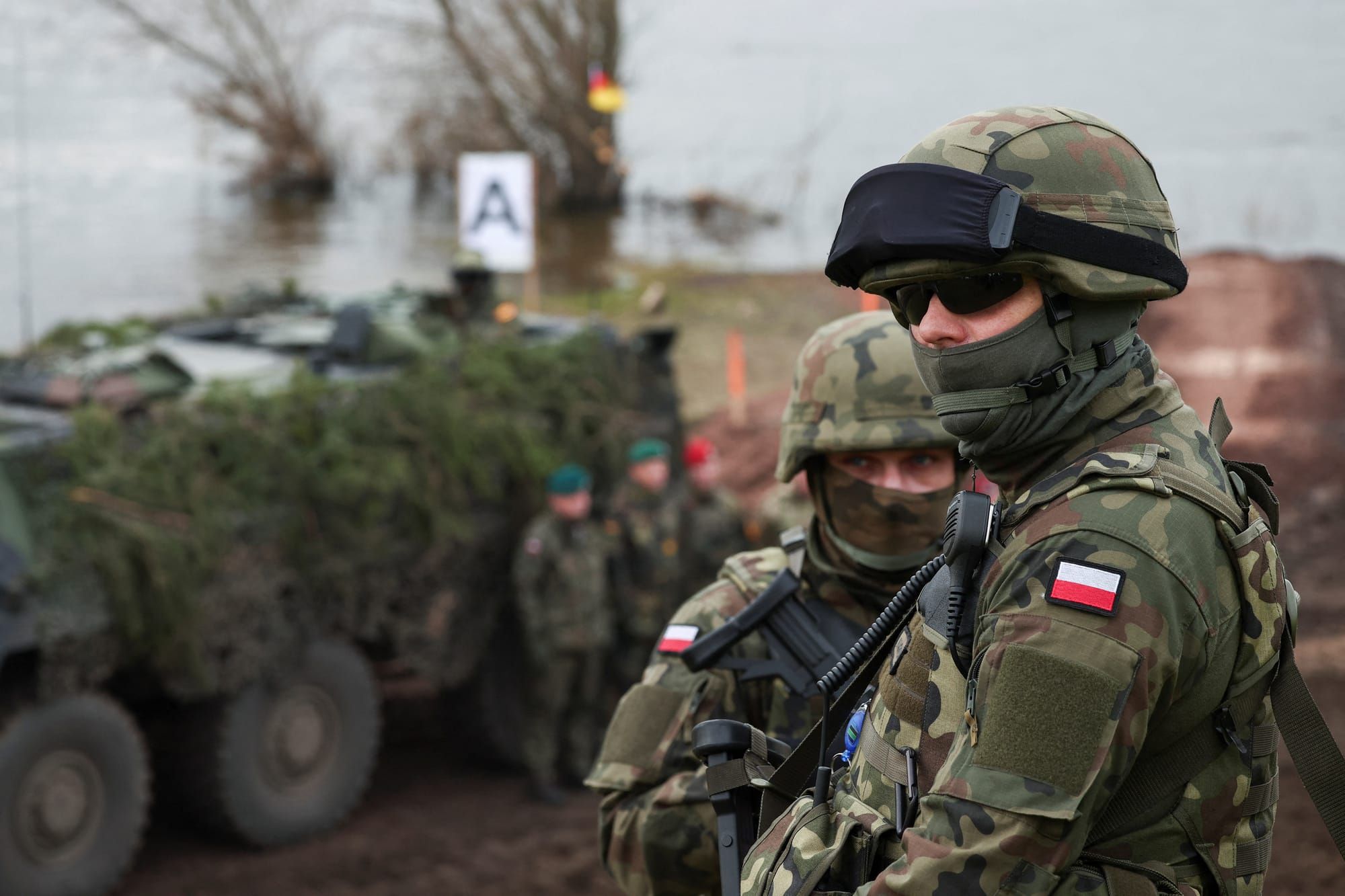
Poland's government sent counter-terrorism police and Border Guard reinforcements to the Kaliningrad frontier on 2 November after Polish military intelligence, allied services and NATO's top commander said armed men could cross from Russia.
Hours after the operation began, the Border Guard reported people carrying torches moving at the border near the town of Sępopol in Warmian-Masurian province. Tusk told a cabinet meeting on 3 November that the forces had been mobilised quickly and that a provocation had probably been prevented, though he said that could never be fully confirmed.
Polish authorities are preparing for a scenario that NATO governments have discussed for a decade and U.S. intelligence placed on its calendar in August: an unacknowledged armed incursion into alliance territory, small enough to leave doubt over who sent it and whether it counts as an attack on all 32 members.
The warning
RMF FM reported on 2 November, citing unnamed security sources, that Poland's Military Intelligence Service (SWW) and intelligence agencies of unnamed allied countries had sent alerts the previous week about possible sabotage on the Russian border. One scenario under consideration was a violation of the border by armed groups.
Tusk said Polish and allied services had for some time reported that sabotage or more serious provocations on the border with the Russian Federation could occur in the first days of November, alongside sabotage prepared by hostile services. He said General Alexus Grynkewich, NATO's Supreme Allied Commander Europe and the commander of U.S. forces in Europe, had passed on warnings to the same effect.
More precise information then indicated that armed people could enter Polish territory in the first half of November, Tusk said. The government responded by sending police, Border Guard reinforcements and counter-terrorism officers to the area.
The night of 2 to 3 November
Tusk said the Border Guard report came in shortly after midnight and described individuals carrying torches. RMF FM correspondent Krzysztof Zasada reported that Polish services intervened near Sępopol, a town in Bartoszyce County that sits close to the Kaliningrad frontier.
No crossing took place and the people observed withdrew deeper into Kaliningrad Oblast, according to RMF FM. Neither the government nor the police have said how many people were seen, whether they were armed or which side of the line they stood on when first observed.
Tusk told the cabinet that tension and escalation from Russia could continue and that vigilance had to be maintained. Polish authorities have reported no confirmed act of sabotage and no armed border crossing connected to the operation.
The police operation
National Police Chief General Inspector Marek Boroń confirmed the operation to RMF FM on 2 November. He said police were securing the area in anticipation of events that could lead to sabotage and that the operation relied in part on information from external services.
Officers transferred from other provinces and police counter-terrorism units are working in the Warmian-Masurian and Podlaskie provinces with the armed forces, the Border Guard and the intelligence services. A command post at National Police Headquarters in Warsaw coordinates the operation.
Boroń said the larger police presence was meant to protect residents and infrastructure from sabotage and the activities of foreign intelligence services. Police headquarters described the operation as linked to acts of sabotage and the actions of eastern services, a reference to the Russian and Belarusian intelligence agencies. Police spokeswoman Katarzyna Nowak told TVN that the details are confidential.
Police took the lead because an incursion by men in civilian clothes, or in uniforms without insignia, would begin as a criminal and counter-terrorism matter under Polish law. A declared military attack by a foreign state would fall to the armed forces and to the constitutional procedures for a state of war.
The readiness order and the tribunal dispute
Deputy National Police Chief Tomasz Michułka sent provincial commanders a written order on 29 October placing officers on full readiness for immediate deployment from 2 to 8 November. The letter cited the security situation nationwide.
Michułka's order coincided with a confrontation over control of Poland's Constitutional Tribunal. Riot police were called to secure the tribunal building in Warsaw on 30 October during protests against an attempt by judges backed by the government to take control of the court. Tusk told the cabinet on 3 November that no one in the executive may enter the tribunal by force, a reference to an overnight visit to the building by President Karol Nawrocki on 31 October.
Several Polish media outlets read Michułka's order as preparation for the tribunal dispute. Police headquarters said on 30 October that the order concerned current threats of sabotage and subversion. Boroń wrote to officers on 1 November that the order answered attempts by eastern foreign intelligence services to destabilise the country, and he told RMF FM the border operation had no connection to the tribunal.
Tusk said Russia was provoking tension both abroad and inside Poland around the tribunal dispute and the U.S. midterm elections, which take place on 3 November.
The Russian position
The Russian embassy in Warsaw has said that Poland's information space shows a sharp increase in militarist rhetoric, including what it called fake news about potential acts of sabotage, according to the Russian state news agency TASS. The embassy has made no public comment on the movement near Sępopol.
Kremlin spokesman Dmitry Peskov said in September that claims of a planned Russian attack on NATO had no connection with reality or with Russia's intentions. Russian officials made the same denials in the months before the full-scale invasion of Ukraine in February 2022.
The Polish government closed the Russian consulates in Poznań in October 2024, Kraków in May 2025 and Gdańsk in November 2025, each time in response to sabotage it attributed to Russian intelligence. The Russian government has denied involvement in all of the incidents and retaliated by closing Polish consulates in Russia.
The Russian campaign against Poland
The International Centre for Counter-Terrorism in The Hague identified Poland in March 2026 as the primary focus of Russian sabotage operations in Europe.
Polish prosecutors have tied the May 2024 arson that destroyed Marywilska 44, Warsaw's largest shopping centre, to orders from Russian intelligence, and four suspects went on trial in October 2026. The Polish government confirmed in November 2025 that an explosion which damaged a railway line used to supply Ukraine was sabotage.
Nearly 20 Russian drones entered Polish airspace during an attack on Ukraine on the night of 9 to 10 September 2025. Poland requested consultations under Article 4 of the North Atlantic Treaty and NATO launched Eastern Sentry, a mission to reinforce air and ground defences on the eastern flank, on 12 September 2025.
A Russian Kh-101 cruise missile crossed into Polish airspace in July 2026 and came down in a field in eastern Poland about 80 kilometres from the Ukrainian border. A Russian military helicopter crossed from Kaliningrad in September 2026 and stayed in Polish airspace for about 42 seconds.
The intelligence assessments
The Wall Street Journal reported on 7 August 2026 that new U.S. intelligence assessed Russia could launch a limited attack on a NATO member between autumn 2026 and 2029, with the aim of fragmenting the alliance and testing its collective defence commitment. Poland and the Baltic states were the most exposed, according to the reporting.
Tusk told the Sejm on 17 September that, according to intelligence assessments, Russia planned drone and missile strikes on countries supporting Ukraine and would present them as accidents. He said the purpose would be to show that Article 5 existed only in theory.
Czech military intelligence chief Petr Koudelka said in September that such a scenario could emerge within months. Intelligence chiefs in the Baltic states said they had seen no sign of an imminent attack, and none of the officials published evidence that the Russian government had decided to strike.
Tusk said in April that a Russian attack on a NATO member was a matter of months rather than years. He said in October that Russia could intensify sabotage and other hybrid attacks against Poland and the Baltic states before Christmas.
Kaliningrad and the Suwałki Gap
Kaliningrad Oblast is a Russian exclave of about 15,000 square kilometres on the Baltic Sea, bordered only by Poland and Lithuania. It is home to the headquarters of Russia's Baltic Fleet and to nuclear-capable Iskander-M ballistic missiles with a range of up to 500 kilometres, enough to reach Warsaw from the exclave.
Polish Foreign Minister Radosław Sikorski said in June 2025 that a large part of Russia's ground troops had been withdrawn from Kaliningrad to fight in Ukraine. He did not say that the exclave's missile, air defence or naval forces had moved.
East of Kaliningrad, roughly 65 kilometres of the Polish-Lithuanian border separate the exclave from Belarus, where Russian forces train and exercise. Military planners call this strip the Suwałki Gap. It carries the only land routes connecting Lithuania, Latvia and Estonia to the rest of NATO.
Western military analysts have modelled a Russian push from Kaliningrad and Belarus to close the gap and cut the Baltic states off from reinforcement by land. A German war game published in early 2026 placed Russian forces in the Lithuanian city of Marijampolė within three days of a ceasefire in Ukraine.
The incursion scenario
An armed group crossing from Kaliningrad would first meet the police, the Border Guard and soldiers on Polish soil. Polish authorities would have to establish who sent it before the government could formally attribute the incursion to the Russian state.
Poland could then call for consultations under Article 4 of the North Atlantic Treaty, as it did in September 2025. Invoking Article 5 requires the North Atlantic Council to agree that an armed attack on a member has taken place, after which each ally decides what action it deems necessary, including armed force. The alliance has invoked Article 5 once, after the attacks on the United States on 11 September 2001.
Heather Conley, a former U.S. deputy assistant secretary of state, told the Wall Street Journal that NATO allies have so far preferred not to escalate in response to attacks below the Article 5 threshold. An unacknowledged incursion by a small group would test where allies place that threshold.
Poland's constitution allows the Sejm to declare a state of war in the event of armed aggression against Polish territory or when a treaty commitment to joint defence requires it. The president can declare martial law at the request of the Council of Ministers.
The war scenario
The Polish armed forces, which would meet any attack first, number about 210,000 soldiers, and General Wiesław Kukuła, the chief of the general staff, has set a target of 500,000 by 2039. He told senior officials in February that Russia poses an existential threat to Poland and that military modernisation is too slow.
The Polish government has budgeted 200 billion złoty, or 4.8 per cent of gross domestic product, for defence in 2026, the highest share in NATO. It has been building fortifications and obstacles along the Kaliningrad and Belarus borders under the East Shield programme since November 2024. Poland left the Ottawa Convention banning anti-personnel mines in 2026, allowing their use along its eastern borders.
About 10,000 U.S. troops are stationed in Poland. U.S. President Donald Trump said on 21 May that he would send 5,000 more, days after the Pentagon delayed a rotation of about 4,000 soldiers. NATO multinational battlegroups are based in Poland and in each Baltic state.
Russian Iskander batteries in Kaliningrad could strike Polish cities, airfields and the rail and road hubs that would carry allied reinforcements. Defending the Suwałki Gap would decide whether NATO could reach the Baltic states by land, and the Baltic Sea would become contested between Russia's Baltic Fleet and allied navies.
The 4th Warmian-Masurian Territorial Defence Brigade is due to become a border defence brigade by the end of 2026 and take responsibility for the Kaliningrad frontier. Heightened national alert levels are in force across Poland until 30 November.
Michułka's readiness order expires on 8 November. The government has not published the intelligence assessment behind the deployment, identified the allied services that issued the warnings or said what the people seen near Sępopol were doing at the border.