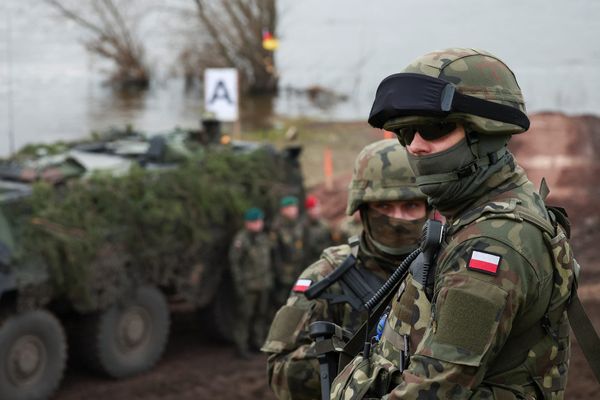

Norway is deploying NASAMS air defence sensors and more than 30 extra soldiers to Kirkenes, seven kilometres from the Russian border, to detect stray drones, the Ministry of Defence said on 3 November.
The ministry said the deployment was preventative and followed no specific new threat. The sensors are meant to detect drones, raise alerts and give the armed forces the clearest possible picture of movement in the airspace along the 198-kilometre border. The soldiers will serve with the Ranger Battalion at the Garrison of Sør-Varanger until the end of the year.
Finnmark borders the Kola Peninsula, home to Russia's Northern Fleet and the Olenya bomber base that Ukrainian drones have struck repeatedly since 2024. Norwegian authorities say the risk they are preparing for is a drone knocked off course, including Ukrainian drones bound for Kola that Russian GPS jamming could push west across the border.
Defence Minister Tore O. Sandvik said Norway had seen drones go astray in other countries and was taking it seriously. "We shall be prepared, even if we do not see a heightened air threat," he said in the ministry's statement.
The deployment
The Royal Norwegian Air Force is placing the sensors in Kirkenes, the administrative centre of Sør-Varanger, a municipality of about 10,000 people which also contains Storskog, Norway's only border crossing with Russia. The ministry said the move also gives the armed forces practice in sending personnel and equipment quickly to a new area.
Sandvik said experience from Ukraine showed the value of a clear air picture and early warning, and that the sensors would improve the ability to detect drones across Finnmark. He made no accusation against Russia and pointed to drone activity and stray drones in other European countries in recent years.
Responsibility for stopping illegal drone flights in Norway rests with the police. The armed forces step in when the police ask for help. Both can impose airspace restrictions when needed.
Justice Minister Astri Aas-Hansen, who is also responsible for civil preparedness, said the measure strengthened Norway's readiness. The ministry said the armed forces work with the police and other total defence agencies to enforce airspace restrictions when required.
On 8 September a suspected Russian Shahed-type drone crossed into Moldovan and Romanian airspace, forcing airspace closures and the scrambling of NATO fighter jets. On 3 October Moldovan President Maia Sandu said five Russian air attack weapons, including drones and Banderol missiles, had violated Moldova's airspace and exploded on its territory during a Russian attack on Ukraine.
The border
The Norwegian Police Directorate said in November 2025 that it would modernise the land border under a separate police programme, building fences at the former crossing at Skafferhullet and at the Storskog checkpoint. New masts, detection sensors and surveillance cameras were also planned, and the Skafferhullet fence alone was priced at about 400,000 euros.
Finnmark police chief Ellen Katrine Hætta said at the time that drones would be used to watch some sections of the border. The programme is run by the Police Directorate and the Defence Staff with Finnmark police, the Norwegian Border Commissioner, the Finnmark Brigade and the Ranger Battalion. Norway received NOK 190 million from the European Union in 2024 to strengthen the border.
Russian nationals and companies have been barred from flying in Norwegian airspace since 28 February 2022. Norway's Supreme Court ruled that the ban covers drones. Norwegian police arrested about a dozen Russians in late 2022 for flying drones or photographing restricted sites, and the Russian Embassy in Oslo said the response amounted to "psychosis".
The stray drone risk
The County Governor of Troms and Finnmark said in a press release that Ukrainian drones aimed at targets on the Kola Peninsula could end up on the Norwegian side of the border because of Russian GPS jamming. The governor's office judged the risk to be very low but said it could not be ruled out.
The governor's office set out what residents should do if a stray drone poses an immediate danger to life and health. Police would send an emergency alert with instructions to mobile phones in the affected area. Residents were told to shelter in place rather than travel long distances, go to a cellar where one exists, stay away from windows or use solid parts of a building such as stairwells.
On 29 March 2026 two drones came down near Kouvola in south-eastern Finland during Ukrainian strikes on Russian oil and port facilities on the Gulf of Finland. The Finnish Air Force identified one as a Ukrainian AN-196.
The Finnish pilot tracking the AN-196 held fire to avoid collateral damage, the air force said. Finnish police later found that the drone carried an unexploded warhead and destroyed it in a controlled detonation. A third drone was found on the ice of Lake Pyhäjärvi at Parikkala, near the Russian border, on 31 March, and police reported a further crashed drone with an unexploded warhead in a forest in Iitti in April.
Prime Minister Petteri Orpo said the stray drones appeared linked to Ukraine's attacks on Russian targets near Finland. The Ukrainian government apologised and said the drones had not been aimed at Finland, and Ukrainian officials attributed the diversions to Russian electronic interference. Estonia, Latvia and Lithuania reported Ukrainian drones crashing on their territory the same week after attacks on Russian Baltic oil export terminals.
On 13 September 2026 an object that crossed from Lithuania into Russia's Kaliningrad region was identified as a drone. Polish prosecutors later said the armed drone recovered off Poland's coast the following day may have overflown Lithuania.
Finnish Foreign Minister Elina Valtonen said on 12 May that Ukraine would send anti-drone specialists to Finland after four wrecks were recovered in south-eastern Finland in late March and early April. Ukrainian Foreign Minister Andrii Sybiha said the specialists would work on preventing further incidents and on aerial surveillance over Finland and the Baltic states.
The jamming
Russian interference with GPS signals over Finnmark has been recorded since 2017. The Norwegian Communications Authority, Nkom, counted 18 days of GPS jamming in Finnmark airspace in 2021, 122 days in 2022 and 294 days in 2023.
Norway's Ministry of Defence traced jamming between 16 October and 7 November 2018, during NATO's Trident Juncture exercise, to Russian forces on the Kola Peninsula. Russian presidential spokesman Dmitry Peskov said at the time that such allegations were as a rule unfounded. Finnish Prime Minister Juha Sipilä said the same month that the disruption of GPS signals across Lapland had been almost certainly deliberate and had put civil aviation at risk.
Finnmark has 11 airports with daily passenger traffic, most of them small. Pilots with SAS, Norwegian and Widerøe, as well as air ambulance crews flying into Kirkenes, Vadsø, Vardø, Båtsfjord, Berlevåg and Mehamn, have reported loss of GPS signals.
In May 2026 Nkom said strong jamming over the Varanger Peninsula had been recorded at altitudes as low as 500 metres. Nkom had three monitoring stations in the border region and planned two more during 2026, alongside mobile detectors on its own vehicles and on Hurtigruten ships sailing between Bergen and Kirkenes.
Nkom submitted a formal request for information to Russia's radio communications authority and received no reply, Espen Slette of Nkom said. Digitalisation Minister Karianne Tung said the jamming and spoofing of GPS signals was "a violation of international law".
Russia's Northern Fleet has several electronic warfare units near Severomorsk and in the Pechenga area near the Norwegian and Finnish borders. Nkom has also measured spoofing around Kirkenes, in which false signals deceive a receiver about its position, at altitudes of about 4,500 feet.
Russia has built more extensive jamming systems around Olenya and at several sites in northern Karelia and on the Kola Peninsula since Ukrainian drones began striking the region. Nicolai Gerrard of Nkom said the daily jamming over eastern Finnmark was likely a spillover from Russian electronic defences around its own bases.
Russia's consul general in Kirkenes, Nikolay Konygin, has dismissed concerns about the jamming. "I'm not afraid of flying. This is Norway," he said.
Hætta said she had raised the jamming and its effect on search and rescue in meetings with Russia's FSB security service. She said the FSB told her it would look into the matter.
The Kola Peninsula
Olenya air base lies about 90 kilometres south of Murmansk and about 200 kilometres from the Norwegian border. It hosts Tu-22M3 and Tu-95 bombers that Russia has used to fire missiles at Ukrainian cities.
Ukraine's military intelligence said a drone hit a Tu-22M3 at Olenya in July 2024, about 1,800 kilometres from Ukrainian territory. Further drone attacks on the base followed in August and September 2024, when Russian authorities closed the airspace over the peninsula and diverted civilian flights. On 1 June 2025 Ukraine's Operation Spiderweb struck Olenya and Belaya air base in Siberia with drones.
The head of Russia's space agency Roscosmos confirmed in 2026 that drones had targeted the Plesetsk space centre in Arkhangelsk region, south-east of the Kola Peninsula.
Murmansk regional governor Andrei Chibis convened military and security officials on 11 April 2026 to prepare for further Ukrainian strikes. Chibis said "the enemy is increasingly attempting to strike targets within the country".
The Pechenga valley, about 55 kilometres from Kirkenes airport, is home to Russia's 200th Motor Rifle Brigade and 61st Naval Infantry Brigade and their training ground. Along the peninsula's northern coast are the Northern Fleet's nuclear submarine bases and large nuclear weapons storage sites.
Norway's updated long-term defence plan says Russia is preparing for a potential future conflict with NATO while fighting in Ukraine. The plan cites a major Russian military build-up along the NATO border, including a doubling of ground forces in the north-west.
The sensors
NASAMS, the National Advanced Surface-to-Air Missile System, was developed by Kongsberg and the U.S. firm Raytheon in the 1990s for the Norwegian armed forces. It is used by 13 countries, and Norway has supplied launchers and missiles to Ukraine, where the system has been used against Russian missiles and drones. Norwegian Foreign Minister Espen Barth Eide said in Kyiv that Norway was working with Ukraine to integrate Ukrainian-made interceptors into NASAMS.
The ministry did not say on 3 November which NASAMS sensors it was sending to Kirkenes or how many.
In November 2025 the Norwegian Defence Materiel Agency ordered new NASAMS command posts, wheeled communication nodes and THOR combat net radios from Kongsberg in a contract worth about NOK 1 billion. The agency also ordered long-lead components so that additional NASAMS systems could be delivered quickly under the long-term plan.
The Finnmark Brigade's new combat air defence battery may receive NASAMS and the NOMADS short-range system, the battery commander said. The systems would be based in Porsanger, about 200 kilometres from the border, and could move around the region. The brigade already fields the Polish-made Piorun shoulder-launched missile, which is designed to shoot down helicopters and drones.
The Finnmark Brigade
Norway converted Finnmark Land Command into the Finnmark Brigade on 20 August 2025, the Norwegian Army's first new brigade since the Cold War and the first ever based in Finnmark. Its commander is Brigadier John Olav Fuglem.
On 20 August 2026 the brigade gained an artillery battalion, a combat air defence battery and a signals company at Porsangmoen. Permanent staff grew from 280 to 350 over the year. Full strength including conscripts and reservists is set at about 4,000.
The artillery battalion has received its first four K9 Vidar self-propelled howitzers, with 24 more due in 2028, and fired them for the first time at the Halkavarre range in August. Logistics and engineering units are to follow, then medical and military police units and a reserve-based Alta Battalion. Fuglem said at the ceremony: "We are now talking about a proper brigade."
Construction at Porsangmoen includes two garages and an accommodation block due in about a year, and Fuglem estimated that the brigade's infrastructure would be complete by 2030. Lakselv Upper Secondary School opened a defence and preparedness programme with a first class of 14 pupils.
The Storting adopted an updated long-term defence plan in June 2026 that brings forward the brigade's completion to 2033, two years earlier than planned. The plan commits Norway to spending 3.5 per cent of GDP on defence by 2035 and names electronic warfare, short-range air defence and drone defence among its priorities.
Sandvik presented the plan in March 2026 with Prime Minister Jonas Gahr Støre and Defence Chief Eirik Kristoffersen, adding NOK 115 billion and bringing planned defence spending to NOK 1,848 billion over 10 years. The money funds five new frigates, upgrades to existing frigates and faster development of the Finnmark Brigade.
The government has proposed NOK 6.5 billion more for the armed forces in the 2027 budget. The Ranger Battalion that receives the extra soldiers is the brigade's border guard unit, alongside the Porsanger Battalion and the Finnmark Home Guard district.
Fuglem said in an interview that the espionage threat in the border region had grown over the past year. He said Norwegian forces work with residents of Pasvik and other border communities to identify suspicious activity.
The threat assessment
Norway's Police Security Service, PST, said in its annual threat assessment on 6 February 2026 that it expected Russian intelligence services to step up activity in Norway this year. PST said Russian services would focus on military targets, allied exercises, Norway's support for Ukraine and operations in the High North, the Arctic and Svalbard.
PST wrote that Russian intelligence "may see benefit in carrying out sabotage operations on targets in Norway in 2026". The service said Russian services were trying to recruit Ukrainian refugees, of whom about 100,000 live in Norway, especially those with family or property in occupied areas.
PST director Beate Gangås said Norway faced its most serious security situation since the Second World War. The Russian Embassy in Oslo said the accusations were unfounded and politically motivated.
In a joint national threat assessment for 2026, the Norwegian Intelligence Service, PST and the National Security Authority identified Russia as the main threat to Norway and its allies. On 23 September 2026 PST said it saw a risk of sabotage against Norway's defence industry.
The Gerbera-2
Ukraine's Defence Intelligence Directorate, known as HUR, published a 3D model and component data for an enlarged Russian drone, the Gerbera-2, on its War&Sanctions portal on 2 November. HUR said Russia had reworked the original Gerbera, which was built as a decoy to overload Ukrainian air defences.
The first Gerbera appeared over Ukraine in July 2024, attributed by a Russian drone unit's video to the Gastello Design Bureau. HUR said in November 2024 that the drone was assembled at a plant in Yelabuga, Tatarstan, from airframe kits supplied by the Chinese model aircraft maker Skywalker Technology, at roughly a tenth of the price of a Shahed. The portal previously listed its range at 600 kilometres.
HUR found that the original Gerbera's jamming-resistant antenna used chips from Analog Devices and Texas Instruments in the U.S. and NXP Semiconductors in the Netherlands.
A video released by the Russian drone unit Stalin's Falcons on 28 July 2024 showed three Gerbera variants: an explosive one-way attack drone, a signals intelligence drone and a decoy meant to draw out and locate air defence radars. Early airframes weighed about 18 kilograms dry and cruised at about 97 kilometres an hour. Ukrainian forces later reported Gerberas fitted with extra fuel tanks, and in February 2026 Serhii Beskrestnov, an adviser to Ukraine's defence ministry, said a Gerbera had been used to carry a smaller first-person-view attack drone.
The Gerbera-2 has a three-metre wingspan and a 2.6-metre fuselage. A 63-litre fuel tank, divided into sections to keep the airframe stable in manoeuvres, gives it a range of up to 1,200 kilometres, HUR said.
Its two-cylinder two-stroke engine is effectively half of the engine used in the Geran-2, Russia's licensed copy of the Iranian Shahed-136, HUR said. Production of that engine has been localised at Alabuga in Tatarstan.
The sample HUR examined carried a 10-kilogram OFZBCh-10 fragmentation high-explosive incendiary warhead and extra bags of incendiary mixture. Russian specifications put the maximum warhead at 25 kilograms.
HUR listed an updated flight controller, a 12-channel Kometa satellite positioning module and a mesh modem from the Chinese firm Shenzhen Sinosun Technology. A new video processing unit labelled Sosiska is built on a Chinese Coke Pi microcomputer. Of the components HUR catalogued, eight were made in China and four in the U.S.
The examined drone carried a dual IP camera mounted above the fuel tank, which HUR said was designed to spot Ukrainian interceptor drones. Other versions carry forward-facing cameras or cameras on three-axis gimbals. HUR said the extended range allows Russia to use the drone far beyond Ukraine.
HUR said in January 2026 that Russia had also introduced the Geran-5, a faster jet-powered attack drone with longer range that relies on foreign components.
The Polish recovery
Polish military and hydrographic services found a drone in the Baltic Sea off the beach at Rusinowo, in West Pomeranian Voivodeship, on 14 September 2026. Defence Minister Władysław Kosiniak-Kamysz announced the find the same day.
Colonel Bartosz Okoniewski, deputy regional prosecutor for military affairs in Poznań, said on 16 September that the drone carried a high-explosive fragmentation warhead fitted with a fuze. Soldiers separated the warhead from the airframe and destroyed it on the beach on the evening of 15 September. Prosecutors preliminarily identified the drone as a Russian Gerbera-2 and opened an investigation into an aircraft crossing the state border without permission.
HUR cited the Rusinowo drone as evidence that the Gerbera-2 was being flown beyond Ukraine. The recovery followed the incursion of 9 and 10 September 2025, when 19 drones entered Polish airspace during a Russian attack on Ukraine, Prime Minister Donald Tusk said.
Allied aircraft shot down up to four of the 2025 drones. Poland invoked Article 4 of the North Atlantic Treaty.
At least some of the drones in the 2025 incursion were unarmed Gerbera decoys. Debris from one shot-down drone struck the roof of a house in Wyryki, in eastern Poland. A tail section of a Gerbera was later found on the Latvian coast near Varve in Ventspils district, and Latvian Defence Minister Andris Sprūds said it contained no explosives.
The range
By straight-line distance, Pskov in western Russia is 617 kilometres from Stockholm, 776 kilometres from Warsaw, 987 kilometres from Copenhagen, 1,034 kilometres from Oslo and 1,113 kilometres from Berlin.
From Murmansk, Kirkenes is 146 kilometres away, Tromsø 559 kilometres, Luleå in Sweden 601 kilometres and Bodø 793 kilometres. Real flight paths routed around air defences would be longer than these city-to-city figures.
HUR did not say on 2 November where Gerbera-2 drones are launched. The 1,200-kilometre figure is the range Russian specifications claim for the airframe with its enlarged 63-litre tank.
The pay order
Russia's Ministry of Defence has drafted an order that would move December pay for most service members into January, the independent outlet Verstka reported on 30 October. The draft amends the 2019 procedure for paying military allowances.
Under current rules, service members are paid between the 10th and 20th of each month for the previous month, with December pay due by 25 December. The draft moves December pay to 11 to 21 January of the following year.
Personnel in the Joint Group of Forces fighting in Ukraine are exempt and would still receive December pay by 25 December. The draft also refers to clause 74 of the existing procedure, under which contract soldiers receive their December bonus together with their December allowance.
Records cited by the outlet trace the practice of paying December allowances before the new year through a 1986 Soviet State Bank instruction, Defence Ministry Order No. 250 of 7 May 2008 and Order No. 2700 of 30 December 2011, which required December pay by the last working day of the month. The change would be the first in at least 18 years.
The draft gives no reason for the change. If adopted as written, it would take effect this year and move December 2026 pay into January 2027.
Federal budget revenues from January to September 2026 rose 10 per cent to 29.64 trillion roubles, while oil and gas revenues fell 17.2 per cent to 5.47 trillion roubles, according to Finance Ministry figures.
Non-oil and gas revenues rose 18.8 per cent to 24.17 trillion roubles. Spending over the same nine months rose 14.5 per cent to 34.83 trillion roubles, leaving a deficit of 5.2 trillion roubles, or 2.2 per cent of GDP.
The Finance Ministry has estimated the full-year deficit at 7.3 trillion roubles, about double the original plan.
Regional governments have cut or delayed payments tied to the war. Authorities in Stavropol Krai postponed payments to the families of soldiers killed and wounded in the war until 2027.
Payments to families of the dead have been cut by a factor of 20 in Ulyanovsk region and by a factor of 10 in Saratov region. Stavropol's payments are normally due within five business days of a claim's approval, but authorities can delay them when the regional labour ministry's account lacks funds.
Official statements in 2023 put the starting monthly salary for a soldier fighting in Ukraine at 195,000 roubles, nearly 14 times the median salary in some regions. The United Kingdom's Defence Intelligence assessed in August 2023 that salaries and benefits were highly likely a strong incentive to enlist, especially for recruits from poorer regions.
In March 2023 service members and relatives in 52 Russian regions and occupied Crimea posted complaints of delayed or missing pay on the social network VKontakte. Relatives posted payslips from the ministry's online accounts showing zeros where allowances should have been and were told in reply that delays could follow a soldier's transfer between units. Valentina Melnikova, head of the Committee of Soldiers' Mothers of Russia, said the military bureaucracy could not keep track of the number of new soldiers in its ranks.