Volodymyr Zelenskyy approved new Security Service of Ukraine operations against Russia on 4 August, 40 days after authorising a campaign meant to force Russia to end the war, without saying whether that goal was met.
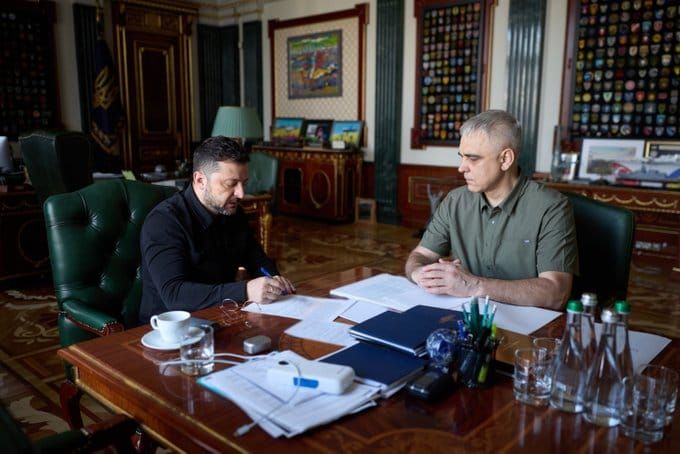
Oleksandr Poklad, acting head of the service, briefed the president on its priorities for August, Zelenskyy wrote on X. Zelenskyy said the service had good results and that he had approved further steps to remove people inside it who work for themselves rather than for Ukraine. He made no mention of the 40-day operation.
I received a report on our operations to counter Russian aggression. The Security Service of Ukraine has delivered strong results, and today I approved new operations. Oleksandr Poklad briefed on the Service’s priorities for August. I also approved further steps for the Head of… pic.twitter.com/ldhPbnIxZt
— Volodymyr Zelenskyy / Володимир Зеленський (@ZelenskyyUa) August 4, 2026
Russia has made no public move towards ending the war in those 40 days. It widened its strikes on Ukraine's Black Sea ports, holds marginally more Ukrainian territory than on 25 June and has offered no concession at the negotiating table. Zelenskyy dismissed his own defence minister on 15 July, then dismissed his commander-in-chief six days later under pressure from the street protests the first sacking set off.
Refineries, tankers and Crimea
The Security Service published weekly target summaries throughout the campaign. Its 13 July report named the Yaroslavl oil refinery, the First Plant refinery in Kaluga region, the oil loading terminal at Vysotsk seaport in Leningrad region, the Cherkasy pumping station in Bashkortostan on the Transneft-Ural system and fuel depots in Tver region, Stavropol Krai and Kerch.
Eight attack drones reached the Cherkasy site after a flight of 1,500 kilometres, the service said. It also struck the Hvardiiske airfield in occupied Crimea, damaging three aircraft hangars, and a Pantsir-S2 air defence system near Simferopol.
A Sea Baby naval drone struck the stern of the tanker Blue in Ukraine's exclusive economic zone near occupied Yalta. The vessel carries sanctions from the EU, the United Kingdom, Canada, Australia and Ukraine for moving Russian oil around international restrictions.
Ukraine hit the Lukoil refinery at Volgograd on 31 July, a plant with annual crude processing capacity of 15 million tonnes, along with an aircraft factory at Yevpatoriia in occupied Crimea, the General Staff said. Zelenskyy confirmed damage on 1 August to three refineries in Bashkortostan and to the sanctioned container ship Yanina, and Rosatom chief executive Alexey Likhachev acknowledged the strike on the Yanina, the Institute for the Study of War said.
Ukraine's General Staff said on 4 July that 42.7 per cent of Russia's projected refining capacity had been disabled and put industry losses at 13.5 billion dollars since August 2025. The International Energy Agency said more than 20 per cent had been knocked offline. Russian refineries processed an estimated 3.6 million barrels of crude a day in July, the lowest level since May 2002 and roughly a third below the seasonal norm, according to EA Analytics data cited by Bloomberg on 3 August. Russian plants averaged between 5.3 million and 5.6 million barrels a day in the same period of the year from 2020 to 2025, and the combined annual capacity of refineries now fully halted or significantly reduced comes to nearly a quarter of Russia's total. Bloomberg's own count found strikes on 24 of Russia's 34 large refineries in roughly 50 attacks over 100 days.
Russia banned petrol exports in April, jet fuel exports from 1 June and diesel exports from 8 July, and turned to India, Kazakhstan and Belarus for imports.
Russia's oil export revenues fell by 5 billion dollars to 15.8 billion, the Kyiv School of Economics Institute reported in its oil tracker, with oil product exports down to about 1.6 million barrels a day, a record low. Diesel and gasoil exports dropped from a steady 900,000 to a million barrels a day to roughly 580,000 after the refinery strikes. Turkey drew 87 per cent of its diesel and gasoil imports from Russia before the ban.
Oil and gas revenues to Russia's federal budget came to 3.66 trillion rubles in the first half of 2026, down 23 per cent year on year and the lowest since 2020, meeting 41 per cent of the annual plan. The Accounts Chamber forecasts a full-year shortfall near 1 trillion rubles. Economist Kirill Rodionov put refinery repair costs at several hundred billion rubles at minimum, and the government has paid record subsidies to refiners for three consecutive months.
No one has published a total cost for the 40-day campaign. Ukraine's General Staff figure of 13.5 billion dollars covers everything since August 2025, and the Security Service, which costed its Spiderweb operation of June 2025 at 7 billion dollars, has issued no equivalent estimate for this one.
Strikes on Ukrainian ports
Three Russian cruise missiles hit the bulk carrier Golden Leo on 19 July as it left Odesa loaded with corn, killing 10 people, the Ukrainian Sea Ports Authority said. Nine crew members died along with a 66-year-old Ukrainian port pilot, from a complement of 17 Syrian and Indian seafarers, and four of the dead were Indian nationals. Eight people were rescued overnight while further strikes remained a threat. The Guinea-Bissau-flagged, Turkish-owned vessel sank off the coast on 26 July.
Odesa regional prosecutors opened a war crimes investigation under article 438 of Ukraine's criminal code, which covers violations of the laws and customs of war resulting in death. Russia's Defence Ministry said it had struck two bulk carriers carrying military cargo at the port of Odesa and offered no evidence for that.
Russian forces hit 28 merchant vessels around Odesa between 20 June and 20 July, killing 21 sailors, according to figures compiled by the historian Phillips O'Brien. The Maritime Executive put Russia's July total at 20 to 28 commercial ships in the greater Odesa area. A strike on 13 July hit a Togo-flagged ship unloading mineral fertilisers, killing five crew and injuring 10.
Maersk and CMA CGM suspended calls at the greater Odesa ports and rerouted cargo to Constanta in Romania. Viktor Berestenko, president of the Association of International Freight Forwarders of Ukraine, told RBC-Ukraine that container lines run to fixed schedules and that even short spells of uncertainty produce cancelled services and diverted ships. Restoring shipping needs "protection of ports and approaches to them", he said, along with functioning war-risk insurance and constant contact with owners and insurers.
Black Sea war-risk rates moved above 1 per cent of cargo value after the July strikes, with one broking source putting them near 1.5 per cent, Reuters reported. Repositioning empty containers and rebalancing equipment could push costs up for months even if the security situation steadies, Berestenko said.
Russian missile and drone strikes on Odesa, Chornomorsk and Pivdennyi have taken roughly a third of Ukraine's seaborne grain export capacity out of use, the Ukrainian Agrarian Council said on 15 July. Those three ports carry more than 90 per cent of Ukraine's farm exports, the country's largest source of foreign currency earnings.
Monthly throughput at the Odesa ports has fallen from about 6 million tonnes to about 4 million, and four of their 13 large grain terminals suspended purchases. Euronext wheat rose 7 per cent on 15 July to 231.75 euros a tonne, its highest since February 2025. Ukraine supplies about 6 per cent of world wheat exports and about 11 per cent of world corn exports.
Economic impact
The National Bank of Ukraine put the cost of the port shutdown at 2.5 billion dollars in foreign currency earnings over a single quarter, and at roughly 0.9 per cent of GDP for the year. Governor Andriy Pyshnyy said Ukraine has exported 4 to 4.5 million tonnes of farm produce a month in recent years with about 90 per cent of it moving through the seaports, against a combined rail and Danube capacity of about 2.5 million tonnes a month.
Danube capacity has been cut by low water during the heatwave, Pyshnyy said, and the alternative routes should reach about 3.5 million tonnes a month once operations resume in August and September. He said those routes cost significantly more than the sea corridor and that the Danube ports themselves risk heavier shelling.
Turkey raised its transit fee by about 15 per cent on 1 July, and Ukrzaliznytsia proposed a 30 per cent rail increase from 1 August that would add 5 to 6 dollars a tonne. Ukraine had forecast about 43 million tonnes of exports for the 2026/27 season that began in July, against 37 million the season before.
The central bank raised its 2026 real GDP growth forecast to 1.8 per cent at the end of July, back to the January level after cutting it to 1.3 per cent in April. It estimated second-quarter growth at 0.8 per cent year on year after a contraction of 0.6 per cent in the first quarter, and named attacks on logistics, ports, energy and businesses as the constraint on anything stronger. It also flagged bankruptcy risk for farmers.
Ukrainian ports handled 42.4 million tonnes of cargo in the first half of 2026, the Centre for Economic Strategy reported. Ukraine's balance of goods and services stood at minus 6.3 billion dollars in June, on exports of 4.6 billion against imports of 10.9 billion. International reserves reached 51.3 billion dollars at the end of June after 11.3 billion dollars in external assistance arrived that month, 6.8 billion of it from the EU.
Territory taken in July
Russian forces advanced across 37.85 square kilometres of Ukraine in July, an average of 1.22 square kilometres a day, and advanced or infiltrated into about 121.56 square kilometres in total, the Institute for the Study of War said on 1 August. Its assessment found no significant gains two and a half months into Russia's spring and summer offensive, and Russia's monthly rate of advance has not shifted much since February, before the offensive began in mid-March. Russian forces took 455.74 square kilometres in July 2025.
Russia's Defence Ministry said its forces took more than 728 square kilometres in July, its highest monthly figure since October 2024. No independent monitor has published a figure near it.
Kostyantynivka in Donetsk Oblast took the additional infiltration missions of July without being taken, ISW said. Russian troops hide in basements and ruined buildings inside the city to wait for reinforcements, a Ukrainian special forces officer told ISW, and use summer foliage for cover on the approach. Molniya first-person-view drones with a range of 20 kilometres and aircraft-type drones reaching 40 kilometres have complicated night resupply through Kramatorsk and Slovyansk, a brigade non-commissioned officer said. Two KAB-250 glide bombs killed two civilians in Druzhkivka on 2 August, the Ukrainian National Police said.
DeepState recorded a net Russian gain of 10 square miles in the four weeks to 28 July, while Russia Matters' reading of ISW data showed a net Russian loss of one square mile over the same weeks. Ukraine lost two square miles of Russian territory in Kursk and Belgorod oblasts in that period, its first loss of Russian ground since 9 September 2025, and now holds two square miles.
A Ukrainian brigade spokesperson said on 1 August that Russian forces are still pushing towards Zaporizhzhia City and may attempt a more concerted effort in August and September. ISW said it has seen no sign of preparation for a new major offensive there beyond the current advances on Orikhiv from the south and in the Hulyaipole direction.
Command changes during the campaign
Zelenskyy dismissed Mykhailo Fedorov as defence minister on 15 July, six months into the job, in a reshuffle that also ended Yulia Svyrydenko's term as prime minister and installed Naftogaz chief executive Serhiy Koretsky in her place.
Fedorov, 35, held the defence ministry for the first 20 days of the 40-day campaign. He built up the drone programme and pushed mid-range strikes on Russian logistics in occupied Crimea, the approach the campaign then ran at longer range, and he persuaded Elon Musk to switch off Starlink terminals in use by Russian forces. Fedorov said his team had cut Russian forces off from Starlink, isolated occupied Crimea and pushed through an unpopular reform of the army.
Yevhenii Khmara commanded the Security Service's Alpha special operations centre and ran the 40-day campaign as its acting head, and the same reshuffle moved him to the defence ministry as acting minister on 16 July. Poklad, until then first deputy head, took the service on 17 July under decree 622/2026. Both the minister credited with Ukraine's deep-strike capability and the officer running the campaign changed jobs inside 48 hours, halfway through the 40 days.
Pavlo Yelizarov, a deputy commander of the air force working on drones, resigned over the dismissal and said it was "a great blow to the country's defence capability". Dmytro Koziatynskyi, who organised the July 2025 protests against a law curbing the independence of Ukraine's anti-corruption agencies, called the first rally. Ukraine is barred from holding elections while martial law is in force, and NBC News described the demonstrations as a rare wartime display of dissent.
Protests began the following day in Kyiv, Lviv, Odesa and Dnipro and then ran daily. A Rating Group poll taken on 20 and 21 July put trust in Fedorov at 65 per cent, up from 35 per cent a week earlier, against 59 per cent for Zelenskyy and 23 per cent for Syrskyi, down from 39. Of those surveyed, 72 per cent opposed the dismissal and 5 per cent backed it. The poll reached 1,000 respondents by telephone, with a margin of error of 3.1 per cent.
Zelenskyy dismissed Syrskyi on 21 July and appointed Joint Forces commander Mykhailo Drapatyi in his place, with Ihor Skybiuk taking over the General Staff the next day.
Fedorov crisis
Fedorov told Ukrainska Pravda on 29 July that the reason for his removal was "connected to procurement, tenders" and the restructuring his ministry had begun there. He said the changes produced dissatisfaction among people who then pressed the president, that law enforcement attention to the ministry's work had grown from early April, and that he had warned Zelenskyy about a possible disinformation campaign against him.
Fedorov said Zelenskyy told him of the decision less than an hour before a meeting of the Servant of the People faction in parliament. He rejected media accounts that he had issued an ultimatum himself, and said he turned down the other posts he was offered because he had no interest in a job without authority over the course of the war.
Zelenskyy gave his faction a different reason on 16 July, according to Censor.NET: Fedorov's conflict with Syrskyi, with both men needing to go and Syrskyi impossible to remove at that point. Fedorov said Syrskyi had blocked his initiatives and had been willing to intrigue against him.
Daria Kaleniuk, executive director of the Anti-Corruption Action Centre, told the Kyiv Independent that "the entire government resignation was conceived by Zelensky solely to remove Fedorov."
The Defence Procurement Agency will handle roughly 600 billion hryvnias in 2026 along with part of the EU's 60 billion euro weapons loan, and overdue deliveries to the front at the agency stood at close to 46 billion hryvnias, the centre wrote in a statement after the dismissal. It wrote that the absence of a logical explanation from Zelenskyy pointed to the protection of corruption in defence, and that no successor could bring order to that spending if the president wanted the flows preserved.
The Anti-Corruption Action Centre and other activists have accused Poklad of leading the 2025 raids on the National Anti-Corruption Bureau and of building political cases, the Kyiv Independent reported. Zelenskyy has now tasked him with purging the Security Service of officers who serve themselves.
Negotiations and the peace track
Kyrylo Budanov, head of the President's Office, told journalists on 3 August that pressure on Russia would continue and that Ukrainians should not fixate on counts of 40, 100 or 115 days. Budanov said Russia still believes it can win militarily and that the war is strategically "at a dead end" for it.
Rustem Umerov became head of the Foreign Intelligence Service on 3 August under decree 695/2026, keeping the leadership of Ukraine's delegation to the trilateral negotiations with Russia and the United States, which have been stalled since February. He also continues to coordinate the Drone Deal, which secures long-term annual funding for Ukrainian defence manufacturers from foreign partners including in the Middle East. Zelenskyy said Umerov has the capacity to run diplomacy, defence and the talks with the U.S. at the same time.
Ihor Klymenko, interior minister since 2023 and previously head of the National Police, replaced Umerov as secretary of the National Security and Defence Council. The same set of decrees removed Oleh Luhovskyi as acting intelligence chief. Zelenskyy had dismissed Oleh Ivashchenko from the service on 2 January and moved him to Defence Intelligence, then made Luhovskyi acting head on 4 February, leaving the agency seven months without a permanent chief.
Anti-corruption mass protests have been ongoing in Ukraine, the largest seen through out the war. Organisers of the 31 July rally in Kyiv said it was the largest protest since the Revolution of Dignity in 2014. Veteran Dmytro Koziatynskyi said protesters want Fedorov returned and given a year to deliver reforms before any judgement on him.