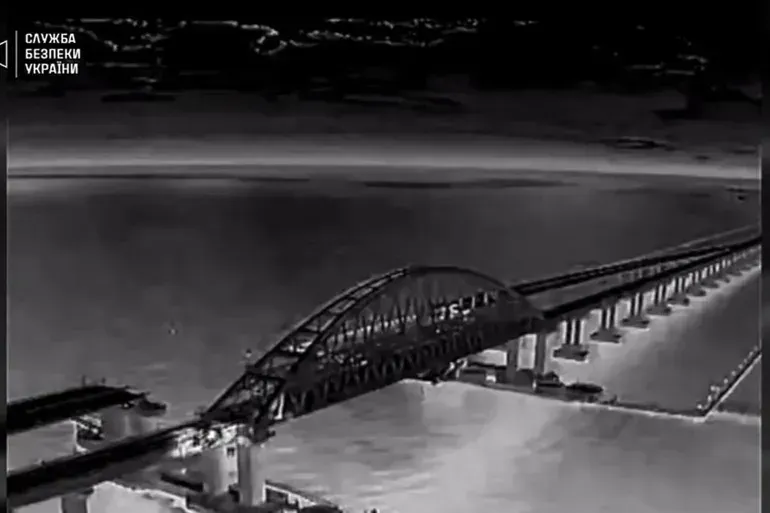
Ukrainian drones and missiles brought down a road span of the Crimean Bridge on 17 November, cutting Russia's only road link to occupied Crimea, hours after Russian ballistic missiles hit two of Kyiv's main bridges over the Dnipro.
"One of the metal arches and the road span beneath it were completely destroyed," Ukraine's Security Service (SBU) said in a statement. Parts of the structure now lie on the seabed, the SBU said. Videos and images posted by Zelenskyy, which have been independently verified and geolocated, show the arch lying in the strait, a gap in the roadway and the parallel rail bridge still standing.
The 19 km bridge joins Russia's Krasnodar region to the peninsula, and the collapsed span crossed the Kerch-Yenikale canal, the only navigable route between the Sea of Azov and the Black Sea. Russia's Transport Ministry suspended road and rail traffic and said preliminary information showed no casualties. Trains resumed on one track later that day. The first passenger train left the Russian side at 1.04pm Moscow time, the ministry said.
In Kyiv, Zelenskyy said four ballistic missiles were aimed at the Southern Bridge and three at the Northern Bridge overnight. Both were closed while engineers checked whether they could still carry traffic. By about 4pm the Southern Bridge had partly reopened to vehicles within a weight limit travelling from the east bank towards the city centre, and the western approach stayed shut because of damage. "Once specialists give us their findings, we'll know when we can reopen traffic," Mayor Vitali Klitschko said.
Defence Minister Yevhen Khmara said the Crimean strike used only Ukrainian weapons and technology. "This is a direct response to the terror against our infrastructure," he said. Dmitry Peskov, the Russian presidential spokesman, said there was "no doubt that the bridge will be restored" and that it would be better than before. Russia's Investigative Committee called the attack a terrorist act by Ukrainian armed groups.
The arch over the Kerch-Yenikale canal
The attack of 17 November was the second on the bridge in two nights. Drones hit it on 16 November and left scorch marks and a damaged arch on one of the road spans, satellite images showed. Road traffic was partly halted. Peskov's office described that damage as minor.
Zelenskyy called the second strike the seventh stage of an operation that had run for several weeks, in which Ukrainian forces first destroyed air defence systems, radars and electronic warfare equipment along the approach to the bridge. He said Palianytsia missile-drones hit the road section while Neptune missiles, Ruta weapons and FP-5 Flamingo cruise missiles hit the rail section. The SBU said its Alpha special forces fired the Palianytsia weapons. Neither the SBU nor Zelenskyy said which hit brought the arch down.
Denys Shtilierman, a co-owner of Fire Point, the Ukrainian company that makes the Flamingo, appeared to confirm on social media that the missile was used. Destinus, a Netherlands-based defence company, said its Ruta missiles hit the bridge on both days and that its drones helped suppress air defences. The SBU said the operation was its fourth against the bridge, after a lorry bomb in October 2022, sea drones in July 2023 and underwater explosives in June 2025.
Russia's Defence Ministry said its forces shot down 1,441 Ukrainian drones over 22 regions overnight into 17 November, above the 1,336 it reported the previous night. Both figures are the ministry's own and cannot be checked independently. Sergei Aksyonov, the Russian-installed head of Crimea, said two people were killed in a drone attack in the Leninsky district near Kerch.
Ferries, rail and the land corridor
Russian forces once relied on the bridge to supply troops in southern Ukraine. The military now depends more on a land corridor through occupied parts of Zaporizhzhia and Kherson regions, and the crossing is now used mainly by residents and visitors. Mikhail Razvozhayev, the Russian-installed governor of Sevastopol, said supply chains were intact and that the bridge had carried little cargo, mostly cars and buses. Aksyonov said foot passengers could cross by ferry.
Ukraine's General Staff said the bridge was the main route for fuel, ammunition, equipment and personnel heading to Crimea and southern Ukraine. It said the Chonhar and Henichesk bridges on Crimea's northern edge had also fallen this autumn, a claim that could not be independently confirmed. Ilya Abishev, a Russian military analyst, said the road arch helped support the span and that a long closure would leave traffic dependent on ferries and the land route.
Marat Khusnullin, the deputy prime minister leading a government commission on the bridge, told Russian state media that officials had completed a damage assessment and set the scope of construction. The commission also discussed alternative routes for cargo, he said. He gave no timetable or cost. Andrii Kharuk, a Ukrainian military aviation specialist, estimated the fallen structure at about 6,000 tonnes and said rebuilding it could take a year or more, because the replacement would have to be assembled on shore. Emil Kastehelmi, a Finnish military analyst, wrote that the road bridge would not be repaired during the war.
Andrey Sizov, head of the agricultural consultancy SovEcon, wrote on Telegram that the debris could significantly delay any resumption of shipping from the Sea of Azov, because the canal would first have to be cleared. Shipping on the Azov has been suspended since July because of drone attacks, he wrote. The sea normally handles about a quarter of Russian grain exports.
Putin opened the road bridge in 2018. It cost about US$3.7 billion and was built for 40,000 cars a day, according to Russian official figures. A lorry bomb in October 2022 killed four people and cut its capacity for several months.
Two crossings in Kyiv
Two people were killed in Kyiv's Obolonskyi district, the State Emergency Service said, though it was unclear whether they died in the missile strike or during a drone alert later that morning. Rush-hour traffic backed up across the city and metro stations filled with people looking for another way across the river. Klitschko said the strikes damaged infrastructure and cut water and heating in parts of the city.
The Southern Bridge in the Holosiivskyi district carries a metro line as well as road traffic. The Northern Bridge in the Desnianskyi district links the north of the city with the east bank, where more than a third of Kyiv's roughly 3 million people live. Drone strikes in early October had already damaged the road surfaces of both. Russian forces began attacking Kyiv's Dnipro bridges on 1 October, the first such strikes since the full-scale invasion, and switched from drones to ballistic missiles later in the month. Ballistic missiles hit the Southern Bridge on 27 October, hours after UN investigators said Russia's grid attacks were war crimes.
Elsewhere on the night of 17 November, two people were killed and 31 injured in Zaporizhzhia, and three were injured in Smila in Cherkasy region, regional officials said. DTEK, the private energy company, said 700,000 households in Dnipropetrovsk region were without power that morning. Deputy Energy Minister Artem Nekrasov said consumers in eight regions had lost supply. Russia's Defence Ministry said it had hit transport, military and energy facilities in Kyiv, Zaporizhzhia, Cherkasy and Dnipropetrovsk regions, along with port infrastructure and cargo ships.
Russia fired four Iskander-M ballistic missiles and 114 drones at Ukraine the following night, and missiles and drones hit 15 locations, Ukraine's air force said on 18 November. A 17-year-old girl was severely injured in a missile strike on Berestyn in Kharkiv region on the evening of 17 November and died in hospital, regional authorities said.
Strikes from Kyiv to Kerch
Zelenskyy said Russia was striking Ukrainian infrastructure every day, including bridges in Zaporizhzhia, Dnipro, Kyiv and the Odesa region, and wrote on X that Ukraine was reminding Russia that the war would always return to where it began. Russia's Defence Ministry has described the Kyiv bridges it acknowledged striking in October and November as routes for Ukrainian weapons and military vehicles. Ukraine's General Staff has described the Crimean Bridge in the same terms.
Russia and Ukraine are both parties to Additional Protocol I to the Geneva Conventions. Under its Article 52, a bridge or other object is a lawful target only if its nature, location, purpose or use makes an effective contribution to military action and its destruction offers a definite military advantage. Article 51 prohibits attacks expected to cause civilian harm excessive in relation to that advantage. The Southern Bridge carries a metro line used by residents of the east bank, and the Crimean Bridge carries civilian traffic to and from an occupied territory.
Elbridge Colby, the U.S. under-secretary for policy at the Pentagon, told the Ukraine Defence Contact Group at NATO headquarters on 17 November that Ukraine's long-range strikes had not been effective in driving an end to the war, in the Pentagon's assessment. Boris Pistorius, the German defence minister, called the criticism "quite a stupid thing" and said Russia's nightly strikes on energy, water and heating should be the subject of criticism. Wes Streeting, the British defence secretary, said Ukraine's long-range operations had weakened Russia's military and saved lives.
Putin is due to meet President Donald Trump and Chinese President Xi Jinping in Shenzhen on 19 November, on the sidelines of the Asia-Pacific Economic Cooperation summit, a week after Ukrainian, Russian and U.S. delegations held their first talks in nine months in Abu Dhabi. Trump told reporters on 16 November that Ukraine would be on the agenda.