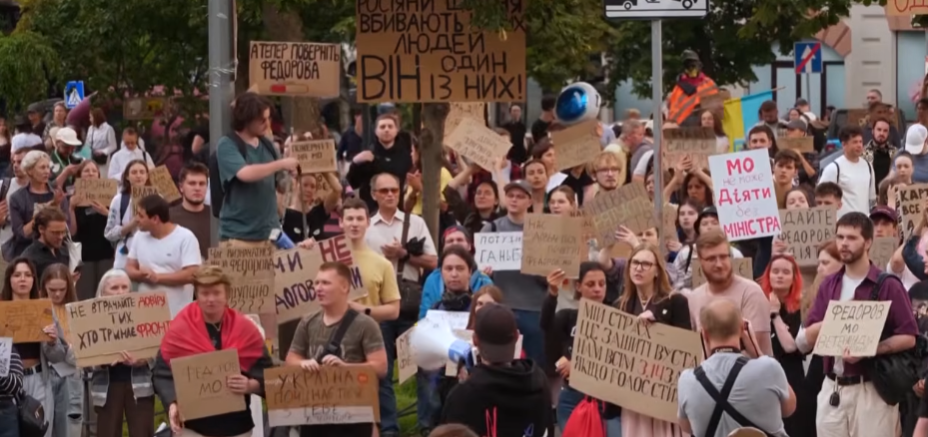
Ukrainians filled Ivan Franko Square in Kyiv on 24 July for a ninth consecutive day of protests demanding President Volodymyr Zelenskyy reinstate Mykhailo Fedorov, the reformist defence minister he dismissed on 15 July.
Fedorov, 35, lost the defence portfolio in a cabinet reshuffle that followed the resignation of Prime Minister Yulia Svyrydenko and dissolved her government after a year in office. Zelenskyy has never accounted for the sacking in full. The protests, called the Cardboard Maidan for the handwritten signs held above the crowds, have run daily across more than a dozen cities since 16 July, spreading to Lviv, Kharkiv, Odesa, Dnipro, Ivano-Frankivsk, Lutsk and Mykolaiv, and have already forced one concession from the president.
Protesters set two demands at the outset: reinstate Fedorov and dismiss Commander-in-Chief Oleksandr Syrskyi, whose feud with the minister lay behind the sacking. Zelenskyy removed Syrskyi late on 21 July and appointed Major General Mykhailo Drapatyi, 43, a field commander widely respected among soldiers, to replace him. Fedorov publicly welcomed the appointment. Zelenskyy praised Syrskyi's role in the defence of Kyiv, the Kharkiv counteroffensive and the Kursk operation.
Andrii Hnatov, chief of the general staff, was dismissed on 22 July and replaced by former Air Assault Forces commander Ihor Skybiuk. Fedorov had made the removal of both Syrskyi and Hnatov his condition for returning to the ministry. Major General Yevhenii Khmara, former head of the Security Service's Alpha Group, was named acting defence minister pending a parliamentary vote on a permanent replacement.
Organisers had suspended the main Kyiv rally after Syrskyi's removal, setting 24 July as the deadline for the government to act, while smaller demonstrations continued daily in the interim. Veteran Dmytro Koziatynskyi, one of the movement's public faces, called Ukrainians back to Ivan Franko Square on 24 July for what he said would be an open-ended protest. Turnout ran lower than the week before. Organisers said the daily demonstrations would now continue without end until Fedorov is back in office.
Fedorov rejected an alternative post on 23 July, saying he would serve only as defence minister. Zelenskyy said he had offered him a deputy prime minister role for military innovation, a proposal the president set out at a Kyiv press conference held alongside Irish Prime Minister Micheál Martin. "I will not accept any position other than defence minister," Fedorov said in a statement shared with reporters.
Heorhii Pavliuchenko, 25, joined the Kyiv crowd and said the dismissal was one of "the biggest mistakes" the government had made since Russia's full-scale invasion.
What the polling shows
Rating group polling taken on 20 and 21 July put trust in Fedorov at 65 per cent, up from 35 per cent a week earlier. Opposition to his dismissal stood at 72 per cent, with five per cent in favour and 17 per cent indifferent. The survey questioned 1,000 respondents aged 18 and over by telephone across all government-controlled oblasts, with a margin of error of 3.1 per cent at a 95 per cent confidence level.
Trust in Syrskyi fell to 23 per cent from 39 per cent over the same week. The same survey put former commander Valerii Zaluzhnyi, now ambassador to the United Kingdom, top on trust at 70 per cent, Fedorov second at 65 per cent, presidential chief of staff Kyrylo Budanov third at 62 per cent and Zelenskyy fourth at 59 per cent.
A hypothetical first-round presidential vote put Zelenskyy on 22.3 per cent, Zaluzhnyi on 14.9 per cent and Fedorov on 13.4 per cent. The pollsters said the survey was completed before Syrskyi's departure was reported.
Who Fedorov is
Fedorov took the defence ministry on 14 January 2026 at 35, with no military background, succeeding Denys Shmyhal. He had led the digital transformation ministry since 2019, launched the Diia state-services app and founded the IT Army of Ukraine after Russia invaded in February 2022. Lawmakers from both Zelenskyy's party and the opposition backed his appointment.
Fedorov pushed drone and cyber programmes as minister, moved to open up arms distribution and challenged the general staff over management he described as chaotic. He cracked down on procurement corruption and pressed for faster decision-making. He fell short of his pledge to fix recruitment as Ukraine's conscription crisis deepened.
The dispute behind the dismissal
Zelenskyy has tied the sacking only to Fedorov's conflict with Syrskyi and given no fuller account. Tension between the two had been expected since Fedorov's appointment and turned on opposing approaches to running the army, with the general staff resisting his reforms. Syrskyi, 60, born in Russia's Vladimir region and schooled in Moscow, favoured a centralised command culture that soldiers and analysts criticised as Soviet in style. Fedorov accused him of blocking his initiatives and pressing Zelenskyy to remove him, a charge Syrskyi denied.
Analysts said the reshuffle was meant to sideline a rising figure and had backfired, hardening public support behind him. Interior Minister Ihor Klymenko was tapped as Fedorov's permanent successor, a nomination protesters have urged parliament to reject. Klymenko's spokesperson said he was surprised by the proposal.
Russian strikes on Ukrainian cities continued through the standoff. A Russian ballistic missile hit a training ground in Kyiv Oblast on 24 July, the day the main protest resumed, striking an arms exhibition where representatives of the country's defence industry had gathered. At least 10 people were killed and about 100 wounded, Prosecutor General Ruslan Kravchenko said. The Bucha district was hit hardest. Prosecutors opened two criminal proceedings, one over Russia's violation of the laws of war and one over possible negligence by the event's organisers for holding a large gathering that became a target.
Fedorov refuses any post but defence minister, and Zelenskyy has not offered it back.