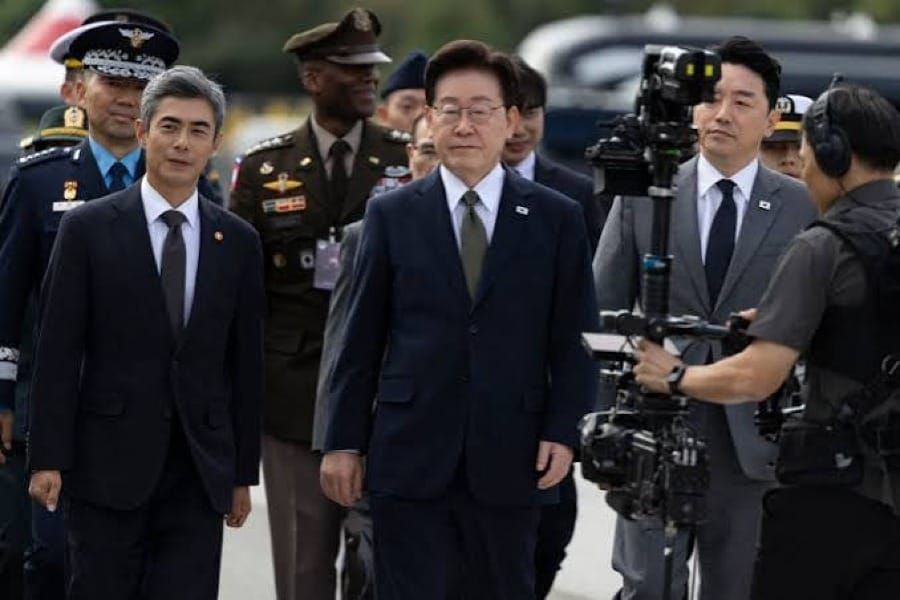
South Korean President Lee Jae Myung threatened on 2 October to take unspecified measures against Ukraine unless Kyiv acknowledged a confidentiality agreement covering the transfer of two captured North Korean soldiers and issued an apology. "If the refusal to acknowledge the facts and issue a public apology continues, we will take additional measures," Lee wrote on X, according to a Reuters translation. He wrote that the matter concerned "the dignity of the people and the nation of the Republic of Korea" and "cannot be overlooked", SBS reported.
Lee also expressed "grave regret" over Ukrainian remarks about an imminent military clash between North and South Korea, saying they amounted to encouraging war on the Korean peninsula, Reuters reported. When Seoul asked Kyiv to acknowledge the agreement and apologise, "Ukraine instead spoke of an imminent inter-Korean military clash," Lee wrote, in SBS's translation.
Kyrylo Budanov, head of the Office of the President of Ukraine, told the outlet Newsforce on 27 September that North Korea was "learning from our war and arming itself". "The situation is worsening with each passing day. And it is only a matter of time before a trigger event occurs that leads to uncontrollable consequences," he said, according to the Ukrainian news agency UNN. Budanov pointed to North Korean plants mass-producing single-use attack drones and to a recent suspected landmine explosion on the South Korean side of the demilitarised zone. SBS reported that he offered no specific evidence that Pyongyang was preparing for combat on the peninsula.
The disclosure
Zelenskyy announced the transfer in his address to the UN General Assembly in New York on 23 September. "Kim Jong Un uses them like currency and gets something in return," he said of the North Korean troops sent to fight for Russia, Al Jazeera reported. North Korea has deployed about 15,000 troops to support Russia since 2024.
Ukrainian forces captured the two soldiers in Russia's Kursk region in January 2025. They arrived in South Korea in mid-September and were found to have no major health problems, the Korea Herald reported. One had served in a reconnaissance unit after being conscripted at 17, Euronews reported, and Al Jazeera reported that one had tried to kill himself when he was captured. Both men consistently told South Korean officials in consular interviews that they wanted to go to the South, the Korea Times reported.
Dmytro Lytvyn, Zelenskyy's communications adviser, denied on 25 September that any confidentiality agreement existed. He said Ukraine was an "open country" and that handing over soldiers in secret would be "unusual", Euronews reported.
Lee called the disclosure "very disappointing" in the days after the speech. "I do not know why the Ukrainian side broke the agreement and made the matter public," he said. Seong Ghi-hong, a senior secretary to the president, said on 27 September: "It is in itself a very serious matter that the Ukrainian side violated the confidentiality agreement." He described a statement from the Ukrainian presidential press office as false, said it seriously undermined trust and demanded an explanation and an apology.
Park Yoon-joo, the first vice foreign minister, summoned Ukraine's acting ambassador on 28 September to lodge a formal protest. Foreign ministry spokesperson Park Doo-soon said on 29 September: "We understand that the two sides reached a clear understanding during consultations at various levels to keep the matter confidential, given its implications for the safety of the soldiers and their families." He also said: "This is a humanitarian issue that is not linked to any other precondition or matter."
Motives and fallout
South Korea's National Intelligence Service concluded that Zelenskyy's disclosure "appeared intended to build public support in South Korea for providing arms to Ukraine", the Korea Herald reported. Seoul has not supplied lethal weapons to Ukraine, citing a domestic ban on military aid to countries at war. Park Won-gon, a professor at Ewha Womans University, told Euronews the government was concerned that confirming the soldiers' arrival could further fuel hostility towards Seoul.
Andrii Sybiha, Ukraine's foreign minister, called the dispute "a diplomatic misunderstanding" in an interview published on 28 September. "South Korea is an important country for us. And I very much hope for momentum, continued cooperation," he said. Reuters reported that the two countries' foreign ministers had discussed possible remedies, including an apology, and that South Korean officials were weighing what response Seoul could accept given Ukraine's wartime circumstances.
Kyiv had not publicly acknowledged an agreement or apologised by the time of Lee's post. Analysts cited by Reuters said any additional measures would probably target the humanitarian, financial and reconstruction assistance South Korea provides to Ukraine, and that Seoul relies on Ukrainian intelligence about North Korean military activity.