South Korea's presidential office demanded an official explanation and apology from Ukraine on 27 September, accusing Kyiv of breaking a confidentiality agreement over the transfer of two North Korean prisoners of war to Seoul and then denying that the agreement existed.
Seong Ghi-hong, senior presidential secretary for public relations, said in a statement: "The presidential office expresses strong regret over Ukraine's unilateral disclosure and its subsequent false announcement that there had not been a non-disclosure agreement." He said the episode "seriously undermines trust between the two governments and gravely damages friendly relations between the two countries". Seoul was "considering additional measures that may be necessary regarding this matter", Seong said. He did not say what those measures might be.
Ukrainian officials raised the transfer with Seoul repeatedly and through several channels and asked for it to be kept secret, according to Seong. Kyiv feared that disclosure would draw criticism at home that it had given up a chance to trade the two men for Ukrainian soldiers held in Russia, he said. Seoul agreed to secrecy for security, diplomatic and humanitarian reasons, including the safety of the prisoners and of relatives still in North Korea.
Zelenskyy's announcement
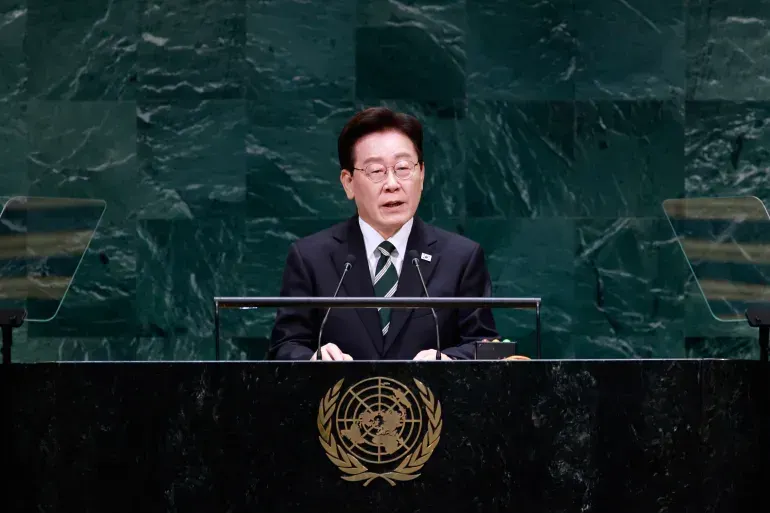
Zelenskyy disclosed the transfer in his address to the 81st UN General Assembly in New York on 23 September. "Recently, we sent two North Korean prisoners of war to the Republic of Korea," he said. He said the soldiers had not been easy to capture alive and that one "tried to kill himself" when he realised he was about to be taken prisoner. "Kim Jong Un uses them like currency and gets something in return," Zelenskyy said of North Korea's troops in Russia, and he said advanced weapons technology was spreading across Asia.
South Korean President Lee Jae Myung wrote on X the next day that Ukraine had disclosed the transfer in breach of a nondisclosure agreement and that "it was appropriate in every aspect not to disclose" it given the possible consequences. "I do not know what circumstances led the Ukrainian side to disclose the matter despite the confidentiality agreement, but it is deeply regrettable," Lee wrote. South Korea's foreign ministry declined to confirm or deny details of the transfer, citing the prisoners' safety and the protection of their families.
A source in Ukraine's Office of the President told Ukrainian reporters on 25 September: "Ukraine did not promise to hide this, and we never hide it when it concerns prisoners." The source said Seoul had not asked Kyiv to withhold details, that Ukraine had disclosed nothing significant about the process and that "Ukrainians have the right to know what is happening".
Dmytro Lytvyn, an adviser to Zelenskyy, told journalists: "There was no such agreement. That is not true." He said Ukraine was "an open country" and that handing over the soldiers in secret would have been strange. "From the entire story, which is long and detailed, we reported only the fact itself, that they were sent to the Republic of Korea," Lytvyn said. Ukraine's embassy in Seoul did not respond to requests for comment on 27 September.
Protection decision in Seoul
South Korea's Ministry of Unification said on 28 September that it would decide whether to grant the two men state protection under the law on North Korean defectors. Yoon Min-ho, the ministry's spokesperson, said the process "will be reviewed in line with relevant laws and past cases". Asked whether the Act on the Protection and Settlement Support of Residents Escaping from North Korea would apply, he said: "For now, it would be fair to see it that way." The ministry said it would explain the procedure at a later date.
The unification minister normally decides protection for North Korean defectors, Yoon said, but the director of the National Intelligence Service decides when a case could significantly affect national security. Asked about any reaction from Pyongyang, Yoon said: "No developments have been detected so far."
Article 3 of South Korea's constitution defines the Republic of Korea's territory as the whole Korean peninsula, and Seoul treats North Koreans as its citizens with the right to settle in the South. Lee's government, which has sought better relations with Pyongyang since he took office in June 2025, had appeared hesitant for months to take custody of the pair.
Captured in Kursk
Ukrainian forces captured the two soldiers in Russia's Kursk region in January 2025, and Zelenskyy announced the capture on 11 January 2025. They were the first North Korean soldiers taken alive since Pyongyang sent troops to fight for Russia in 2024. South Korea's National Intelligence Service said one was born in 2005 and had served as a rifleman since 2021 and the other was born in 1999 and had served as a sniper reconnaissance soldier since 2016. Both were wounded, one in the jaw and the other in the hands, and both were held by the Security Service of Ukraine. One carried a Russian identity document issued under an assumed name from the Republic of Tuva.
Ukrainian soldiers reported that North Korean troops who were surrounded or wounded chose suicide over surrender, and South Korean intelligence said memos recovered from dead soldiers showed commanders pressing troops to kill themselves before capture. Both prisoners later said they wanted to go to South Korea, according to a South Korean opposition lawmaker.
Lee and Zelenskyy discussed the prisoners at the NATO summit in Ankara in July. Kang Yu-jung, Lee's senior spokesperson, said afterwards that the two leaders had agreed to resolve the prisoners' status in accordance with international law. Their agreement built on a pledge to cooperate on the issue made at a meeting of the two countries' foreign ministers in March.
North Korean troops in Russia
North Korea has sent an estimated 14,000 to 15,000 soldiers to support Russia since 2024, most of them to the Kursk border region, according to South Korean intelligence. Vladimir Putin and Kim signed a mutual defence treaty in Pyongyang in June 2024. Ukrainian intelligence has estimated that about 3,000 North Koreans were killed and 1,500 wounded, while South Korean, Ukrainian and Western officials have cited figures of more than 6,000 dead. No North Korean troops are known to have fought on Ukrainian territory. Zelenskyy said in August that up to 50,000 more North Korean troops could be sent to Russia.
South Korea has given Ukraine only non-lethal aid, and Kyiv has pressed Seoul for advanced air defence systems. Seoul has also backed efforts to revive talks with North Korea, and US President Donald Trump has again said he is willing to engage with Kim. Lee told the UN General Assembly on 22 September: "I hope the long-suspended dialogue between North Korea and the US can resume without delay."
Budanov's warning
Kyrylo Budanov, head of Zelenskyy's office, said in an interview published on 27 September that North Korea was using its experience in the war to improve its weapons. "North Korea is learning from our war and arming itself. The world must see this connection while there is still time," Budanov said. He said Pyongyang had set up mass production of single-use attack drones, that some of the weapons it had recently introduced were Russian-made and that its military buildup was meant to prepare for combat on the Korean peninsula.
Budanov said incidents near the Military Demarcation Line were becoming more frequent and that "it is only a matter of time before a trigger event occurs that leads to uncontrollable consequences". He gave no public evidence that North Korea was preparing to attack South Korea. His interview was published on the same day Seoul demanded an apology from Kyiv.
Three soldiers from South Korea's 25th Army Division were wounded on 21 September by an explosion south of the Military Demarcation Line in the western sector of the demilitarised zone. "Three of our military officers conducting a search operation at a point south of the Military Demarcation Line in the western section of the DMZ were injured in an unidentified explosion," a Joint Chiefs of Staff official said. One of the three underwent amputation surgery on his ankle at the Armed Forces Capital Hospital. Military investigators are examining whether the blast came from a North Korean mine laid south of the line, a mine washed across by heavy rain or a South Korean mine.
North Korean troops have laid mines along the line since 2024 as part of a border fortification drive, and some have crossed 10 to 15 metres into the South while doing so. Yoo Yong-won, a South Korean lawmaker, said the blast site was "near a minefield the North Korean military created south of the MDL between last year and early this year".
Strike drills
North Korea's army fired attack drones, tactical cruise missiles, short-range ballistic missiles and large-calibre rockets at a single island target off Wonsan on 12 September, the first drill in which state media described drones and missiles used together. Weapons with different speeds and flight paths fired at once can overload air defences, and analysts said adding drones to North Korea's missile forces could drain South Korean interceptors and raise the success rate of follow-up strikes. Kim oversaw two launches of an upgraded Hwasong-11Ma hypersonic missile on 20 September, and South Korea's Joint Chiefs of Staff said the missiles flew about 450 kilometres and more than 600 kilometres. North Korea test-fired guided 240mm rockets with a range North Korea put at up to 115 kilometres on 22 September.