
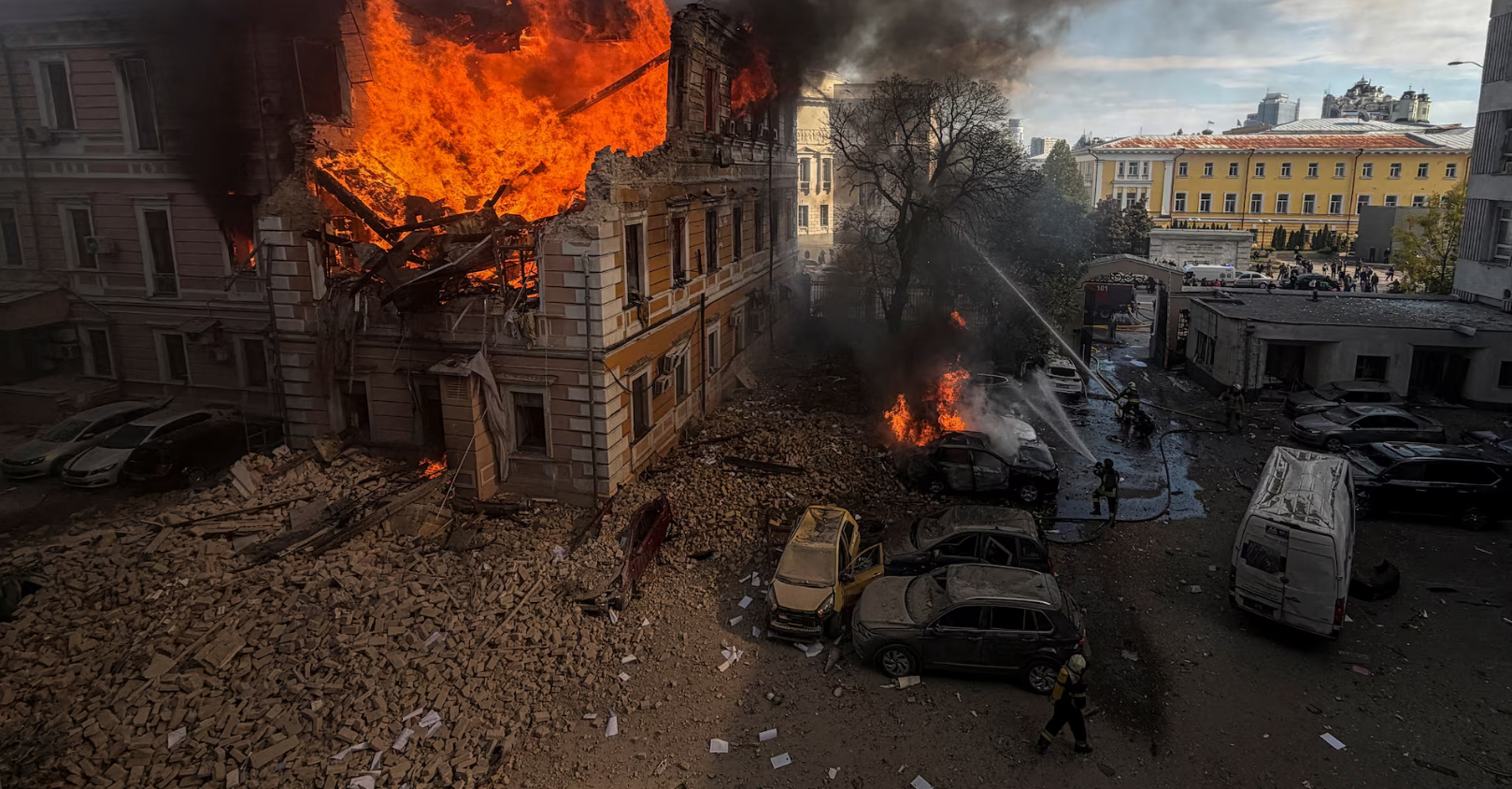
Russian ballistic missiles hit Kyiv at about 01:20 on Tuesday 29 September, hours after a day of drone strikes on the capital. City officials said two people were killed and 26 injured in Kyiv on Monday and early Tuesday, among them three children. Drones hit the Dobrobut private clinic, injuring seven people, six of them staff, as well as the Darnytsia pharmaceutical plant, filling stations and a business centre in Sviatoshynskyi district. The Ukrainian air force said Russian forces launched more than 120 drones in the latest wave, most of them jet-powered. "Every Russian terrorist attack results in casualties that could have been prevented had the pressure on Russia finally become total," President Volodymyr Zelensky said.
A Russian drone hit the main building of the National Academy of Sciences of Ukraine on Monday 28 September, near the junction of Volodymyrska Street and Taras Shevchenko Boulevard in the historic centre of Kyiv, a short walk from the German embassy. The drone came in fast and at a steep angle and set the building on fire. Staff climbed down firefighters' ladders from the upper floors. The office of the state language protection commissioner said people "were saving themselves by climbing out of windows of the burning building, risking fatal fall to avoid burning to death".
At least two people were killed and five injured, according to the Kyiv city military administration and the academy. The academy said a woman killed in the strike was an aide to Volodymyr Horbulin, a former secretary of Ukraine's National Security and Defence Council who has an office in the building. "Horbulin himself is alive. We have also lost contact with another colleague whose office was hit," the academy's press service said. A person familiar with his condition told the BBC that Horbulin was cut by broken glass and has returned home. The language commissioner's office said two academicians had been killed, a figure the academy had not confirmed by Tuesday morning. The academy called the attack "Russian terror" and "barbarity".
The academy was founded in 1918 with the geochemist Volodymyr Vernadsky as its first president and oversees 159 research institutions. It says more than 300 of its buildings and facilities have been destroyed or damaged since February 2022. Zelensky said: "There will certainly be a response to Russia for this." Foreign minister Andrii Sybiha wrote that Russia "is deliberately expanding the boundaries of what it believes the world will tolerate".
A guided bomb hit a nine-storey apartment building in Kharkiv at 04:19 on 28 September, wounding 43 people, 11 of them children, according to Ihor Terekhov, the city's mayor. A drone struck an office centre in central Dnipro during working hours the same morning, killing three people and wounding at least 18. The Russian defence ministry said its forces had hit a Nova Poshta distribution hub in Odesa, a cargo ship in the Black Sea and another vessel in the port of Chornomorsk. Dmitry Peskov, the Russian president's spokesman, told reporters: "Ukraine will have to pay a price for the actions that have taken place in recent months. That is happening right now."
Kyivstar, Ukraine's largest mobile operator, told Interfax-Ukraine on Sunday 27 September that its headquarters in Kyiv had been hit in a Russian drone attack. Nobody was reported hurt at the building. Zelensky said a data centre in the capital was struck twice the same morning, wounding two children and an adult. The Russian defence ministry said its forces had hit a data centre belonging to Vodafone Ukraine, the country's second-largest mobile network, and data centres of Omega Telecom and Kyivstar. It said the strikes had cut internet services used by the Ukrainian military, and it posted a drone image on social media captioned "Digital detox" and "Mandatory!".
Ukraine's digital transformation ministry said about 100,000 households in Kyiv and the surrounding region lost internet service after strikes on provider data centres on Wednesday 23 September and Thursday 24 September. Foreign minister Andrii Sybiha wrote on X that Russia "has targeted major Ukrainian data centres, seeking to disrupt the flow of information. Rapid alerts about missile and drone threats are essential, they save lives."
Cosmonova, a Kyiv data centre operator, said on 26 September that its facility would "no longer operate" after repeated Russian strikes. Several Ukrainian television channels lost their broadcasts, and Kolo.TV, an internet provider hit for the third time, suspended service while it moved equipment to other sites. The Russian defence ministry said on 26 September that it was targeting data centres because they "process and transmit intelligence data for the Ukrainian Armed Forces". Prime Minister Serhii Koretskyi said: "All infrastructure is at risk until the war ends."
A drone struck an office building in Kyiv's Solomianskyi district at 15:02 on Friday 25 September, killing four people. Vitali Klitschko, the mayor, said the bodies were found in the car park and seven people were injured, one of them a child. The building houses Datagroup, one of Ukraine's largest telecommunications companies. Datagroup said none of its employees were hurt and that customer data was intact. Across the city that day, attacks killed five people and injured 31, and by Saturday the toll from Friday's strikes had risen to seven.
Zelensky said drones had also hit a warehouse used by McDonald's on 25 September. "An attack drone against ordinary food products," he said. "The Russians are constantly expanding their escalation campaign: American and other businesses, data centers, internet providers, all ordinary life is simply a target for Russia."
Russian forces launched 170 drones at Ukraine overnight into 27 September, 76 of them jet-powered, according to the Ukrainian air force, which said 147 were shot down or jammed. Russian attacks killed 14 people and injured 57 across the country over the day, with the heaviest casualties in Sumy, Zaporizhzhia and Donetsk regions. Zelensky said Russia had launched more than 2,200 attack drones, about 1,650 glide bombs and 38 missiles in the previous week. He said Ukrainian military intelligence had obtained documents showing the Russian government plans to spend $12 billion in 2027 on jet-powered drones and loitering munitions.
An economy under fire
Ukrainian officials now describe the Russian air campaign as "total war", a phrase meant to capture its focus on output, jobs and supply lines rather than front-line gains or the power grid alone. Russian forces have hit commercial sites throughout the full-scale invasion, which began in February 2022. The scale of the attacks has grown sharply since the summer, as Russian advances on the ground have largely stalled.
Orysia Lutsevych, head of the Ukraine Forum at Chatham House, a London research institute, told The New York Times: "In a war of attrition, the economy becomes the prime target." She said the Russian government was trying to raise the cost to Europe of keeping Ukraine's war effort going. A larger bill gives material to far-right parties in Britain, France and Germany that oppose aid to Ukraine.
Oleksandr Kravchenko, Ukraine's economy minister, said on 12 September that losses from Russian strikes on businesses could reach $10 billion this year. Much of the cost is indirect: lost sales, disrupted working days and logistics bottlenecks. Kravchenko estimated the value of a single destroyed Rozetka warehouse in Brovary, outside Kyiv, at about $70 million. The online retailer is one of at least eight large companies whose sites have been hit this summer, along with Epicentr, Nova Poshta, Silpo, Auchan, Varus, Dnipro-M and Coca-Cola. A strike on 5 August killed 17 people and destroyed several warehouses at once.
Taras Vysotsky, the agriculture minister, said on 28 August that Russian attacks had destroyed about 90 per cent of the food logistics capacity of Ukraine's retail chains. An industry estimate puts the loss at about 40 per cent of the country's modern warehouse space. More than 60 warehouse workers have been killed. The goods lost include fresh produce, meat, buckwheat, soft drinks, vodka, wine, infant formula, toys, trainers, autumn clothing lines, parcels and post, car parts and hundreds of tonnes of medicines.
Ukraine's cabinet responded with a three-part support package: wider coverage for its compensation scheme, a five-percentage-point interest subsidy on loans of up to UAH 1 billion (about $22 million) for large businesses and an extension of the 5-7-9 lending programme for smaller firms.
The European Bank for Reconstruction and Development cut its forecast for Ukraine's growth this year to 1.5 per cent on 24 September, down from 2.2 per cent in June. It lowered its 2027 forecast to 2.5 per cent from 4 per cent. The bank said attacks on energy and economic infrastructure "have shifted the economy from slow recovery to near stagnation". Some economists expect growth of zero for 2026.
Dimitar Bogov, the EBRD's chief economist, told The New York Times that labour shortages and heavier bombardment meant Ukraine was entering "its most difficult period of the war". Household spending power remained strong, he said, but people "are not able to spend".
Ukraine's grain and oilseed exports are expected to fall by 50 to 60 per cent in the second half of 2026 because of attacks on Black Sea ports, the EBRD said. Alternative routes along the Danube and through the EU's Solidarity Lanes have less capacity to absorb the shortfall. Inflation reached 7.7 per cent in July. The bank has committed €10.8 billion to Ukraine since February 2022.
Zelensky told European governments in early September that Ukraine needed $27 billion to close a budget gap. The EU had already approved a loan worth more than $100 billion in April.
Air alerts from dawn to dusk
Russian forces changed tactics in late August, keeping major Ukrainian cities under air-raid alerts for more of the working day. Many shops and service businesses close while an alert is in force, and sales fall with each hour lost.
Tymofiy Mylovanov, a former economy minister who is now president of the Kyiv School of Economics, told The New York Times that all-day attacks were bringing the economy close to a "standstill" as people spent hours in shelters. The university plans a new building constructed entirely underground to protect its students.
Ukraine's economy shrank by about 20 per cent in 2022 and has grown in each year since. Defence technology is one of the fastest-growing sectors: its output more than doubled in 2024. The government has since classified economic data on defence industries, which Russian forces target. Solar and wind installations have also expanded, spreading generation across many small sites that are harder to knock out with a single missile.
Exports of steel, iron ore and grain have fallen by about a third since 2022, but foreign aid has more than made up the difference. Central bank reserves have risen from $29.1 billion before the invasion to $48.7 billion.
Railways and ports
Sybiha said on 15 September that Russian forces had damaged or destroyed more than 500 Ukrainian locomotives since February 2022, more than 250 of them in 2026 alone. Ukrainian Railways had about 1,800 locomotives before the war. Ukraine is now losing about one a day on average to Russian strikes, which use a targeting system that can find trains even when they are moving.
A drone hit a passenger train's locomotive on 13 September about two kilometres from the Polish border. Strikes on 15 September hit rail facilities in Volyn region near Poland and in Lutsk and Vinnytsia region. Sybiha appealed for replacement locomotives built for Ukraine's 1,520-millimetre gauge and wrote that "supporting Ukraine's railway resilience will help avert a humanitarian crisis".
Russian forces have also timed attacks to the farming calendar, hitting grain silos in summer to destroy storage before and during the harvest. The EU is sending mobile silos to Ukraine. Farmers who cannot sell their grain are expected to default on loans, with likely consequences for Ukrainian banks.
The internet as a target
Ukraine's government has spent the war trying to keep phone and internet networks alive through long power cuts, requiring operators to hold backup generators and batteries. The country's internet market is split among hundreds of small providers, which makes it harder for any single strike to take a whole city offline. Officials and industry figures fear that repeated attacks through the winter could still reach the systems behind banks, payment networks and public services.
Serhii Sternenko, a blogger and former government adviser, wrote on X that Kyiv residents should prepare for winter "by getting Starlink terminals or other means of maintaining communications". He wrote that the Russian aim was "not only to strike at the capital's energy infrastructure but also to destroy all datacentres and internet operators".
Polish authorities said a fire at a Starlink ground station in central Poland that serves the Ukrainian military was sabotage. Krzysztof Gawkowski, Poland's deputy prime minister and digital affairs minister, said on 25 September: "The fire engulfed the power station and the generator; it is clear that this act of sabotage was deliberately designed to disable the station." He said the station was back in service and that the attack was part of Russian hybrid warfare, as Prime Minister Donald Tusk had said. Denmark's defence intelligence service said the same week that a limited Russian military attack on a NATO member "could potentially take place in the coming months".
Russia's own economy
Ukrainian long-range drones have spent months hitting Russian oil refineries, the country's most valuable industry, and the warehouses of its two largest online retailers, Wildberries and Ozon. Strikes on Wildberries began in July. Ozon, which had taken market share from its damaged rival, came under attack in late August. Small businesses that sell through both platforms lost inventory.
Russian petrol prices have risen 21 per cent since January, to an average of 78.51 roubles a litre on 14 September. Leningrad region has capped sales at 30 litres per vehicle until 1 October. Zabaikalsky region in Siberia has imposed a 15-litre limit at 48 filling stations, and Kaluga region has introduced odd-even number-plate rationing and banned sales into canisters. The Russian government extended a ban on diesel exports to 30 September. The Ukrainian military claims its strikes have taken more than 45 per cent of Russian refining capacity offline, a figure that has not been independently confirmed. Ukraine's general staff said on 26 September that its drones had hit the Ilsky refinery in Krasnodar region. The Security Service of Ukraine said its drones hit four oil depots in Krasnodar region overnight into 28 September, including a Lukoil fuel depot in Pavlovskaya. Zelensky said Ukrainian drones also struck defence plants in Tula and Voronezh regions. The Russian defence ministry said it had shot down 254 Ukrainian drones over 12 regions between 20:00 on Sunday and 08:00 on Monday, Moscow time. "We are consistently responding to Russian strikes against life with our own long-range capabilities," Zelensky said.
The Russian finance ministry reported a federal budget deficit of about $67.6 billion for January to August, 2.5 per cent of GDP, against about $44.5 billion planned for the whole of 2026. It now expects the full-year gap to reach about 3 per cent of GDP. On 24 September the ministry published a draft budget for 2027 to 2029 with new tax rises, a year after it raised VAT for 2026. The draft widens the income tax band on interest, dividends and property sales from 13 to 15 per cent to 13 to 22 per cent, affecting about four million people. It applies VAT of 22 per cent to cross-border online purchases, adds a 100-rouble fee on foreign parcels worth less than €200 and imposes a 30 per cent levy on windfall earnings of mining and metals companies. The ministry projects a 2027 deficit of about 2 per cent of GDP, based on an oil price of $50 a barrel.
A wine importer's warehouses
Good Wine, a wine distributor based in Kyiv, has contracts with about 1,000 wineries around the world, a flagship shop in the capital and outlets across the country. Its main Kyiv warehouse was hit in tank fire in the first weeks of the invasion. About 1.6 million bottles shattered in the blasts and the fire that followed. The owners gave away scorched but unbroken bottles and rebuilt.
A Russian long-range strike hit the rebuilt warehouse this year. Two other company warehouses and a commercial kitchen were also struck. No employees were killed, but the company lost about $9 million in stock, including a collection of rare vintages.
Dmytro Krymsky, a co-founder, told The New York Times that Good Wine is moving towards storage spread across several sites so that no single strike can halt the business. "Every day the war goes on, everything becomes more expensive," he said.
Ukrainian companies are weighing three broad options: just-in-time delivery, dispersed storage or building below ground. Designs for warehouses buried about six metres deep, beyond the reach of most munitions, are under consideration, and one Ukrainian firm has designed an underground data centre. At least three companies build private bunkers for households and businesses. Bunkerok, founded in 2023, installs about 170 a year. Another new builder trades as Hobbit House.
Eight million books
Two Russian drones hit the warehouse of Ranok Publishing in Kharkiv at about 11:00 on Saturday 1 August. Ranok is one of Ukraine's largest children's and educational publishers, and the strike came as it was shipping textbooks for the new school year. About 50 employees were in the building when the first drone struck. The fire burned too hot for them to put out, and the second drone hit within minutes. Everyone reached the shelter unhurt. The fire burned for almost a week.
All eight million books in the building were destroyed, including 620,000 school textbooks. Viktor Kruglov, Ranok's chief executive, put the loss at about UAH 300 million in remarks published by Razom Media, and told the Associated Press it was "almost a year's turnover". The same warehouse was damaged in 2022. "This was not a random strike, but a deliberate attack on the book warehouse," he said in the Razom Media remarks. Kruglov, who was in the warehouse with his staff when it was hit, told The New York Times: "Russia thinks that books are more dangerous for them than military equipment. They deliberately damage, erase, extinguish everything which is connected with Ukrainian culture."
Artem Bidenko, head of the Ukrainian Publishing Association, told The New York Times that Russian attacks had destroyed as many as 15 million new books in recent months, close to half of Ukraine's annual output. Culture ministry figures put the total at 13 million books in two summer months, about a third of annual output, with damage to more than 40 publishers worth €34.2 million. Tetiana Berezhna, the culture minister, told the Associated Press: "This is a deliberate policy of Russia because they understand that culture is what makes us feel resilient." Her ministry is raising money for independent publishers.
Publishers are now looking for warehouse space in western Ukraine, which has been hit less often than the Kyiv region. The attacks on book stocks intensified after Ukraine began its drone campaign against the Russian e-commerce warehouses.
Viktoriia Haidai, commercial director of Konvi Print, one of Ukraine's largest printing houses, was camping when an employee called in the middle of the night to say a ballistic missile had hit the plant in Kyiv. She drove back in flip-flops, jeans and a T-shirt and found firefighters pouring water into the building, she told The New York Times. "I remember an enormous amount of water pouring in from every direction," she said. "It was awful because the water was ankle-deep. And I understood that all of that water was pouring onto the books, onto the products stored there. It was horrifying. But I didn't feel like crying or anything like that. Inside, it was just pure anger."
More than 600,000 books at Konvi, mostly school textbooks, were damaged or destroyed. Haidai told the Associated Press that a replacement printing press would cost €1.2 million and that full recovery would take four to five years. She kept one book from the wreckage: a Ukrainian literature textbook with a shrapnel hole through its centre.
A ballistic missile destroyed much of Kyiv's Pochaina market in August. Pochaina was the city's oldest and largest book market, a maze of stalls selling secondhand Russian and Soviet books alongside older works by Ukrainian authors. Natalia Sotnyk, who worked at a shop there holding about 70,000 books, including editions older than the Soviet Union, told The New York Times: "People came to us from all over the country. There were many copies that you simply won't find anywhere anymore, and we never again will." Some Ukrainian book lovers told the newspaper they did not mourn the loss of the Russian-language stock, though they would never have burned it themselves.
Russian strikes have also hit the warehouse of the children's publisher that issues the Harry Potter series in Ukrainian and destroyed almost the entire stock of several small publishing houses, leaving them close to bankruptcy.
Vladimir Putin has said in speeches since 2021 that Ukraine is not a real country, that Ukrainian is a dialect of Russian and that his war defends oppressed Russian speakers. Most Ukrainians understand Russian, particularly in the east, much of which Russian forces now occupy, but most speak Ukrainian as their first language. Choosing Ukrainian over Russian has long been a political act. Ukrainian publishers cite a record of suppression that includes restrictions on Ukrainian-language printing in the Russian Empire and Soviet repression of Ukrainian books in Lviv in the late 1930s. After 1991, cheap Russian-language imports held back the Ukrainian book trade for two decades. Ukrainian translations of Harry Potter that reached shops before the Russian editions became bestsellers in the early 2000s. Russia's covert war in the east from 2014 and the full invasion in 2022 pushed millions of Russian-speaking Ukrainians to switch to Ukrainian.
Bookshops across Ukraine still have stock. Some pupils started the school year this month without textbooks, especially in the fourth and ninth grades, which were due new editions this year. Kruglov told Razom Media that reprinting tens of thousands of titles would take at least a year, and he is looking for money and printers to replace what he lost.
Kruglov, 56, had recently ordered copies of a new Ukrainian edition of Antoine de Saint-Exupéry's "The Little Prince", a book he shares with his son Ivan, who is almost six. The copies burned in the Kharkiv warehouse. Kruglov told Ivan about the fire, and Ivan asked whether his parents had grown up in a war too, and whether they had slept on the floor of a shelter at his age. He often asks whether Russian drones will kill them.
Kruglov told The New York Times that the war was changing his son. "It's awful, actually, because of course this war changes his psyche," he said. "That's why I try to read to him every day, because I know that books give some calm, some normality." He is reading Ivan a Paddington Bear book and a book about dinosaurs, depending on the boy's mood.