
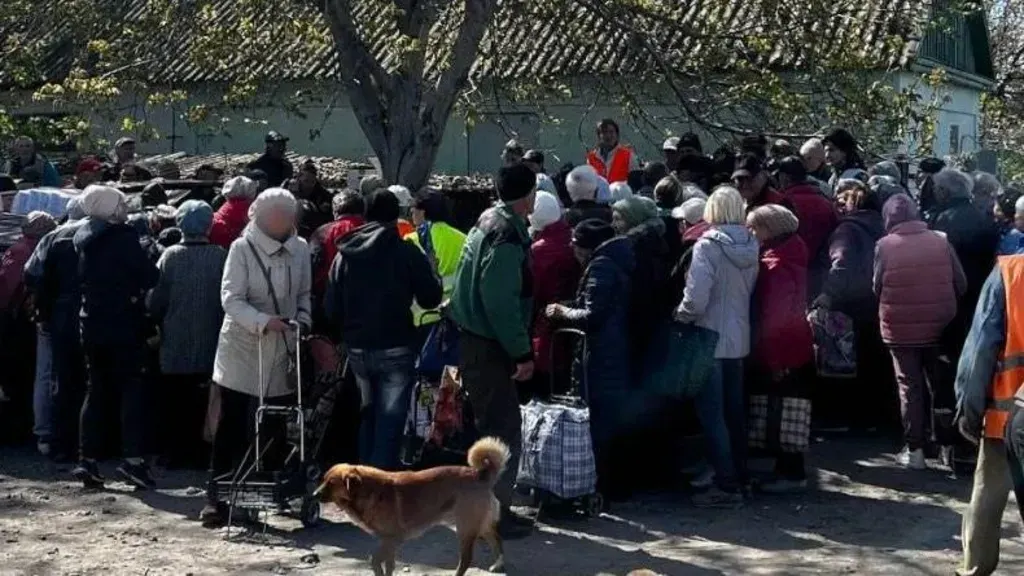
Ukrainian drone crews dropped about four tonnes of food, water and medicine to 100 locations in Russian-occupied Oleshky and the villages around it on the night of 26 September, the Kherson regional military administration said. Oleksandr Prokudin, the region's governor, called it the largest drop of its kind so far. Six units flew the missions across the Dnipro: the 30th Marine Corps, the Hrim tactical group, the 34th Borysfen Marine Brigade, the Bolharychi unit of the 11th National Guard Brigade, the 34th National Guard Regiment and the 79th Border Guard Detachment. Officials could not say how much of the food reached civilians and how much Russian troops shot down, seized or resold.
"In Oleshky, the Russians are holding around 2,000 of our people hostage. Among them are nearly 50 children," Prokudin said on 27 September. He said the deliberate blocking of aid and the creation of famine among civilians were war crimes.
Oleshky is on the left bank of the Dnipro, 9km across the river and its flooded islands from Kherson city, which Ukrainian forces retook in November 2022. Russia has held Oleshky since the first weeks of the full-scale invasion and claimed to annex the Kherson region in September 2022. The city had about 24,000 residents before the war and the wider Oleshky community about 40,000. Ukrainian officials said in April that more than 8,000 people remained in the community. Andrii Sybiha, Ukraine's foreign minister, now puts the number left in the city at about 2,000, including about 50 children. Dmytro Lubinets, Ukraine's parliamentary human rights commissioner, said more than 6,000 people, about 200 of them children, remain across the city and its villages. Independent Russian-language reporting from inside the occupied area put the city's population at about 1,500, with 40 children, and 4,000 more in nearby villages.
A woman in the city waiting to be evacuated wrote in a message that she had nothing left to eat. "We're in Oleshky [and] we can't get out. We're going hungry … Right now, I've got absolutely nothing to eat," she wrote. She said she had weighed 110kg before the war and now weighed 67kg. "At first I was glad [to lose some weight], but now I realise I'll die without proper protein-rich food. It's very hard. The house where we stayed last winter was also destroyed and burned down. Just like our own home … We're still alive."
"The blockade is complete," another resident wrote this month. "Like a horror movie."
How the food stopped
Tetiana Hasanenko heads the Oleshky military administration, the Ukrainian local authority that now works from the right bank in Kherson. She said deliveries from the Russian-held side began to fail in December 2025 as minefields grew denser and drones hunted vehicles on the roads. "The density of the minefields has become very high," she said. "From December onwards, food deliveries became much less frequent because vehicles were hitting mines and being targeted by drones. By winter, supplying food had already become very difficult."
Oleshky's last shop closed in January 2026 and its last pharmacy soon after. Regular supply lorries stopped entering the city in February, and the last vehicle carrying food got through on 26 May. A delivery attempt on 2 June failed when vehicles struck mines and came under drone fire. On 1 September drones hit a food convoy heading for the city, killing two people and injuring others. Ukrainian officials blamed Russian drones for both attacks. Moscow blamed the Ukrainian armed forces for the 1 September strike.
Ukrainian units have flown food across the Dnipro by drone since March, Prokudin said. Russian troops shoot the drones down, confiscate the parcels or sell them on, and residents who pick them up have been detained, taken to basements and beaten, he said. "The occupiers are detaining residents of Oleshky for receiving humanitarian aid parcels," Prokudin said. In at least one case the intended recipient was arrested, Ukrainian officials said.
Oleshky has had no mains electricity, gas or piped water for years. Its lowest streets flooded when the Kakhovka dam was destroyed on 6 June 2023, an act Ukraine blames on Russian forces. Residents cook on wood-burning stoves. With no power the cash machines stopped working, and residents barter for what little is for sale. Sugar and salt cost about 1,000 roubles a kilogram, and a packet of Citramon, a common headache tablet, costs the same, Hasanenko said. Some residents walk 20km along a mined and drone-watched road to the village of Radensk to look for supplies.
"There's no other infrastructure, electricity, therefore no ATMs, no cash. Oleshky isn't functioning," Hasanenko said. "People used to grow food in their vegetable plots before the war. There was not only enough for themselves but they used to sell it to Crimea and Kherson city. Now they cannot even grow it for themselves."
Courgettes, purslane and dogs
Residents who still have food eat once a day, according to their messages: a soup without potato, made from courgettes grown in what were the flower boxes of the city's apartment blocks and sometimes thickened with purslane, a weed that grows wild on the left bank. Others gather lamb's quarters and amaranth. Early in the summer one resident wrote that stocks of everything were nearly gone and that the city would reach crisis by August. "And come autumn, we'll definitely die. I'm already dying. I'm getting weaker by the day," the resident wrote. Ukrainian officials confirmed in September that some residents have killed and eaten dogs.
Ukraine's summer drone campaign against Russian supply routes on the left bank has left Russian front-line troops short of food, and soldiers take what civilians have stored, residents and officials said. "A week ago, the orcs came into people's yards and dug up all the potatoes, onions and garlic," one resident wrote, using a Ukrainian insult for Russian soldiers. "They took all the food supplies from the elderly women. When one of the grandmothers started shouting, they replied that people 'soon to be living in heaven' like them should subsist on nothing but water."
Residents have been digging out cellars that filled with mud when the Kakhovka reservoir emptied into the lower Dnipro in 2023, looking for jars of pickled vegetables and tinned meat laid down before the flood. "Some people have been digging out these cellars looking for canned vegetables, pickled vegetables and canned meat that people were storing up for winter," Hasanenko said. She said a 74-year-old man digging out his own cellar refused to let Russian soldiers into it and was killed by them. His name and the date of his death have not been published, and the account has not been independently confirmed.
The hospital basement
Oleshky's hospital has four doctors, no medicines, no equipment to speak of and too little generator fuel, Hasanenko said. It has begun turning away civilian patients and has asked residents to donate grain. Ambulances no longer answer calls. The hospital morgue was destroyed, and about 100 bodies have been kept in the basement since May. "There are dead bodies not only in the basement of the hospital, but all over the city," Hasanenko said. "They're just lying there because you cannot pick up the dead body. The drones are flying constantly and then the dogs are eating the bodies." She said: "It's an old city. It has existed for almost a thousand years, and in all this time, people never lived in such horrible conditions, in such a hell like they do now."
Evacuation
The International Committee of the Red Cross told Ukraine on 7 May that it was ready to help evacuate civilians from Oleshky. Lubinets's office has compiled and checked an evacuation list, which named 358 people by mid-September, and Ukraine's military has prepared a temporary local ceasefire to cover a humanitarian convoy. Russia has not confirmed that it will take part, Lubinets said on 16 September. "These people must be rescued. Because the city has turned into a death trap," he wrote on Telegram.
Civilians who leave now do so on their own, through Russian-held territory, and need a Russian passport to pass the checkpoints, a document residents cannot obtain inside Oleshky. Men fear being conscripted into the Russian army on the way. Kseniia Arkhypova, a volunteer from Oleshky who organises departures, said 47 people got out in September and about 300 more are waiting. The first stretch of road, 20km to Radensk, is watched by drones, and the journey onward through occupied Crimea and Russia costs up to $500 a person.
Hasanenko said Russian commanders are holding civilians in the city to deter an assault across the river. "The Russians are afraid that an offensive [against Oleshky] will start from Kherson city and they are just keeping people, civilians, as human shields," she said. Oleksandr Tolokonnikov, deputy head of the Kherson regional military administration, said Russian forces park military equipment in residential streets and use the presence of civilians to shield it from Ukrainian strikes.
Moscow's lies
Vladimir Saldo, the Russian-installed head of the occupied part of the Kherson region, said in April that food and fuel were reaching Oleshky, that the city had water and that "life in the city continues". Occupation officials denied in July that there was a humanitarian catastrophe, and in August acknowledged that the city had no water or electricity and unreliable communications. Saldo's administration has not announced an evacuation.
Dmitry Peskov, the Kremlin spokesperson, said on 21 September that a "critical" situation had developed in Oleshky. "The Kyiv regime is doing everything it can to obstruct deliveries," he said. Peskov said Russian troops were working to resolve the situation. Russia has refused a humanitarian corridor that would take civilians across the Dnipro to Ukrainian-held territory.
Kyiv at the UN
Sybiha said on 20 September that Russia was "deliberately creating a humanitarian catastrophe in the occupied part of the Kherson region" and called Moscow "the only obstacle" to an evacuation. He raised Oleshky during the UN general assembly's high-level week in New York and met Mirjana Spoljaric, president of the ICRC. At the UN on 23 September he said: "Russia is deliberately making life there impossible. They are starving them to death." On 26 September he called on the UN and the ICRC to use their mandates to deliver aid and evacuate civilians, and said people "cannot survive on statements of concern alone".
Michael O'Flaherty, the Council of Europe's commissioner for human rights, called on 25 September for an immediate local ceasefire, unhindered humanitarian access and the safe evacuation of civilians. "I am alarmed by the rapidly deteriorating humanitarian crisis in Oleshky," he said. He said Russia, as the occupying power, is bound by international humanitarian law to supply food and medicine to the population and to allow relief operations if it cannot.
The All-Ukrainian Council of Churches and Religious Organisations asked the UN and the Red Cross on 20 September to evacuate the city, saying it was "under a humanitarian blockade and is on the brink of a humanitarian catastrophe". Fans at Ukraine's Nations League match against Hungary on 25 September raised a banner reading "Save Oleshky", and supporters held a rally in Bristol calling for humanitarian access.
Strikes across Ukraine
Russian strikes killed eight people across Ukraine on 27 September, Ukrainian authorities said. A drone hit a market in Sofiiska Borshchahivka, on the western edge of Kyiv, killing two people and injuring about 10, prosecutors said. Vitali Klitschko, Kyiv's mayor, said nine people were injured in the capital, including a child. Russian drones also struck the headquarters of Kyivstar, Ukraine's largest mobile operator, the company said. On 28 September a guided aerial bomb hit an apartment building in Kharkiv and injured 22 people, including children, Ihor Terekhov, the city's mayor, said.
Volodymyr Zelenskyy, Ukraine's president, said Russia had fired about 3,900 drones, aerial bombs and missiles at Ukraine over the previous week. "Anywhere in the world, this choice of targets would be called by one word: terrorism," he wrote on X. He said new sanctions on the financial networks, supply chains, companies and individuals behind Russian weapons production "must take effect as early as October", and asked Washington to fully apply the Lindsey Graham Act, which allows sweeping sanctions on Russia.
Prokudin's appeal
Prokudin addressed Russian commanders directly after the weekend drop. "Food was delivered directly to 100 distribution points. And now I would like to address the Russians," he said. "Civilians have absolutely nothing to do with the Ukrainian armed forces. Because of the conditions you have created in Oleshky, people simply have no choice but to take food. Do not deprive people of the chance to survive and avoid starvation."
"Russia, as the occupying power, is obliged to provide people with food, medicines and adequate conditions for healthcare and hygiene. If its own resources are insufficient, the occupying authorities must consent to humanitarian operations by international organisations and other states. Instead, we are seeing the opposite," Prokudin said. "Russian occupying forces are obstructing the provision of aid to the civilian population. They are destroying vehicles attempting to deliver humanitarian supplies. And they are killing people trying to bring in food and medicines. They are also blocking all initiatives and agreements regarding the evacuation of people from Oleshky."