A voice identified as Juan Orlando Hernández's asks Honduras's president, Nasry Asfura, for about US$150,000 "a la cuenta de Rosales" to rent an apartment and set up a "unidad de periodismo digital" in the United States, in a call that Diario Red dates to 30 January 2026 and published on 30 April 2026. The voice says the unit would be managed by "alguien más de aquí, del equipo del Presidente de Estados Unidos", someone from the US president's team, "de los republicanos que nos están colaborando", and run as an information cell based in the US "para que no nos rastreen ahí en Honduras", so that they could not be traced in Honduras. "Se vienen unos expedientes contra México, se vienen unos expedientes contra Colombia", the voice says, files are coming against Mexico and Colombia, and against the family of Manuel Zelaya, the former Honduran president. The voice attributed to Asfura offers to send the money from a friend's account, possibly in cash, then proposes "otros 150.000" for Hernández himself, adding "Vamos a sacarlo de INSEP", the ministry of infrastructure and public services.
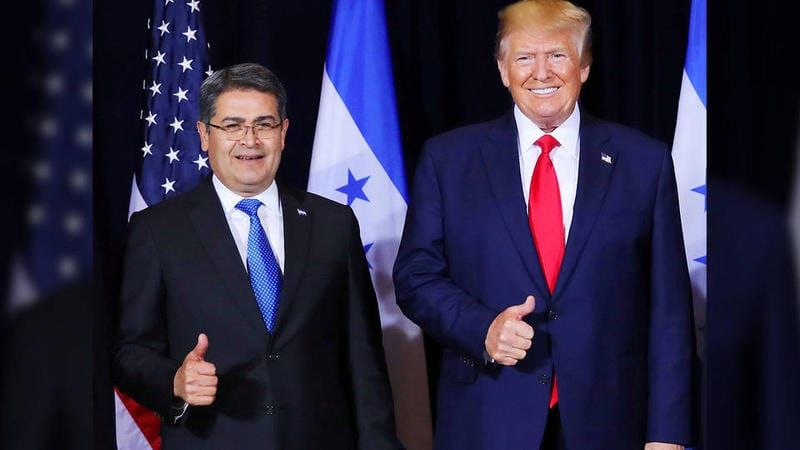
Asfura had been sworn in as president on 27 January, three days before the call. Trump had pardoned Hernández 60 days earlier, on 1 December 2025, freeing him from a 45-year US sentence for cocaine trafficking, three days after he had endorsed Asfura on Truth Social and announced the pardon less than 20 minutes later.
The Deepfake Rapid Response Force at Witness, a human rights technology organisation, rated the call real or probably real for the Honduran outlet Criterio.hn, and Earshot, an audio-investigation nonprofit working for Drop Site News, found the Hernández and Asfura voices in three files it tested likely authentic with moderate confidence. Witness found signs of AI manipulation in two later clips attributed to Hernández. Hernández wrote on X that the audio was a "burdo montaje tecnológico", a crude technological fabrication, and Asfura has made no public statement on it, AFP reported.
The audio describes a proposed covert political influence operation: a concealed US base, funding from the Honduran presidency and a public ministry, a Latin American news front and files aimed at the governments of Claudia Sheinbaum in Mexico and Gustavo Petro in Colombia, neither of whom is named in the published clips. The same months saw US agencies take part in Mexican state operations without the federal authorisation Mexican law requires, court Mexican politicians as informants and set a goal of tripling indictments of Mexican officials. The published documents connect the Honduran audio to the US government through Trump's pardon and through Hernández's own claims about Trump's team; they connect it to none of the US actions in Mexico.
The call
Diario Red and its partner site, hondurasgate.ch, say they hold 37 audio files from WhatsApp, Signal and Telegram conversations between January and April 2026, La Nación of Costa Rica reported. Diario Red's transcription of the 30 January call between the voices identified as Hernández and Asfura runs in this order, according to the outlet.
Hernández's voice asks for "unos 150 mil dólares" to the Rosales account to rent an apartment and open an office for a digital journalism unit. It says the unit would be managed by someone from the US president's team, "de los republicanos que nos están colaborando", and that "nos van a montar un sitio de noticias donde van a sacar unos datos importantes sobre Manuel Zelaya y Xiomara Castro", the former president and his wife, Castro, who governed Honduras until 27 January.
Asfura's voice answers: "Te voy a transferir desde una cuenta de un amigo. A ver si te lo pueden entregar en efectivo, pero explícame qué vamos a hacer con eso, qué ganamos." I will transfer it from a friend's account; see if they can deliver it in cash, but explain what we are going to do with it, what we gain.
Hernández's voice explains: "Vamos a montar una célula Presidente. Desde aquí, desde Estados Unidos, informativa, para que no nos rastreen ahí en Honduras. Va a ser como un sitio de noticias latinoamericanas." It says a call with Milei "fue exitosa" and that "podemos hacer cosas grandes para toda Latinoamérica", then names the targets: files against Mexico, files against Colombia "y lo más importante contra Honduras, en este caso contra la familia Zelaya".
Asfura's voice closes: "También creo yo que necesitas un poco más de dinerito. Para vos. Entonces vamos a mandar otros 150.000. Y así vos podés sobrevivir un poco más allá. Vamos a sacarlo de INSEP." The second US$150,000 in the transcript is framed as money for Hernández to live on in the US, drawn from the public works ministry, separate from the cell's funding.
The Mejía call
A second call the same day, between Hernández's voice and one attributed to María Antonieta Mejía, Asfura's vice president, sets out the purpose in political terms. Hernández's voice says he needs "esa liquidez porque vamos a montar una oficina aquí. Con el apoyo de algunos republicanos para poder atacar y extirpar el cáncer de la izquierda de ahí de Honduras y de toda Latinoamérica", with the support of some Republicans to attack and remove the cancer of the left from Honduras and all of Latin America.
Hernández's voice says "pudimos hablar con Javier Milei, y él está apoyando con 350 mil dólares también" and that "otro gran amigo de nosotros de México está apoyando, ya para el tema de los mexicanos", another great friend of ours from Mexico is supporting the Mexican matter. Mejía's voice replies: "Presidente, si gusta, omitamos los detalles. Sólo quería confirmar la cantidad. Ya que ya la sé, yo me voy a encargar de toda la gestión, 300 mil dólares entonces." President, let's leave out the details; I only wanted to confirm the amount; I will handle all of it, 300,000 dollars then. The figure equals the two sums of US$150,000 discussed with Asfura's voice.
The people named
Hernández, president of Honduras from 2014 to 2022 for the National Party, was extradited to the US in 2022 and convicted in Manhattan in 2024 of conspiring to import cocaine and of weapons charges. In the audio he is the organiser: he asks for the money, names the backers, describes the cell and names the targets.
Asfura, the National Party candidate whom Trump endorsed, is the source of public money in the transcript. His voice asks what they will gain, offers a friend's account and cash, and proposes the INSEP payment, and he has not addressed the audio publicly.
Mejía, the vice president, takes charge of "toda la gestión" for US$300,000 in the transcript and asks to leave out the details; she has made no public statement on the audio.
Rosales is the holder of the account to which Hernández's voice asks for the first US$150,000. Diario Red, hondurasgate.ch and the outlets that followed the story have not identified him or her, and the account's bank and country are unknown.
The member of "the team of the President of the United States" and the "Republicans who are helping us" are unnamed in the published clips. Trump is the only US political figure named in the audio, in a separate note in which Hernández's voice tells Tomás Zambrano, president of Honduras's National Congress, "es lo que el Presidente Trump diga", it is whatever President Trump says, a clip Witness analysts suspect was manipulated.
Milei is named twice: in the Asfura call as the subject of a successful call with Hernández and in the Mejía call as the source of US$350,000. The "great friend from Mexico" is unnamed, and Excélsior's reporting on the leak names no Mexican participant.
Diario Red names two further officials in its narration, not in quoted audio: Zambrano and Cosette López-Osorio, a member of Honduras's National Electoral Council, whom it describes coordinating with Hernández to remove judicial obstacles to him and sideline the opposition. A third instalment on 1 May alleged that Honduras's new authorities sought to remove the electoral councillor Marlon Ochoa "con cárcel o muerte", with prison or death.
What the cell was to publish
The published clips describe the content three ways: "unos datos importantes" about Zelaya and Castro, "expedientes" against Mexico and Colombia and a campaign to "atacar y extirpar el cáncer de la izquierda". The terms "desinformación mediática", "fake news" and an objective to "golpear mediáticamente", strike in the media, at Petro and Sheinbaum appear in Diario Red's narration by Valeria Duarte Galleguillos, not in the quoted audio.
The transcript supports a proposed covert information campaign: a news site presented as Latin American, run from the US to hide its Honduran origin, funded by Honduran officials and directed at named foreign governments. Whether its files were to be genuine, misleading or fabricated is not stated in the published audio. The clearest reference to shaping public belief falsely comes in the 9 April note to Zambrano, in which Hernández's voice says churches would make people forget the past "y que piensen que fue la izquierda que hizo eso", and think it was the left that did it; one Witness team found that note had been generated entirely by AI.
The money
The transcripts name four sums: US$150,000 to the Rosales account for the cell, from a friend's account or in cash; a further US$150,000 for Hernández from INSEP; US$350,000 from Milei; and US$300,000 to be arranged by Mejía. Diario Red, hondurasgate.ch and the outlets that followed the story have published no bank statement, INSEP disbursement or transfer showing that any of it was paid, and have identified no website, social media account or publication as the cell's work. Bill Scher wrote in the Washington Monthly on 12 May that the news site was described only as planned.
INSEP spends public money on roads, bridges and public buildings. Honduras's penal code makes malversación de caudales públicos, the diversion of public funds by an official, a crime, and the code adopted in 2019 set the penalty at four to six years in prison, La Prensa reported. A payment from the ministry's budget to a former president living in the US, for his own upkeep, is the transfer the 30 January transcript describes. INSEP's payment ledgers and the Finance Ministry's transfers for February to April 2026 would show whether the money left the ministry.
In the US, anyone who agrees to act at the direction of a foreign government or foreign political party, or of a person outside the US, as a publicity agent, information-service employee or political consultant must register with the Justice Department within 10 days under the Foreign Agents Registration Act, and wilful violations carry up to five years in prison, the Congressional Research Service states. The Act's threshold is agreement to act at the order, request or direction of a foreign principal, and the cell described in the transcript was to be funded by Honduras's president and vice president; the Justice Department's FARA filings for 2026 would show whether anyone registered for Honduran principals.
Trump
Trump endorsed Asfura on Truth Social on 28 November 2025, two days before Honduras's presidential election, and announced less than 20 minutes later that he would pardon Hernández, Axios reported. Roger Stone, Trump's longtime adviser, had passed Trump a four-page letter from Hernández in prison. Trump called the prosecution "a Biden setup" and Karoline Leavitt, the White House press secretary, called it "Biden over-prosecution". Hernández was released on 1 December. Asfura won the election and took office on 27 January.
In audio Diario Red published on 29 April, Hernández's voice tells Asfura "gracias a mí, usted está sentado en esa silla", thanks to me you are sitting in that chair, and asks for support for a return to the presidency "porque eso fue lo que hablamos con el presidente Trump", because that is what we discussed with President Trump, according to the outlet's transcription. Another clip has the voice say "Juan Orlando regresa pronto" and "Juan Orlando is coming back for presidency".
Diario Red's narration says the pardon was secured through "un intenso lobby liderado por Roger Stone y la bancada republicana", with Netanyahu's support. The quoted audio names neither Stone nor any Republican lawmaker; Stone's documented role is the delivery of the letter. Trump's endorsement, the pardon announcement and the letter are documented; Hernández's statements that the cell would be run by a member of Trump's team and that his return was agreed with Trump are his own claims in disputed audio, uncorroborated by any named person or document. The US and Argentine governments had not commented on the audio by 9 May, AFP reported.
Israel
Hernández's voice says in the 29 April release: "El dinero del indulto ni siquiera salió de ustedes. Ni siquiera salió de ustedes, salió de una junta de rabinos, y de una gente que apoyaba a Israel, y ellos habían apoyado en un pasado a Yani Rosenthal." The pardon money did not even come from you; it came from a board of rabbis and people who supported Israel, who had once backed Yani Rosenthal, a Liberal Party politician who ran for president in 2021. The voice says "el primer ministro de Israel nos va a dar el apoyo" and tells Zambrano "te mandé la gente de Israel, te mandaron dinero", I sent you the people from Israel, they sent you money.
The clips give no amount, no names of rabbis or donors and no description of what "pardon money" paid for. Diario Red's headline says Israel paid for the release and its narration says Hernández's return and candidacy "estarían financiados en su totalidad por Israel"; those are the outlet's conclusions. Benjamin Netanyahu, Israel's prime minister, is not named in the quoted audio, and his office has made no public statement on it.
Milei
Nicolás Trotta, an Argentine opposition deputy, filed a resolution asking Manuel Adorni, the cabinet chief, whether officials had contact with Hernández and whether the government runs digital campaigns aimed at other countries, Chequeado reported. Milei's government has made no public statement on the US$350,000 attributed to him.
Authenticity
Diario Red belongs to a media group led by Pablo Iglesias, a founder and former leader of Spain's left-wing Podemos party, and hondurasgate.ch describes itself as a collaboration with Honduran journalists who remain anonymous. Iglesias told the Argentine newspaper Perfil that the material came from people in Mexico who asked for a meeting, Chequeado reported; the outlets have not identified the source or released the original files with their metadata, and hondurasgate.ch has acknowledged that the published files are selected segments.
Diario Red and hondurasgate.ch said the 37 files had been checked with Phonexia Voice Inspector, software made by a Czech voice-biometrics company. Phonexia said its software was never used to validate the material, cited factual and technical inaccuracies and demanded removal of its trademarks. The Phonexia report posted on hondurasgate.ch shows only that the files contain a human voice.
Earshot tested three files, two attributed to Hernández and one to Asfura, against known speech samples using the machine-learning tool Resemblyzer and examined breaths, hesitations and room noise. It found them authentic samples of the two men's voices and likely not AI-generated, with moderate confidence because of telephone-quality sound, José Luis Granados Ceja wrote for Drop Site News on 19 May. Drop Site said the source of the audio was undisclosed and that Will Freeman of the Council on Foreign Relations had questioned the story.
The Witness analysis, published by Criterio.hn on 8 June and updated on 8 July, rated the 30 January call genuine on both of its teams. Both suspected AI manipulation in the 18 March and 9 April notes to Zambrano, and one team found the 9 April note had been generated entirely by AI. The second team did not listen to the files, relied on automated detectors and warned that the OPUS audio format may fall outside their training, and the first team said its evidence was not conclusive.
Graudio Forensics, whose report was commissioned by Beatriz Parra Cruz and cited by Hernández's defence, found signs of a synthetic voice in two files and called the audio an AI creation, while saying it could not be conclusive without the original files and the device used to capture them, Contracorriente reported. Honduras's National Congress voted unanimously on 5 May to ask the Public Ministry for an international forensic examination by certified laboratories in the US, with monthly progress reports. Criterio.hn reported in July that the ministry had published none.
Honduras
Zambrano wrote on X that Congress would begin reviewing “los audios falsos que la conexión de la izquierda internacional ha estado difundiendo”, the fake audio the international left had been spreading, and said “es evidente que esas voces no son las nuestras”, that some had been faked with a Colombian or Nicaraguan accent and that the forgery was “tan evidente que resulta cómica”, so obvious it was comic. He said Congress would “proceder de inmediato a iniciar las acciones legales correspondientes” against those responsible once forensic results arrived, El Heraldo reported on 6 May.
Lenin Valeriano, a National Party deputy, had moved the day before that Congress ask the Public Ministry for an independent international forensic examination of the files in US laboratories certified and recognised by the DEA and FBI, covering metadata, the source of the leak and any editing, with monthly progress reports, Tiempo reported. “En los últimos días hemos visto una gran operación mediática de desinformación que busca desestabilizar el país”, Valeriano said. Iroshka Elvir, a Liberal Party deputy, proposed sending the files to two more countries, naming Chile, and Zambrano said the third country would not be one aligned with Libre or the left. Sergio Castellanos, a deputy for Libre, the party of Zelaya and Castro, called the files “sumamente delicados” and said those named should resign if they proved authentic; Kilvett Bertrand, a deputy, called them a smear by “una clase política derrotada una y otra vez en las urnas”. Congress approved the motion unanimously. Criterio.hn reported in July that the ministry had published no progress report.
The Public Ministry that Congress asked to test the audio was headed by Pablo Emilio Reyes, whom National and Liberal deputies appointed on 25 March, the day 93 of the 128 deputies voted to remove the attorney general, Johel Zelaya, two days after impeachment proceedings opened, on charges that he had used his office to favour Libre against electoral officials from the National and Liberal parties, AFP reported. “He sido juzgado y prácticamente condenado de forma anticipada”, Zelaya wrote on X. Rebeca Ráquel Obando resigned as president of the Supreme Court the same day as Zambrano began reading the impeachment request against her. Nineteen organisations, among them the Due Process of Law Foundation, WOLA and CEJIL, said on 26 March that the process was incompatible with international human rights standards and warned against using impeachment to remove justice and electoral officials. The Supreme Court’s Constitutional Chamber admitted Zelaya’s appeal in August and refused to suspend his removal.
Congress removed Marlon Ochoa, the Libre representative on the National Electoral Council, on 16 April by 88 votes of 128, on a report from a commission chaired by Tania Pinto that accused him of obstructing the council and the 2025 election timetable, El Heraldo reported. The commission also recommended removing Mario Morazán, a magistrate of the Electoral Justice Tribunal, and two alternate magistrates, Lourdes Mejía and Gabriel Gutiérrez; Morazán has appealed his removal to the Constitutional Chamber. Ochoa, who did not appear before Congress, wrote on X that “hoy han negociado y pagado mi condena” and that he was being pushed toward a prison where “planifican mi muerte”, adding that he had proof. Zelaya, Obando, Morazán, Lourdes Mejía, Gutiérrez and Ochoa are the officials Diario Red’s narration of 29 April names in describing a plan, coordinated by Hernández with Zambrano, María Antonieta Mejía and López-Osorio, to remove judicial obstacles to Hernández; every removal took place before Diario Red published, and the outlet’s 1 May allegation that the authorities sought to deal with Ochoa “con cárcel o muerte” rests on the same audio set.
Two Colombian lawyers, Luis Guillermo Pérez Casas and Mario Cerrato Valdés, filed a complaint against Hernández with the Public Ministry on 25 May citing 13 of the 37 files, and Pérez announced a further forensic examination with Berta Oliva’s Committee of Families of the Detained and Disappeared in Honduras, Contracorriente reported.
Mexico
The 30 January call names Mexico first among the targets of “expedientes”, and in the Mejía call Hernández’s voice says an unnamed “gran amigo de nosotros de México” was supporting “el tema de los mexicanos”. Paul Lara of Excélsior wrote on 3 May that the leaked material describes a plan to “desgastar al gobierno de Claudia Sheinbaum para facilitar el retorno de la derecha al poder”, to wear down Sheinbaum’s government and ease the right’s return to power, attributing that aim to the leaks; his report names no Mexican participant. The goal of weakening Sheinbaum appears in Diario Red’s and Excélsior’s accounts; the published audio names Mexico as a target and gives no method beyond the files and the news site.
Sheinbaum addressed the audio at her morning press conference on 6 May. “Sí, escuché los audios, no vi completo el reportaje”, she said, describing an office to be set up against Colombia and Mexico “financiada por gobiernos extranjeros, particularmente argentino”, and said of Hernández that “se le libera, no se entendió muy bien su liberación”, his release was never well explained, El Universal reported. She said “podrán montar una oficina de campañas sucias contra nuestro gobierno en Honduras con recursos de un pueblo amigo”, they may set up an office for dirty campaigns against our government in Honduras with the resources of a friendly nation, and that it would not make a dent in her government, which she placed against an international right-wing network linked to groups in Spain, the US and Argentina, France 24 reported.
Sheinbaum’s office published a poll in May giving her 72 per cent approval.
Colombia
Petro asked on X why Netanyahu would pay to free a convicted drug trafficker, and at a Council of Ministers meeting on 20 May asked Armando Benedetti, the interior minister, to convene the Electoral Guarantees Commission over what he called a foreign-funded network trying to sway Colombia's 31 May presidential election. He said Netanyahu had given Hernández money and offered no evidence. On 21 May he called Hernández a "forajido extranjero", a foreign outlaw, and said he would file a complaint; Hernández wrote in reply that Petro's mask was slipping.
Petro also asked whether a fake audio linked to the campaign of Iván Cepeda, the Pacto Histórico candidate, in which a speaker presented as an armed dissident threatened rural residents of Guaviare who did not register to vote, belonged to the Honduran plan. Pedro Sánchez Suárez, Colombia's defence minister, said police had traced it to an extortion scheme run from La Picaleña prison in Ibagué, with no link to armed groups or to Hernández. Abelardo de la Espriella, endorsed by Trump, beat Cepeda in the 21 June runoff by about one percentage point, more than 251,000 votes, and Cepeda conceded on 24 June.
The CIA in Chihuahua
Two USians whom a US official and two other people familiar with the matter told the Associated Press were CIA employees were killed in a crash on 19 April returning from a drug raid in the Chihuahua mountains, and Sheinbaum said two days later that her government had not been informed of the operation. Mexico's federal security cabinet found neither man accredited for field activities, the Security Ministry told federal prosecutors it held no authorisation for them and Article 70 of the National Security Law requires officials to report contact with foreign agents within three days. The Los Angeles Times reported that CIA personnel had joined at least three Chihuahua operations in 2026, and state files place one of the dead, Richard Leiter Johnston III, in Chihuahua from October 2025.
The US Embassy said the men were "supporting Chihuahua state authorities' efforts to combat cartel operations" and declined to name their employer; the CIA declined to comment and has not said who in the US government approved the deployment. Sheinbaum said Ronald Johnson, the US ambassador and a former CIA officer, should have told federal authorities, and her government ordered the two surviving US personnel out of the country. On the Mexican side the operation went through the Chihuahua state government, bypassing the federal Security Ministry and the accreditation process. Judge Ricardo Alfonso Santos Dorantes on 25 October bound over César Jáuregui Moreno, Chihuahua's former attorney general, for trial on a treason charge carrying five to 40 years; state prosecutors say the decision to bring in the foreigners led to him, and his lawyer, Héctor Villasana, says the testimony points to Pedro Román Oseguera Cervantes, the state investigation agency director killed in the crash. Baldomero Mendoza, who teaches criminal law at the National Autonomous University, told El Universal that unauthorised entry of foreign agents does not on its own prove the intent to subject the nation to a foreign power that treason requires.
Informants
At least a dozen Mexican elected officials, many from Sheinbaum's Morena party, have offered US authorities information on colleagues, and a DEA initiative to contact Mexican officials privately helped set off the approaches, Steve Fisher, Jack Nicas and Alan Feuer reported in the New York Times on 27 June. Sheinbaum said her federal government had no information that anyone was cooperating. Kevin Sieff reported in The Atlantic on 24 July that prosecutors were using informants to build cases against sitting politicians, according to Animal Político's account. The governors of Sonora and Tamaulipas, Alfonso Durazo Montaño and Américo Villarreal Anaya, have lost their US visas and entered the US under Significant Public Benefit parole, a status usually given to cooperating witnesses, Fisher and Kate Linthicum reported in the Los Angeles Times; both deny wrongdoing, and Roberto Velasco, the foreign minister, said the US had sent no notice of any revocation.
Marina del Pilar Ávila Olmeda, governor of Baja California, was taped with men presented as outside advisers to the FBI. In audio published by Héctor de Mauleón of El Universal on 13 July she asks whether US authorities want to extradite her and offers what she has heard at state security meetings, Mexico News Daily reported; in earlier audio she names her lawyer as Michael Nadler, and in later audio a consultant, Juan Sandoval, as a former FBI agent. The men's identities have not been established. Ávila says the conversations date from 2025, concerned her visa and were a trap set by her predecessor, Jaime Bonilla Valdez, who denies it; Omar García Harfuch, the federal security secretary, said no crime could be inferred from the audio.
Prosecutions and sanctions
Aakash Singh, an associate deputy attorney general and aide to acting Attorney General Todd Blanche, told federal prosecutors in mid-May to triple indictments of corrupt Mexican officials, add terrorism charges and treat their embarrassment as a bonus, the Times reported, citing one US official; Terrance Cole, the DEA administrator, said the indictments were the start. Prosecutors in Manhattan had indicted Rubén Rocha Moya, the Morena governor of Sinaloa, and nine others on 29 April on charges of protecting the Chapitos faction of the Sinaloa Cartel, and Jay Clayton, the US attorney, said the cartel relies on corrupt officials. Rocha Moya calls the charges a political attack, none of the 10 has been tried and Mexico's foreign ministry said in May the US had not supplied the evidence behind its arrest requests. Gerardo Mérida Sánchez, his former security secretary, surrendered on 11 May and was accepted as a cooperating witness, El Imparcial reported, and Judge Katherine Polk Failla called the evidence against him abundant; Enrique Díaz Vega, the former finance secretary, surrendered on 15 May. Rocha Moya has been on leave since 2 May, and the journalist Jesús Lemus says his lawyer opened talks with prosecutors. Enrique Inzunza Cázarez, a senator named in the indictment, left the Morena caucus and kept his seat.
The Treasury's Office of Foreign Assets Control on 29 September designated 21 people and 25 companies tied to the Los Mayos faction, including Ismael Zambada Sicairos, and placed Carlos Alberto Torres Torres, Ávila's ex-husband, at the centre of a Mexicali bribery scheme it said reached "the highest levels of the Baja California state government", alleging payments from the city's former police chief, Pedro Ariel Mendívil García, and laundering by his brother Luis through companies and political campaigns. A designation is an administrative finding, not a court ruling, and Torres denies any cartel link. Ávila left Vida Orgánica Tijuana, a company she founded with the Torres brothers, on 10 September, 19 days before the Treasury designated it, according to notarial filings reported by Zeta; she says she left in 2023. Mexico froze the designated accounts the same day, and Sheinbaum consented to the freeze to avoid friction with the Trump administration after challenging her officials over the US evidence, the Wall Street Journal reported. The State Department has revoked the visas of at least 50 Mexican politicians and officials, mostly Morena allies, since May 2025, Quadratín reported, citing a Reuters count.
The memorandum
Trump said on 15 October that the cartels control Mexico and that he had not yet launched a full attack by land, and his administration has given Mexican officials a memorandum proposing that US security personnel accompany operations inside Mexico and seeking more intelligence sharing, the Times reported on 24 October. Sheinbaum rejects US military operations on Mexican soil and calls her policy collaboration without subordination. The Senate approved at her request the entry of 139 soldiers of the US 101st Airborne Division for joint exercises in Chihuahua in September, the route Mexican law sets for foreign troops. Mexico has sent 92 cartel suspects to US courts since February 2025.
Coordination
Trump's endorsement of Asfura and his pardon of Hernández, delivered through Stone's letter, are the documented acts linking the Trump administration to the two men in the 30 January call. The audio adds Hernández's statements that a member of Trump's team would run the cell, that Republicans were helping and that his return was agreed with Trump; those statements name no US official and are uncorroborated.
The CIA deployments in Chihuahua, the DEA approaches, Singh's directive, the Treasury designations, the visa revocations and the 24 October memorandum share no published personnel, money, communications or instructions with the Honduran audio. The published evidence of the administration's stated intent toward Mexican officials, from Trump, from Singh's call and from the memorandum, names prosecution of officials accused of protecting cartels as the aim. The material made public so far does not establish coordination between the Honduran plan and US actions in Mexico, and it does not rule it out; the identity of the Trump team member, the Republicans and the Mexican backer would settle it.
The documents
The original audio files, with their metadata and the devices they came from, would let an independent laboratory settle which of the 37 are genuine; the Public Ministry examination Honduras's Congress requested on 5 May would be the official test. The statements of the Rosales account and INSEP's payment ledgers for February to April 2026 would show whether the two sums of US$150,000 moved, and to whom. Corporate filings in the US for any news company registered after 30 January 2026 with links to Hernández or Rosales, and the Justice Department's FARA filings for Honduran principals, would show whether the cell was set up and who ran it. Hernández's communications with White House staff and Republican members of Congress from December 2025 to April 2026 would confirm or contradict his statement that someone from Trump's team would manage it. The Justice Department's pardon file and Stone's communications with the White House would show who argued for Hernández's release and whether any Israeli official, rabbi or donor did. The CIA's authorisation for the Chihuahua deployments, the DEA's guidance for contacting Mexican officials and the text of the 24 October memorandum would show who directed the US actions in Mexico and to what end.