
The State Department designated Brazil's two largest gangs as terrorist organisations on 28 May, the day after Flávio Bolsonaro asked Darren Beattie and Deputy Secretary of State Christopher Landau for the designation in person. Three officials told Reuters that Beattie and Ricardo Pita instructed US diplomats that restoring Jair Bolsonaro to power was US policy. The State Department did not answer questions about the two men and said Brazilians have the right to choose their leaders.
Flávio Bolsonaro, senator and Liberal Party (PL) presidential candidate, met Christopher Landau, the deputy secretary of state, and Darren Beattie, the State Department's senior adviser on Brazil, at the department on 27 May 2026. Paulo Figueiredo, a right-wing commentator who attended, wrote that they discussed "the urgency of designating the PCC and the Comando Vermelho as foreign terrorist organisations". On 28 May the department designated both gangs as Specially Designated Global Terrorists, and Secretary of State Marco Rubio signed the Foreign Terrorist Organization designation the same day. Beattie and Ricardo Pita, a second political appointee, led a campaign to restore the Bolsonaro family to power and pushed for sanctions meant to tilt Brazil's election, 10 current and former US officials told Reuters in an investigation published on 24 October. Brazilians vote today in the runoff between Bolsonaro and President Luiz Inácio Lula da Silva, who trailed him in the first round by 47.03 per cent to 45.16 per cent of valid votes.
Reuters could not establish whether the two men acted on orders from the White House or from Rubio, or how much weight their lobbying carried in the gang decision. The White House declined to comment and sent questions to the State Department, and Lula's office did not answer Reuters. Tommy Pigott, the department's spokesman, left questions about the two officials unanswered and said in a statement that US action against drug traffickers and for free speech protects USians and that Brazilians have the right to choose their leaders in free and fair elections.
The instructions
Beattie and Pita told US diplomats in Brazil, before the campaign formally began, that it was US policy to return Jair Bolsonaro to the presidency, although he was barred from running, three of the 10 officials told Reuters. The Supreme Federal Court (STF) convicted him of plotting a coup on 11 September 2025 and sentenced him to 27 years, and the two officials then moved their backing to Flávio, his eldest son, the same three officials said. They told embassy staff in Brasília to stay away from other conservative contenders who might challenge the senator for the right's nomination.
Orna Blum ran the State Department's office for Brazil and the Southern Cone until she retired in 2025 in protest at the Trump administration, and she is one of the officials who described the campaign to Reuters. Blum said the United States was entitled to pursue its economic and strategic interests, and that using foreign-policy tools to pressure another democracy over the legal fate of a political ally meant "the line between diplomacy and political intervention has been crossed".
Mario Braga, a Latin America analyst at the risk consultancy RANE, told Reuters that President Donald Trump may have withheld an endorsement of either candidate to avoid being seen to meddle, because that perception could help Lula.
The gang designations
David Gamble, then the State Department's acting sanctions coordinator, arrived in Brazil on 4 May 2025. The US embassy said he would discuss organised crime and US sanctions programmes against terrorism and drug trafficking, after Eduardo Bolsonaro, Jair's third son and then a federal deputy, said Gamble was coming to discuss punishing Justice Alexandre de Moraes of the STF. Pita travelled with Gamble, and on 5 May he met Jair Bolsonaro at his home in Brasília's Jardim Botânico, with Flávio present. Eduardo wrote on X that Pita expressed support for his father and promised to carry his message back to the department.
Eduardo had befriended Pita through US conservative circles, and both wanted the Primeiro Comando da Capital (PCC) and the Comando Vermelho (CV) designated as terrorist organisations, according to Reuters. The family expected a designation to damage Lula, whom his opponents accuse of failing to control crime. After the Brasília trip, Pita asked State Department sanctions staff to work out how the designations imposed on Mexican cartels in February 2025 could be applied to Brazil, a former official said.
Pita had moved to a post outside Brazil policy by May 2026. Trump received Flávio and Eduardo Bolsonaro in the Oval Office on 26 May, and Flávio told reporters afterwards that he had asked Trump to designate the PCC and CV "as soon as possible". On 27 May the brothers met Rubio and then Landau and Beattie. The global terrorist designations took effect on 28 May, and the Foreign Terrorist Organization listing took effect when the Federal Register published it on 5 June.
The State Department's announcement said the two gangs had attacked Brazilian police officers, officials and civilians and that their networks reached into the United States. Celso Amorim, Lula's special adviser on international affairs, called the designation a "pretext for intervention". The Brazilian Intelligence Agency (Abin) listed the designations among the US measures in a reserved report in August that rated the risk of US interference in the election as critical, Folha de S.Paulo columnist Mônica Bergamo reported.
Moraes
Eduardo Bolsonaro had campaigned since at least 2024 for Global Magnitsky sanctions on Moraes, who oversaw the coup investigation into his father, and in a livestream in March 2025 he said the sanctions were practically certain. Around April 2025 he visited Beattie in his State Department office, two former US officials told Reuters. Beattie phoned the Treasury's Office of Foreign Assets Control (OFAC) to argue for sanctions on Moraes, and Treasury Secretary Scott Bessent raised no objection, according to a former official with direct knowledge. A Treasury official said Bessent and Rubio are fully aligned on foreign policy.
Rubio revoked the US visas of Moraes and seven other STF justices and their close relatives on 18 July 2025, accusing Moraes of a witch hunt against Jair Bolsonaro. The seven were Luís Roberto Barroso, Dias Toffoli, Cristiano Zanin, Flávio Dino, Cármen Lúcia, Edson Fachin and Gilmar Mendes. OFAC sanctioned Moraes on 30 July and added his wife, Viviane Barci de Moraes, on 22 September 2025, 11 days after the STF convicted Jair Bolsonaro.
The Treasury removed Moraes, his wife and the family holding company Lex Instituto de Estudos Jurídicos from the sanctions list on 12 December 2025 without giving a reason. Moraes, who has said he was removing false content that undermined trust in Brazil's democratic institutions, did not answer Reuters.
The tariffs
Trump announced a 50 per cent tariff on Brazilian goods on 9 July 2025 in a letter that tied it to the "witch hunt" trial of Jair Bolsonaro. Reuters could not determine whether Beattie or Pita had a hand in the tariff or the visa revocations. Political analysts in Brazil told the agency that the tariff lifted the Lula government's poll numbers, and US and Brazilian companies that depend on bilateral trade, among them the meatpacker JBS, controlled by Wesley and Joesley Batista, lobbied against it.
US negotiators sent Brazil a 21-point proposal on 16 October 2025 to end the tariff, and two of the points concerned the election, according to a copy obtained by Estadão: a commitment to a free and fair presidential vote in 2026 and a pledge that Brazil would not detain or otherwise stop political dissidents from taking part. Brazilian officials in the talks told the newspaper the second point referred to Jair Bolsonaro. Lula met Trump in Kuala Lumpur on 26 October 2025 and asked him to lift the tariff and the sanctions on Moraes.
Trump signed an order on 20 November 2025 that removed the 40 per cent portion of the tariff on Brazilian beef, coffee, cocoa and fruit. The US Trade Representative imposed a further 25 per cent tariff on Brazilian imports from 22 July 2026 under Section 301 of the Trade Act of 1974.
Visas and envoys
Beattie applied for a visa to attend a critical minerals forum in São Paulo on 18 March 2026 and asked to visit Jair Bolsonaro in prison. Moraes authorised the visit on 10 March and then reversed himself, and on 13 March Itamaraty, Brazil's foreign ministry, revoked Beattie's visa, saying the purpose of the trip had been omitted and misrepresented.
Two more State Department envoys, Riley Bernes and Samuel Samson, applied for Brazilian visas in July. The US embassy had asked Sóstenes Cavalcanti, the PL's leader in the Chamber of Deputies, to receive them, and their mission was to cast doubt on Brazil's electronic voting machines, Agência Pública reported. Itamaraty refused both visas that month. On 4 August the State Department revoked the visa of Maria Luiza Viotti, Brazil's ambassador in the United States, calling it a reciprocal measure over Brazil's delay in accepting Daniel Perez, Trump's nominee for ambassador to Brazil.
A State Department official told Brazilian reporters on 13 August that the United States would accept the result if the vote was free and fair. Katherine Bowles, the department's assistant secretary for legislative affairs, wrote to Representative Delia Ramirez on 15 October that the United States supports the Brazilian people's right to a free and fair election, and defended the Moraes sanctions and the gang designations in the same letter.
Beattie and Pita
Beattie was fired as a White House speechwriter in 2018 after it emerged that he had spoken on a panel at the H.L. Mencken Club conference in 2016 alongside Peter Brimelow, founder of the anti-immigration site VDARE. Beattie has said he said nothing objectionable at the conference. After the 6 January 2021 attack on the US Capitol he promoted the claim, since debunked, that the FBI planted agents in the crowd. He joined the State Department in January 2025, became acting under secretary for public diplomacy on 4 February 2025 and moved to the Bureau of Western Hemisphere Affairs as senior adviser in November 2025. Reuters describes him as the architect of the administration's "free speech diplomacy", which seeks to punish countries accused of censoring right-wing speech by USians, US companies and their allies abroad.
Pita grew up in Venezuela under Hugo Chávez, wrote about it for the Heritage Foundation's Daily Signal and was a member of Heritage's Young Leaders Program. He was staff director of the House Foreign Affairs subcommittee on the Western Hemisphere before joining the State Department in January 2025 as senior adviser for Western Hemisphere affairs, and he is now acting deputy assistant secretary for North America. Reuters places him among officials close to Rubio who regard Lula as a threat to US interests in Latin America.
Eduardo Bolsonaro
Eduardo Bolsonaro, who did not answer Reuters, has lived in the United States since 2025 and lobbied there for the tariff and the Magnitsky sanctions. The STF convicted him of coercion in the course of judicial proceedings for seeking foreign sanctions against Brazilian authorities. The conviction became final on 3 October 2026, and on 7 October Moraes ordered his sentence of four years and two months carried out and his passports cancelled.
The vote
Trump hosted Flávio Bolsonaro in the Oval Office on 26 May, less than three weeks after he received Lula at the White House on 7 May, and on 2 June he wrote on Truth Social that the senator loves his country. On 5 October Trump called Bolsonaro's first-round lead a "very, very big victory". Datafolha's last full poll, published on 22 October, put the two candidates at 50 per cent of valid votes each.
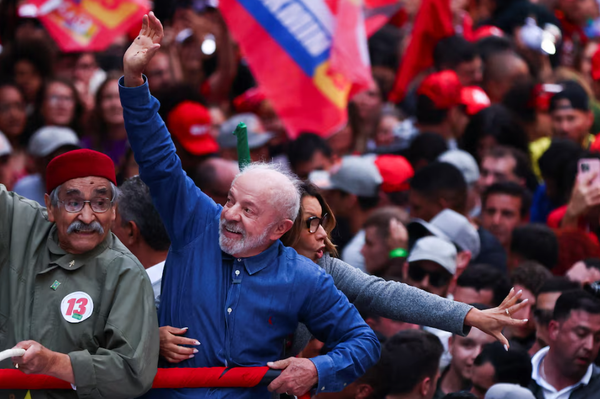
Lula closed his campaign on Saturday on Avenida Paulista in São Paulo, where supporters filled at least 14 blocks. The Workers' Party (PT) put the crowd at more than 2 million and gave no method for the count. Lula told the rally the vote was about people who would not allow "a militiaman to go to the Planalto Palace", his term for Bolsonaro. After voting in São Bernardo do Campo this morning, Lula, 80, said the runoff street campaign was the biggest he had seen in 50 years of politics.
Lula carried São Paulo city in the first round and needs a wider margin there to win, Al Jazeera's Euan Marshall reported. Mariana Hatayshi went to the rally with her mother, Regina, but could not get near the stage. Both women voted for Lula this morning, as they did on 4 October. "It's not left versus right anymore. It's democracy against backsliding," Mariana told Marshall.
The coup case
Jair Bolsonaro refused to concede the 2022 election to Lula, and on 8 January 2023 his supporters stormed Congress, the STF and the presidential palace in Brasília. The STF found in September 2025 that he had plotted to keep himself in office after that defeat. Flávio Bolsonaro has said he will seek an amnesty for his father if elected.
The law
Lula's coalition filed a 117-page action at the Superior Electoral Court (TSE) on 23 September alleging that Flávio and Eduardo Bolsonaro pushed the Trump administration to impose tariffs and sanctions and then used them in the campaign. It asks the court to strip Flávio and his running mate, Alfredo Gaspar, of the ticket or of office and to bar the brothers from running for eight years. Article 22 of Complementary Law 64 of 1990 lets a coalition ask the TSE to investigate abuse of power for a candidate's benefit, and a ruling against the candidate brings an eight-year ban on running, even after the winner takes office.
The documents
Beattie's and Pita's cables and emails to the US embassy in Brasília from early 2025 would show what diplomats were told about restoring Jair Bolsonaro and about contact with other conservative contenders. Messages between Rubio's office and the two officials would show whether they acted on instructions. The administrative file behind Public Notice 13030 and the State Department's notes of the 27 May meeting with Landau would show what weight the Bolsonaros' requests carried in the gang designations. OFAC's file on Moraes would show who argued for the sanctions of 30 July 2025 and why the Treasury lifted them on 12 December.