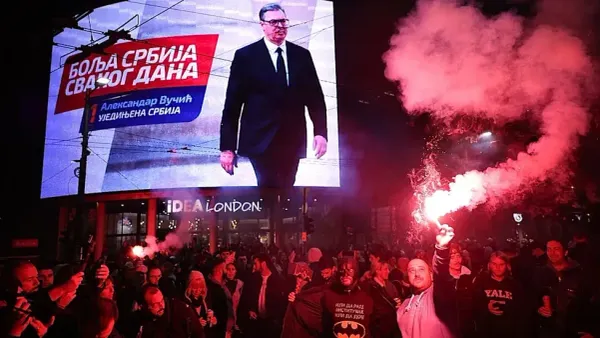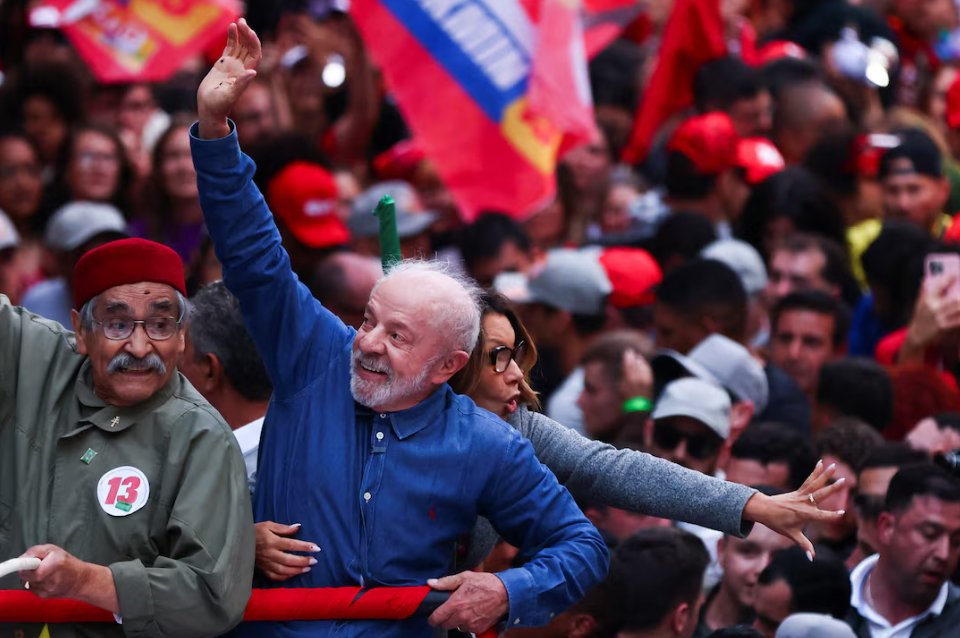
Luiz Inácio Lula da Silva beat Senator Flávio Bolsonaro in Brazil's runoff on 25 October with 51.75 per cent of valid votes, three weeks after trailing him by 2.2 million votes in the first round, the first candidate in Brazil's democratic history to overturn a first-round defeat in a presidential runoff. The win kept Latin America's largest country out of a run of right-wing victories that has taken in Argentina, Chile, Colombia, Honduras and Peru, and came a day after 10 current and former US officials told Reuters that two State Department appointees had led a campaign to return the Bolsonaro family to power. During his third term the UN Food and Agriculture Organization removed Brazil from its Hunger Map and violent deaths fell to their lowest rate since 2012, according to the Brazilian Forum on Public Security.
Luiz Inácio Lula da Silva won Brazil's presidential runoff on 25 October and a fourth, non-consecutive term, the Superior Electoral Court (TSE) announced. With 98.27 per cent of sections counted at 21:10 Brasília time, he had 51.75 per cent of valid votes to 48.25 per cent for Senator Flávio Bolsonaro, 63,049,525 votes to 58,795,080, a lead of 4,254,445 that the remaining sections could not overturn. In the first round on 4 October he had trailed Bolsonaro by 47.03 per cent to 45.16 per cent, about 2.2 million votes, and he is the first candidate since direct presidential elections returned in 1989 to win a runoff after losing the first round. Lula, who turns 81 on 27 October, begins a fourth term on 5 January 2027, 24 years after he first took office.
Voters in Colombia, Chile, Argentina, Honduras and Peru had elected right-wing governments in what Al Jazeera described on 4 October as a wave of right-wing election victories, which it tied to the drive by Donald Trump's administration to restore US pre-eminence in the hemisphere. Some Brazilian diplomats told the outlet that the US government saw Brazil as the last big obstacle to a sweep of Trump-aligned governments, and Fernando Brancoli, an analyst it quoted, called the country "the last progressive or left-wing bastion right now".
A day before the vote, 10 current and former US officials told Reuters that Darren Beattie and Ricardo Pita, two State Department political appointees, had led a campaign to return the Bolsonaro family to power. Tommy Pigott, the State Department's spokesman, said in a statement to Reuters that US action against drug traffickers and for free speech protects USians and that Brazilians have the right to choose their leaders in free and fair elections. Bolsonaro said on 17 September that his campaign had received no help from the US government, adding: "That narrative won't stick, sorry."
The third term
The UN Food and Agriculture Organization (FAO) announced on 28 July 2025 that Brazil was off its Hunger Map, with undernourishment below 2.5 per cent of the population for 2022 to 2024, after Brazil had returned to the map in the FAO's assessment of 2018 to 2020. The Brazilian Institute of Geography and Statistics counted 6.4 million people in severe food insecurity in 2024, about 3.2 per cent of the population and the lowest level in its survey.
Intentional violent deaths fell 8.2 per cent in 2025 to 40,775, the lowest rate since 2012, the Brazilian Forum on Public Security found, and phone robberies fell from 492,905 in 2022 to 308,723 in 2025, Lupa reported. Lula's government held more than 30 meetings with US officials after the first US tariffs in July 2025, and on 20 November 2025 Trump removed the 40 per cent portion of the tariff on Brazilian beef, coffee, cocoa and fruit.
Lula closed his campaign on Avenida Paulista in São Paulo on 24 October before supporters who filled at least 14 blocks, and said after voting that the runoff street campaign was the biggest he had seen in 50 years of politics. He told the UN General Assembly on 22 September that "Brazil is no one's backyard".
Lula beat Jair Bolsonaro, Flávio's father, in the 2022 runoff, and on 8 January 2023 Jair Bolsonaro's supporters stormed Congress, the Supreme Federal Court (STF) and the presidential palace. The STF convicted Jair Bolsonaro on 11 September 2025 of plotting a coup to overturn that result, and he is serving 27 years and three months under house arrest.
The count
Cristiano Zanin, an STF justice who was Lula's lawyer in the Lava Jato cases and whom Lula appointed in 2023, ordered voting kept open until 19:00 in every polling section at 17:02, two minutes after the TSE's results system opened and 30 minutes after a petition from Lula's coalition reached the court. The TSE suspended its count with 0.25 per cent of machines tallied. The coalition cited bus shortages that morning; in Salvador at least 75 city buses stayed in their garages, and Maurício Kertzman Szporer, president of the Bahia Regional Electoral Court, ordered the arrest of Pablo Souza, the city's mobility secretary, calling the hold-up an "evident violation of the Electoral Code".
Zanin issued a second decision in the case, Reclamação 101.673/BA, limiting the extension to places where machines had not been closed and ordering that votes in machines already closed be counted as normal. Kassio Nunes Marques, the TSE president, wrote to the regional courts at 17:49 that sections still open should stay open until 19:00.
Bruno Reis, Salvador's mayor, of União Brasil, said union activists had stuck Workers' Party (PT) stickers on the buses and that the operator would not send them out carrying campaign material. A complaint filed for Lula's campaign said São Paulo kept about 60 per cent of its buses running despite a court order to run the whole fleet, and Mayor Ricardo Nunes's administration said it would comply with the order. Alexandre Espinosa, the deputy electoral prosecutor-general, told Nunes Marques at 17:01 that the voting hour set by law should stand and that those responsible for the cuts should be investigated.
Bolsonaro's campaign had asked the TSE that afternoon for voting until 19:00 in 17 municipalities in São Paulo, Paraná and Santa Catarina, citing rain and flooding, and for presidential results to be held back until voting closed there. The Federal District's Regional Electoral Court said its polls had closed at 17:00 and would not reopen. In the 2022 runoff the TSE presidency refused to extend voting despite Federal Highway Police checkpoints on roads in the northeast.
The TSE resumed publishing results at 19:02, and Lula opened with 56.94 per cent of valid votes on 0.3 per cent of machines. Bolsonaro overtook him at 19:46 with 13.98 per cent of machines counted, by 50.03 per cent to 49.97 per cent, Bloomberg Línea reported from the TSE feed. Lula retook the lead at 20:26 with 48.42 per cent of machines counted, by 50.03 per cent to 49.97 per cent, a margin of 41,053 votes, and the TSE's figures showed him mathematically elected at 21:10.
Rogério Marinho, a PL senator and coordinator of Bolsonaro's campaign, wrote on X that Zanin's order was a "shameful and untimely decision by an STF justice" and that for the PT "when they lose, it's a dictatorship". Marcel van Hattem, a Novo party deputy elected to the Senate on 4 October, wrote that he would file for Zanin's impeachment, and Senator Jorge Seif of the PL said he intended to do the same. José Guimarães, Lula's minister of institutional relations, wrote that Nunes Marques's conduct of the election had been "chaotic", and Guilherme Boulos of Lula's campaign called the extension an important victory against a "low blow".
The Rio Grande do Sul Regional Electoral Court said it would not reopen sections that had already closed, and the Organization of American States asked at 17:55 for calm and respect for the result. The TSE's justices met behind closed doors after Zanin's order.
Men throwing bricks and glass bottles attacked a PT sound truck in Montes Claros, Minas Gerais, on the night of 24 October and hit Iara Pimentel, a PT city councillor, in the face. Andrei Rodrigues, director-general of the Federal Police (PF), called it the most serious case of the weekend.
The US campaign
Trump received Bolsonaro and his brother Eduardo Bolsonaro, a former federal deputy, in the Oval Office on 26 May, and Bolsonaro said afterwards that he had asked Trump to designate the Primeiro Comando da Capital (PCC) and Comando Vermelho (CV) gangs as terrorist organisations "as soon as possible". The brothers met Beattie and Christopher Landau, the deputy secretary of state, the next day, and on 28 May the State Department designated both gangs as Specially Designated Global Terrorists. Three of the officials who spoke to Reuters said Beattie and Pita had earlier told US diplomats that returning Jair Bolsonaro to the presidency was US policy, and moved their backing to Flávio after the STF convicted his father.
Trump announced a 50 per cent tariff on Brazilian goods on 9 July 2025 in a letter that tied it to the "witch hunt" trial of Jair Bolsonaro, and on 30 July the Treasury imposed Global Magnitsky sanctions on Justice Alexandre de Moraes, who oversaw the trial. The Treasury removed Moraes from the sanctions list on 12 December 2025. Secretary of State Marco Rubio had revoked the US visas of Moraes and seven other STF justices on 18 July 2025, accusing Moraes of a witch hunt against Jair Bolsonaro.
US negotiators sent Brazil a 21-point proposal on 16 October 2025 that included a commitment to a "free and fair presidential election in 2026" and a pledge not to limit "political dissidents" from taking part, according to a copy obtained by Estadão. Brazilian officials in the talks told the newspaper the second point referred to Jair Bolsonaro.
The US Trade Representative imposed a further 25 per cent tariff from 22 July 2026 after finding that Brazilian courts had issued secret orders to US social media companies to take down political content. Bolsonaro had asked the trade office on 1 July to delay it for 180 days, until after the election, arguing that the delay "would eliminate that narrative, regardless of the electoral result". On 5 October Trump called Bolsonaro's first-round lead "a big victory, close, but a very, very big victory".
Katherine Bowles, the State Department's assistant secretary for legislative affairs, wrote to Representative Delia Ramirez on 15 October that the United States supports "the right of the Brazilian people to a free and fair electoral process". Democratic lawmakers led by Senator Bernie Sanders had asked the administration to commit to respecting the result, and the reply gave no such commitment.
The intelligence reports
The Brazilian Intelligence Agency (Abin) sent the presidency, the TSE and the Justice Ministry a reserved report in late August that rated the risk of US interference at a "level of criticality", Folha de S.Paulo columnist Mônica Bergamo reported. Abin officials told French and German officials visiting Brasília from 9 to 11 September that the agency had "confirmed the existence of interference from the United States as well as Russia", according to a meeting report seen by Reuters, and gave the visitors no details of the Russian activity.
Nunes Marques told reporters on 4 October: "We have no report from the PF or Abin that points to any kind of risk." Rodrigues opened a preliminary check into possible US interference the same day at the request of the Attorney General's Office, and by 7 October the PF had closed it, saying it had found no minimal indications of US government action in the vote.
Money, platforms and foreign leaders
The State Department committed about US$1 million to a programme titled "Countering Lawfare and Censorship in Brazil" on 30 September, The Guardian reported, to support groups opposing what the programme calls judicial overreach and censorship by the STF. A Brazilian arm of Rockbridge Network, the donor group that grew out of a 2019 summit convened by Peter Thiel and JD Vance, now US vice president, offered memberships at US$500,000 and US$1 million a year, according to documents Folha obtained. Six people close to the campaign told Folha that Pedro Sang, named as Rockbridge Brasil's chief executive, advised Bolsonaro's pre-campaign on polling and artificial intelligence. Rockbridge said its Brazilian company never operated or received funds, and Bolsonaro's office said the campaign took no foreign money or structure.
NetLab at the Federal University of Rio de Janeiro found 1,613 election ads paid for in foreign currency on Meta's platforms from July to September, and 98.1 per cent of those that gave a location were paid from the United States. Meta employees acknowledged in internal messages published on 16 October that Lula's Instagram account was restricted on 9 October while the platform recommended Bolsonaro's profile and WhatsApp channel. Meta said the faults were technical and hit accounts on both sides, and that any suggestion it favours a candidate is false.
Israeli Prime Minister Benjamin Netanyahu backed Bolsonaro in a video to the Liberal Party (PL) convention on 25 July, a post on X on 5 October and a phone call on 8 October, and Bolsonaro had promised to move Brazil's embassy from Tel Aviv to Jerusalem. Argentine President Javier Milei told the same convention "We trust you to stop the socialist scum" and called Moraes "bald trash". Israelis vote in their own general election on 27 October.
Russian President Vladimir Putin sent Lula a message on 7 September calling him "dear friend" and saying relations were "developing successfully in the spirit of strategic partnership". Russia has been Brazil's largest diesel supplier since April 2023.
Lula's campaign
Lula's government put R$354 billion into election-year measures, more than R$55 billion of it in tax waivers and R$34 billion outside the budget, the fact-checking agency Lupa counted in its check of the 18 October debate. Lula's claim that night that Jair Bolsonaro left a deficit of 2.8 per cent of GDP was false, Lupa found; the central government ran a primary surplus of R$54.1 billion in 2022. The STF authorised three Federal Police inquiries into Lula's son Fábio Luís Lula da Silva in July and August 2026, Aos Fatos reported.
Bolsonaro's lawyers asked the TSE to disqualify Lula for abuse of power through government messages about public programmes sent on WhatsApp. Lula told the Paulista rally that the vote was about people who would not let "a militiaman go to the Planalto Palace", his term for Bolsonaro, and said outside his São Paulo home on election day that he would seek the arrest of mayors who cut transport.
The law
Article 22 of Complementary Law 64 of 1990 lets a party or coalition ask the TSE to investigate abuse of economic power or improper use of the media for a candidate's benefit, and a ruling against the candidate can strip a registration or a mandate and bars the candidate from running for eight years, even after the winners are proclaimed. Lula's coalition filed such actions against Bolsonaro and his running mate, Alfredo Gaspar, on 23 September over the US measures and on 21 October over Meta. Article 24 of the Elections Law bars candidates from receiving money or anything of monetary value from a foreign entity or government, "including through advertising of any kind".
Beattie's and Pita's cables to the US embassy in Brasília would show what diplomats were told about restoring Jair Bolsonaro, and messages between the two men and Rubio's office would show whether they acted on instructions. The State Department's grant agreement for the Brazil programme would name its recipients. The Salvador mobility secretariat's instructions to the Plataforma bus consortium and its garage dispatch logs for the morning of 25 October would show who ordered the 75 buses held, and each regional court's log of sections that reopened after 17:00 would show how many voters Zanin's order reached.
Pending
Souza is due back in Brazil from France on 26 October, according to Salvador's city hall, with the Bahia court's arrest order outstanding. Meta owes Sanders and 12 House Democrats written answers by 4 November on its handling of the campaign. The TSE delivers diplomas to the winners by 19 December, and Lula is sworn in on 5 January 2027. Nunes Marques's office has said he will take Jair Bolsonaro's request for a criminal review of his conviction to the full STF after the runoff, and Prosecutor-General Paulo Gonet has opposed the request.