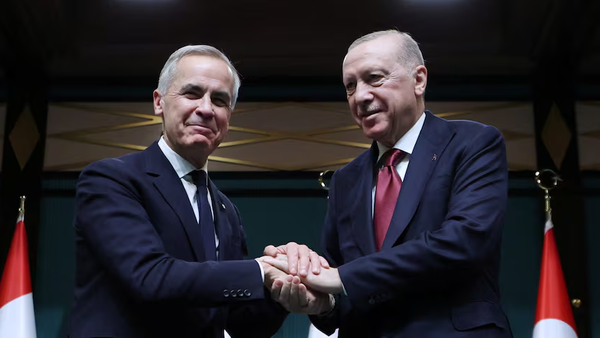
Mark Carney said in Istanbul on 23 October that the speed cap on Ukraine's Starshield terminals caused "direct casualties", three days after the US ambassador told a Gatineau conference that Canada had made "a conscious decision" to move away from SpaceX. The federal government has committed about C$5 billion to Telesat's Lightspeed network and signed space agreements with South Korea and Norway this year, and Telesat's 69 new military satellites are booked to launch on SpaceX Falcon 9 rockets.
Mark Carney told reporters in Istanbul on 23 October that the slowdown of Starshield, the military version of SpaceX's Starlink network that Ukraine uses to fly interceptor and strike drones, had caused "direct casualties". Canada did not want to depend on "one provider that may change their view or may be forced to change their view by one nation state", he said. In September he told The New York Times that "Starlink, we will diversify away from, no question", and named Europeans and possibly South Koreans as partners. Since September 2024 the federal government has committed about C$5 billion to Telesat's Lightspeed constellation in a loan, capacity purchases and a military contract, and Telesat says the 69 satellites it is adding for the Canadian Armed Forces will be "launched by SpaceX on already-secured Falcon 9 rockets".
Carney spoke a day after Russia fired 21 ballistic missiles at Kyiv in three waves, killing one person in the city, according to the Ukrainian government. Three days earlier US Ambassador Pete Hoekstra told Space Canada's SpaceBound conference in Gatineau, Quebec, that Canada had made "a conscious decision" to move away from SpaceX. The Wall Street Journal reported on 20 October that Musk ordered the Starshield cap; Musk wrote on 14 October that limits on Starshield "are decided by the US military and ultimately POTUS".
Istanbul
A reporter asked Carney whether he was concerned that Musk could limit Ukraine's defences. "I search for the right adjective to describe whoever took this decision," he said, against a country "literally fighting for the lives of its citizens against naked aggression". "So are we concerned? Yes, we are concerned." He cited the strike on central Kyiv in the previous 36 hours, which he said hit civilians with no military or quasi-military target nearby.
Carney said Canada was "highly, highly reliant on certain systems in certain countries" and was "in the process of diversifying those". He said he had spoken at length with Volodymyr Zelenskyy, Ukraine's president, twice in the past week about Ukraine's air defence and Starlink. The press conference closed the first bilateral visit to Türkiye by a Canadian prime minister.
In the Times interview Carney said that pooling capacity with allies would cut a dependency that had "in certain circumstances been turned on and off in a way that was not sovereign to the actors in the conflict". He told the European Parliament in Strasbourg on 17 September that Canada and Europe could "pool new sovereign compute capacity and build more secure broadband connections".
South Korea
Hanwha Systems, the defence electronics arm of South Korea's Hanwha group, signed memorandums of understanding with Telesat and MDA Space on 26 January 2026 during a Korean delegation's visit to Canada. The Telesat memorandum covers military user terminals that work on both Lightspeed and K-LEO, the low Earth orbit constellation South Korea is building for its armed forces, and Hanwha said it would include long-term Lightspeed service in its bid for the Canadian Patrol Submarine Project. The MDA memorandum covers MDA's AURORA software-defined satellites as candidates for K-LEO, for which South Korea set aside 320 billion won (about C$304 million) last year. Both followed a letter of intent signed on 10 November 2025 by the Canadian Commercial Corporation and South Korea's Defense Acquisition Program Administration.
Lisa Campbell, president of the Canadian Space Agency, and Taeseog Oh, administrator of the Korea AeroSpace Administration, signed a memorandum between the two agencies at the Space Symposium in Colorado Springs in April. It names low Earth orbit satellite communications first among five fields of cooperation, ahead of Earth observation, positioning and timing, space science and space traffic management, and sets up a working group to pick joint projects and pair companies from both countries. Carney and President Lee Jae Myung opened negotiations on a Canada-Korea Defence Cooperation Agreement covering defence science, technology and materiel when they met at the G7 summit in Évian on 16 June.
Norway
Carney and Jonas Gahr Støre, Norway's prime minister, said in a joint statement in Ottawa on 20 September that the two governments would improve interoperability between their satellite systems. Kongsberg, the Norwegian defence and space group, would explore work on Lightspeed and signed a separate memorandum with MDA Space on satellite surveillance of Arctic shipping. The statement also confirmed that Canada will join the German-Norwegian Type 212CD submarine programme.
Jean-Claude Piedboeuf, acting president of the Canadian Space Agency, and Christian Hauglie-Hanssen, director general of the Norwegian Space Agency, signed their agencies' memorandum electronically the week of 14 September. It covers space-based and dual-use capabilities for Arctic and northern needs and joint projects through the European Space Agency, where Norway is a full member and Canada a cooperating state.
Europe
Eutelsat, the Paris-based operator whose largest shareholder is the French state and whose other major shareholders include the UK government, has offered the Department of National Defence Arctic capacity on its OneWeb network of more than 600 low Earth orbit satellites. The plan, estimated at C$250 million, would bring National Defence into a French defence ministry initiative, with service within a few months of signature. Eutelsat already supplies some services to the Canadian Armed Forces, including troops deployed in Latvia.
Emmanuel Macron, France's president, raised the offer with Carney at the G7 summit in Alberta in June 2025, and Carney's first question was what it would mean for Telesat, Eutelsat and French defence officials told CBC News. David van Dyke, Eutelsat's general manager for Canada, said the company would give Canada "the ability to not be under the control of a singular individual" and that Eutelsat sells to governments, security forces and mines, not households. Lori Idlout, the MP for Nunavut, told Nunatsiaq News that Canada should consider it, "especially considering how much the Arctic relies on Starlink".
Canada became the first country outside Europe to join Security Action for Europe, the European Union's defence loan instrument, in December 2025. SAFE lends EU states up to C$244 billion for ammunition, missiles, drones, artillery and other equipment, and Canada is the only country outside Europe with preferential access. The European Commission's Arctic strategy of 20 October calls Canada "a natural ally in the Arctic" and proposes a data cable from Europe through Greenland and Canada to Japan and South Korea. Carney meets EU leaders at the 21st EU-Canada summit in Montreal on 29 October.
Kepler and NordSpace
David McGuinty, the minister of national defence, announced on 21 October a two-year, C$4.7 million contract with Kepler Communications of Toronto to build and test laser links that let satellites pass data to one another without a ground station, for Arctic and remote operations. The contract is part of the C$17.9 million Gateway to the Stars challenge run by National Defence's Innovation for Defence Excellence and Security programme. "Canada's North is strategically vital, yet remains underserved by traditional connectivity infrastructure," said Mina Mitry, Kepler's chief executive.
McGuinty also announced a 10-year, C$20 million agreement under which NordSpace of Markham, Ontario, will keep a launch pad at the Atlantic Spaceport Complex in St. Lawrence, Newfoundland and Labrador, on standby for the Canadian Armed Forces. NordSpace is building its orbital rocket, Tundra, in Markham and aims to finish the orbital pads, mission control and fuel storage by spring 2027. National Defence signed a similar 10-year agreement with Maritime Launch Services in Nova Scotia in March, and Canada joined NATO's STARLIFT launch initiative as a full member the same day. "Sovereign launch means Canada can replace damaged or threatened systems on our own terms and on our own timelines," McGuinty said. Small satellites and launch vehicles, he said, are "where we start; they're not where we stop".
The money
Telesat LEO, a subsidiary of Ottawa-based Telesat, signed a C$2.14 billion loan with the federal government on 13 September 2024. It runs 15 years at 4.75 percentage points above the Canadian Overnight Repo Rate Average, with interest added to the loan during construction, and gives the government warrants for 10 per cent of Telesat LEO at a valuation of US$3 billion. The Quebec government lent C$400 million on similar terms for warrants of 1.87 per cent. The federal government has also committed C$600 million to buy Lightspeed capacity for rural high-speed internet once the network runs.
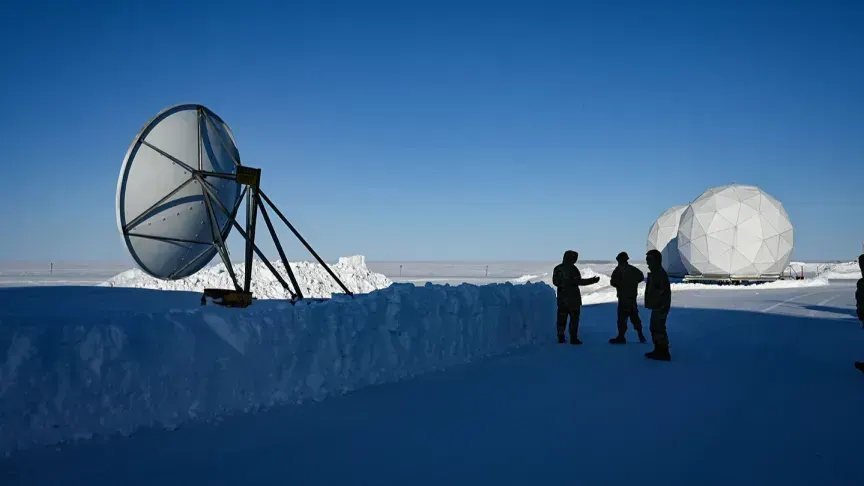
The Defence Investment Agency awarded Telesat LEO an initial contract of about C$2.3 billion on 4 August 2026 under the Enhanced Satellite Communications Project, Polar, with options worth about C$214 million and C$218 million. It buys military Ka-band coverage from 65 to 90 degrees north for 15 years including the options, starting in 2028. MDA Space will lead a later contract for a separate medium Earth orbit constellation carrying X-band and UHF military communications north of 65 degrees, with Telesat as subcontractor.
Telesat will add 69 satellites, taking Lightspeed from 156 to 225, all built by MDA Space in Montreal and paid for in government milestone payments from the third quarter of 2026. Telesat puts the cost of the 225-satellite network at about C$7 billion, with C$2.7 billion spent so far. Dan Goldberg, Telesat's chief executive, said the contract gives the forces sovereign connectivity "years earlier than originally planned".
MHR Fund Management, the New York investment firm of Mark Rachesky, holds 18,035,092 Class B units in Telesat, about 35.4 per cent of the outstanding Class B shares, according to an early warning report MHR filed on 9 July 2026.
The rockets
Telesat booked 14 Falcon 9 launches with SpaceX on 11 September 2023, each carrying up to 18 Lightspeed satellites from California and Florida, with launches to begin in 2026 and global service in 2027. Goldberg told CNBC that day that Falcon 9 was "affordable, it's reliable" and that a 2019 agreement with Jeff Bezos's Blue Origin for New Glenn launches still stood. Telesat's August 2026 release moves global service to the first quarter of 2028 and puts the 69 Arctic satellites on Falcon 9 rockets already booked, plus one more Falcon 9 that "remains subject to the completion of a launch services agreement".
SpaceX has stopped taking bookings for its Transporter and Bandwagon rideshare flights beyond late 2028, citing a full Falcon 9 manifest, industry sources told SpaceQ in August. GHGSat, Kepler and the Canadian Space Agency have flown satellites on those missions, and SpaceQ's research note says dedicated small rockets such as Rocket Lab's Electron and Firefly's Alpha charge two to more than three times as much per kilogram. Budget 2025 set aside C$182.6 million over three years for a sovereign launch programme.
The cap
Ukrainian units began losing Starshield links overnight on 13 to 14 October whenever terminals moved faster than about 160 km/h. Sources in Ukraine's Defence Ministry told Interfax-Ukraine that, depending on the equipment and unit, connections dropped at speeds from about 72 to about 161 km/h, cutting off interceptor and medium-range strike drones. Zelenskyy said on 17 October that terminals in Ukraine still lost connection above 161 km/h while vehicles fitted with them in EU countries kept working at 180 km/h.
Trump told reporters on 22 October that Musk had "put it back". The Journal reported that Trump called Musk on 21 October to ask him to lift the restrictions. Asked on 23 October whether he had spoken to Musk, Trump said: "I have not spoken to him. I might ... have to, but I have not. I've heard ... it was fixed, but if it's not, I'll fix it."
Denys Sienik, Ukraine's chargé d'affaires in the United States, wrote on X the same day that "speed restrictions remain in place". Andriy Klymenko, commander of the 414th Unmanned Systems Brigade, told The Washington Post that Starshield was dropping out constantly, at a higher speed than the day before. Serhii Beskrestnov, Zelenskyy's adviser on defence technology, wrote that his team saw "no indication that the Starlink restrictions have been lifted".
Yevhenii Khmara said in a statement carried by AFP on 24 October that monitoring systems were registering speeds above 400 km/h and that "the connection is stable".
Richard Blumenthal, the senior Democrat on the Senate Permanent Subcommittee on Investigations, opened an inquiry on 22 October and asked Defence Secretary Pete Hegseth who holds the technical and legal authority to make such changes. A letter led by Senators Mark Kelly and Thom Tillis asked Hegseth to expand Ukraine's Starshield contract. On 22 October Ukraine's Defence Ministry signed a letter of intent with ICEYE and Nokia, both Finnish, to study a satellite communications system Ukraine would own.
Hoekstra
Hoekstra spoke on stage with Beth Burke, president of the Canadian American Business Council. He described Canada's stance as "We're not gonna rely on SpaceX ... or actually you're closing the market to SpaceX," SpaceQ reported, without naming a rule or contract. "You've made it a conscious decision that you've said we're gonna move away from SpaceX, it's kind of like, 'Okay, great.' That's helpful for us as a government," he said. "I think Elon will probably find other people that he can do business with, and my guess is that he already is."
He said the Trump administration did not consider itself in a trade war with Canada. On northern defence he said it did not know whether Canada would contribute to Golden Dome, the planned US missile shield, and that if it could not work with Canada it was "not standing still", pointing to two US military bases planned in Greenland.
The North
Tom Zubko, owner of New North Networks, told a SpaceBound panel on 21 October that northern alternatives to Starlink are very limited and that Amazon Leo or the EU's IRIS² network could help in a few years. Madeleine Redfern, chief executive of the Native Women's Association of Canada, told the same panel that when a Telesat satellite failed in 2011, "the whole entire northern part of Canada went black".
Doug Ford, Ontario's premier, cancelled the province's C$100 million Starlink contract on 4 March 2025 in response to US tariffs. Signed in November 2024, it was to connect 15,000 rural and northern homes and businesses by June 2025. Stephen Lecce, Ontario's energy and mines minister, confirmed the cancellation in July 2025 and would not say what the province paid SpaceX to exit.
The Treasury Board's white paper on digital sovereignty, published in late 2025, states that "using a Canadian supplier or storing data in Canada does not guarantee data will be outside the jurisdiction of foreign courts". The Globe and Mail's editorial board quoted the passage on 24 October and wrote that Rogers sells direct-to-cell satellite service through Starlink.
The contracts
The Defence Investment Agency's contract with Telesat LEO would show what remedies the government holds if launches slip and the 2028 service start is missed. Telesat's 2023 launch agreement with SpaceX, and any amendment covering the 69 Arctic satellites, would show whether SpaceX can delay, reprice or cancel the launches, and the agreement for the final Falcon 9 would show whether it has been signed. National Defence's file on the Eutelsat proposal would show whether the department has priced OneWeb capacity as a bridge to 2028.
SpaceX's configuration logs for Ukraine's Starshield terminals, and Space Systems Command's correspondence with the company, would show who set the 160 km/h cap overnight on 13 to 14 October and who lifted it before 24 October. Nine senators asked Platte Moring, the Defence Department inspector general, for written confirmation of an investigation's status and an initial briefing by 1 November 2026.