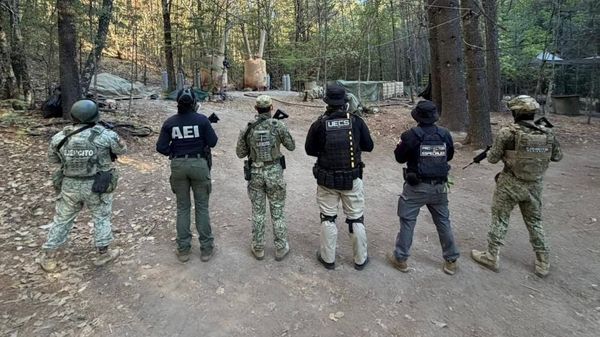

Three people have died in custody at Camp East Montana, the tent concentration camp on the Fort Bliss Army base in El Paso, Texas, since it opened in August 2025, and the El Paso County medical examiner ruled one of those deaths, of Geraldo Lunas Campos on 3 January 2026, a homicide. The Government Accountability Office reported in June that "evidence associated with the incident was missing or destroyed". ICE's inspectors found 49 violations of detention standards at the camp in February and 52 in May. On 19 October, US Immigration and Customs Enforcement posted a revised justification for keeping Amentum Services Inc. at the camp into late 2028 without competing bids, which would lift the estimated value of Amentum's contract to about $2.8 billion, a projected value over future years, not money already paid.
Camp East Montana's detainees are civilians held without trial on civil immigration grounds, most of them never convicted of a crime, which meets the definition of a concentration camp used by Andrea Pitzer, author of One Long Night: A Global History of Concentration Camps: "the mass detention of civilians without trial". ICE's case for skipping competition rests on Amentum's ownership of the camp's housing units, generators, security systems and kitchen equipment. The documents made public do not show how Amentum came to own them or whether federal money paid for them. ICE made the March award, the July extension and the October justification after its own offices had documented the deaths, the missing evidence and the violations; the available documents do not show how the officials who approved those decisions weighed them. A DHS spokesperson told The Hill in July that detainees at the camp were not being beaten or abused.
The $2.8 billion decision
ICE's Office of Acquisition Management posted the redacted justification on SAM.gov on 19 October under contract number 70CDCR26C00000016, the number of Amentum's March award. It states that ICE "intends to definitize a previously awarded letter contract" with Amentum on a sole-source basis. Project Salt Box, which reported the justification the same day and published a copy, read it as keeping Amentum at the camp into late 2028. The document calls Camp East Montana a temporary facility and says officials are still deciding whether to replace it.
Amentum's March award was a letter contract, a stopgap that lets a contractor start work before price and terms are fixed. GAO described it as noncompetitive, with its price and terms still unsettled. The Federal Acquisition Regulation requires the price and terms of a letter contract to be settled within 180 days or before 40 per cent of the work is done, whichever comes first, unless the contracting officer authorises more time "in extreme cases". The 180 days from the 12 March award ran out on 8 September 2026, six weeks before the justification seeking to settle the contract appeared.
The justification cites a nationwide shortage of detention beds and ICE's February inspection of the camp as reasons the agency had to act quickly. It blacks out how many problems that inspection found, a figure ICE had published in April.
Three deaths, one homicide ruling
Lunas Campos, a 55-year-old Cuban father of four, was arrested by ICE in Rochester, New York, in July 2025 and held at Camp East Montana from September. On the night of 3 January 2026 guards took him to the camp's segregation unit. At 21:37 Lieutenant Paul Walden called 911 and said Lunas Campos "tried to hang himself, then we put him in custody, kept going", according to 911 audio The Washington Post obtained. Paramedics dispatched for an "apparent suicide" arrived at 21:48 and found him pulseless on the floor of his cell with two staff members performing CPR, the El Paso Fire Department's report states. At 22:38 Deputy Facility Director Daniel Rios called police to ask for a detective to investigate a "suicide", telling the dispatcher, "I don't have the details."
Adam Gonzalez, the county's deputy medical examiner, found abrasions on Lunas Campos's chest and knees, bleeding in his neck and petechial haemorrhages in his eyelids, and gave the cause of death as asphyxia due to neck and torso compression. He wrote that Lunas Campos "was witnessed to become unresponsive while being physically restrained by law enforcement", and ruled the manner of death homicide in a report released on 21 January. A homicide ruling means death at the hands of another person; it is a medical classification and does not decide criminal responsibility.
Santos Jesus Flores, a detainee in the segregation unit, told the Post that Lunas Campos arrived in handcuffs and ankle shackles, refused to enter a cell until he got his medication, and that guards then grabbed him and choked him while he repeated "No puedo respirar". Three detainees in nearby cells gave Human Rights Watch matching accounts, one quoting his last words as "You are suffocating me". Jonathan Blitzer of The New Yorker said on NPR's Fresh Air that at least five detainees saw or heard the encounter and that Lunas Campos had been asking for his asthma inhaler.
ICE's statement on 9 January said staff found Lunas Campos "in distress" in segregation and began lifesaving measures, without mentioning a struggle. DHS spokesperson Tricia McLaughlin said in mid-January that he had attempted suicide, resisted staff and stopped breathing during the struggle. ICE's preliminary review dated 16 January says he had wrapped a sweatshirt around his neck and resisted guards trying to handcuff him, and that guards then used force, without describing what force; about seven minutes later, nurses arriving with medication found him without a pulse. ICE's death report in February called the encounter a "spontaneous use of force".
The guards worked for the camp's contractors. Acquisition Logistics LLC, the prime contractor at the time, had subcontracted security to Akima Global Services LLC, a Virginia-based subsidiary of an Alaska Native corporation. Amentum, then another Acquisition Logistics subcontractor, became prime contractor in March. Lunas Campos's family sued Acquisition Logistics, Akima and the guards in a petition, case 2026DCV3228, filed at the end of June, alleging the guards killed him and the companies failed to train and supervise them.
Francisco Gaspar-Andres, 48, from Guatemala, died in hospital on 3 December 2025; DHS attributed the death to liver and kidney failure and said he received constant, high-quality care, while his daughter told Human Rights Watch he had been ignored when he asked for help. Victor Manuel Diaz, 36, from Nicaragua, died on 14 January 2026 in what ICE presumed was a suicide. He had been placed in a medical holding room rather than a suicide-resistant cell and left unattended for more than 15 minutes, GAO found.
Evidence missing or destroyed
GAO's June report, citing an ICE discrepancy report dated 20 February 2026, states that "evidence associated with the incident was missing or destroyed". GAO does not say what the evidence was, when its loss was discovered, whether it was never collected, lost or deliberately destroyed, or who was responsible for keeping it. The same discrepancy report found that the contractor did not give ICE the use-of-force and death reports it was required to file after Lunas Campos died.
ICE's February inspection documented a wider failure. Camp staff did not routinely film uses of force, catalogue and keep the footage or write the required reports, and after-action reviews missed their deadlines and were not sent to ICE. The 3 January incident is missing from ICE's daily use-of-force summaries, which list three uses of force at the camp between its opening and February 2026, the Post found. The missing evidence, the unfiled reports and the general failure to keep footage are three separate findings by two offices; the documents published so far do not show whether they are connected.
ICE posted its preliminary review of the death to its online FOIA library alongside 32 other redacted death reviews. Project Salt Box downloaded them on 26 September; by 28 September they had been removed, and the organisation published archived copies.
El Paso police said the case falls under federal jurisdiction because it happened on an Army base. Todd Lyons, ICE's acting director, told a House appropriations subcommittee on 16 April 2026, "That case now is with the FBI". ICE's Office of Professional Responsibility has put its own investigation on hold pending the criminal inquiry, GAO reported. The FBI declined to comment to the Post in May.
What ICE knew
ICE did not inspect the camp before detainees arrived, contrary to its own policy. GAO and ICE each sent officials to inspect the camp in September 2025. One of those officials told Blitzer that the warning relayed up the chain afterwards was "someone is going to die here", because none of the cells for detainees at risk of suicide had been made safe for them. In October 2025 ICE raised concerns about missing vision panels in the doors of the camp's medical holding rooms, GAO found. The panels were still missing on 14 January 2026, when Diaz died in one of those rooms.
| Date | Finding or decision | Source |
|---|---|---|
| September 2025 | GAO and ICE site visits; an official warns "someone is going to die here" | NPR |
| October 2025 | ICE flags missing vision panels in medical holding rooms; a detainee escapes | GAO |
| 3 December 2025 | Gaspar-Andres dies; ICE discrepancy report on tuberculosis screening | GAO |
| 3 January 2026 | Lunas Campos dies in segregation | Washington Post via ADN |
| 14 January 2026 | Diaz dies in a medical holding room without vision panels | GAO |
| 21 January 2026 | Medical examiner's homicide ruling released | AP via KJZZ |
| 26 January 2026 | Discrepancy report on a contract guard's lost loaded firearm | GAO |
| 10 to 12 February 2026 | ICE inspection finds 49 deficiencies, 22 on use of force | AP via Texas Tribune |
| 20 February 2026 | Discrepancy report: evidence in the Lunas Campos death "missing or destroyed" | GAO |
| 3 March 2026 | Discrepancy reports on the escape, cleanliness and suicide prevention; 14 measles cases confirmed | GAO |
| 12 March 2026 | ICE awards Amentum a no-bid letter contract worth about $453 million | GAO |
| May 2026 | Follow-up inspection finds 52 deficiencies, 12 of them priority | Newsweek |
| 9 June 2026 | GAO reports waste and performance failures and makes four recommendations | GAO |
| Late July 2026 | ICE notice extends Amentum through September 2027 | Texas Observer |
| 19 October 2026 | ICE posts justification to keep Amentum into late 2028 | Project Salt Box |
ICE issued eight discrepancy reports against the contractor between 3 December 2025 and 3 March 2026 and awarded Amentum the no-bid contract nine days after the last of them. Amentum took over operations in April; the May inspection, the first conducted under its management, found more deficiencies than February's, including eight repeats. The July extension and the October justification followed both inspections and GAO's report. The documents obtained do not show whether the contracting officers who approved the March award, the July extension and the October justification reviewed those findings, or how they weighed them.
Why Amentum?
ICE's contracting office argues in the justification that only Amentum can do the work because the company owns the camp's housing units, generators, security systems and kitchen equipment. The July extension notice cited "the proprietary nature of its infrastructure". Neither document, as reported, says who bought that equipment, who paid for it, when Amentum came to own it, whether the Army's original task order gave the government any right to buy it or transfer it to another operator, or whether ICE studied alternatives such as leasing it. GAO's June report does not address ownership.
Acquisition Logistics signed a $200 million subcontract with Amentum on 16 July 2025, two days before the Army awarded Acquisition Logistics the camp contract. What that subcontract covered has not been disclosed. An Amentum representative attended an occupational safety investigation at the site during construction, the Texas Observer reported, and DHS described the company as "a close partner with ICE in managing Camp East Montana" before March. Amentum's ownership could rest on the terms of that subcontract, on the property clauses of the Army's task order or on a purchase after the March award; the documents obtained so far do not show which, or which federal officials approved the arrangement.
ICE posted its notice of intent to award Amentum a sole-source contract on 11 March 2026 and gave other firms until 11:00 Eastern time on 12 March to submit capability statements. The notice told companies it was not a request for competitive quotes. Amentum was the only company to express interest, according to the October justification. DHS said Amentum was chosen for its "size, maturity and pedigree".
Amentum, based in Chantilly, Virginia, has more than 50,000 employees and mostly works for the Department of Defense. Its affiliates have paid $57.6 million in False Claims Act settlements since 2000, the largest a $21 million DynCorp settlement in 2025, and Amentum remains a defendant in a whistleblower suit over costs at a 2021 Afghan refugee programme. The settlements and the lawsuit concern other contracts.
The cost to taxpayers
The Army issued the solicitation on 9 June 2025, received 11 offers and on 18 July awarded Acquisition Logistics, a firm then registered to a home in Virginia, a firm-fixed-price task order worth up to $1.3 billion under a Navy contract vehicle for small businesses, Public Citizen found. The company's largest previous federal contract was worth $16 million. When a losing bidder, Gemini Tech Services, protested on 28 July, the Army told Acquisition Logistics to keep working the same day; the Court of Federal Claims later found the Army had breached the statute by proceeding before notifying GAO and issuing a written determination, although it dismissed the protest.
The $1.3 billion was a ceiling, not a payment. The task order priced beds at 1,000 at first, adding 250 a week up to 5,000, and priced meals by capacity, with no tiered pricing for lower occupancy. It contained no quality assurance surveillance plan, the document that lets the government withhold money for poor performance; ICE and Army officials told GAO the omission was due to "expedited time frames". GAO found the government paid up to $11.5 million for guards, medical staff, transport and meals between 1 and 15 August 2025, before the first detainees arrived, about $423,000 for unneeded meals from 16 August to 30 September and $7.1 million more for unneeded meals from 1 October 2025 to 12 March 2026, after ICE took over the contract. The camp held about 1,600 people at the end of February.
Amentum's $200 million subcontract sits inside the $1.3 billion ceiling. ICE ended Acquisition Logistics' task order for convenience in mid-April 2026, GAO reported, after giving Amentum a letter contract worth about $453 million on 12 March to run the camp through 30 September 2026. A notice in late July extended Amentum through 30 September 2027 at a potential added cost of $776 million, for about $1.2 billion in total. The October justification would raise that to about $2.8 billion. The Amentum figures are estimates and ceilings; ICE has published neither the amounts obligated nor the amounts paid under either company's contract.
The justification prices the first seven months at about $477 million, roughly $68 million a month, rising to about $97 million a month over the final six months, Project Salt Box reported. A further $57 million is redacted. The published copy does not explain the increase, and without the pricing schedule it cannot be attributed to added services, higher occupancy assumptions, equipment costs or inflation. ICE's estimate of $68 million a month would equal about $1,100 per detainee per day if the camp held the average of just over 2,000 people it held in early July, and about $450 at its 5,000-person capacity; both figures divide ICE's estimate by occupancy and are not payment data.
In June, DHS told GAO it was moving the camp's contract to tiered pricing tied to the number of people held. GAO reported in a second review that ICE had not done so as of August 2026 and was still paying for services it did not need. The October justification lists a fixed price for each month.
The fight for independent oversight
Gerald Akari Angye and three other detainees sued ICE, DHS and the Department of War on 29 May 2026 on behalf of everyone held at the camp now or in future. On 15 October they asked US District Judge Leon Schydlower in El Paso for a preliminary injunction ordering changes to medical care, living conditions and the use of force, and the appointment of independent monitors. The motion is backed by declarations from 43 people, 29 medical files, four government oversight reports and two expert declarations and argues that conditions at the camp amount to punishment of civil detainees, which the Fifth Amendment forbids. An ICE spokesperson told KFOX14 the agency does not comment on pending litigation; the government had not filed a response by 16 October.
ICE's February inspection found 49 deficiencies, against 13 at the next-worst facility its inspectors examined that year, and still rated the camp "acceptable/adequate". Inspectors found that staff did not document suicide checks, that a detainee with tuberculosis symptoms was not isolated or reported to ICE, that medical grievances went unanswered for six to 14 business days and that the contractor refused to give them its staffing levels. Texas health officials confirmed 14 active measles cases at the camp on 3 March 2026, and the camp closed to visitors and lawyers.
Human Rights Watch and the American Civil Liberties Union interviewed 80 people, 71 of them held at the camp, between October 2025 and June 2026 and published their findings on 15 July. Of those interviewed, 64 said guards had beaten them or that they had seen guards beat others, and at least 60 said the camp failed to give them prescribed medication on a regular schedule. Detainees described masked "anti-disturbance" teams of 10 to 20 guards answering hunger strikes, requests for medical help and protests over recreation with beatings, and two described guards blocking or switching off cameras before beatings. Video does not corroborate those accounts; ICE's inspectors separately found that the camp did not keep use-of-force footage.
Sworn declarations filed with the motion describe guards beating Cubans who refused removal to Mexico and camp workers driving groups to the border at Santa Teresa, New Mexico, around 23 October 2025, where masked people told them to "jump over into Mexico". The filing does not say who employed the masked people.
The documents still missing
ICE's inspection reports, its discrepancy reports against the contractor and GAO's audit documented the failures at Camp East Montana before the agency moved to keep Amentum through 2028, and the agency cites Amentum's ownership of the camp's infrastructure as the reason no other company can run it. The unredacted justification would show which officials signed it, what the $57 million covers and why monthly costs rise from $68 million to $97 million. The property clauses of the Army's task order with Acquisition Logistics, its $200 million subcontract with Amentum and any later transfer documents would show who paid for the housing units, generators and kitchens and whether the government kept any right to them. ICE's contract file would show whether a contracting officer authorised extra time past 8 September to settle the March letter contract and whether the approving officials reviewed the inspection and discrepancy reports.
USAspending and the Federal Procurement Data System would give the amounts obligated and paid under each contract. The contractor's evidence logs and chain-of-custody documents for the segregation unit on 3 January 2026, the 20 February discrepancy report and the use-of-force reports the contractor failed to file would show what evidence existed and how it was lost. The guards' employment files at Akima would show who was on duty and whether they kept working afterwards. The Army expects to finish its GAO-recommended study of what went wrong at Camp East Montana on 30 December 2026.