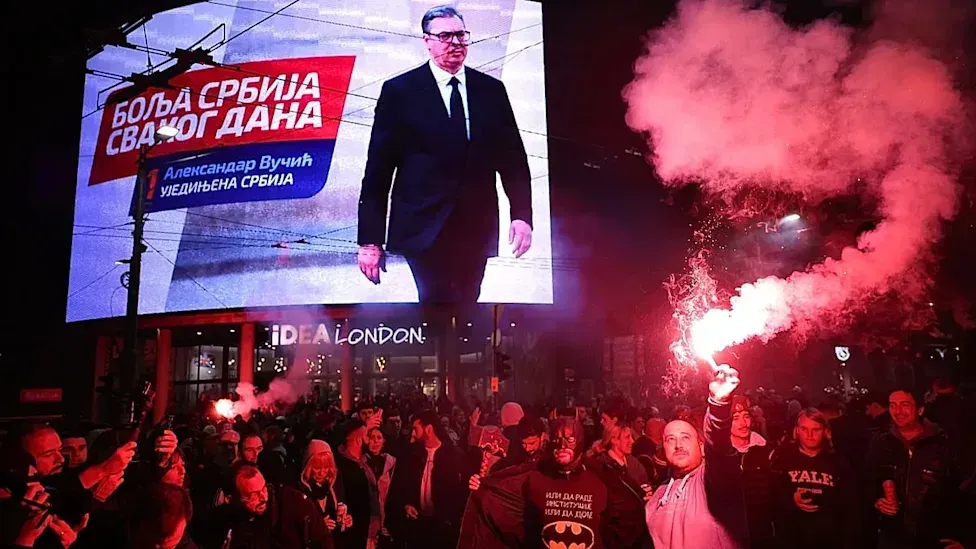
The Student List, whose 250 candidates were chosen by student assemblies, won Serbia's parliamentary election on 25 October, and Aleksandar Vučić conceded defeat for the Serbian Progressive Party (SNS), which has governed Serbia for 14 years. The Republic Electoral Commission's (RIK) preliminary count from 7,926 of 8,392 polling stations gave the Student List 2,116,719 votes, or 52.19 per cent, to 1,602,913, or 39.52 per cent, for Vučić's United Serbia list, a lead of 513,806. The Centre for Free Elections and Democracy (CeSID) and the polling firm Ipsos projected from their own sample 140 of the 250 seats in the National Assembly for the Student List and 103 for United Serbia. RIK allocates seats only after it declares the final count.
Vučić conceded at 21:30 at SNS headquarters in Belgrade, saying a sample count made it clear "that we have lost these elections". He had resigned the presidency on 27 September, 28 days earlier, to run for prime minister.
The vote fell a week before the second anniversary of the collapse of the renovated railway station canopy in Novi Sad on 1 November 2024, which killed 16 people. Students went into blockade after an attack on a vigil for the dead and by the end of that year had shut nearly every university in the country. Their first demands were for the station's reconstruction documents and for the people who assaulted students to be identified. By May 2025 they were demanding early elections. Their list won on 25 October 2026 on turnout that CeSID and Ipsos estimated at 69.3 per cent, against 58.77 per cent in 2023.
The concession
Republika, a pro-government daily, published RIK's first count at 21:29 from 203 polling stations, with United Serbia on 54.21 per cent and the Student List on 36.85 per cent. Vučić began speaking a minute later and said a stratified sample gave the Student List between 135 and 140 seats and his own list about 105. He told supporters his list had about 1.72 million votes and the Student List about 2.2 million, figures he attributed to the sample. CeSID's projection from 56 per cent of its sample, published at 21:56, gave the Student List 138 seats.
Vučić told the room the vote had confirmed a revolution carried out with the support of several European countries and "the American deep state, the one against President Trump", and he called the winners contractors doing dirty work designed by others to bring down a sovereign country. He offered no evidence. He said the new government would impose sanctions on Russia by March or April, and he congratulated Nataša Kandić, founder of the Humanitarian Law Centre, saying her policy had won with large outside support.
Vučić said some members would leave the SNS, that he would never leave Serbia and that his side would fight on from opposition. He also called journalists from N1 and Nova S scum who had lied, Hina reported.
Vučić had told the rally that opened his campaign on 3 October: "Absent an intervention of some (foreign intelligence) service, we will defeat them." The Associated Press reported that he had said, without providing evidence, that foreign agents backed the student movement. Vučić had courted Donald Trump Jr. and Richard Grenell, Trump's former envoy for the Balkans, and backed a hotel project on the site of the General Staff building in Belgrade involving Jared Kushner's company, Axios reported.
Ana Brnabić, speaker of the National Assembly, has been acting president since 28 September, and as acting head of state she proposes the candidate for prime minister after consulting the lists elected to the new Assembly. She stood third on the United Serbia list, after Vučić and Miloš Vučević, the SNS president. At the SNS headquarters at 22:25 she said "the colour revolution has won" and that the party would go on defending Serbia.
Election night
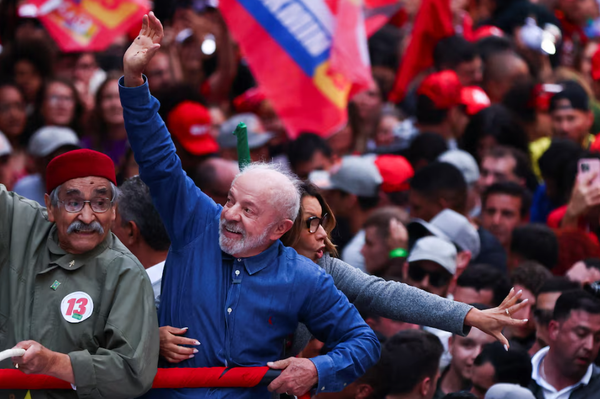
The Student List declared victory at its regional headquarters in Niš at 21:44, 14 minutes after Vučić began speaking, beside a stage put up near the city hall. The crowd there chanted "pobeda" ("victory").
Crowds entered Pionirski park in central Belgrade that evening and pulled down the metal fences and tents of Ćacilend, the camp of Vučić supporters facing the presidency, which had stood for more than a year, Hina reported. Government supporters set it up before the March 2025 protests under the banner "Students Who Want to Study", and European Western Balkans reported that it was mostly filled with SNS activists.
Thousands were still celebrating in Belgrade, Novi Sad and Niš after midnight. A Beta reporter who followed the Belgrade crowds from Terazije through Slavija to the Law Faculty logged no incidents and saw police nowhere along the route, N1 reported. Crowds revived "Gotov je" ("He's finished"), the slogan of the movement that helped bring down Slobodan Milošević in October 2000.
Ilija Srdanović, who heads the Student List, told supporters that the list would begin work the next day "to build a state governed by the rule of law". The movement's choice for prime minister was still unclear on the morning of 26 October, Hina reported.
From Novi Sad to the ballot
Students at the Faculty of Dramatic Arts in Belgrade were attacked on 22 November 2024 during a silent vigil for the canopy victims, and media reports later identified some of the attackers as SNS officials. The faculty went into blockade and other faculties followed. Students set four demands: publication of the station reconstruction documents, identification of those who assaulted students, dismissal of proceedings against students and a 20 per cent rise in funding for public universities. The Public Gatherings Archive, an independent group that counts crowds from aerial images, estimated about 100,000 people at the first mass student protest at Slavija Square on 22 December.
Miloš Vučević resigned as prime minister on 28 January 2025, after men with baseball bats attacked students putting up stickers in Novi Sad and broke one woman's jaw. The Assembly took about 50 days to acknowledge his resignation. On 15 March 2025 the Public Gatherings Archive counted between 275,000 and 325,000 people in Belgrade, and the Interior Ministry put the peak at 107,000. A device that protesters called a sound cannon scattered part of the crowd, hundreds later reported headaches and dizziness, and the authorities denied using one.
On the night of 12 August 2025, rocks, bottles and fireworks were thrown at protesters in Vrbas from the direction of SNS premises, local media said, and bne IntelliNews reported that images from Vrbas and Bačka Palanka showed SNS supporters throwing flares and bottles at crowds, with protesters throwing objects back. Dragan Vasiljević, the police director, reported 16 officers and 52 citizens hurt in Vrbas alone and said demonstrators had come to attack SNS offices. Vučić and other officials called the demonstrators terrorists.
About 110,000 people gathered in Novi Sad on 1 November 2025 to mark a year since the collapse, by the Public Gatherings Archive's count, against the Interior Ministry's 39,000. On 23 May 2026 the archive estimated 180,000 to 190,000 people at Slavija calling for elections, the second-largest protest since the fall of Milošević, and the ministry put the figure at about 34,000. Masked men threw stones, bottles and pyrotechnics at riot police near government buildings that evening, European Western Balkans reported, and Ivica Dačić, the interior minister, said 23 people were detained.
The Student List
The student movement registered the Student List as a citizens' group on 9 September, the day Vučić called the election, under the name "Student List, Students Win". RIK approved it unanimously on 15 September. Srdanović, a cardiologist and professor at the Faculty of Medicine in Novi Sad, has asked to be described only as first on the list. The list published on 14 September puts Katarina Stanković, Željko Hubač and Aleksandar Cvetković behind him and includes Dejan Bodiroga, the former basketball player, and the actor Feđa Dimović.
More than 80 student plenums chose the candidates over several months, Vreme reported before the election was called. Seats on the list were shared among the six university cities of Belgrade, Novi Sad, Niš, Kragujevac, Novi Pazar and Kosovska Mitrovica by student numbers, and each of Belgrade's 51 faculty plenums in blockade picked its own names.
Students themselves were barred from standing, and the plenums excluded anyone who had belonged to the SNS, the Socialists, the Serbian Radical Party, United Serbia or Srpska Lista, anyone who had served in the executive or legislature for the governing coalition and, as a general rule, former officials of the parliamentary opposition. Any faculty could veto a candidate with stated reasons, and a name was struck when more than half of all plenums agreed.
The students said the list was not drawn up by party leaders behind closed doors and that they did not want a new leader or a personality cult. Its 11-point Student Plan covers corruption, education, health and housing. The BBC reported that the list campaigned on removing officials who broke the rules in cracking down on protesters, ending party loyalists' control of public enterprises and freeing the public broadcaster from political control. Vučić and the SNS have denied the corruption the movement accuses them of.
The road to the vote
Vučić dissolved the Assembly on 9 September 2026, more than a year before the regular vote was due, and said in a televised statement that any delay "would threaten the survival of democracy", Reuters reported. The SNS had nominated him for prime minister on 5 September. The vote was set for 25 October, the earliest date the law allows, 46 days after dissolution.
The Constitution bars a third presidential term, and Vučić resigned on 27 September, eight months before his second term was due to end in May 2027. He said he had pardoned 49 people before leaving office, among them 23 prosecuted over the protests. Five days later Vladimir Putin told a plenary session of the Valdai Discussion Club in Moscow that he hoped Vučić would be the "future prime minister" and that Russia welcomed his wish to cooperate, TASS reported.
The Movement of Free Citizens and the Green-Left Front stood aside and backed the Student List on 9 September, after other opposition parties failed to agree a single list. The Socialists expelled their vice-president, Branko Ružić, on 31 August for supporting the students.
A CRTA and Stanford University survey in June gave the Student List 44.9 per cent of decided voters to 35.7 per cent for the SNS. Factor Plus, a pollster opposition politicians accuse of favouring the SNS, gave the SNS and its partners 48.7 per cent to 37.1 per cent for the Student List on 21 September. Jelena Vasiljević, a senior research associate at the University of Belgrade's Institute for Philosophy and Social Theory, told Al Jazeera two days before the vote that turnout would decide it and that the list had to bring out habitual non-voters. "The political dynamic has changed from the ground up," she said.
Péter Magyar's Tisza party had beaten Viktor Orbán's Fidesz in Hungary's election on 12 April 2026 with 53.6 per cent of the vote, ending 16 years of Orbán's rule on turnout above 77 per cent.
The count
RIK's count from 4,838 stations at 01:10 on 26 October had put the Student List ahead by 97,184 votes, on 48.52 per cent to 43.26. By the morning the commission had processed 94.45 per cent of stations, with 466 still to come. The SNS-led list won 1,721,572 votes in the December 2023 election on RIK's preliminary count, about 119,000 more than United Serbia's total from 94 per cent of stations in 2026.
Serbia has 6,451,292 registered voters. The Center for Research, Transparency and Accountability (CRTA) estimated turnout at 67.8 per cent by 19:00 against 55.5 per cent at the same hour in 2023, and bne IntelliNews reported it as the highest for a Serbian parliamentary election since 1992. Kragujevac's city election commission reported 67.48 per cent by 18:00, and the Student List put turnout in Niš at 73.6 per cent at the close. Serbians abroad could vote at 93 polling stations in 37 countries, where 102,147 people were registered. Danas reported long queues in Washington and Vienna.
Dačić's Socialist Party of Serbia, which formed the first SNS-led government with Vučić's party in 2012, won 89,441 votes, or 2.21 per cent, below the 3 per cent threshold, and will sit outside the Assembly for the first time since 1990, Hina reported. Dačić said his party had faced a "referendum atmosphere".
The CeSID and Ipsos projection gives three seats to the Alliance of Vojvodina Hungarians, two to the Albanian Coalition and one each to Rasim Ljajić's list and SDA Sandžaka, national minority lists for which the threshold is waived. European Serbia, the alliance led by Marinika Tepić and Zdravko Ponoš, took 0.3 per cent, and the Russian Party and the Party of Russian-Serbian Unity took 0.3 per cent between them.
Polling day
CRTA deployed more than 2,000 observers to a random sample of 500 polling stations and found voters photographing their ballots at 48 per cent of stations nationally, 79 per cent in Belgrade and 58 per cent in Vojvodina. Polling boards failed to use the ultraviolet lamp that checks for multiple voting at 30 per cent of stations, and people voted without valid identification at 8 per cent.
Raša Nedeljkov, CRTA's programme director, said observers could not establish whether voters photographed their ballots under pressure, but that CRTA linked the practice to coercion it had documented before polling day. CRTA counted people voting on behalf of others at 13 per cent of stations and by midday had reported ballot stuffing at stations in Žabalj and Sjenica. An observer was intimidated at a station in Zemun, Nedeljnik reported. Andreas von Beckerath, the EU ambassador to Serbia, said the bloc was deeply concerned about violent incidents at several polling stations.
The campaign
The government revised the budget at the end of August and paid almost €1 billion in one-off payments to adult citizens, with RSD 6,000 for every adult not covered by other payments, the OSCE Office for Democratic Institutions and Human Rights (ODIHR) found in its interim report of 9 October. The government also set aside one-off payments of €160 to €300 for pensioners and promised public-sector pay rises of 8 per cent, and 12 per cent for social workers, from December. ODIHR said election participants and civil society groups pointed to unequal conditions in the race and the use of public resources, including the one-off payments.
Vučić attended 173 campaign events between May and August, CRTA counted, and the Friedrich Naumann Foundation found that he appeared on television 129 times in August, about four times a day. Between 5 and 11 October, Vučić alone received more political airtime than the entire opposition, CRTA's media monitoring found. Biljana Pantić, an SNS deputy, said voters were choosing between a party that put stability and development first and those who had reduced politics to "hatred, violence" and attacks on Vučić.
Both campaigns closed on 22 October, the Student List with a rally at Slavija and Vučić in a Belgrade sports hall. Vasiljević told Al Jazeera that the SNS relied on a disciplined core electorate held together by a clientelist model.
Reactions
Milojko Spajić, Montenegro's prime minister, was the first foreign leader to congratulate the Student List, Hina reported. Magyar, now Hungary's prime minister, wrote on X that he had assured the list "of Hungary's support" and that his own victory in April had given them strength. Milorad Dodik, the Bosnian Serb leader of the Alliance of Independent Social Democrats, congratulated the Student List on X. Alain Berset, Secretary General of the Council of Europe, welcomed Vučić's acceptance of the result.
Joe Wilson, a Republican congressman and co-chair of the Helsinki Commission, said Serbians had won through "sheer determination", RFE/RL reported. The White House had not commented when RFE/RL published at 00:15 on 26 October. Možemo, the party that governs Zagreb, congratulated the list and said it hoped for a peaceful transition.
The EU and Russia
Marta Kos, the European Commissioner for Enlargement, wrote on X after the result that "the door to the EU is open". António Costa, president of the European Council, and Ursula von der Leyen, president of the European Commission, each wrote on X praising the turnout, and Costa said the EU was ready to support reforms on the rule of law. Tonino Picula, the European Parliament's rapporteur for Serbia, said judgement on whether the vote was regular should be left to the observation missions.
Serbia has opened 22 of the 35 chapters in its accession talks and provisionally closed two, the last opened in December 2021, according to European Commission figures cited by Diplomacy and Law. The European Parliament resolved on 8 July 2026 that talks should advance only once Serbia aligns with EU sanctions on Russia. Jan Nowinowski, an analyst at the Centre for Eastern Studies in Warsaw, wrote on 21 October that the Student List had said it would not impose sanctions on Russia if it entered government, and Geopolitical Monitor reported that the list had pledged to keep Serbia out of sanctions.
The list has taken a hard line on Kosovo, proposed reviewing agreements reached under EU mediation and floated a referendum on EU membership within six months of taking office, Al Jazeera reported. Igor Bandović, director of the Belgrade Centre for Security Policy, told Al Jazeera that such a referendum could slow or halt accession.
The US sanctioned Naftna Industrija Srbije (NIS), which runs Serbia's only refinery, over its majority Russian ownership, and the US Treasury has extended a licence for MOL Group's talks to buy the 56.15 per cent Russian stake until 30 October. Gazprom supplies about three-quarters of the gas Serbia uses, under an arrangement that runs to 31 December.
The investigations
The Higher Public Prosecutor's Office in Novi Sad indicted 13 people over the canopy collapse, among them Goran Vesić, the former construction minister, and Jelena Tanasković, former director of Serbian Railways Infrastructure. The Higher Court in Novi Sad dropped the case against six of them on 24 December 2025, and the Court of Appeal in Novi Sad restored the indictment against Vesić, Tanasković and four others on 15 June 2026, clearing the way for all 13 to stand trial.
The station had been renovated as part of the Belgrade to Budapest railway, and in August 2025 the Public Prosecutor's Office for Organised Crime opened a corruption investigation into 14 people over the line's reconstruction. Prosecutors allege damage of US$115 million and a benefit of at least US$18.7 million to Chinese contractors.
Vesić had signed a contract in May 2024 with Affinity Global Development, a company linked to Kushner's Affinity Partners, under which Serbia would remove the heritage protection from the General Staff complex, demolish its buildings and grant a 99-year rent-free lease on the land. On 16 December 2025 prosecutors filed an indictment proposal accusing Nikola Selaković, the culture minister, of abuse of office and forgery of an official document. Affinity withdrew from the project hours later.
The Assembly passed laws proposed by Uglješa Mrdić, an SNS deputy, that took effect on 9 February 2026 and placed the organised crime prosecutor under the Higher Public Prosecutor's Office in Belgrade. The organised crime prosecutor had opened investigations into the canopy collapse and the General Staff building, and Kos and Michael McGrath, European commissioners, objected to the changes.
What happens next
RIK must finish counting the remaining 466 polling stations and declare the final result, and only then allocate seats. The commission's station-by-station tallies would show whether the final count holds the 12.67-point gap. The polling-board minutes for the Žabalj and Sjenica stations would show whether stuffed ballots entered the count, and the Finance Ministry's ledger of the one-off transfers would show how much of the almost €1 billion was paid before 25 October.
Article 101 of the Constitution requires the outgoing speaker to convene the new Assembly no later than 30 days after RIK declares the final results. Brnabić holds that post as well as the acting presidency. The Assembly then has 90 days to elect a government, which needs the votes of at least 126 of the 250 deputies, on a candidate Brnabić proposes after consulting the lists. Until a new government is elected, the cabinet of Đuro Macut, the non-party medical professor the Assembly elected prime minister on 16 April 2025, stays in office.
Brnabić served as prime minister from 2017 to 2024 before becoming speaker. She may act as president for no more than three months, and the presidential election to replace Vučić must be held by 27 December, 90 days after the vacancy. Meduza named her in October as a possible candidate for Vučić's camp. Vučić said on the day he resigned that the first round must be held by the end of this year.