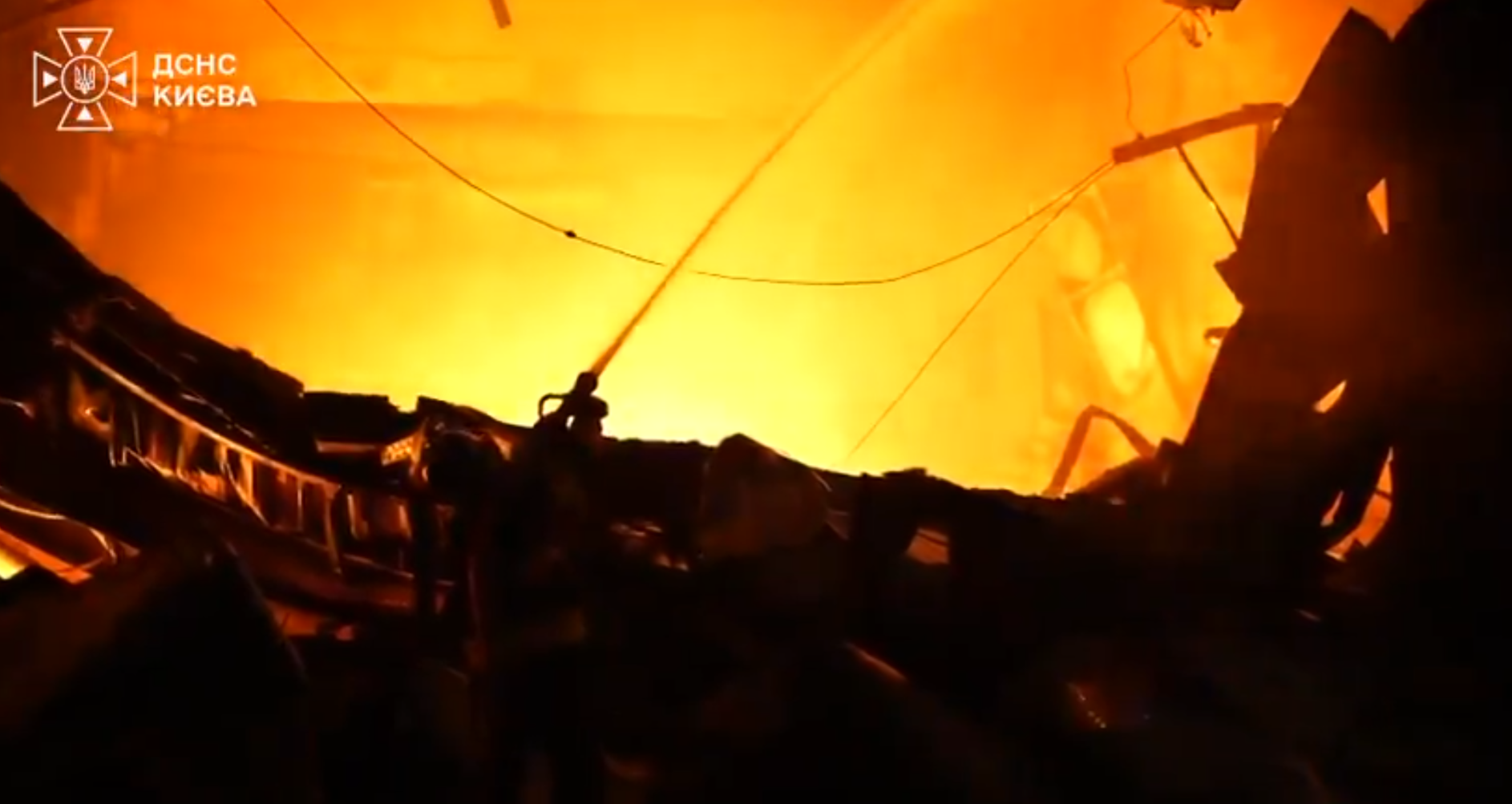
Russia began the attack at 18:00 on 21 October, the day Vladimir Putin freed US prisoner Stephen Hubbard at the start of a three-hour meeting with Steve Witkoff and agreed in principle to new talks. Ukrainian officials say at least one of the missiles carried a cluster warhead into Kyiv's historic Pechersk district; Russia's Defence Ministry says it struck drone and missile plants.
Vladimir Putin opened his meeting with Steve Witkoff at the Constantine Palace in St Petersburg on 21 October by announcing that Stephen Hubbard, a 74-year-old US citizen held since 2022, was already at Pulkovo Airport. Witkoff, Donald Trump's special envoy, answered on camera: "You are a humanitarian also, sir, and I salute that." At 18:00 that evening Russia launched Iskander-M, S-400, Zircon and Onyx missiles and 210 drones at Ukraine, with Kyiv as the main target.
Ukrainian President Volodymyr Zelenskyy said 21 ballistic missiles hit the capital in three waves, and Russian attacks over the day killed at least nine people across the country. The strike followed a fortnight in which Trump waived new sanctions on Russia and struck a deal for Russian diesel, while Patriot interceptors that NATO allies had paid for waited on a US signature, according to Ukrainian officials.
Three waves on Kyiv
The ballistic missiles came in at about 22:00, about 02:00 and about 03:30, according to the Ukrainian outlet ZN.ua. A reporter in the city counted at least 13 explosions in less than eight minutes shortly after 03:00. The Ukrainian Air Force said air defences brought down 181 of the 210 drones, including 87 of the 110 jet-powered ones, and logged strikes at 32 locations. Air defences shot down none of the ballistic missiles that reached Kyiv, CNN reported, citing the Air Force.
Russian strikes killed a 48-year-old man in the Dniprovskyi district on the left bank of the Dnipro and destroyed 13 detached houses on several of its streets, police and the Kyiv City Prosecutor's Office said. The prosecutor's office counted one dead and 24 injured across the city. Police said six people were injured in the district, four of them children, the youngest aged five. Elsewhere in the city a 16-year-old boy was taken to hospital with a closed head injury, prosecutors said.
In the Holosiivskyi, Obolonskyi, Pecherskyi and Sviatoshynskyi districts the attack damaged eight apartment buildings, a building-supply hypermarket, a restaurant, a monastery building, a post office and offices, prosecutors said. In Pecherskyi a strike wrecked an ambulance station and six ambulances parked at it, Kyiv Mayor Vitali Klitschko said. A resident of a private house near one of the left-bank strikes said neighbours pulled a man and his wife out of a burning house next door.
Missiles damaged metro infrastructure on the Pivdennyi Bridge, and by morning trains on the green line ran in two separate sections, Syrets to Vydubychi and Osokorky to Chervonyi Khutir, Kyiv Metro said. Police closed the bridge to traffic heading to the left bank, and the city added buses on routes 22 and 91. Zelenskyy listed energy facilities, a railway station, the metro, shopping centres and businesses among the sites hit.
Russia's Defence Ministry, which said it hit military-industrial plants in Kyiv without naming them, said Russian air defences downed 808 Ukrainian drones overnight, and Moscow Mayor Sergei Sobyanin said 630 of them were flying at the capital. Ukrainian forces struck a weapons plant in Serpukhov, south of Moscow, Ukrainian monitoring channels reported.
Russian drones had struck Kyiv on each of the two previous mornings. On 20 October a drone struck commuter traffic and killed three people, and on 21 October drones killed two people in a 24-storey apartment block. The UN Human Rights Office reported in early October that more than 400 civilians a week were killed or injured in Ukraine over the first eight months of 2026, a 55 per cent rise on the same period of 2025.
Voices from Pechersk
Dasha Bilous, 25, said a missile fragment landed beside her house in the Pecherskyi district and blew out every window, and that she thought she was going to die. She is weighing leaving the capital. There is "no safe place in Kyiv", she told the Kyiv Independent, and asked who had sent the city its "gift": "Putin? Witkoff? Trump?"
Yaroslav Bahai, a teacher who lives in the same district, sheltered in the hallway of his flat with his family while the windows blew in and a fragment pierced the refrigerator in the kitchen. He spent the morning queueing for humanitarian aid. When he asks his students where they see themselves in five years, he said, "Now they say it's hard for them to even imagine what tomorrow will look like."
Andrii Saulevych, who manages the Khlibna Kraina coffee shop in Pecherskyi, had its windows blown out overnight and was serving coffee again by 08:00. Asked about Witkoff's description of Putin, he said: "Humanitarians don't act this way." Nataliia Stativko, a former journalist whose home on a street hit by a missile was damaged, said residents had thought the attacks were war and the destruction of Ukraine, "but it turns out to be an act of humanity".
In Rusanivski Sady, a district of private houses in Dniprovskyi on the left bank, video published by the TSN news channel showed homes flattened in the attack. At the Pecherskyi ambulance station, where six vehicles were wrecked, Klitschko said none of the medical staff were hurt.
Cluster warheads in Pechersk
Serhii Beskrestnov, Zelenskyy's adviser on defence technology, said overnight that one of the Iskander missiles carried a K5 cluster warhead, which bursts above the ground and scatters 58 submunitions over an area of 400 by 400 metres. "This strike was not carried out for military purposes," he said. "The goal was to destroy part of the Old Town and injure as many people as possible."
Zelenskyy wrote on Facebook on the afternoon of 22 October that three ballistic missiles carried cluster warheads and that one struck the historic district near the monastic buildings of the Kyiv Pechersk Lavra. Ukrinform reported his account placing the impact between the Lavra and St Vvedensky Monastery, and he called the choice of weapon and area deliberate. The Ukrainian Orthodox Church's information department said a separate impact, which it attributed to drone debris, hit the roof of St Vvedensky Monastery at 03:05. The identification of the cluster warheads rests on Beskrestnov's Telegram post and Zelenskyy's statement.
Human Rights Watch made its identification after an earlier ballistic attack on Kyiv, on 5 August 2026, from evidence it verified itself. Its researchers geolocated two videos and seven photographs and confirmed a remnant at the Nova Poshta sorting centre as the nose cone of a 9M720 Iskander-M carrying a cluster munition warhead, alongside a pattern of near-simultaneous explosions, in a strike that killed three people.
The weapons
The Air Force named four missile types. The Iskander-M is a short-range ballistic missile, and Ukraine's military intelligence agency, the HUR, said this month that Russia makes up to 65 a month and held about 115 in October. It is the missile Human Rights Watch identified with a cluster warhead after the August strike on the Nova Poshta depot.
The Zircon was designed to sink warships. The HUR classes it as a solid-fuel missile on a quasi-ballistic path rather than the hypersonic cruise missile Russia describes, with a top recorded speed of Mach 6.8, a range of about 1,000 km and a warhead of about 120 kg. Russia built 33 in the first seven months of 2026, the agency said in August, and it put the stock at more than 120 in October.
The Onyx, or P-800, is an anti-ship cruise missile that Russia has fired at Ukraine from coastal Bastion launchers in occupied Crimea. Defense Express, a Ukrainian military analysis group, estimated its top speed at about Mach 2.6 and its warhead at up to 300 kg in 2024. The HUR said Russia holds more than 600 Onyx missiles and has upgraded them for strikes on ground targets.
The S-400 is an air defence system, and Russia has fired its 48N6-family missiles at Ukrainian cities since at least January 2023. Ukrainian analysts estimated in 2023 that the missile flies at about 2.5 km a second and carries a warhead of about 180 kg, and that it can reach a target 200 km away in one to two minutes. Its accuracy against ground targets "tends to zero", the analyst Pavlo Lakiychuk said.
The drones included 110 jet-powered Shahed types, Gerbera and Italmas attack drones and Parodiya decoys meant to draw fire, the Air Force said. The HUR said Russia produces about 10,000 Geran-type drones a month, about 4,000 of them jet-powered, and that its 2026 state order exceeds 100,000 drones and decoys.
Across Ukraine
Regional authorities reported at least nine people killed and 56 injured in Russian attacks over the day to the morning of 22 October. In Zaporizhzhia region three people were killed and three injured, Governor Ivan Fedorov said, and he counted 862 Russian attacks on 48 settlements. In Donetsk region attacks killed one person in Druzhkivka and one in Kramatorsk and injured nine, Governor Vadym Filashkin said.
In Kharkiv region one person was killed and 15 injured, three of them children, across Kharkiv and 11 other settlements, Governor Oleh Syniehubov said in the morning. He later said a Russian strike on a market in Lozova had killed two women, aged 50 and 60. Drones killed one person in Sumy region, where the regional administration counted nearly 60 attacks on 26 settlements, and two Banderol drone strikes on an enterprise in Chernihiv killed one person, Governor Viacheslav Chaus said.
Zelenskyy said Russia hit 12 regions overnight and that 34 people were injured, five of them children. He also said Russia had struck critical energy facilities more than 170 times since 11 October, the day Trump announced an energy ceasefire.
Reactions
Zelenskyy said Russia had answered another round of talks with ballistic missiles and that real pressure on Russia was needed: stronger air defences, faster missile deliveries, the means to destroy ballistic missile launchers and sanctions. Foreign Minister Andrii Sybiha wrote on X that the night showed what Russian "humanism" truly sounds like. "Appeasement, servility, and flattery will not stop this war. Only strength will," he wrote.
Finnish Prime Minister Petteri Orpo arrived in Kyiv on 22 October to show Finland's strong support for Ukraine, his government said, and Russia launched another ballistic missile attack on the city in daylight while he was there. Orpo visited a school damaged by a Russian drone earlier in October.
The European External Action Service put 117 new sanctions listings to EU ambassadors on 21 October, 31 of them aimed at Russian oil refining and exports and 52 at banks, two weeks after Trump's diesel deal. "We see that we have to pressure the aggressor to stop the war, not the victim to surrender," said Kaja Kallas, the EU's foreign policy chief.
The White House's Rapid Response account defended Witkoff on X, asking whether the envoy should "have insulted the man, imperiled the release of an American citizen". Russia's Defence Ministry said its strikes hit "Ukrainian military-industrial facilities involved in the production and storage of long- and medium-range cruise missiles" and transport sites in Kyiv, and port facilities and vessels in Odesa region, where Suspilne reported a strike on a food production plant.
The St Petersburg meeting
Witkoff and Putin talked for about three hours, with Putin's foreign policy aide Yuri Ushakov and his investment envoy Kirill Dmitriev at the table and Jared Kushner, Trump's son-in-law, joining by video. Witkoff presented an updated proposal to end the war that he had carried from talks with Zelenskyy and European leaders in Oslo the day before. The two sides also discussed Russia's offer to help end the war in Iran, Russian fertiliser exports to the US and the restoration of economic ties, CNN reported.
Witkoff thanked Putin on Trump's behalf for lifting Russian export controls on diesel. "It's an example of us working together. I want to thank you for that," he said, adding that US farmers and truckers were grateful too, according to TASS. Russian state media said the first diesel cargo for the US left Russia that day.
Ushakov told reporters afterwards that Putin had informed Witkoff Russia was "in principle" ready to resume three-way talks with Ukraine and the US around 10 November, possibly in Abu Dhabi. He said Putin had been ready weeks earlier and blamed the cancellation on Ukrainian strikes on Russia on the day of Russia's parliamentary elections. Ushakov also said the proposals Witkoff brought, which he attributed to Ukraine and the European Union, contained "little that was useful", and Russian officials told TASS that Ukraine must make "necessary decisions" or its situation "will be worse".
Zelenskyy backed resuming the talks. "Russia said many times it is ready for a meeting and then things changed and got cancelled," he said. He told Fox News that Ukraine would accept no settlement drawn up by China, Russia and the US and that any deal would need approval by Ukraine's parliament. He also said Ukraine was willing in principle to freeze the war on the current line of contact in return for security guarantees.
Putin's spokesman Dmitry Peskov said a meeting of Trump, Putin and Chinese President Xi Jinping was raised in St Petersburg, possibly on the sidelines of next month's Asia-Pacific Economic Cooperation summit in China, though he said no proposals were made. On 22 October Peskov said Putin had been invited to the G20 summit in Miami in December. "The American administration is doing a lot to help a peaceful settlement," he said, while European governments were "doing a great deal to provoke the further escalation of fighting".
At a roundtable in Washington on 21 October, as Kyiv sat under a ballistic missile alert, Trump said a deal to settle the war was "maybe now the closest we've been".
Hubbard
Russian troops seized Hubbard, a retired English teacher from Michigan, from his home in eastern Ukraine in April 2022. A Moscow court convicted him on 7 October 2024 of fighting as a mercenary for Ukraine and sentenced him to more than six years. The State Department designated him wrongfully detained, and the US government says the charges were fabricated.
Witkoff and Dmitriev met Hubbard at Pulkovo, where Witkoff told him Putin sent him "blessings", and he flew home to the US, landing in Texas. Peskov said Putin freed Hubbard on humanitarian grounds. On the same day, Russian authorities said they had detained a German national accused of serving in the Ukrainian army.
Trump wrote that Putin agreed to free Hubbard with "no 'swap' necessary", and that the release would not have happened had the US not stopped new sanctions on Russia from taking effect the week before. Trump had said he asked Putin to release Hubbard in a telephone call the previous week. On 18 October, two days after waiving the sanctions, he wrote that he did not want to "drive, foolishly, Russia away from the bargaining table" and referred for the first time to "hostage negotiations". Hubbard was the only US citizen the State Department then classed as wrongfully detained in Russia, the New York Times reported.
Republican Senator Thom Tillis wrote "WTF, Steve?" in reply to Witkoff's remark and told him to ask the families of children Putin has abducted whether they agree. Senator John Cornyn, also a Republican, wrote that Putin is a "stone cold killer". Vice President JD Vance said he agreed with Witkoff "saying something nice to a person who just released an American hostage", and Trump called the remark a "good saying" for "that particular purpose".
Sanctions waived, diesel deal
Trump announced on 9 October that Russia would supply millions of tons of diesel to the US and world markets, and his administration waived sanctions on Russian diesel exports through April 2027. Russia would send 300,000 tons at once, 500,000 tons in November and 1 million tons "immediately thereafter", Trump said. The next day he said it was "time for Ukraine to get a new president".
On 16 October, two days before they were due to take effect, Trump signed an executive order waiving the sanctions and tariffs in the Graham Sanctioning Russia and Iran Act, which he had signed into law in September. "I am hereby waiving the application of such sanctions, restrictions, and duties provided for in the Graham Act," the order says. It also waived the provision that kept the sanctions in force and the clause tying their termination to a peace agreement accepted by Ukraine, ABC News reported. Without the waiver the law would have required tariffs on Russian petroleum products such as diesel and sanctions on the ships carrying them.
Republican Senators Mitch McConnell, Thom Tillis, Susan Collins and John Cornyn had urged Trump on 13 October to rescind the diesel deal and apply the sanctions. On 19 October Trump told reporters that "Russia, frankly, has been fine on Ukraine", hours after a Russian drone strike on a park in Kharkiv region killed six people, two of them children. "We've given a lot to Ukraine. They've given nothing to us," he said.
Witkoff and Kushner had offered Russia three economic incentives in late September for a partial ceasefire covering energy or the sea, the New York Times reported on 10 October, citing Ukrainian officials. The offer included releasing Russian sovereign assets frozen in the West as an upfront incentive rather than a reward, reviving a 2025 proposal to release up to US$100 billion; a sale of Lukoil's foreign assets to Middle Eastern investors, some with business ties to the US negotiators; and relief for Belarusian potash exports. Ukrainian negotiators asked for matching dollar-for-dollar releases to Ukraine and guaranteed faster military aid if Russia broke a truce.
Trump announced on 11 October that "Effective immediately, there is an ENERGY CEASEFIRE" and that both sides had agreed. Zelenskyy said Russia struck Ukrainian energy sites the same day, and neither government confirmed agreeing to a truce, CBS News reported. Three days later Russia fired 39 ballistic missiles at Ukraine's power grid.
Warnings, satellites and interceptors
Ukraine's Air Force said it intercepted four of the ballistic missiles fired overnight into 14 October, when strikes hit three power plants in Kyiv. CNN reported the next day, citing a source familiar with the situation, that Ukraine had exhausted its stock of US-made Patriot interceptors, the main weapon it has against ballistic missiles. Ukraine had 10 Patriot missiles left on 7 October, a source told the Washington Post.
Ukrainian officials said on 19 October that a batch of Patriots paid for by NATO allies was awaiting Defense Secretary Pete Hegseth's approval. Secretary of State Marco Rubio said on 20 October that the interceptors were in short supply and needed elsewhere. "We have our own needs, too," he said.
Zelenskyy said that for at least a week his military had received no early warning from partners of ballistic missiles aimed at Kyiv, the intelligence that lets the city sound alerts and air defence crews prepare. He said on 20 October, after a call with Rubio, that the warnings had resumed. "We are thankful to American side now that it works," he said.
Ukrainian officials said SpaceX curtailed Starshield, the military version of Starlink that Ukraine uses to fly drones, without notice on 13 and 14 October, cutting service to any drone moving faster than 160 km/h. Three officials told Reuters the order came from inside the White House, while the Wall Street Journal and CBS News reported that Elon Musk ordered it. "It wasn't me and I don't think it was Elon," Trump said on 16 October. Zelenskyy told Fox News on 21 October that Ukraine's access to Starshield remained "limited".
The law
Rule 12 of the International Committee of the Red Cross study of customary international humanitarian law defines as indiscriminate an attack that uses a method or means of combat which cannot be directed at a specific military objective, or whose effects cannot be limited as the law requires. Human Rights Watch called the 5 August cluster strike on Kyiv a potential war crime, citing the indiscriminate nature of the weapon. Russia and Ukraine are outside the 2008 Convention on Cluster Munitions, and Human Rights Watch urged both to join it.
Remnants of the warhead and submunitions from Pechersk, photographed and geolocated, and the forensic findings of the Kyiv City Prosecutor's Office would establish whether a K5 or other cluster warhead struck near the Lavra and how many such warheads fell on the city. The Russian Defence Ministry's list of the Kyiv plants it says it hit, set against satellite imagery of those sites, would show whether any military objective lay near the Pechersk impact. The Air Force's timing of its first warning against Russian launch times would show whether US early warning reached Kyiv before the 22:00 wave.
The written terms of the diesel arrangement and the determination behind the 16 October waiver would show what the US gave for Hubbard beyond the sanctions decision Trump himself tied to the release. Trump said he raised Hubbard with Putin in a call the week before the release, and the White House readout of that call would show whether sanctions were discussed.
Dates ahead
Nine senators asked the Defense Department's inspector general for an initial briefing by 1 November on the Starshield disruption and the missed missile warnings. Russia is due to raise diesel shipments to 500,000 tons in November. Ushakov named 10 November as the earliest date for three-way talks in Abu Dhabi, and Peskov said a Trump, Putin and Xi meeting could take place at the Asia-Pacific Economic Cooperation summit in China next month. Putin has an invitation to the G20 summit in Miami in December.