Meta employees acknowledged in internal messages that Luiz Inácio Lula da Silva's Instagram was restricted on 9 October, five days after Flávio Bolsonaro beat him in the first round, while the platform recommended the senator's profile and WhatsApp channel. Lula's government has spent two years moving to make Meta liable for what it hosts, and the Trump administration put tariffs on Brazil partly over court orders against US platforms. Lula's campaign calls it election interference; Meta says the faults were technical, hit accounts on both sides and had nothing to do with politics.
Luiz Inácio Lula da Silva's official Instagram account could not pay to boost feed posts for almost 24 hours on 9 October, five days after Flávio Bolsonaro beat him in the first round by 47 per cent to 45. In internal messages reviewed by Folha de S.Paulo, a Meta employee identified by the initials A.G. wrote that the president's account was limited compared with the senator's, and staff acknowledged that Instagram had recommended Bolsonaro's profile and his WhatsApp channel. Lula's campaign estimates that 1.3 million people missed its ads that day. Between July and September, Meta's platforms carried at least 1,613 election ads paid for in foreign currency, which Brazilian election rules forbid, according to NetLab at the Federal University of Rio de Janeiro. Brazilians vote in the runoff on Sunday, 25 October.
Meta told Reuters that the technical faults in the messages were already public, that the conversations concerned only their severity and that any suggestion it favours one side is false. In a statement on 16 October it said allegations that it acts to interfere in the election or favour a candidacy are false.
Two days before the vote
Lula told Bloomberg in an interview published on 24 October that his campaign would fight Meta and "prove that we can defeat the digital empire". Meta's Brazil spokespeople pointed Bloomberg to the company's 16 October statement and said the incidents were unrelated technical problems that it has since addressed.
Justice Ricardo Villas Bôas Cueva, the TSE's chief electoral inspector, opened Lula's disqualification case on 22 October and gave Meta and X 24 hours to explain their use of artificial intelligence, their criteria for distributing content and any differences in how they treated the two campaigns, at R$500,000 a day for each company that fails to comply without cause. Meta must also answer for automatic translations, political ads and searches for GIFs and hashtags, and say whether a human reviewed "Flavinho de Papai", a video Instagram removed over alleged AI use. X must explain how its Grok chatbot works. The judge wrote that opening the case does not confirm the accusations and gave Bolsonaro and his running mate five days to respond.
Lula and Bolsonaro met for their last debate on TV Globo in Rio de Janeiro on the night of 23 October. Datafolha's 22 October survey put them at 50 per cent of valid votes each.
The messages
Folha published the messages on 16 October. Meta's first explanation, the newspaper reported, was a global data outage that hit more than 3,000 accounts on 7 October. The outage lasted about five hours; the block on Lula's boosting came two days later and lasted nearly 24. Employees complained internally about how long the fix took and wrote that the Lula campaign was chasing them.
Users who searched WhatsApp for "Exército do Lula", a pro-Lula channel, were shown "Tropa do Flávio" among the results, and Meta's technical explanation was that the president's name was too long. Bolsonaro's profile appeared in Instagram search recommendations in October while other candidates' did not, a practice the Superior Electoral Court (TSE) bars.
Meta blocked ads from Bolsonaro's campaign for using artificial intelligence, according to the messages, and his campaign denies using it. On 23 September both candidates' ad accounts were locked for about an hour after an error flagged "suspicious activity". Bolsonaro's campaign has joined the TSE case and says it was also treated unfairly. Lula's coalition told the court that from 1 to 7 October Bolsonaro's Instagram reels averaged 15.64 million views against 5.91 million for Lula's.
The court
WhatsApp users reported on the evening of 13 October that Meta AI refused to make "Lula 13" artwork on a red background while producing "Flávio 22" pieces in green and yellow. O Globo's own tests found "Lula", "Luiz Inácio", "Flávio Bolsonaro" and "Bolsonaro" all blocked. Lula's campaign added the AI tests to its TSE petition.
Justice Marco Aurélio Bellizze of the TSE ordered Meta on 15 October to stop reducing distribution, blocking recommendations or restricting search results in ways that unbalance the two candidacies, on pain of R$500,000 (about US$98,700) a day. On the AI images, Bellizze found the evidence did not show Meta had acted to block content favourable to Lula.
Meta told the court on 16 October that it would build a system letting only registered candidates, parties and coalitions buy election ads, and that government bodies, NGOs and news outlets would be barred from social-issue ads from 19 October until after the vote. It warned that errors could include wrongly blocking authorised advertisers, the problem that gave rise to the case. The TSE gave Meta 24 hours on 19 October to prove compliance. Meta said on 20 October that it had completed the measures and that any automatic block on a presidential campaign's ad account now goes to human review within two hours.
Lula's coalition, Brasil Pronto pra Mais, filed an electoral judicial investigation action on 21 October asking the TSE to bar Bolsonaro and his running mate, Alfredo Gaspar, from office for eight years for abuse of economic power and improper use of social networks. Senator Camilo Santana, a coordinator of Lula's campaign, said the platforms had made a clear attempt to stop the campaign advancing. Bolsonaro's team had filed the day before to disqualify Lula over mass WhatsApp messages about government programmes.
The research
Ekō, a corporate accountability group, opened a new Instagram account on 14 October, followed Lula, Bolsonaro and both parties and viewed posts without engaging. Of the 50 posts Instagram then pushed to the account, 74 per cent were pro-Bolsonaro or right-leaning and 18 per cent pro-Lula or left-leaning, Ekō found, although the pro-Lula posts averaged 398,000 likes each, more than double the pro-Bolsonaro average.
NetLab collected the foreign-currency ads from Meta's own ad library. They came from 187 advertisers, cost about R$2 million and drew 171.1 million impressions. Of the ads that disclosed where the payer was, 98.1 per cent were paid from the United States, and 99.5 per cent were paid in US dollars. Meta ran every one of them unlabelled as political and reclassified or removed them later. Marie Santini, NetLab's director, called it scandalous that Meta earned R$2 million from illegal ads during the election.
Meta's Oversight Board said on 20 October that heavy-handed enforcement of anti-fraud rules against Lula's ad accounts was a failure that should have gone to an internal team of experts. United Nations human rights experts said on 21 October that information, including from Meta employees, suggested accounts linked to one side of the race had been disproportionately curtailed, without naming the side, AFP reported.
Senator Bernie Sanders and 12 House Democrats led by Representative Pramila Jayapal wrote to Mark Zuckerberg, Meta's chief executive, on 22 October, asking for a briefing the next day and written answers by 4 November, including whether Meta will let an independent auditor review its moderation and distribution data.
Roberta Braga, founder of the Digital Democracy Institute of the Americas, told Bloomberg she did not believe Meta was deliberately tipping the election but that its errors had a disruptive effect in a race that close.
What Meta stands to lose under Lula
More than 90 per cent of Brazilians use WhatsApp, and Bloomberg describes Brazil as one of Meta's most lucrative markets. Facebook alone had about 102 million active users there in 2024, according to the National Data Protection Authority (ANPD), which that July ordered Meta to stop training its AI on Brazilians' posts on pain of R$50,000 a day.
The Supreme Federal Court (STF) ruled by eight votes to three in June 2025 that article 19 of the Marco Civil da Internet was partly unconstitutional. Platforms became liable for most illegal content they leave up after an extrajudicial notice, and for paid or bot-amplified content without any notice at all, and must keep a legal representative in Brazil and publish transparency reports. A Lula decree in May 2026 gave the ANPD power to oversee and investigate violations, under rules in force since July.
Lula sent Congress a bill on 17 September 2025 that would let the competition regulator, CADE, designate digital platforms with revenue above R$5 billion a year in Brazil or R$50 billion worldwide as systemically relevant and impose special obligations and fines on them through a new digital markets superintendence. The Chamber of Deputies voted 276 to 186 on 18 March 2026 to fast-track it.
The Ministry of Justice asked the ANPD on 17 October to investigate whether Meta's election moderation broke the Marco Civil, and federal prosecutors sued Meta on 21 October, seeking R$500,000 a day for each account it blocks arbitrarily. Daniel Arnaudo, a visiting researcher at Fundação Getulio Vargas, wrote in Tech Policy Press that platforms' engagement with Bolsonaro's party may be driven partly by a shared interest in fighting content regulation.
Meta and the Bolsonaro camp
Meta ran the largest big tech lobbying operation against Brazil's fake news bill, PL 2630, which would have made platforms liable for third-party content and ads, Agência Pública found. Its public policy director, Kaliana Kalache, led the mobilisation of the evangelical caucus with a paper arguing the bill could ban biblical passages, and 14 of the 19 Meta policy staff Pública mapped had held public office. The bill's rapporteur, Orlando Silva, pulled it on 2 May 2023 for lack of votes. Sóstenes Cavalcante, leader of Bolsonaro's Liberal Party (PL) in the Chamber, told Pública the party's ties with big tech improved after that fight.
Meta, X, Google, TikTok and Kwai attended the PL's first communication seminar in January 2025. Jair Bolsonaro met Meta's Brazil leadership at its Brasília office on 2 April 2025 under a non-disclosure agreement. At the PL's second seminar in Fortaleza that May, Felipe Ventura, a Meta business trainer, had party activists install Meta AI and showed them how to generate images to impress followers and use WhatsApp Business for political persuasion, The Intercept Brasil reported. Bolsonaro told the room the tech companies were on the "right side", and PL president Valdemar Costa Neto thanked them for coming.
Flávio Bolsonaro said on 4 June 2025, as the STF resumed the liability case, that Lula's government was using the court to "calar a direita" (silence the right), and that the Marco Civil and the penal code already covered online speech.
Meta and Trump
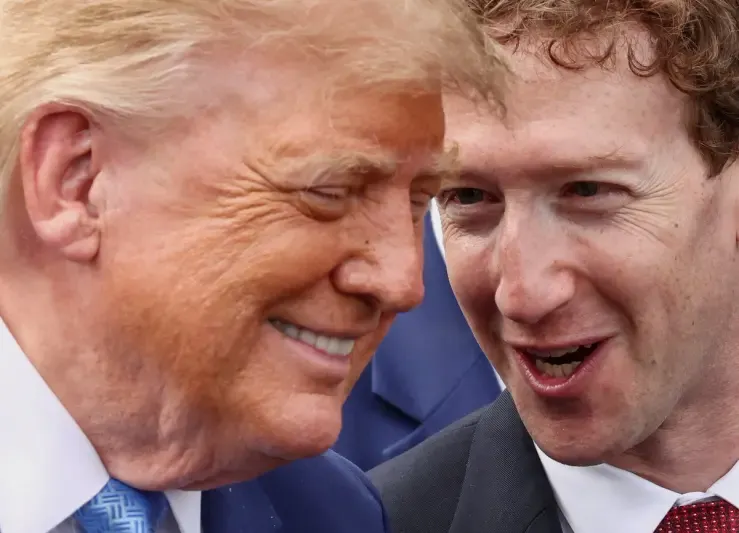
Protesters outside Meta's São Paulo offices on 19 October carried pictures of Zuckerberg and Donald Trump, and Paulo Teixeira, a federal deputy from Lula's Workers' Party, told them through a megaphone that Meta was manipulating Brazil's election in Trump's service. He offered no evidence of instructions from the Trump administration.
Zuckerberg dined with Trump at Mar-a-Lago in November 2024, and in December Meta gave US$1 million to Trump's inaugural fund, after giving nothing to Trump's first inauguration or Joe Biden's. Meta named Joel Kaplan, a Republican, to replace Nick Clegg as head of public affairs and put Dana White, the UFC chief and a Trump ally, on its board in the first days of January 2025.
On 7 January 2025 Zuckerberg ended Meta's US fact-checking programme and said the company would "work with President Trump to push back" against foreign governments, singling out Latin American countries with "secret courts that can order companies to quietly take things down". João Brant, the Brazilian presidency's secretary for digital policy, said Meta had shown it was willing to serve as a platform for Trump's agenda. Brazilian officials read the remark as aimed at the STF, which had blocked X for 40 days the year before.
Meta agreed later that month to pay US$25 million to settle Trump's lawsuit over his 2021 suspension, with US$22 million going to his presidential library. On 12 January 2026 it named Dina Powell McCormick, Trump's deputy national security adviser in his first term, president and vice chair, and Trump called her a "great choice" on Truth Social minutes later. She is married to Senator David McCormick, a Pennsylvania Republican, Gulf News reported.
The trade case
Jamieson Greer, the US trade representative, opened a Section 301 investigation of Brazil on 15 July 2025, six months after Zuckerberg's pledge, describing it as covering "Brazil's attacks on American social media companies" and alleging that Brazil retaliated against US firms for failing to censor political speech. Trump wrote on Truth Social in late August 2025 that he would impose "substantial" tariffs and chip export curbs on countries whose digital rules were designed to harm US technology.
The trade representative's office found on 1 June 2026 that Brazilian courts had issued secret orders directing US social media companies to take down political content, suspend US residents' profiles, sometimes worldwide, and keep the users in the dark, backed by heavy fines and freezes on company assets. It imposed a 25 per cent tariff on a range of Brazilian goods from 22 July 2026. Flávio Bolsonaro had asked the office that month to delay the tariff until after the election, arguing it would hand Lula a political win.
Trump and Brazil
Trump announced a 50 per cent tariff on Brazilian goods on 9 July 2025 in a letter that tied it to the "witch hunt" trial of Jair Bolsonaro, the candidate's father, and on 30 July the Treasury imposed Global Magnitsky sanctions on Justice Alexandre de Moraes, who oversaw that trial. The sanctions were lifted on 12 December 2025. Jair Bolsonaro is serving a 27-year sentence under house arrest for attempting a coup after his 2022 defeat, and Flávio has vowed to free him.
Folha reported in September that Rockbridge Network, the political donor group co-founded by Vice President JD Vance, had set up a Brazilian company; Rockbridge said the project never received funding or began operations. Lula's campaign has asked the TSE to investigate it as a possible campaign finance violation.
Meta and Israel
Meta's director of public policy for Israel and the Jewish diaspora, Jordana Cutler, joined the company in 2016 after senior posts in the Israeli government, including as an adviser to Prime Minister Benjamin Netanyahu, and has described her job as liaison with that government. Internal documents reviewed by The Intercept show she used Meta's escalation channels to flag at least four posts by Students for Justice in Palestine and other content opposing Israeli policy. Meta spokesperson Dani Lever said a separate team of experts reviews every flagged post and that Cutler does not write the rules.
Drop Site News, citing leaked Meta data, reported that Meta complied with 94 per cent of takedown requests from the Israeli government after 7 October 2023, making Israel the largest source of such requests worldwide. Human Rights Watch documented more than 1,050 takedowns and other suppression of content posted by Palestinians and their supporters in October and November 2023, during what it called hostilities between Israeli forces and Palestinian armed groups, and attributed part of it to undue government influence over removals. Meta told the BBC that any suggestion it deliberately suppresses Palestinian voices is "unequivocally false".
Powell McCormick's biography for the World Economic Forum credits her with work as Trump's deputy national security adviser that laid the foundations for the Abraham Accords, the 2020 agreements normalising Israel's relations with the United Arab Emirates and Bahrain.
The law
Under article 22 of Lei Complementar 64 of 1990, the TSE can strip a candidate of registration or a mandate and declare them ineligible for eight years for abuse of economic power or improper use of the media, provided the circumstances are serious enough to affect the fairness of the vote; the beneficiary of the abuse can be sanctioned even if the conduct was a third party's. Lula's action has to show that Meta's handling of his accounts was abuse that benefited Bolsonaro and was grave enough to meet that test. Meta's commercial and regulatory interests in the result are a matter of public filings and votes; whether any of them shaped a decision inside the company is what the TSE's technical questions are meant to establish.
Meta holds the incident ticket and engineering logs for the 9 October block, which would show whether it was tied to the 7 October outage. The recommendation parameters the TSE ordered disclosed on 15 October would show why Instagram search surfaced Bolsonaro's profile. Meta's answers to Villas Bôas Cueva's 22 October order would set out its content distribution criteria for both campaigns. Meta's advertiser verification files and payment data for NetLab's 187 advertisers would identify who paid for the 1,613 foreign-funded ads.
Before and after the vote
Meta restricts AI-generated or altered content in the 72 hours before voting, on election day and the day after. Meta's ban on social-issue ads by third parties runs until the runoff is over. Bolsonaro and Gaspar have five days from 22 October to answer Lula's action, and both disqualification cases stay before the TSE after the result is certified. The digital markets bill awaits a final vote in the Chamber of Deputies. The 13 US lawmakers expect Meta's written answers by 4 November.