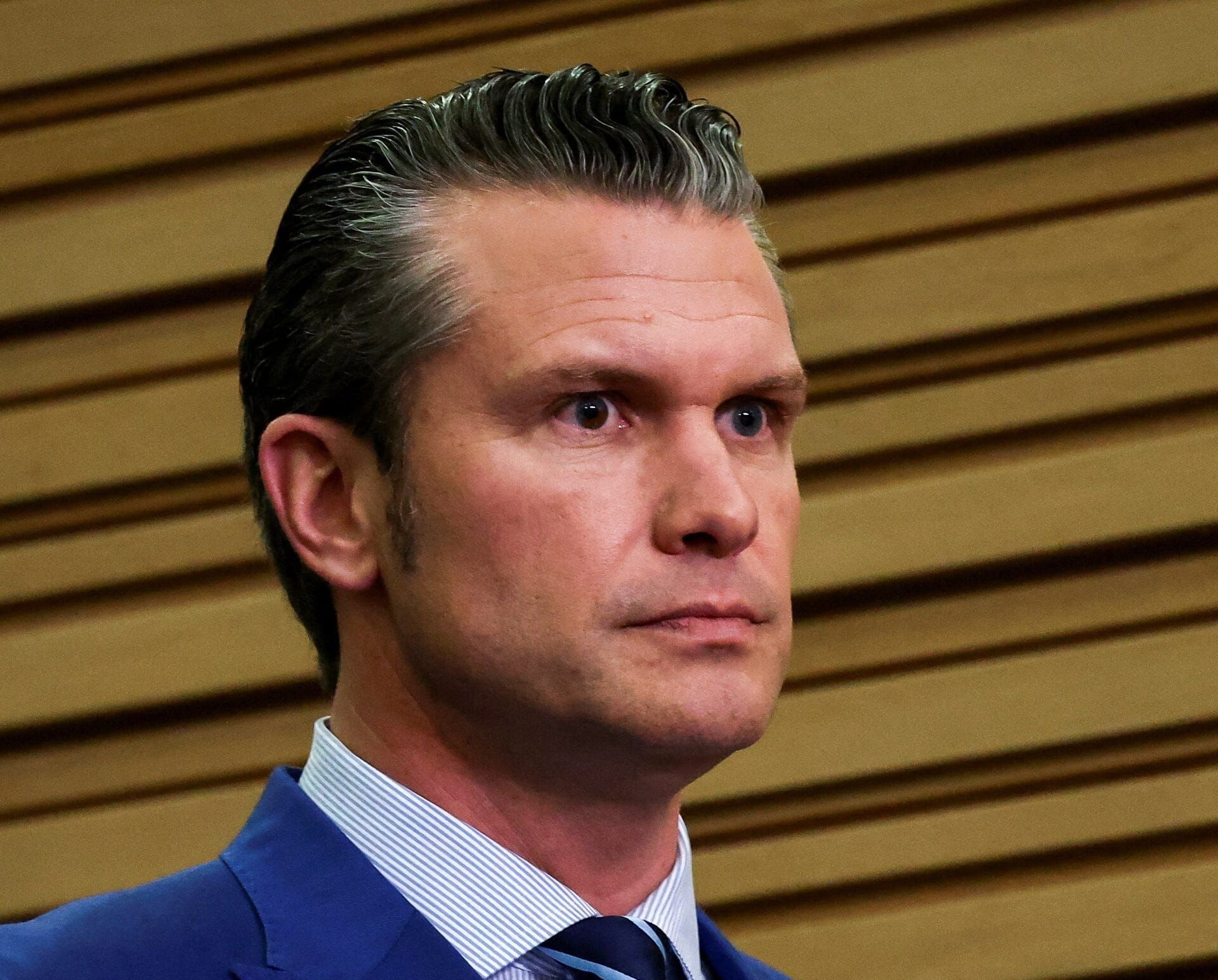
Canada’s defence minister said on 21 November that his government had not been shown a classified Pentagon directive limiting contact between Canadian and U.S. officers, days after Defence Secretary Pete Hegseth’s office began circulating it.
“There is some sort of document we haven’t seen,” David McGuinty told reporters at the Halifax International Security Forum. The Washington Post first disclosed the memo late on 20 November, citing officials who said it had circulated the previous week. Senator Mike Rounds of South Dakota, one of the U.S. legislators at the Halifax forum, gave the only public account of its contents. He said it limits meetings between U.S. generals and admirals and their Canadian counterparts to those that advance Pentagon objectives, and requires U.S. officers to seek permission before attending Canadian think-tank events or social engagements.
More than 700 Canadian Armed Forces members were serving in the U.S. at any one time when National Defence last gave Parliament a count, in 2016. Canada also pays for the Halifax forum, an annual gathering where Canadian ministers and commanders meet U.S. counterparts outside formal channels. The memo is the second U.S. cut to bilateral defence contact this year. In May the Pentagon paused its participation in the Permanent Joint Board on Defence, the advisory body William Lyon Mackenzie King and Franklin Roosevelt created in 1940. Both moves have come while Canada raises defence spending, shifts 70 per cent of its defence purchasing to Canadian firms and reviews its order for 88 U.S.-made F-35 fighters.
Senior Canadian military leaders learned of the directive from the Post’s report, according to The Globe and Mail, which cited three military sources and a senior government source who said Canada had received no formal or informal notice. Two of the sources said officer exchange programmes could be affected. McGuinty said cooperation on defence, security and intelligence was continuing and described Canada’s position as business as usual. Gen. Jennie Carignan, the chief of the defence staff, said her daily dealings with U.S. counterparts had not changed. Three Canadian defence officials said they had seen no change in military operations and were trying to verify what the memo contained.
Sean Parnell, the Pentagon’s chief spokesman, said the department was “taking steps to ensure its engagements with Canada advance tangible U.S. defence objectives”. He said intelligence sharing, the North American Aerospace Defense Command (NORAD) and cooperation through NATO were exempt, and gave no list of the programmes the memo covers. Rounds said the directive appeared intended to push Canada to spend more on its military. He said it was drafted months ago and signed only recently. The reason for the timing was unclear, he said.
Canada’s defence outlays reached about C$63 billion in the 2025-26 fiscal year, more than 50 per cent above the C$41 billion spent a year earlier. That brought Canada to the NATO target of 2 per cent of GDP for the first time since the Cold War, and the 2026 federal budget projects combined spending above 4 per cent of GDP in 2027-28.
What Canada keeps
NORAD, created under a 1958 agreement, is the core of Canada’s continental defence. It is a binational command with a U.S. commander and a Canadian deputy, and Canadian and U.S. personnel staff its headquarters at Peterson Space Force Base in Colorado side by side. Its missions are aerospace warning, aerospace control and maritime warning along a border of 8,891 kilometres. In June 2022 Canada committed C$38.6 billion over 20 years to modernise its share of the command, including over-the-horizon radar to track missiles and aircraft approaching across the Arctic.
Beneath NORAD, the two militaries plan through a Combined Defence Plan for the defence of the continent, and a Tri-Command Framework signed in September 2009 sets out how NORAD, U.S. Northern Command and Canadian Joint Operations Command work together. Canadian personnel at NORAD report through a Canadian element that also runs six detachments elsewhere in the U.S.
McGuinty listed the joint work he said continues unchanged: drug interdiction in the Caribbean, integrated air and missile defence and coordinated fighter responses to aircraft approaching North America. Canada belongs to the Five Eyes intelligence alliance with the U.S., Britain, Australia and New Zealand. An official from one Five Eyes country told the Post that the U.S. had given no formal notice of any change to intelligence sharing, but had shared less over the past year across several platforms.
Canadian officers and the Halifax forum
Rear-Adm. Scott Bishop gave that count in testimony to the House of Commons defence committee. About 300 of the members were assigned to NORAD, 147 of them at its headquarters, and the rest worked as liaison and exchange officers or studied at U.S. military colleges. U.S. exchange officers serve inside Canadian units in turn. An officer on exchange works as a member of the host country’s armed forces under conditions both governments agree in advance, according to the Canadian Forces ombudsman.
The Halifax forum is run by a non-profit and funded by the Canadian government. The Atlantic Canada Opportunities Agency signed a C$9.98 million contribution agreement on 13 January 2025 to pay for the 2025 and 2026 forums, and Canada’s defence minister co-hosts the event. By 2020 the federal government had put C$25.4 million into the forum since its first meeting in 2009. A delegation of eight U.S. senators attended in 2025 and met McGuinty’s delegation there. Under the rule Rounds described, U.S. officers would need permission to attend events of this kind in Canada.
The spending demand
Hegseth hosted McGuinty at the Pentagon on 22 September 2025 and pressed Canada to meet its NATO commitment and to rebuild its military around the defence of North America, according to the Pentagon’s readout. McGuinty reaffirmed the commitment in Canada’s statement on the meeting. NATO leaders had agreed at The Hague on 25 June 2025 to spend 5 per cent of GDP on defence and security by 2035, at least 3.5 per cent of it on core military needs.
Carney’s first budget, tabled on 4 November 2025, set aside C$81.8 billion over five years to rebuild the Canadian Armed Forces. The Pentagon’s 2026 National Defense Strategy, published on 23 January, puts defence of the U.S. homeland and U.S. interests in the Western Hemisphere first and tells allies to carry more of their own defence. It commits the U.S. to building Golden Dome, a missile defence system over North America.
Elbridge Colby, the Pentagon’s policy chief, cited Canada when he paused the joint defence board on 18 May. “We can no longer avoid the gaps between rhetoric and reality,” he wrote on X, saying Canada had failed to make credible progress on its commitments. He linked to the transcript of Carney’s speech to the World Economic Forum in Davos on 20 January, in which Carney said the international order was in “a rupture, not a transition” and urged middle powers to act together.
King and Roosevelt set up the board at Ogdensburg, New York, in August 1940. It had not met since 2024. The two governments agreed in 1947 to keep it as a peacetime forum that later advised on creating NORAD. McGuinty responded in May by pointing to Canadian spending on Arctic radar, aircraft and submarines able to operate under ice. Carney said he would not overplay the pause and cited NORAD as evidence of continuing cooperation. Six analysts at the Center for Strategic and International Studies, a Washington think tank, concluded on 26 May that the Davos speech and Canada’s moves to buy less U.S. equipment had probably contributed to the decision.
The 51st state, Lake Ontario and the cadets
On 27 May 2025, a week after announcing Golden Dome, Trump wrote on Truth Social that Canada would have to pay US$61 billion to take part as a separate country and nothing if it became the 51st state. Gen. Gregory Guillot, NORAD’s commander, has said Canada’s involvement centres on the sensor layer that would detect threats. A spokesperson for McGuinty said in February that the talks were continuing and that Canada would take part only if it suited both countries.
On 27 August, days after Canada walked away from trade talks, Trump signed Executive Order 14422 ordering the U.S. federal government to call Lake Ontario “Lake America” on its maps and documents. The order has no force in Canada. Carney said the lake’s name, taken from a Wendat word, predates both countries and would stay.
On 31 August, Hegseth posted on X a photograph from the Instagram account of the Vernon Cadet Training Centre in British Columbia. It showed a teenage cadet receiving an award from her instructor, and Hegseth added a Canadian flag and the caption “this is real”. Cadets are young people in a youth programme and are not members of the Canadian Armed Forces. The Army Cadet League of Canada condemned the post, and McGuinty said it was beneath the dignity of Hegseth’s office. The Pentagon stood by it on 1 September, saying the post spoke for itself.
Carney told reporters in Ottawa the same day that the Trump administration should “stop doing memes, stop throwing shade and stop trying to be tough”. He tied any return to trade talks to a more serious approach from the U.S. government. Early on 5 September, Hegseth quoted a Canadian Coast Guard post about its personnel taking part in Ottawa’s Pride celebration and added only a Canadian flag. On 2 September, at the Indo-Pacific Chiefs of Defence conference in Victoria, a Canadian reporter asked Adm. Samuel Paparo, head of U.S. Indo-Pacific Command, whether he would follow an order to attack Canada. Paparo called the scenario preposterous and asked whether he should also be questioned on “what my attack plans are for the Martians”.
Kandahar
Hegseth has said that only one or two U.S. allies took part in active fighting in Afghanistan, and that U.S. troops joked that ISAF, the acronym for the NATO-led International Security Assistance Force, meant the allies saw USians fight. More than 40,000 Canadian service members served in Afghanistan between 2001 and 2014, and 158 were killed. Canada led the coalition effort in Kandahar province, where 42 U.S. service members were killed while under Canadian command. Operation Medusa in September 2006, the largest Canadian combat operation in more than 50 years, killed 12 Canadian soldiers.
Building at home
Carney launched Canada’s first Defence Industrial Strategy in Montreal on 17 February. It commits C$6.6 billion to Canadian industry and sets a target of awarding 70 per cent of defence acquisitions to Canadian firms within 10 years, up from 43 per cent in 2025. Purchases follow a build, partner and buy order, and Carney said Canada would buy abroad only after exhausting the first two options. The strategy aims to add 125,000 jobs and raise defence exports by 50 per cent. It sets readiness targets of 75 per cent for navy ships, 80 per cent for army vehicles and 85 per cent for air force aircraft. Figures released in 2025 showed 54 per cent of the navy’s fleet out of service.
The national security strategy published on 29 October directs procurement towards strategic autonomy and resilience and commits Canada to diversifying its security partners, while keeping its NORAD obligations. It calls for a relationship with the U.S. based on “shared responsibility for the security of North America”. On 6 July, Carney named Germany’s Thyssenkrupp Marine Systems as preferred supplier for up to 12 submarines able to operate under Arctic ice, ahead of South Korea’s Hanwha Ocean. The government aims to sign the contract in late 2027, and Carney announced a C$32 billion plan for military infrastructure in the Arctic and the North in March 2026.
Canada signed for 88 Lockheed Martin F-35s in 2023, holds a firm order for 16 and confirmed long-lead payments for 14 more in February 2026. Carney ordered a review of the remaining aircraft in March 2025, and McGuinty told a Senate committee on 27 April that other countries’ aircraft remained on the table. The Department of National Defence’s 2021 evaluation, obtained by Radio-Canada in November 2025, scored the F-35 at 57.1 of 60 points for military capability and Saab’s Gripen E at 19.8. Saab said its aircraft met or exceeded every requirement. La Presse reported on 30 May that a mixed fleet of about 30 F-35s and 60 Gripens, with Gripen assembly in Canada, had emerged as the government’s preferred option. Pete Hoekstra, the U.S. ambassador to Canada, has said that moving away from the F-35 would damage NORAD.
Tariffs and the trade talks
U.S. tariffs imposed under Section 232 of the Trade Expansion Act on Canadian cars, steel, aluminium and forest products remain in force. Trump froze talks in October 2025 over an Ontario government advertisement quoting Ronald Reagan on tariffs. Canada suspended the resumed negotiations in August 2026 after last-minute U.S. demands. Talks had resumed by mid-November, when Carney reported progress, and Dominic LeBlanc, the minister responsible for Canada-U.S. trade, briefed the government’s advisory committee on U.S. economic relations on 19 November.
Trump said at the White House on 20 November that Canada had not agreed a deal on his terms. “We can’t let them feel that way anymore,” he said of the Canadian government, which he said felt emboldened. The Pentagon memo was reported that evening.
In Halifax on 21 November, McGuinty said Canada would buy less from the U.S. and produce more at home in 10 core areas, and announced an initial contribution of C$100 million to the NATO Innovation Fund.