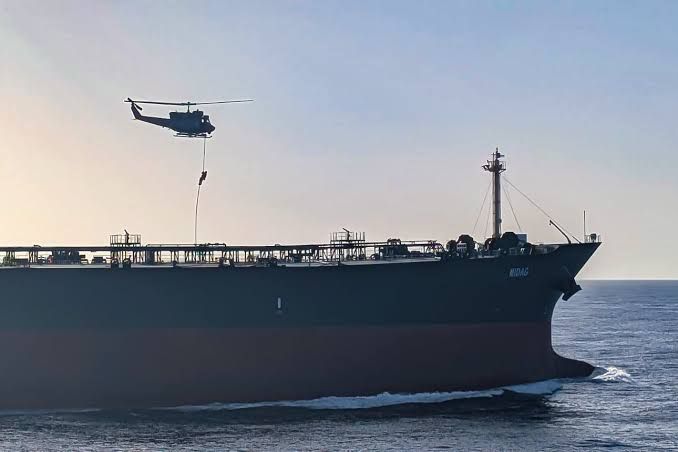
European Union naval personnel boarded the oil tanker Midag in the central Mediterranean on 13 November, confirmed it was sailing under a false flag and then let it continue its voyage, three days before EU governments sanctioned 49 more Russian banks and 15 companies behind Russia's shadow fleet.
Kaja Kallas, the EU's foreign policy chief, said the boarding by the bloc's Operation Irini was carried out under Article 110 of the UN Convention on the Law of the Sea, which allows a warship to board a foreign vessel on the high seas if it suspects the ship has no nationality. "The EU will keep disrupting Russia's shadow fleet at sea and through diplomatic means," Kallas wrote on X. Personnel reached the deck by fast-roping from a helicopter, and the vessel was not detained.
The Midag, a 2003-built Aframax tanker with the IMO number 9266841, had claimed the flag of Zimbabwe, a landlocked country, since July, according to the S&P Global ship database. Under its previous name, Midas, and flying the flag of Panama, it docked at Russia's Kozmino oil terminal on the Pacific coast on 6 May and left Russian waters two days later, ship-tracking data show. Its declared draught rose from 6 metres to 14.7 metres while it was there, indicating that it loaded cargo.
The U.S. Treasury sanctioned the ship on 19 May, but for carrying Iranian crude rather than Russian oil, saying it had moved hundreds of thousands of barrels of Iranian oil since early 2026. Its owner at the time, Ocean Marvel Shipping Company of the Marshall Islands, was sanctioned with it. S&P Global now lists Xuanyue Shipping & Trading of Liberia as its registered owner and operator and records no protection and indemnity insurer. What the tanker carried when Irini boarded it, and where it was going, have not been disclosed. It left Port Said in Egypt for the Mediterranean on 10 November and was north of Algeria heading west on 15 November.
Inspection without seizure
A flag-verification boarding does not give Irini power to seize a ship, though documents gathered on board can support later action by national authorities. Under Article 92 of the convention, a ship that sails under two or more flags, using them as convenient, may be treated as a ship without nationality. Irini had carried out six such boardings by the end of October.
The Council of the EU extended Irini's mandate to 31 March 2029 on 9 October in Decision 2026/2243 and added the task of constraining Russia's shadow fleet, with €16.88 million for common costs from April 2027. The operation was set up in 2020 to enforce the UN arms embargo on Libya. Kallas had announced in June that its ships would begin stopping vessels suspected of belonging to the shadow fleet. Information collected can be shared with member states, EU bodies and, where applicable, NATO, and each inspection must be reported to the EU's Political and Security Committee, which can consider further measures.
Irini's flagship, the Italian frigate ITS Thaon di Revel, boarded the EU-sanctioned tanker Toa Payoh west of the island of Pantelleria on 2 August, and that ship was not detained either. Russia's Foreign Ministry accused the operation of unlawful inspections. Maria Zakharova, the ministry's spokeswoman, said earlier that stopping and inspecting tankers would be a flagrant violation of international law, and the ministry dismisses accusations that Russia runs a shadow fleet as political fabrication.
French forces went further in January 2026, when they boarded the tanker Grinch in the Mediterranean between Spain and North Africa and diverted it to a French port. Nikolai Patrushev, a Kremlin aide responsible for shipping, said the next month that the Russian navy could be deployed to stop Western seizures, calling them piracy-like attacks.
The 16 November listings
EU foreign ministers adopted asset freezes on 12 Russian citizens and 101 entities in Russia and third countries on 16 November, under Council Decision 2026/2575 and Implementing Regulation 2026/2574. The 12 individuals are also barred from entering the EU.
The 49 financial institutions include RFK Bank, which is owned by the state arms exporter Rosoboronexport, the Sberbank-owned payments service YooMoney, Bank 131, Unistream, SPB Bank and the Petersburg Settlement Centre. More than 100 Russian banks were already under EU sanctions, and the European External Action Service said the bloc now covered nearly all major Russian banks.
In energy, the list adds the Kirishi refinery, Gazprom Neft's Moscow and Omsk refineries, TAIF-NK in Tatarstan, Gazprom Neftekhim Salavat and the refineries at Orsk, Saratov, Ilsky, Novoshakhtinsk and Khabarovsk, along with the Petersburg Oil Terminal and companies running the gas complex at the Baltic port of Ust-Luga. EU companies may no longer supply goods and services the industry needs, including for rebuilding refineries. Ukrainian drones have struck Kirishi and Omsk since the start of October.
The 15 shadow-fleet companies are accused of owning, managing, financing or insuring tankers. Of these, 11 are registered in the United Arab Emirates, Oman, the Seychelles and Hong Kong and four in Russia. They include Lidoil DMCC, Spikoil DMCC, Lynx Ship Management FZCO and Serpentine Marine SPC, according to the Council's decision. Buyers and traders of Russian oil were listed too, among them Guron Trading of Hong Kong and Barrelion Trading and Imperium Trading of the UAE. Igor Konfino, Daniil Mosin and Sergei Grib, who run companies affiliated with the state shipping group Sovcomflot that own shadow-fleet vessels, were sanctioned personally.
The listings also cover Tatyana Kim, founder of the online retailer Wildberries, and Alexander Chachava, the largest shareholder of its rival Ozon, both of which the EU says sell military and dual-use goods that supply Russian forces. Sergei Matviyenko, a businessman and son of Valentina Matviyenko, the speaker of Russia's upper house, was listed, as was ALT Capital, a Singapore fintech company whose platform the EU says helps circumvent export controls. Separately, ministers sanctioned 30 people and two entities for information manipulation and cyber attacks, including 24 employees of the Social Design Agency, which the EU says works for the Russian presidential administration, and the hacker group NoName057(16).
Kallas wrote after the meeting that Russia would be disappointed if it was betting on European fatigue. Britain said in July that a shadow fleet of more than 700 vessels carried three quarters of Russia's sanctioned oil.
Revenue at a five-month high
Russian oil producers earned about US$21.2 billion from exports in October, 65 per cent more than a year earlier and the most since May, the International Energy Agency said in its monthly report on 13 November. Urals and ESPO, Russia's main export grades, both traded above US$100 a barrel as attacks on tankers in the Strait of Hormuz and Houthi strikes on Saudi energy facilities pushed up prices. Russian barrels do not have to pass through Hormuz to reach China and India, their largest buyers.
Crude exports held at 5.33 million barrels a day, about 4 per cent above a year earlier, and made up more than 80 per cent of the revenue. Exports of refined products, at 1.49 million barrels a day, were about a third lower than in October 2025, as Ukrainian drone strikes cut refinery runs.
Oil and gas taxes brought the federal budget 971.2 billion roubles (about US$11.8 billion) in October, the most in a year and a half, helped by a quarterly profit tax payment and higher extraction tax as the price spike fed through, Finance Ministry data show. Over the first 10 months of the year oil and gas revenue was still 14.1 per cent lower than in the same period of 2025, and the budget deficit for January to October reached 5.2 trillion roubles, 2.3 per cent of GDP. Payments to oil companies to keep the domestic fuel market supplied cut net oil revenue in October to around US$10 billion.
The European Commission is expected to present a 22nd package of sanctions against Russia before EU leaders meet in Brussels on 26 and 27 November. Irini's mandate to board suspected shadow-fleet tankers in the Mediterranean runs until March 2029.