Israeli Prime Minister Benjamin Netanyahu backed Flávio Bolsonaro in a convention video on 25 July, a post on X on 5 October and a phone call on 8 October, while Brazil's Federal Police closed a check into possible US interference within three days of opening it. Brazil's intelligence agency rated the risk of US interference critical in August and told European officials that Russia was interfering, without giving them details.
Andrei Rodrigues, director of Brazil's Federal Police (PF), opened a preliminary check into possible US interference in the election on 4 October, the day of the first round, after the Attorney General's Office (AGU) pointed to a State Department grant for a programme against "lawfare and censorship in Brazil". By 7 October the police had closed the check after finding no minimal indications of US government action in the vote. The next night Israeli Prime Minister Benjamin Netanyahu phoned Senator Flávio Bolsonaro to congratulate him on the first round, his third public intervention for the candidate since July. Bolsonaro meets President Luiz Inácio Lula da Silva in the runoff on 25 October after taking 47.03 per cent of valid votes to Lula's 45.16.
The Brazilian Intelligence Agency (Abin) sent the presidency, the Superior Electoral Court (TSE) and the Justice Ministry a reserved report in late August, titled "Threats to the 2026 electoral process", that rated the risk of US interference at a "level of criticality", Folha de S.Paulo columnist Mônica Bergamo reported. Kassio Nunes Marques, the TSE's president, told reporters on 4 October: "We have no report from the PF or Abin that points to any kind of risk."
The US measures Abin lists are tariffs, sanctions, designations, visa decisions and trade demands that the Trump administration announced or put in writing, and the dispute is over whether the vote was their target. Abin's claim about Russia has not been tied publicly to either campaign. Datafolha's last full poll before the runoff, published on 22 October, gave Lula and Bolsonaro 50 per cent of valid votes each.
Netanyahu
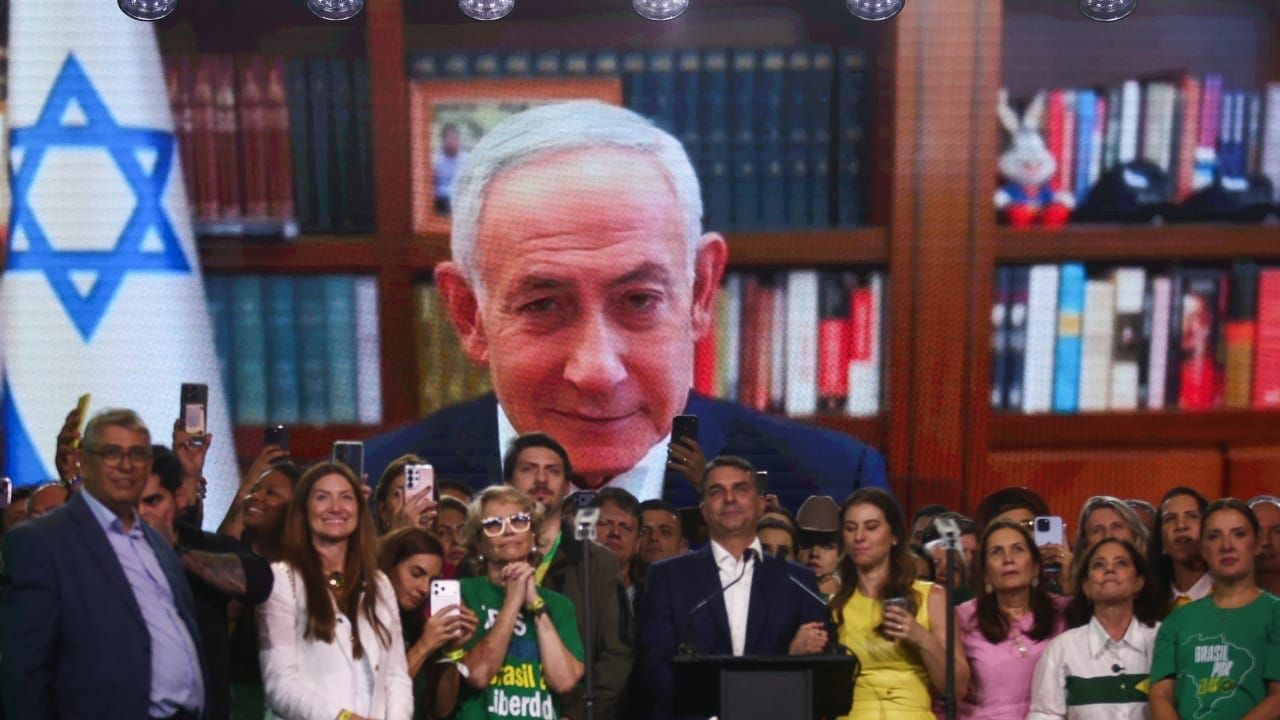
Netanyahu sent a video message to the Liberal Party (PL) convention at São Paulo's Pacaembu stadium on 25 July, calling Bolsonaro "my friend" and congratulating him on the launch of his campaign. He and Argentine President Javier Milei were the two heads of state who backed the candidacy at the convention. The day after the first round, Netanyahu wrote on X that he hoped to "restore the extraordinary friendship between Israel and Brazil" and wished Bolsonaro "a great victory, my friend".
Netanyahu's office said the two men spoke by phone on the night of 8 October, with Eduardo Bolsonaro, the candidate's brother and a former federal deputy, on the line. Netanyahu invited Bolsonaro to Israel, and the statement said both wanted to renew the "deep friendship" between the countries as part of a transformation in Israel's relations with South America. Bolsonaro invited Netanyahu to Brazil in return, according to the Israeli statement, and Eduardo broadcast the call on his YouTube channel.
Bolsonaro chose Israel for his first trip abroad as a pre-candidate. Amichai Chikli, Israel's minister for diaspora affairs and combating antisemitism, invited both brothers to a conference on antisemitism in Jerusalem on 26 and 27 January, and the itinerary continued to Bahrain and the United Arab Emirates. At a dinner with Netanyahu during that visit, Bolsonaro offered to reopen trade negotiations and restore diplomatic ties if elected, people familiar with the dinner told Metrópoles, and gave the prime minister a Palmeiras football shirt. He has also promised to move Brazil's embassy from Tel Aviv to Jerusalem.
Israel holds its own general election on 27 October, two days after Brazil's runoff, and polls cited by Bloomberg Línea suggest Netanyahu's coalition may fall short of a majority in the 120-seat Knesset.
The rupture
Lula has accused Israel of genocide in its war in Gaza since 2024 and compared the killing of Palestinian civilians to the Holocaust, and Israel's government declared him persona non grata over the comparison. Frederico Meyer, Brazil's ambassador, was rebuked in public at Yad Vashem, Israel's Holocaust memorial, and Lula withdrew him from Tel Aviv.
Israel asked Brazil in 2025 to approve Gali Dagan as its next ambassador in Brasília. Itamaraty, Brazil's foreign ministry, never answered the request, and on 25 August 2025 Israel withdrew it and said relations would be conducted at a lower diplomatic level, citing Brazil's "critical and hostile line" towards Israel. Celso Amorim, Lula's special adviser on international affairs, told TV Globo that Brazil had not vetoed Dagan. "They humiliated our ambassador there, a public humiliation," he said. "There was no veto. They asked for agrément and we did not give it." Lula said in October 2025 that Brazil's problem was with Netanyahu and that relations with Israel would face no difficulty once Netanyahu left government.
What Israel gains
Brazil's foreign ministry announced on 23 July 2025 that it was in the final phase of submitting a formal intervention in South Africa's case at the International Court of Justice, which accuses Israel of genocide in Gaza under the Genocide Convention, and expressed "profound indignation" at violence against Palestinians in Gaza and the occupied West Bank. Bolsonaro, who accused Lula's government of antisemitism at the Jerusalem conference in January, would decide as president whether Brazil pursues that intervention.
Elbit Systems, the Israeli arms maker, won the Brazilian Army's tender in April 2024 to supply 36 Atmos self-propelled howitzers worth almost R$1 billion. Amorim opposed the purchase over Israel's war in Gaza, and the Federal Court of Accounts ruled in September 2024 that Brazilian law did not bar it. The defence ministry cancelled a planned purchase of Israeli armoured vehicles in 2025, and in June that year Lula's government was studying the suspension of all defence contracts and military cooperation with Israel.
Brazilian crude exports to Israel fell from 11.9 million barrels in 2022 to 2.9 million barrels, worth US$215.9 million, in 2024, and the trade ministry's data showed none from January to August 2025. The ministry put the fall down to market movements, while oil workers' unions said political pressure over Gaza played a part.
A Bolsonaro victory on 25 October would put an ally of Netanyahu in Brazil's presidency two days before Israelis vote. Bolsonaro has offered Netanyahu restored diplomatic ties, reopened trade talks and Brazil's embassy in Jerusalem.
Israeli firms in Brazil
Michael Federmann's family company, Federmann Enterprises, holds 42 per cent of Elbit Systems, a stake Globes valued at about NIS 32 billion in December 2025, and his son David chairs the company. Elbit won the R$1 billion howitzer tender that Amorim opposed.
Cognyte, the Israeli surveillance company spun out of Verint in February 2021, sold Abin the FirstMile phone-tracking tool at the centre of the PF's case against the agency's parallel structure. Abin bought it without a tender for R$9 million in a contract published on 1 December 2017, and Agência Pública counted more than R$57 million in new Cognyte contracts with Brazilian public bodies from 2017, including the Federal Highway Police under Silvinei Vasques, state police forces and the armed forces. Caio Cruz, son of General Carlos Alberto dos Santos Cruz, a minister in Jair Bolsonaro's government, was Verint's commercial representative in Brazil until February 2021.
Carlos Bolsonaro intervened with Justice Minister Anderson Torres in May 2021 to have the presidency's Institutional Security Office removed from a R$25.4 million tender for the Pegasus spyware made by Israel's NSO Group, UOL reported, with 155 of the 249 licences to sit under Torres's influence and be shared with Carlos. The ministry said the tender was for an open-source search tool and had no connection to Pegasus.
Jair Bolsonaro's government signed defence, public security and cybersecurity agreements with Israel and announced a Brazilian trade office in Jerusalem during his visit on 31 March 2019.
Israel and Meta
Jordana Cutler, Meta's director of public policy for Israel and the Jewish diaspora, joined the company in 2016 after senior posts in the Israeli government, including as an adviser to Netanyahu. Internal documents reviewed by The Intercept show she used Meta's escalation channels to flag at least four posts by Students for Justice in Palestine and other content opposing Israeli policy. Meta spokesperson Dani Lever said a separate team of experts reviews every flagged post.
Meta complied with 94 per cent of takedown requests from the Israeli government after 7 October 2023, making Israel the largest source of such requests worldwide, Drop Site News reported from leaked company data. Human Rights Watch documented more than 1,050 takedowns and other suppression of content posted by Palestinians and their supporters in October and November 2023 and attributed part of it to undue government influence over removals. Meta told the BBC that any suggestion it deliberately suppresses Palestinian voices is "unequivocally false".
Dina Powell McCormick, whom Meta named president and vice chair on 12 January 2026, is credited in her World Economic Forum biography with work as Trump's deputy national security adviser that laid the foundations for the Abraham Accords, the 2020 agreements normalising Israel's relations with the United Arab Emirates and Bahrain. Meta is the company the TSE ordered on 23 October to explain its distribution of the two campaigns' content.
Israeli influence operations
Israel's Ministry of Diaspora Affairs, which Chikli now heads, paid about US$2 million in 2023 for a covert campaign run by Stoic, a Tel Aviv political marketing firm, that used hundreds of fake accounts posing as USians on X, Facebook and Instagram to press US lawmakers, Black Democrats in particular, to keep funding Israel's military, according to four Israeli officials and documents seen by The New York Times. ChatGPT wrote many of the posts, and the operation ran three fake English-language news sites. Meta removed 510 Facebook accounts, 11 pages, 32 Instagram accounts and a group tied to it, and OpenAI said Stoic had built fictional personas. The ministry denied any connection to Stoic.
Facebook banned the Tel Aviv consultancy Archimedes Group in May 2019 and removed 265 accounts, pages, groups and events followed by about 2.8 million accounts, which had targeted elections in African countries, Latin America and Southeast Asia and spent about US$812,000 on ads since 2012.
Tal Hanan, a former Israeli special forces operative who calls himself "Jorge", told undercover reporters in 2022 that his team had worked on "33 presidential campaigns, 27 of them successfully" in the United States, Europe, Africa and Central and South America, according to a Forbidden Stories investigation published with The Guardian in February 2023. He described hacking Gmail and Telegram accounts and a software package, Advanced Impact Media Solutions, controlling more than 30,000 fake social media profiles, and quoted fees of €6 million to €15 million an election. Hanan denied wrongdoing.
The intelligence reports
Abin's August report traces what it calls an escalation of US pressure on Brazil through the designation of the Primeiro Comando da Capital (PCC) and Comando Vermelho gangs as terrorist organisations, tariffs and sanctions against Brazilians and companies over alleged PCC links, which it described as a "change of phase". The Treasury's Office of Foreign Assets Control designated two Brazilian nationals, three Brazilian companies and one Portuguese company on 1 July, saying the network had laundered more than US$30 million in drug money for the PCC through cryptocurrency.
The Abin report singles out Secretary of State Marco Rubio for blaming Lula personally for the tariffs, links the pressure to US strategy documents published between November 2025 and May 2026 and says the sanctions could expose Brazilian companies to secondary penalties and cut them off from the US financial system.
An Abin source told Agência Pública that the agency has produced similar reports since November 2025 and that it classifies speeches by Brazilian far-right figures as "facilitators" of attacks on national sovereignty. The US government sees the opposition as a facilitator of exclusively US interests, the source said, and the agency monitors politicians with mandates and digital influencers whose speeches seek popular or political support for US interference. Abin sources named the extraction of rare earths as the core US interest.
French and German officials visiting Brasília from 9 to 11 September to discuss the European Union's Digital Services Act were told by Abin officials that the agency "confirmed the existence of interference from the United States as well as Russia", according to a meeting report written by one attendee and seen by Reuters. The alleged US interference ranged "from lawfare to interference that is openly acknowledged". The delegation included officials from Viginum, France's agency for detecting foreign disinformation, and Arcom, its media regulator.
A senior Brazilian cyber official at the meeting said cyberattacks in Brazil had nearly doubled compared with 2025, with a sharp rise in hacking and phishing aimed at the president's office that he linked to the election. The State Department did not respond to Reuters and has previously denied seeking to interfere in Brazil's elections.
Abin's public annual assessment, "Intelligence Challenges, 2026 Edition", published in December 2025, warned of disinformation campaigns, cyberattacks on electoral systems and hidden financing of antidemocratic movements without naming any country.
Abin's own conduct has been under investigation since 2023. The PF indicted Jair Bolsonaro, his son Carlos, the former Abin director Alexandre Ramagem and the current director, Luiz Fernando Corrêa, a Lula appointee, on 17 June 2025 over what investigators call a parallel structure inside the agency. Police say it used the FirstMile phone-tracking software about 60,000 times between 2019 and 2023 and spied on four Supreme Federal Court (STF) justices, a former governor of São Paulo and two former presidents of the Chamber of Deputies, and that the current and previous leadership worked to keep the monitoring from becoming public.
In December 2020, Abin's directors denied reports in Época magazine that agency staff had prepared material for Flávio Bolsonaro's defence in the case over his state assembly staff's salaries.
The 21 demands
US negotiators sent Brazil a 21-point proposal on 16 October 2025 to end a 50 per cent tariff, and two of the points concerned the election, according to a copy obtained by Estadão. Brazil would commit to a "free and fair presidential election in 2026" and would not "arbitrarily detain, arrest or otherwise limit political dissidents" from taking part in it. Brazilian officials involved in the talks told the newspaper the second point referred to Jair Bolsonaro. Other points would have barred Brazil from penalising US citizens and companies for speech protected by the First Amendment, required notice and a right of appeal before content penalties on US platforms, and set terms for mining and critical minerals.
Lula met Trump for about an hour in Kuala Lumpur on 26 October 2025 and asked him to lift the tariffs and the sanctions on Justice Alexandre de Moraes and his wife, Viviane Barci de Moraes. Brazil's government found the 21 demands unacceptable and sent a counterproposal on 4 November. A second US proposal, dated 9 January 2026, dropped the domestic political points, and Brazil rejected it too.
Bolsonaro said on 17 September 2026, the day after Estadão published the document, that there was no help from the US government, adding: "That narrative won't stick, sorry." Eduardo Bolsonaro told reporters in Washington the same day that he was "very happy to know that the United States has positioned itself this way". "There is no interference," he said. "Quite the contrary."
Tariffs and sanctions
Trump announced the 50 per cent tariff on 9 July 2025 in a letter that tied it to the "witch hunt" trial of Jair Bolsonaro, and on 30 July the Treasury imposed Global Magnitsky sanctions on Moraes, who oversaw that trial. The administration removed Moraes from the sanctions list in December 2025, and Flávio Bolsonaro said days later that he was not sure it was good for him to have Trump "glued to my image". Jair Bolsonaro is serving 27 years and three months for plotting a coup after his 2022 defeat.
The US Trade Representative imposed a further 25 per cent tariff on Brazilian imports from 22 July 2026 under Section 301 of the Trade Act of 1974, after a year-long investigation that cited practices including weak anti-corruption enforcement, although the United States has run a goods trade surplus with Brazil for years. Rubio wrote that Lula's government had not negotiated in good faith.
Bolsonaro had written to Rubio on 2 June asking that the tariff not be imposed, and in the same letter thanked him for designating the PCC and Comando Vermelho as terrorist organisations. Rubio refused in a reply dated 23 June and noted Bolsonaro's optimism about the election. On 1 July Bolsonaro asked the trade office to delay the tariff for 180 days, until after the election, arguing that this "would eliminate that narrative, regardless of the electoral result", and offered to appoint a negotiator immediately if the opposition won. "Whoever wants the tariff is Lula," he told reporters on 7 July. Quaest found that more Brazilians blamed Bolsonaro than Lula for it.
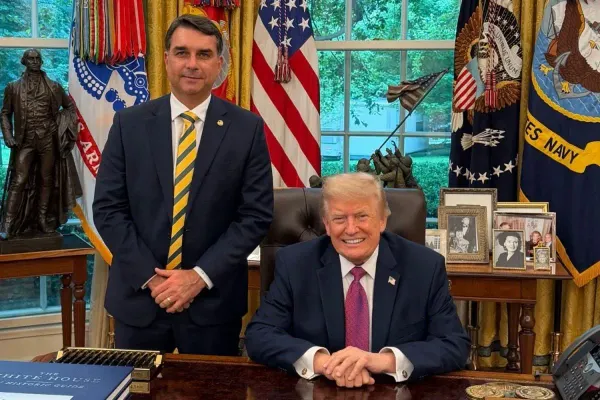
Lula met Trump at the White House on 7 May, and less than three weeks later Trump received Bolsonaro in the Oval Office, where the senator asked him to designate the two gangs. The two men left with a photograph and no statement of support. Days later Trump wrote that Bolsonaro was an "intelligent young man who loves his country very much". Trump, who publicly backed candidates in Honduras, Colombia, Chile, Argentina and Costa Rica over the past year, told reporters before the vote that he was "following it very closely". On 5 October he called the first-round result "a big victory, close, but a very, very big victory".
Eduardo
Eduardo Bolsonaro has lived in the United States since 2025 and lobbied there for the tariffs and the Magnitsky sanctions. The STF convicted him of coercion in the course of judicial proceedings for seeking foreign sanctions against Brazilian authorities. The conviction became final on 3 October, and four days later Moraes ordered the sentence of four years and two months carried out and Eduardo's passports cancelled.
Matt and Mercedes Schlapp, who run the Conservative Political Action Conference (CPAC), are allies of Eduardo, who organises CPAC's Brazilian editions, Agência Pública reported. Flávio Bolsonaro spoke at CPAC in Texas on 28 March with Eduardo beside him, introduced as an "exiled deputy", and asked the United States to "monitor our people's freedom of expression" and to apply diplomatic pressure so that Brazil's "institutions function properly". He said he did not want interference of the kind he said the Biden administration had used to bring Lula to power. Estadão Verifica found that US development aid in Brazil has gone mainly to health and education, and the Armed Forces' own audit of the 2022 vote found no fraud.
At CPAC Hungary in Budapest weeks earlier, the conference's US organisers told the audience that CPAC "will be very committed to helping Flávio in Brazil", according to audio of the event obtained by DeSmog. On another panel Bolsonaro said: "We don't want interference in Brazilian elections."
Milei used his convention speech on 25 July to call Moraes "bald trash" after the justice refused to let him visit Jair Bolsonaro, and told Flávio: "We trust you to stop the socialist scum." Tarcísio de Freitas, the governor of São Paulo, gave Milei the state's highest honour, the Order of Ipiranga, before the event.
Diplomats and visas
Darren Beattie, the State Department's adviser on Brazil policy, applied for a visa to attend a critical minerals forum in São Paulo on 18 March and asked to visit Jair Bolsonaro in prison. Moraes authorised the visit on 10 March and then reversed himself, and on 13 March Itamaraty revoked Beattie's visa, saying the purpose of the trip had been omitted and misrepresented.
Two State Department envoys, Riley Bernes and Samuel Samson, sought visas in July. The US embassy had asked Sóstenes Cavalcanti, the PL's leader in the Chamber, to receive them, and their mission was to cast doubt on Brazil's electronic voting machines, Agência Pública reported. The Washington Post described the delegation as intending to challenge the electoral system. Itamaraty refused both visas.
About 10 days later, on 4 August, the State Department revoked the visa of Maria Luiza Viotti, Brazil's ambassador in Washington, calling it a reciprocal measure over Brazil's delay in accepting Daniel Perez, the Florida congressman Trump named as ambassador to Brasília. The US Senate confirmed Perez on 7 August, and Itamaraty had not granted him agrément by late September. On 13 August a State Department official told Brazilian reporters that the United States would accept the result if the vote was free and fair.
The money
The State Department committed US$176.9 million from its Human Rights and Democracy Fund to 43 projects on 30 September, hours before the money would have expired, including about US$1 million for a programme titled "Countering Lawfare and Censorship in Brazil", The Guardian reported. The programme would support civil society groups opposing what it calls judicial overreach and censorship by the STF, and sources told the newspaper that Trump administration officials pushed the grants through despite requests from Congress to wait. The largest grant, US$40 million, went to a consortium led by the Victims of Communism Memorial Foundation. The State Department said the programmes were under active review and that grantees would meet federal grant guidelines.
Prosecutor-General Paulo Gonet had declined in July to open a preliminary procedure over the same funding notice, saying it did not on its own show foreign interference. The PF check that Rodrigues opened on the AGU's request went to the force's intelligence directorate and never became a formal inquiry.
Rockbridge Network grew out of a 2019 summit convened by Peter Thiel and JD Vance, now vice president, and is led by Chris Buskirk; its affiliated super PAC, Turnout for America, spent US$34.5 million in the 2024 cycle, according to The Washington Post. A Brazilian arm offered membership at US$500,000 and US$1 million a year, payable in cash, cryptocurrency or company shares, and approached businessmen including Joesley Batista of J&F and André Esteves of BTG, Folha reported in September. A technology-sector proposal sent to Bolsonaro while he was a pre-candidate projected more than US$100 billion in economic impact over 10 years and proposed a 23-member council, 19 of them foreigners, that would lend the project "instant credibility".
Six people close to the campaign told Folha that Pedro Sang, named in internal documents as chief executive of Rockbridge Brasil, advised the pre-campaign on social media monitoring, polling and artificial intelligence, chose its headquarters on Avenida República do Líbano in São Paulo and held meetings there in English with US businessmen. SNG Consult, a firm Sang opened in May, is absent from the campaign accounts filed with the TSE. Rockbridge said its Brazilian company never operated or received funds. Bolsonaro's office said the campaign received no foreign money or structure.
NetLab at the Federal University of Rio de Janeiro found 1,613 election ads paid for in foreign currency on Meta's platforms from July to September, and 98.1 per cent of those that disclosed a location were paid from the United States. The Workers' Party (PT) has asked STF Justice Flávio Dino to investigate Rockbridge, paid posts on X from 18 to 21 September that promoted betting odds favourable to Bolsonaro on Polymarket, and free documentaries offered through a PL-linked foundation. The party says it does not attribute the X payments to any candidate or party.
Meta
Meta employees acknowledged in internal messages published by Folha on 16 October that Lula's Instagram account was restricted on 9 October while the platform recommended Bolsonaro's profile and WhatsApp channel. Meta said the faults were technical, already public and hit accounts on both sides, and that any suggestion it favours a candidate is false. Justice Ricardo Villas Bôas Cueva of the TSE gave Meta and X 24 hours on 23 October to explain their distribution of political content and campaign ads, with a fine of R$500,000 (about US$98,700) a day for each company that fails to comply without cause.
The consulates
The US embassy suspended consular services at its Brasília offices and its consulates on 2 October, two days before the vote, citing security concerns it did not specify, and Australia suspended its services the same day. The PF executed two search warrants that day, in São Paulo and near Brasília, over alleged threats to US targets, and Rodrigues said on 4 October: "We did not prove any concrete element." Nunes Marques said the same day that a country may suspend diplomatic activities "whenever there is a rise in tension". Services resumed on 5 October, and a State Department spokesperson told EFE that the administration had no higher priority than the safety of US citizens.
Lula's coalition added the suspension to a 117-page electoral action filed on 23 September before Villas Bôas Cueva, the TSE's inspector general. It alleges that Flávio and Eduardo Bolsonaro pushed the Trump administration to impose tariffs and sanctions and then used them in the campaign, and asks the court to strip Bolsonaro and his running mate, Alfredo Gaspar, of the ticket or of office and to bar the two brothers from running for eight years. Lula had told the United Nations General Assembly the day before that "Brazil is no one's backyard".
Katherine Bowles, the State Department's assistant secretary for legislative affairs, wrote on 15 October to Representative Delia Ramirez that the United States supports "the right of the Brazilian people to a free and fair electoral process". She wrote that Moraes had "engaged in a targeted and politically motivated action" and defended the gang designations. Democratic lawmakers led by Senator Bernie Sanders had asked the administration to commit to respecting the result, and the reply gives no such commitment.
Russia
Abin gave the French and German officials no details of the Russian activity it described, and neither Abin nor Russia's embassy in Brasília answered Reuters. Russia's government has denied interfering in other countries' elections.
Lupa and the LatamChequea fact-checking network catalogued Russian information operations in Brazil in a report published in May. Sputnik Brasil took over Rádio Metropolitana 80.5 FM in Rio de Janeiro in August 2025 and streams pro-Russian content 24 hours a day under the oversight of Gilberto Ramos, honorary consul and head of the Brazil-Russia Chamber of Commerce. Sputnik Brasil had about 82,500 followers on X in January and RT Brasil, which mostly republishes RT's Spanish service in Portuguese, about 19,000.
France's Viginum found that the Matryoshka campaign of 2023 and 2024 targeted Brazilian fact-checkers and newsrooms with fake verification requests, and the DFRLab traced a network called Aliados do Sul that ran a Brazil-Russia friendship association site publishing nearly 500 articles in 2023.
Nova Resistência, a Brazilian group that follows the Russian ideologue Aleksandr Dugin, was described by the US State Department's Global Engagement Center in October 2023 as a key channel for Russian government disinformation, the Lupa report says. Lupa reported on 31 January that the group was promoting the pre-candidacy of Aldo Rebelo, a former defence minister, for the Christian Democracy party, the only 2026 election case in the report.
The Russian presidency said Vladimir Putin and Lula spoke by phone on 4 August at the Brazilian government's request and that Putin thanked Lula for his efforts on Ukraine. On Brazil's Independence Day, 7 September, Putin sent Lula a message calling him "dear friend" and saying relations were "developing successfully in the spirit of strategic partnership". Russia has been Brazil's largest diesel supplier since April 2023, with sales of US$12.4 billion from January 2023 to June 2025.
Jair Bolsonaro met Putin in Moscow on 16 February 2022, eight days before the full-scale invasion of Ukraine, and decorated Andrey Andreevich Guryev, son of the founder of the fertiliser maker PhosAgro, with the Order of Rio Branco. The Guryev family was placed under Western sanctions after the invasion. The joint statement Jair Bolsonaro and Putin issued that day welcomed rising Russian fertiliser supplies to Brazil.
Tereza Cristina, then agriculture minister, had announced days before the trip that Petrobras would sell its unfinished nitrogen fertiliser plant in Três Lagoas to the Russian group Acron, and Petrobras dropped the sale on 28 April 2022, saying Acron's business plan made the required government approvals impossible. On 11 July 2022, with fuel prices weighing on his re-election bid, Jair Bolsonaro said a deal to buy much cheaper Russian diesel was "almost certain". Brazil bought 101,000 tonnes that year and 6.1 million tonnes in 2023, after the European Union's embargo diverted Russian cargoes.
Flávio Bolsonaro told CPAC in March that Brazil was "the solution" for the United States to end its dependence on China for rare earths, and called Lula "openly anti-American".
The law
Article 22 of Complementary Law 64 of 1990 lets a party or coalition ask the TSE to investigate abuse of economic power or improper use of the media for a candidate's benefit. If the court upholds the action, even after the winners are proclaimed, it bars the candidate and everyone who contributed to the abuse from running for eight years, and it weighs the gravity of the conduct rather than whether it could have changed the result.
Article 24 of the Elections Law bars candidates and parties from receiving money or anything of monetary value, directly or indirectly and "including through advertising of any kind", from a foreign entity or government. Consultancy given to a campaign by a foreign-funded organisation would fall under that ban if it was paid for from abroad and left out of the campaign accounts.
Dino ruled in August 2025 that acts of foreign states take effect in Brazil only through a Brazilian law or a Brazilian court, and the PT has asked him to extend that ruling to every stage of the electoral process, including orders to platforms and banks.
The documents
The State Department's grant agreement for the Brazil programme and its disbursement data would name the recipients and show whether any of the US$1 million has arrived. SNG Consult's invoices and bank statements, set against the campaign accounts filed with the TSE, would show who paid Sang and for what.
The TSE's protocol log would show whether Abin's August report reached Nunes Marques before he said on 4 October that he had none. The visa applications for Bernes and Samson and the embassy's request to Cavalcanti would set out what their July mission was meant to do. The embassy's security notice for 2 October would identify the threat behind the suspension. Abin's notes of the September briefing would show what Russian activity it described to the Europeans.