The State Department ordered non-emergency staff and their families to leave Saudi Arabia on 21 October, 11 days after a missile strike on Riyadh's main airport killed 13 people, among them a US citizen. The Houthis say they have since hit the Saudi defence ministry and Aramco facilities in Yanbu, while Saudi authorities have confirmed deaths at Dammam airport and the Shaybah oil field.
The US State Department ordered non-emergency government employees and their family members to leave Saudi Arabia on 21 October, citing Houthi attacks on "civilian airports and other critical infrastructure". The same evening an attack on King Fahd International Airport in Dammam killed a Saudi citizen and an Indian national and injured eight people, and debris from a drone intercepted over Aramco's Shaybah oil field killed a Filipino and a Nepali worker, Saudi authorities said. On 22 October Yahya Saree, the Houthi military spokesman, claimed four missile and drone operations over the previous 48 hours, including strikes on the Saudi defence ministry in Riyadh and Aramco facilities in Yanbu. On 10 October, 11 days before the order, a Houthi missile killed 13 people and injured 309 at King Khalid International Airport in Riyadh, the deadliest attack on the kingdom in more than a decade.
The departure order
Tommy Pigott, the State Department spokesman, announced the ordered departure on X on 21 October. "The safety and security of department personnel and their families remain our highest priority," he wrote. A security alert issued by the embassy in Riyadh the same day said US government employees in the kingdom now need authorisation from the chief of mission to use any Saudi airport and told US citizens to follow cellular alerts from Saudi Civil Defence.
The State Department's 12 October travel advisory rates Saudi Arabia at Level 3, "reconsider travel", citing the risk of drone and missile targeting of US interests by Iran and the Houthis. It tells citizens not to photograph or share images of interceptions or impact sites because Saudi authorities have detained US citizens for doing so. US government staff are barred from travelling within 32 km (20 miles) of the Yemen border.
A diplomatic source in the region told AFP that families of embassy staff were also being withdrawn from the United Arab Emirates, Jordan, Qatar and Bahrain, and four US officials told Reuters that missions in other Gulf states would order family members out. Pigott called that report "inaccurate" and said the order applies to Saudi Arabia only.
The embassy in Riyadh was damaged at the start of the US-Israeli war on Iran in late February and had been working with a reduced staff, some of whom had recently returned. Asked about the order on 21 October, President Donald Trump told reporters he had not known about it. Earlier in the month he called the Houthi attacks "not acceptable" and said the United States would look at whether to join the Saudi campaign.
Dammam and Shaybah
Saudi Arabia's General Authority of Civil Aviation (GACA) said on 22 October that the toll from the attack on King Fahd International Airport on the evening of 21 October had risen to two. The dead were a Saudi citizen and an Indian national living in the kingdom. The eight injured were a Saudi and seven foreign nationals from India, Yemen, Bangladesh and Nepal, with wounds ranging from minor to serious, GACA said. The authority reported material damage and said flights had resumed. Its first statements described the damage without naming a weapon or an attacker. Saree claimed the Dammam strike the following day.
Saudi air defences intercepted a drone heading for a processing facility at the Shaybah field on 21 October, according to the Saudi Energy Ministry. Falling debris set fire to a contractor's vehicle outside the facility's perimeter, killing a Filipino and a Nepali worker and injuring a Pakistani and an Indian. The ministry said production was unaffected. Two days earlier, on 19 October, the Houthis had listed the Shaybah oilfield among their targets, alongside King Khalid airport, Abha airport, Aramco facilities in Yanbu and Saudi naval forces.
Saree announced the latest strikes in a televised statement on 22 October. He said ballistic missiles and drones had made direct hits on the defence ministry building in Riyadh and on Abha International Airport, that the attack on Dammam disrupted air traffic and that the strike on the Aramco facility in Yanbu started a fire. The Saudi-led coalition said it had intercepted drones over Riyadh and Medina. Saudi authorities confirmed the Dammam and Shaybah deaths and had confirmed damage at neither the ministry nor Yanbu by the afternoon of 22 October.
In statements the week before, Saree named Aramco facilities in Dhahran, an Aramco refinery in Riyadh and King Khalid airport as targets and told airline staff, travellers and energy workers to stay away from them. The group has declared Saudi airspace a military zone. In Yemen on 21 October, the internationally recognised government accused the Houthis of striking the airports in Aden and al-Rayyan, near Mukalla. Rashad al-Alimi, head of the governing Presidential Leadership Council, called on other governments to proscribe the group as a "terrorist" organisation.
Riyadh airport
The Houthi airport campaign began on 6 October with attacks on the airports in Jazan and Najran. Strikes on Abha International Airport and King Khalid International Airport over 6 and 7 October killed three people and injured 36, according to GACA. A Moroccan woman and an Algerian woman were killed in Abha, where 28 people were injured. A Sudanese national was killed in Riyadh, where eight residents were injured, five of them Saudi citizens.
Two attacks on King Khalid airport on 8 October killed three Saudi citizens, one of them Hamoud Ali Alkalthami, a captain with the flag carrier Saudia. Saree said the group had fired a ballistic missile at the airport and claimed a direct hit.
The missile that struck the airport on 10 October killed four Saudi citizens, two Bangladeshis and one national each of the United States, Egypt, Jordan, Syria, Palestine and Sudan, GACA said, and injured 309 people, several critically. The toll rose to 13 on 11 October, when the Indian embassy in Riyadh said an Indian citizen wounded in the strike had succumbed to injuries. Secretary of State Marco Rubio condemned the attack, which killed a US citizen. The coalition called it "a full-fledged war crime" under customary international humanitarian law.
A projectile hit terminals 3 and 4, which serve domestic flights, on 11 October, killing a Pakistani national and injuring 11 people. GACA figures put the dead at 20 across the Abha and Riyadh airport attacks between 6 and 11 October. The airport closed after the 10 October strike, with a notice to air missions keeping it shut until at least 17 October. The organisers of the Future Investment Initiative, the kingdom's annual investor conference set for 26 to 29 October, postponed it to 2027 on 19 October. Riyadh's schools and universities had already moved to remote learning for a week in late September.
Hans Grundberg, the UN special envoy for Yemen, condemned the attacks on civilian infrastructure in Saudi Arabia on 11 October and called on the Houthis, who call their movement Ansar Allah, to stop them. All 15 members of the UN Security Council adopted a presidential statement on 15 October that affirmed "the inherent right of the Kingdom of Saudi Arabia of self-defense" and cited the airport strikes of 10 and 11 October.
The air war in Yemen
The Saudi-led coalition said on 12 October that it had carried out 1,879 strikes on Houthi targets and killed about 950 fighters in 24 hours. Saree said on 21 October that Saudi F-15s flying from the Khamis Mushait air base had carried out 62 strikes in the previous 24 hours on Sanaa and the provinces of Marib, Saada, Lahj and Taiz, and that Saudi Arabia had launched 2,855 air and missile strikes on Yemen since 13 July.
A Saudi air strike on a house in Saada province on 18 October killed at least nine people, including five children, and injured 19, according to the Houthi-run Health Ministry. Anees al-Asbahi, the ministry's spokesman, blamed Saudi Arabia for the deaths. A Houthi strike on the al-Ilm military training camp in Shabwa province killed at least 53 people, Reuters reported. On 21 October a Houthi missile hit a house in the city of Taiz, where government forces and Houthi fighters are battling for the highlands that link the province to the government's base in Aden.
The UN Human Rights Office has verified 251 civilian casualties in Yemen since August, 57 of them killed and 194 injured, and half of the dead were children, the UN Office for the Coordination of Humanitarian Affairs (OCHA) said in a report released on 21 October. Almost 260,000 people have been displaced over the same period, about half of them into Taiz. Yemen's Ministry of Education says more than 2.5 million children are out of school.
Majid al-Nazili, a spokesman for the government forces, said on 21 October that they had carried out 835 operations against the Houthis and killed or injured 285 fighters. The government's defence ministry told civilians in Houthi-held areas on 22 October to stay away from Houthi rallies and "cultural courses", which it said it would treat as legitimate military targets because the group uses them to recruit children.
How the truce ended
A UN-brokered truce between the Houthis and Saudi Arabia held from 2022 until 13 July 2026, when Saudi Arabia and Yemeni government forces bombed the runway at Sanaa International Airport to stop an Iranian flight from landing. Sources told Reuters the flight was carrying commanders of Iran's Islamic Revolutionary Guard Corps and missile equipment. The Associated Press reported that it was carrying a Houthi delegation home from the funeral of Iran's supreme leader, who was killed in the opening strikes of the US-Israeli war on Iran in February. Mohammed Abdulsalam, the Houthi chief negotiator, said the group had warned Saudi Arabia against striking the airport.
The Houthis declared a naval blockade on Saudi Arabia on 20 July and began attacking Saudi oil tankers in the Red Sea. Saudi aircraft bombed Houthi targets in Hodeidah on 24 July, and the Houthis fired on Saudi oil sites on the Red Sea coast, including Jizan and Yanbu, two days later.
Houthi forces opened a ground offensive in Taiz province on 3 September and by 11 September had taken Yemen's Red Sea coast, including the port of Mokha, the town of Dhubab and Perim Island at the mouth of the Bab al-Mandab strait. Sources told Reuters that Iranian arms and advice helped the group take Mokha. Esmail Baghaei, Iran's foreign ministry spokesman, denied any Iranian involvement and said the Houthis act on their own interests.
The Presidential Leadership Council launched Operation Dawn of Yemen in early October with Saudi air support, aiming to retake Sanaa, which the Houthis have held since 2014. On 9 October Grundberg told the Security Council that Yemen had "slid back into full-scale war", with fighting west and south of Taiz city and across into Lahj.
The US role
Crown Prince Mohammed bin Salman, Saudi Arabia's de facto ruler, called Trump twice on 10 September to urge US strikes on the Houthis, and Trump declined, Axios reported. The United States instead expanded intelligence and targeting support for the Saudi campaign, with more than 100 US military advisers in the kingdom, CNN reported on the same day. The advisers help Saudi forces track incoming Houthi missiles and drones in real time.
Staff from the US embassy in Muscat met a Houthi delegation in Oman days after the group took the Red Sea coast. The Houthis told them they had no intention of striking US vessels and remained bound by their May 2025 ceasefire with the United States, two sources told Reuters. One Yemeni source said the group also pledged to leave Israeli and other commercial ships alone, except those belonging to Saudi Arabia. Abdulsalam, who is under US sanctions, was part of the delegation.
The Houthi missile that struck King Khalid airport on 10 October killed a US citizen. On 21 October, 11 days later, the State Department ordered its non-emergency staff and their families out of the kingdom.
Britain
Andy Burnham, the prime minister, agreed on 21 September to a Saudi request for "defensive air-to-air refuelling" of Saudi fighter jets, announcing it on his way to the UN General Assembly in New York. One RAF Voyager tanker would refuel Saudi aircraft defending the kingdom against drones and missiles, and the support did not extend to strikes against the Houthis, PA and UK officials said. Burnham called the arrangement time-limited and said he was acting to keep oil shipping routes open.
Wes Streeting, the defence secretary, told Parliament in a written statement on 20 October that the tanker had refuelled Saudi aircraft on operations that included degrading Houthi military targets in Yemen, and extended the refuelling for a further 90 days. Two days before the statement, on 18 October, a Saudi air strike on a house in Saada killed at least nine people, five of them children, according to the Houthi-run Health Ministry. Streeting's statement does not list the Saudi missions the Voyager supported.
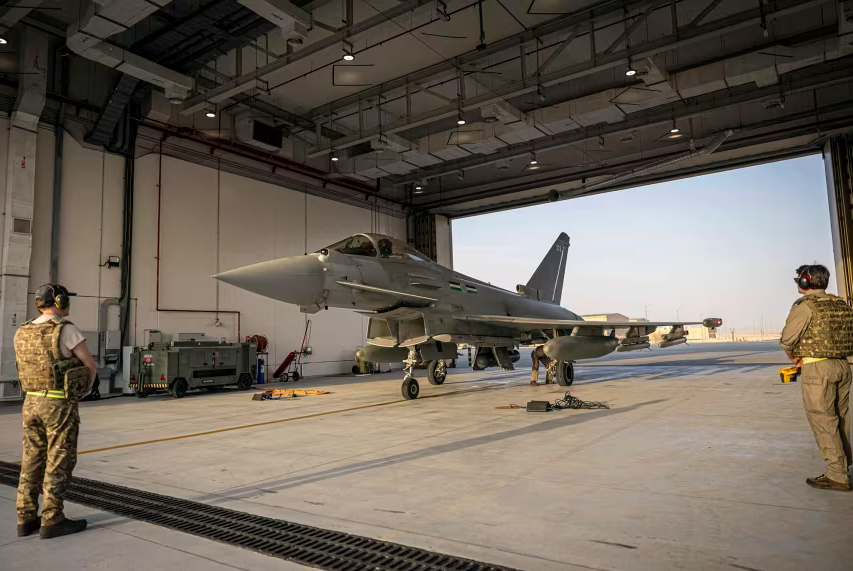
Streeting's statement committed RAF Typhoons to "defensive counter air missions" over Saudi cities, civilians and infrastructure, one A400M transport aircraft to move equipment inside the kingdom and military advisers to work with Saudi staff officers. The Typhoons fly from Qatar, where four of the jets were already based, and the ministry said they would not strike the Houthis. "The continuing attacks from the Houthis on our ally Saudi Arabia are absolutely despicable," Streeting said. Mike Martin, a Liberal Democrat MP, said the RAF had been "hollowed out" and was "paper-thin".
Burnham told the Commons on 12 October, two days after the Riyadh airport strike, that the UK would "continue to stand with Saudi Arabia" and would consider further Saudi requests "as and when they come in". By then the Voyager, which operates from a UK base in Cyprus, had flown 14 missions, and Burnham had indicated in September that the cost of living at home was a factor in approving its deployment. The UK had already deployed its Sky Sabre air defence system to Saudi Arabia earlier in the year to counter Iranian missiles during the US-Israeli war on Iran.
Britain holds the pen on Yemen at the UN Security Council, which makes it the drafter of the Council's texts on the country, and it requested the emergency briefing of 10 September with Bahrain after the Houthi attacks on Saudi Arabia. The government has called the two Iranian flights to Sanaa in July a breach of Yemen's sovereignty and said the Houthis bear full responsibility for the crisis, according to a House of Commons Library briefing of 5 October.
The Campaign Against Arms Trade, Action on Armed Violence, Shadow World Investigations and the Yemen Relief and Reconstruction Foundation wrote to Burnham and Ed Miliband, the foreign secretary, in late September with academics from eight universities, warning that refuelling Saudi jets could make Britain complicit in violations of international humanitarian law. The campaign group says Britain has sold the Saudi-led coalition more than £25 billion of arms since 2015. A court ruled in 2019 that the government's licensing assessment had been unlawful. Liz Truss, then trade secretary, resumed licensing in 2020 on the grounds that violations were "isolated", and the High Court dismissed the group's second challenge on 6 June 2023. Saudi Arabia agreed in 2007 to buy 72 Typhoons from Britain.
France
Emmanuel Macron, the French president, said in a televised interview on 24 September that France would send soldiers, radar units and air defence systems to protect Yanbu, the Red Sea port where Saudi Arabia has diverted crude through the East-West pipeline to avoid the Strait of Hormuz. The forces would protect the site without drawing France into the conflict, he said, and he gave no troop numbers or arrival date. Jean-Noël Barrot, the foreign minister, later called the help "strictly defensive" and said it did not make France a partner in the Saudi war on the Houthis.
Pascal Confavreux, the foreign ministry spokesman, said on 15 October that France had begun carrying out the military parts of an agreement to protect Saudi oil facilities and declined to say what was being sent. After the 10 October strike on Riyadh's airport, the foreign ministry condemned a "heinous attack", said France was already lending troops and equipment to the kingdom and called on the Houthis to stop.
Macron flew into Riyadh unannounced on 21 October and met the crown prince at Al Yamamah Palace. In Doha before the visit he said France had had personnel and capabilities deployed at Yanbu for eight days in a defensive role, had offered help repairing and securing the East-West pipeline and that it was important that "discussions resume" with the Houthis. The Élysée Palace said Saudi Arabia would supply additional diesel to France "for as many months as necessary". The stop capped a Gulf tour of Kuwait, the UAE and Qatar that Macron made to secure oil and diesel after a weekend of violent protests in France over living costs.
Italy
Italy keeps a task force at King Fahd Air Base in Taif, flying four F-2000A Eurofighters, an E-550A early warning aircraft and C-130J transports in support of Operation Inherent Resolve, the US-led campaign against Islamic State. Guido Crosetto, the defence minister, said one of the Eurofighters was hit in a remote part of the base during a Houthi missile and drone attack in mid-September, and that Italian personnel were unhurt.
Crosetto told The National in September that Italy had supplied radars and anti-missile batteries to Saudi Arabia before the war on Iran began in February. He said Italy had also offered technical help to defend against Iranian attacks that could be used against the Houthis.
Germany and the EU
Friedrich Merz, the German chancellor, offered the crown prince solidarity in a call on 13 October. On 15 October the Bundestag voted 421 to 66, with 90 abstentions, to keep up to 350 German soldiers in Aspides, the EU naval mission escorting ships in the Red Sea against Houthi attacks, until the end of October 2027, at an extra cost of about €18.9 million. Germany lifted its veto on Eurofighter sales to Saudi Arabia in 2024, citing the kingdom's "stabilising role".
The Gulf Cooperation Council and the EU postponed a summit of their leaders set for Riyadh on 24 October, Jasem Albudaiwi, the GCC secretary-general, said on 15 October, citing the safety of delegations and the closure of King Khalid airport. The European Council said it remained committed to the partnership.
Egypt
Egypt's National Defence Council, chaired by President Abdel Fattah al-Sisi, agreed on 18 October to give Saudi Arabia "all necessary and possible forms of support". Egypt's constitution requires a two-thirds majority in parliament to send troops on a combat mission abroad, and parliament postponed its vote to 26 October. Sisi said on 21 October that Egyptian support would be to "defend Saudi territory, and does not include an attack on Yemen".
Pakistan and Turkey
Saudi Arabia, Pakistan and Turkey signed the Mecca Joint Defence Agreement on 7 August, under which an attack on one counts as an attack on all. Their defence and foreign ministers agreed in Riyadh on 5 October to invoke it for the first time and to deploy "the agreed military forces and capabilities" to the kingdom. Khalid bin Salman, the Saudi defence minister, wrote that the three had agreed to "activate collective deterrence measures".
Pakistani forces, including fighter and support aircraft, arrived at King Abdulaziz Air Base in the Eastern Province in April, and Pakistan has troops stationed in Saudi Arabia without disclosing how many. Khawaja Asif, the Pakistani defence minister, said Pakistani and Turkish forces were playing a supporting role while Saudi forces did the fighting. Asked whether Pakistani forces had joined strikes in Yemen, he said Pakistan would provide "whatever means are available" to defend Saudi Arabia. Ishaq Dar, the foreign minister, said the pact was defensive in nature.
Turkey's constitution requires parliament to approve any deployment abroad, and parliament had not ratified the pact by 22 October. The Turkish defence ministry said on 15 October that the size of any deployment would depend on Saudi requests and conditions on the ground. The government plans to put a deployment motion to parliament once the pact is ratified, Reuters reported.
Talks
Abdulsalam said on 18 October that Oman had offered a five-day truce during which the two sides would meet, and that the Houthis would stop their attacks if Saudi Arabia agreed to "humanitarian demands". He said the Saudi government had shown no sign it was ready to deal with them. He has described those demands as lifting Saudi restrictions on Yemeni ports and airports, easing economic restrictions and paying civil servants' salaries from Yemen's own resources. Two Saudi sources and three regional sources told Reuters the Houthi terms also include regular flights to Iran, war compensation and an end to Saudi support for the internationally recognised government, and Abdulsalam denied that the group was acting for Iran.
A Saudi diplomat told reporters the week before that the kingdom had called for a meeting with the Houthis in Oman in July and that the group refused to attend. In September Saudi Arabia sent the Houthis a proposal through Oman for a two-week ceasefire and direct talks, the Hezbollah-aligned Lebanese newspaper Al Akhbar reported. Abbas Araghchi, Iran's foreign minister, said on 21 October that he had offered to mediate about 10 days earlier, in a call with his Saudi counterpart Faisal bin Farhan, and that neither Saudi Arabia nor the Houthis had replied.
The law
Under Rule 7 of the customary international humanitarian law study maintained by the International Committee of the Red Cross, parties to a conflict must distinguish between civilian objects and military objectives and may direct attacks only at military objectives. A passenger terminal is a civilian object unless it is being used for military purposes. The Houthis have tied their airport attacks to Saudi restrictions on Sanaa airport and Yemeni ports. Saree has also accused the coalition of using Aden's airport for military purposes and claimed strikes on Saudi military supplies at a camp next to it.
Rule 7 binds the coalition in its strikes on Saada, Taiz and Dhamar and the Yemeni government in its 22 October notice on Houthi rallies. The Security Council's September press statement called for full implementation of resolution 2216 and condemned the Houthi attacks on Saudi Arabia.
GACA's damage assessments for King Khalid, Abha and King Fahd airports would show which parts of each site were hit. The Houthis' own targeting claims, which name the ministry, the Yanbu terminal and the airports, set out what they say they were aiming at. The coalition's target list for 18 October would show what it believed was in the house in Saada. Streeting's statement says the UK expects every partner receiving its help to comply with international law. The Voyager's mission logs since late September, set against the coalition's strike dates, would show whether a UK-refuelled aircraft flew any strike that killed civilians, including the 18 October strike in Saada. OCHA's breakdown of the 251 verified civilian casualties would show how many each side caused.