Russia wants Europe's future security discussed before any ceasefire in Ukraine, Foreign Minister Sergei Lavrov said on 10 November, as U.S.-brokered talks opened in Abu Dhabi without Europeans at the table.
Lavrov said Russia could not accept an immediate ceasefire without knowing what would happen next and that it would be wiser to discuss the outlines of Europe's security architecture first. Ukraine wants a ceasefire on the current front line as the first step. Dmitry Peskov, the Russian presidential spokesman, said on 9 November that the talks would stay trilateral, between Russia, Ukraine and the U.S. The round, held behind closed doors, runs until 11 November, and no results had been announced by the afternoon of the first day.
Yury Ushakov, Putin's foreign policy aide, has called for NATO to return to the positions it held before 1997, when it began admitting former Warsaw Pact states. Draft treaties Russia published in December 2021, two months before the full-scale invasion, demanded an end to NATO enlargement and the withdrawal of allied forces and infrastructure from every state that joined after 1997. Sixteen of NATO's 32 members joined after that date, among them Poland, Finland and the three Baltic states, which border Russia or its exclave of Kaliningrad. Russia was expected to press for that rollback in Abu Dhabi, according to a British newspaper report in October. Ushakov said before the round that Europeans could reach Abu Dhabi if they bought tickets but that nobody intended to invite them.
The European Union, Britain, France, Germany, Italy, NATO, Ukraine and the U.S. issued a joint statement published by the European Commission before the session. Any future agreement must respect Ukraine's sovereignty and territorial integrity and give it credible security guarantees, they said. They committed to a strong post-war European security architecture with NATO at the centre, and to "moving toward broader multilateral discussions involving European partners". Paula Pinho, the Commission's chief spokesperson, told reporters in Brussels that the Commission did not yet know when Europeans would join talks involving Russia.
Who is at the table
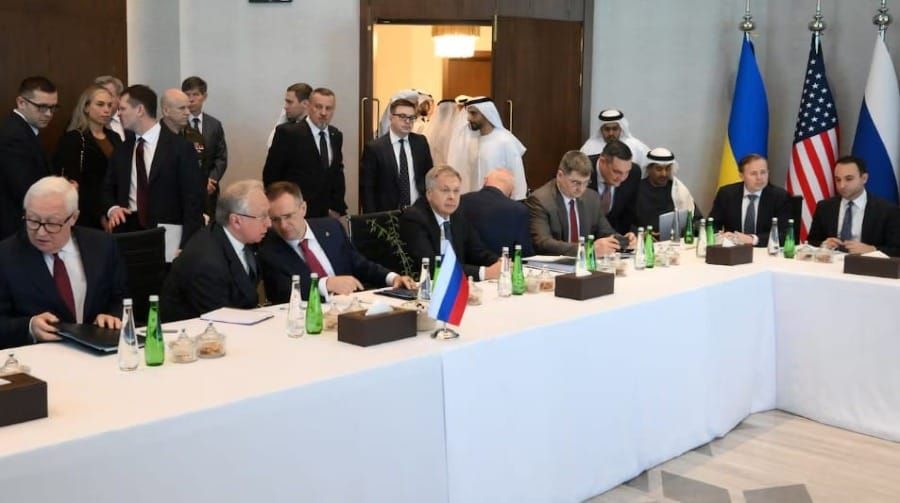
Steve Witkoff, the U.S. special envoy, and Jared Kushner, U.S. President Donald Trump's son-in-law, are mediating. General Alexus Grynkewich, the U.S. Air Force officer who is NATO's Supreme Allied Commander Europe, and Sheikh Abdullah bin Zayed Al Nahyan, the foreign minister of the United Arab Emirates, sat with them. The delegations sat down at about 12.15pm local time (8.15 GMT).
Kushner said in his opening remarks that the aim was "a new understanding building upon the different institutions and understandings of the past". Grynkewich pointed to progress made earlier in a trilateral dialogue between the militaries.
Vladimir Medinsky, an aide to Russian President Vladimir Putin, leads Russia's team, as he did in Geneva in February and at the first talks with Ukraine in Istanbul in March 2022. He told the opening session that his delegation had become bigger and more professional. Russia sent five delegates and six experts. Peskov said on 7 November that Medinsky would be joined by Deputy Foreign Ministers Sergei Ryabkov and Mikhail Galuzin and by Admiral Igor Kostyukov, head of the GRU military intelligence service. Kostyukov led Russia's team at the two Abu Dhabi rounds in January and February. Ryabkov, who handles relations with the U.S. and arms control, is new to the talks.
Rustem Umerov, head of Ukraine's Foreign Intelligence Service, leads the Ukrainian delegation, Zelenskyy's office said. The team includes Kyrylo Budanov, head of the Office of the President, and his first deputy Serhiy Kyslytsia. Vadym Skibitskyi, a deputy chief of military intelligence, and David Arakhamia, who leads the governing Servant of the People faction in parliament, complete it. Umerov said the delegation had a mandate to discuss every issue and listed its priorities on Telegram as an end to hostilities, reliable post-war security guarantees, economic recovery and humanitarian measures.
Europe outside the room
Officials from Britain, France, Germany, Italy, NATO and the European Commission met the U.S. and Ukrainian teams on the morning of 10 November, before the three-way session, Umerov said. The EU sent Bjoern Seibert, head of cabinet to Commission President Ursula von der Leyen, and Anna-Maria Boura, chief foreign policy adviser to European Council President António Costa. Britain, France, Germany and Italy sent their national security advisers. Geoffrey van Leeuwen, director of the NATO secretary general's private office, represents the alliance.
No European officials sat at the negotiating table once the session began. Jean-Noël Barrot, the French foreign minister, had said on French radio on 8 November that "the Europeans will be well represented" without saying in what role. Russia has said EU representatives could join at a later stage. Von der Leyen said on 9 November that substantive discussion of Europe's future security could come only after a ceasefire in Ukraine and must involve NATO allies and EU member states.
Witkoff's announcement of the round on 2 November named only the U.S., Russian and Ukrainian delegations. Giorgia Meloni, the Italian prime minister, wrote to Costa on 5 November that unless EU leaders agreed on a single representative, "we risk condemning Europe to irrelevance". Costa replied on 6 November that no agreement affecting Europe's security could be discussed without European involvement and agreed to put the question to EU leaders in Dublin on 13 November. Radosław Sikorski, Poland's foreign minister, backed Meloni.
Kaja Kallas, the EU's foreign policy chief, said in Warsaw on 6 November that the EU would not implement any agreement it was not party to. Lifting EU sanctions on Russia and admitting Ukraine to the EU both require the agreement of all 27 member states. A reported outline of a U.S. plan, published on 22 October, offered Russia sanctions relief and Ukraine a path to EU membership in return for dropping its NATO bid. Neither government has published that plan.
What each side wants
Russia wants Ukraine to withdraw from the parts of Donetsk, Luhansk, Zaporizhzhia and Kherson regions that Russian forces have never captured, to drop its NATO bid and to accept limits on its armed forces. Lavrov said on 9 November that security issues concerning Russia, Ukraine and the region would top the agenda, and welcomed the U.S. proposal to put collective security first.
Ukraine wants a ceasefire on the current line first and has refused to give up land its forces hold. Zelenskyy wrote on X before the session that his team would propose steps to reduce hostilities and that the sides needed to agree how to arrange a meeting of the three presidents. He spoke to Witkoff and Kushner before the talks began. No meeting of Trump, Putin and Zelenskyy has been agreed, and Putin and Zelenskyy have not met since Russia's full-scale invasion in February 2022.
Senior U.S. officials told reporters before the talks that they saw a real chance of serious progress and that territorial and security arrangements would have to be finalised together. Sanctions on Russia could be lifted in phases and reimposed if Russia broke a settlement, they said, and one official raised reviving the NATO-Russia Council, suspended since 2022. A U.S. official said the U.S. had asked Russia to accept guarantees for Ukraine modelled on Articles 4 and 5 of the North Atlantic Treaty. Under those articles NATO members consult when one is threatened and treat an attack on one as an attack on all.
Kushner set out the U.S. aims on X on 5 November: permanent security consultations, a crisis communications channel, greater military transparency, reciprocal measures to reduce the risk of escalation and a long-term arrangement for European stability. If progress was made, he wrote, the U.S. would move towards a wider format with European governments taking part directly.
Zelenskyy said in a Danish television interview published on 10 November that U.S. negotiators had asked Ukraine to give up Donbas in return for guarantees similar to NATO membership. He said Ukraine had refused. A separate report sets out his account and the territory at stake.
Earlier rounds
The U.S.-brokered process began in Abu Dhabi on 23 and 24 January, the first publicly acknowledged meeting of U.S., Russian and Ukrainian officials since the full-scale invasion. A second Abu Dhabi round on 4 and 5 February produced an agreement to exchange 314 prisoners, 157 from each side. Medinsky led Russia's team in Geneva on 17 and 18 February, a round that produced no significant progress. The three-way talks stopped after the U.S. and Israel went to war with Iran at the end of February.
Witkoff and Kushner met Zelenskyy and European leaders in Oslo on 20 October. The next day Witkoff met Putin outside St Petersburg for about three hours and asked him to resume the three-way talks. Ushakov said afterwards that Putin was ready to do so in early November and that the new round would focus on security arrangements for Russia and Ukraine after the conflict. Trump met Kirill Dmitriev, Putin's envoy for economic cooperation, at the White House on 5 November and told reporters a big agreement involving all of Europe could be close.
Trump said in a television interview broadcast on 8 November that Ukraine would likely "end up with a little bit different shape" after the war, without saying what territory he meant. Peskov replied on 9 November that geographically Ukraine was already a different country.
Strikes during the talks
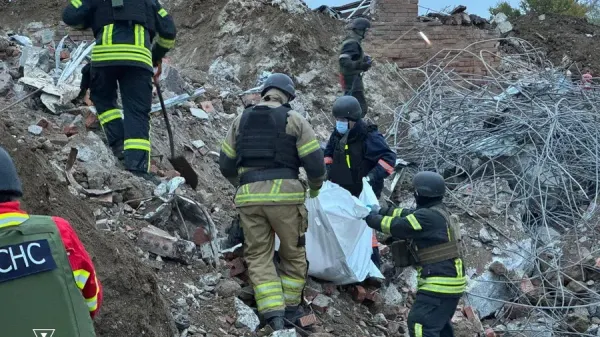
Russia launched 162 drones and one ballistic missile at Ukraine overnight into 10 November, and 317 drones the night before, Ukraine's air force said. Russia's defence ministry said it had targeted electrical substations in four regions on 9 November. Russian forces fired 36 ballistic missiles at Ukraine on 6 November and air defences intercepted four, Zelenskyy said, citing a shortage of interceptors for U.S.-made Patriot systems.
Ukrainian drones started a fire at the KINEF refinery in Kirishi, near St Petersburg, on 9 November, according to the governor of Leningrad region. Zelenskyy spent 10 November in Copenhagen with the prime ministers of Denmark, Sweden, Norway and Finland discussing air defence and the protection of Ukraine's energy system, and Denmark announced DKK 4.8 billion (about US$720 million) in military aid.
U.S. officials said they did not expect a final settlement from the two days and that further meetings involving Putin and Zelenskyy could follow, depending on the outcome. EU leaders meet in Dublin on 13 November with the question of who speaks for the bloc on the agenda, and a package of Patriot interceptors for Ukraine was still undecided going into that meeting.