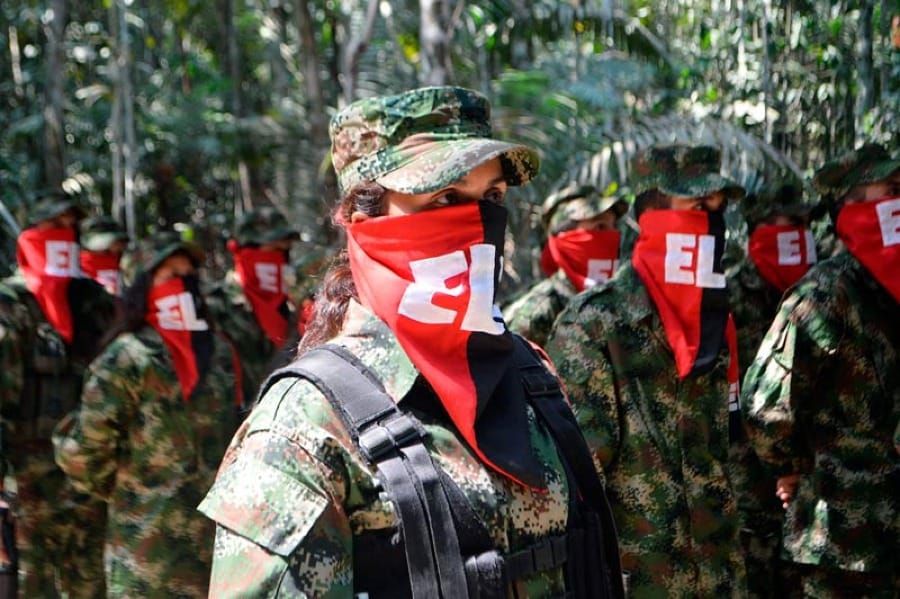
A drone strike killed 23 people at an ELN guerrilla camp in Venezuela's Apure state on 30 October, according to FundaRedes, a Venezuelan rights group.
Four U.S. officials told The New York Times that the United States supplied intelligence and drones for the strike on the camp of Colombia's National Liberation Army (ELN), near Buena Vista del Meta in Pedro Camejo municipality, facing Colombia's Vichada department. U.S. military strikes on boats that the U.S. government claims carry drugs killed 234 people by the end of September. Before Apure, the only reported U.S. strike on Venezuelan land was a drone attack on an empty coastal dock in late December 2025, which two people familiar with it attributed to the CIA.
The officials did not say who flew the drones, although one said the type is normally operated by U.S. forces. A senior Venezuelan officer said Venezuela's armed forces carried out the attack and that he had not been told of any U.S. role. Juan Francisco García Escalona, the FundaRedes coordinator in Apure, said U.S. drones carried out the attack alone and the Venezuelan army had no part in it.
The State Department referred questions to the Pentagon, which referred them to the Venezuelan government. Colombia's defence ministry denied any part in the operation. On 2 November Diosdado Cabello, Venezuela's interior minister, announced that troops and police were being sent to the Colombian border as a precaution. He said investigators were looking into a death in Guasdualito, also in Apure, that occurred "in strange circumstances". His statement did not mention the strike.
The ELN's national command denied in a communiqué on 9 November that any of its fighters had been targeted or hurt, and said the dead were Venezuelan civilians. It said Colombia's Aerospace Force had carried out the bombing with U.S. troops taking part. It called the attack "the biggest false positive" of De la Espriella's government, using the Colombian term for civilians killed by soldiers and presented as guerrillas.
Buena Vista del Meta
Residents of nearby farms heard two loud explosions on the morning of 30 October and found bodies scattered around the camp when they went to look, García said. He shared photographs and video recorded by residents, one of which shows a helicopter in the distance and dark figures on the grassland.
FundaRedes reported nine deaths on 31 October. García said the next day that 10 more bodies had been taken to the morgue in San Fernando de Apure, the state capital, and that an unknown number of wounded had crossed into Colombia. By 4 November the group's count had reached 23. A Venezuelan military source put the toll at 19.
Pilots, suppliers and relatives or partners of ELN members were among the dead, García said, including a woman in her 60s whom he described as a pilot's wife. He named one of the dead, Luis Alexander Solórzano Camacho, as a logistics operator for the group after speaking to his family. FundaRedes said the camp stored and distributed cocaine. It said a senior ELN commander was there when the drones struck and had recruited 16 young people from San Fernando and brought them to the area.
Drones, helicopters and a month of planning
The military source said drones and attack helicopters bombed the camp at dawn, in a forested area away from homes, after about a month of preparation. Personnel from the CIA and the FBI had helped with intelligence and mapping, the source said, and the order for the attack came from the United States.
García said the drones struck before dawn. Venezuelan troops arrived hours later to inspect the site and collect remains, he said, followed by an army rapid-response unit. Javier Tarazona, the FundaRedes director, who was jailed after denouncing the guerrillas' presence in Venezuela and freed this year, had earlier called it the first bombing by Venezuela against the ELN.
The Rodríguez government and the ELN
U.S. forces captured Nicolás Maduro on 3 January. Delcy Rodríguez, his vice-president and oil minister, has governed as acting president since. In June Héctor Rusthenford Guerrero Flores, known as Niño Guerrero, the leader of the Tren de Aragua gang, was killed in Bolívar state in a strike that Trump said Southern Command forces carried out in coordination with Venezuelan authorities. Secretary of State Marco Rubio said during a visit to Colombia in September that the U.S. government had discussed possible operations against the ELN in Venezuela with the Rodríguez administration. He called the situation "not sustainable".
A U.S. federal indictment of Maduro alleges that he and Cabello worked with the ELN to ship cocaine to the United States. The group has used Venezuela as a rear base for decades. In 2021 it drove a FARC dissident unit, the 10th Front, out of parts of Apure after the Venezuelan army had failed to. The ELN grew from about 1,800 members in 2016 to about 6,450 this year, La Silla Vacía reported. In late September a clash between the group and Venezuela's National Guard near Junín, in Táchira state, killed one person and wounded at least five.
Abelardo de la Espriella, Colombia's president since 7 August, ended the three negotiating tables he inherited from Gustavo Petro at the end of August. His government has since announced an airstrike on an ELN camp in Catatumbo, in Norte de Santander. On the day of the Apure strike, Colombia's armed forces said they had dropped leaflets over Cúcuta offering rewards for ELN commanders.
Southern Command in Caracas
Gen. Francis Donovan, head of U.S. Southern Command, and Joseph Humire, the acting assistant secretary for homeland defence and the Americas, met Rodríguez, Cabello and Vladimir Padrino López, then defence minister, in Caracas on 18 February. The Venezuelan government said the meeting produced a cooperation agenda against drug trafficking, terrorism and migration. Southern Command said U.S. joint force personnel had been posted to the reopened embassy.
Donovan publicly thanked Rodríguez after the June strike on Niño Guerrero. On 26 June, two days after earthquakes killed more than 6,000 people, Southern Command sent warships and aircraft to the Venezuelan coast at the government's request. The State Department is negotiating a status of forces agreement that would set the legal terms for U.S. troops in Venezuela, unnamed U.S. officials said on 3 November. One of them said a U.S. military presence was far in the future. Article 13 of Venezuela's constitution bars foreign military bases or facilities serving another country's military purposes.
Jorge Rodríguez, the acting president's brother, still heads the National Assembly. Cabello remains interior minister. On 18 March Rodríguez replaced Padrino López, defence minister since 2014, with Gustavo González López, a former head of the SEBIN intelligence service who has been under U.S. sanctions since 2015. Padrino López moved to the agriculture ministry. Foro Penal, a Venezuelan legal aid group, counted 322 political prisoners on 26 October, 140 of them soldiers. Its count stood at 863 at the end of 2025, before releases under an amnesty law passed in February.
130 bolívares
The monthly minimum wage has been frozen at 130 bolívares since 2022. In May it was worth about 27 U.S. cents. Rodríguez raised the bonuses paid on top of it to US$240. The Federación Venezolana de Maestros put the cost of a family's monthly food basket at US$692 in March.
The national living conditions survey run by the Universidad Católica Andrés Bello found that 68 per cent of households were in income poverty in 2025 and 32 per cent in extreme poverty. Multidimensional poverty, which also counts housing, services, education and health, affected 55 per cent of the population, against 57 per cent a year earlier. The same survey counted 39 per cent of households as multidimensionally poor 12 years earlier.
Oil, CITGO and the London gold
Trump wrote on 28 August that the U.S. had secured "majority US control of more than 65 billion barrels" of Venezuela's proven reserves, at no cost to taxpayers. The U.S. will control 55 per cent of the new joint oil company's output through an equity stake and the right to buy crude at cost, according to MercoPress. Rodríguez said Venezuela would receive about US$19 a barrel under the deal, which runs for 25 years. Energy Secretary Chris Wright signed agreements with Chevron, Eni and GE Vernova in Caracas on 2 September. Article 12 of Venezuela's 1999 constitution declares oil and mineral deposits inalienable public property. In the first sale arranged after Maduro's capture, a US$500 million oil deal in January, the Trump administration kept control of marketing and revenue.
In November 2025 Judge Leonard Stark of the federal court in Delaware approved the sale of CITGO, the U.S. refining subsidiary of the state oil company PDVSA, to Amber Energy, an affiliate of Elliott Investment Management. The auction pays creditors whose assets were expropriated under Hugo Chávez. ConocoPhillips holds more than half of the roughly US$20 billion in claims. Rodríguez and other Venezuelan officials have called the sale theft. PDVSA appealed in January, and the sale still needs approval from the Treasury's Office of Foreign Assets Control.
The Bank of England has held about 31 tonnes of Venezuelan gold, worth roughly US$4 billion, since refusing to release it to the Maduro government in 2019. Rodríguez wrote to King Charles III in July asking for it. In August her government and the opposition's 2015 National Assembly agreed to pursue the gold together. The Financial Times reported on 18 September that the two sides were close to a deal to move it to the Federal Reserve Bank of New York, where the Rodríguez government would gain legal control of the gold but could not sell it immediately.
Chocó and Planadas
Explosive-laden drones killed two professional soldiers, Luis Alejandro Melo Gutiérrez and Juan de la Cruz Méndez Ortiz, in San José del Palmar municipality in Chocó between 31 October and the morning of 1 November, the army's 15th Brigade said. Five others were wounded near Juntas de Tamaná and La Italia, the brigade said. It attributed the attacks on its 25th Land Operations Battalion to ELN members. Air force planes flew over the area while the troops were evacuated. In January drone-dropped explosives wounded 10 soldiers in the same municipality, in an attack the military blamed on the ELN's Ernesto Che Guevara front.
A dump truck loaded with explosives blew up at about 21:44 local time on 1 November in the Aeropuerto district of Planadas, in southern Tolima, a few metres from the town's military base. Four people were killed, among them a girl aged two months, Governor Adriana Matiz said. The hospital reported 17 people wounded by shrapnel. Matiz said the hospital building had suffered 80 per cent damage. The blast damaged 170 homes.
The defence ministry attributed the attack to the Gerónimo Galeano structure of FARC dissidents. It offered a reward of 500 million Colombian pesos for the structure's commander, Florentino Boyocue Tenorio, known as Amazonas, whom it accuses of ordering the bombing. Juan Camilo Hueje, the mayor, said drones had also been seen over the town and imposed a curfew. The army blamed the Ismael Ruiz Front, a unit of FARC dissidents loyal to the commander known as Iván Mordisco, for a drone attack on the same base in August.
Mordisco, whose real name is Néstor Gregorio Vera Fernández, commanded the First Front of the Revolutionary Armed Forces of Colombia (FARC) in Guaviare. In 2016, while FARC leaders were negotiating the peace agreement in Havana, his front announced it would keep fighting. He was the first commander to break with the deal. The FARC was a Marxist guerrilla army formed in 1964 around demands for land reform. Mordisco's group, the Central General Staff (Estado Mayor Central, EMC), presents itself as its continuation. In an October 2022 video, three months after the Colombian government announced he had been killed in a bombing, Mordisco said the FARC's political goals had not changed.
InSight Crime, which tracks organised crime in the Americas, describes the EMC as a federation of fronts financed by cocaine trafficking, illegal mining and extortion. A judge in Tolima ordered a man held after prosecutors accused him of collecting extortion payments from coffee growers and cattle ranchers for the Ismael Ruiz Front.
The EMC entered talks with Petro's government in 2023. It split in 2024, after the government suspended a ceasefire over the killing of an Indigenous leader, and Mordisco's faction left the talks. A smaller faction under Alexander Díaz Mendoza, known as Calarcá, kept negotiating as the Estado Mayor de Bloques y Frentes. The two factions have since fought each other in southern Colombia. On 30 August 2026 the De la Espriella government said an airstrike on an EMC camp in Guaviare had killed 20 members.
Law 2640
Congress approved De la Espriella's submission-to-justice bill on 3 November. He signed it the next day as Law 2640, an amendment to Law 418 of 1997, the public order law. Members of illegal armed groups who surrender get reduced sentences. The law gives them no political status and opens no negotiations, and arrest warrants and extradition stay in force. Petro's Law 2272 of 2022 had sorted armed groups by political character so that some could negotiate.
To qualify, members must hand over weapons, explosives and illegally acquired assets, identify members, commanders and financiers, release hostages and recruited children and help find the disappeared. Those who conceal information can lose the benefits. Gabriel Becerra, a member of the House of Representatives, said he would challenge the law in court over defects in its passage. María Fernanda Carrascal, also a representative, questioned the executive's power to decide which organisations count as terrorist. Illegal armed groups in Colombia grew from 15,120 members in December 2022 to 28,802 in July 2026, according to defence ministry figures.
Tolemaida and 19 November
About 350 U.S. military personnel and more than 400 Colombian soldiers are taking part in Southern Vanguard, an annual exercise at the Tolemaida military base in Cundinamarca, according to the U.S. Army. Colombia's defence ministry said the exercise runs from 27 October to 11 November and covers counter-narcotics operations, illegal mining and drone threats.
Fecode, the teachers' federation, the Central Unitaria de Trabajadores (CUT) and other organisations have called a national strike for Thursday 19 November against the government's Economic Rescue Law, a tax and spending bill before Congress. The CUT said the bill would raise value added tax on some everyday goods from 5 per cent to 19 per cent. It said health contributions for some workers would double from 4 per cent to 8 per cent.
The boat-strike memo
The Justice Department's Office of Legal Counsel wrote the legal memo used to justify the boat strikes on 5 September 2025, three days after the first one. The American Civil Liberties Union and the Center for Constitutional Rights sued for its release under the Freedom of Information Act in December 2025.
The mother of Chad Joseph, 26, and the sister of Rishi Samaroo, 41, two Trinidadian men killed in a strike on 14 October 2025, filed a separate wrongful-death suit in federal court in Massachusetts on 27 January. Their case relies on the Death on the High Seas Act, a 1920 law covering deaths more than three miles off U.S. shores, and the Alien Tort Statute.
On 30 September Judge Paul Engelmayer of the U.S. District Court for the Southern District of New York found that the Defense Department treats the memo as its "working law" for the strikes. He rejected the government's deliberative-process and attorney-client privilege claims and ordered the memo handed over for private review within 14 days, with a sworn list of everyone who has had access to it. He later refused to reconsider. The government's last ground for withholding the memo, presidential communications privilege, is before him.