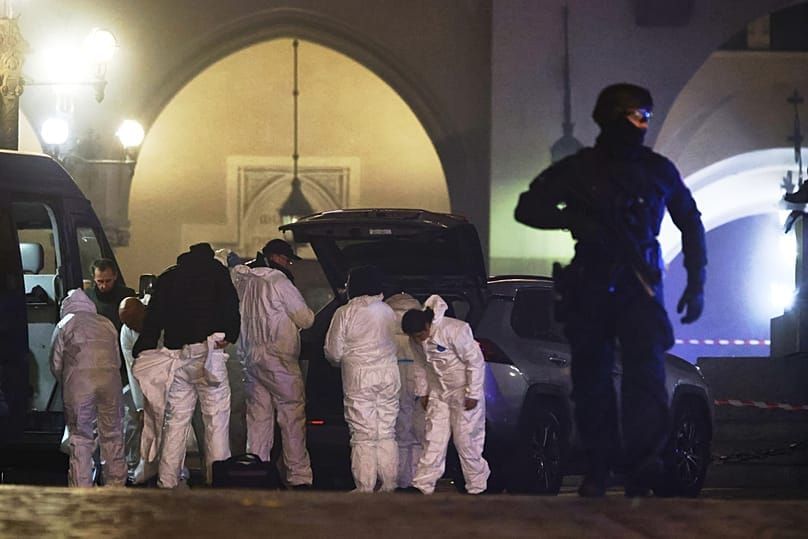
A gunman in military gear drove onto Kraków's main square on Saturday afternoon and fired from his car at people, killing six in an attack that prosecutors are treating as terrorism.
Interior Minister Marcin Kierwiński told a press conference in Kraków that evening that the suspect, a Polish man born in 2002, had acted alone and held radical, ultra-nationalist views. "Everything indicates he was fascinated by far-right ideologies, though this will be checked," he said. Kierwiński described the finding as the product of a first, rough analysis.
Four women and two men died on Rynek Główny and in the streets around it. Three of the dead were Polish women and one was a British man. The gunman wounded 15 people, among them two police officers, five carriage drivers who work on the square and visitors from Austria, Germany, Portugal, Russia and Britain.
Counter-terrorism police searching the suspect's flat in Ostrowiec Świętokrzyski, about 200 kilometres north-east of Kraków, found the bodies of a 53-year-old man and two women aged 52 and 21 on Saturday evening. Police confirmed on Sunday that they were the suspect's father, mother and sister, and that the three had gunshot wounds.
"Until now in Poland we haven't had such drastic cases of terrorism," Prime Minister Donald Tusk said in Kraków, according to the BBC. President Karol Nawrocki declared national mourning for 8 and 9 November, and the city's mayor, Łukasz Gibała, ordered mourning in Kraków until 11 November, cancelling municipal events for Independence Day.
Gibała has disputed the minister's account of the motive. He told the YouTube channel Kanał Zero that the attacker was a clinical case and that the attack had nothing to do with political ideologies, and said he did not know what the minister was relying on. "In my opinion we are dealing with the case of a madman," he said.
Within hours of the attack, posts on X tied the suspect to Rodacy Kamraci, a nationalist movement whose founder is in prison, and to Grzegorz Braun's Confederation of the Polish Crown. The posts reasoned from his uniform, his upbringing and his gun licence. Officers from the Central Bureau for Combating Cybercrime have joined the inquiry to establish whether he belonged to radical online groups or posted extremist material before the attack.
From Szczepańska Street to the Rynek
The suspect drove a black Subaru with Ostrowiec registration plates, a car registered to his father. Shortly before 15:00 he came down Szczepańska Street, stopped at the corner of the square and fired at people walking along Sławkowska Street, according to a reconstruction by Zero.pl. Several passers-by were hit at the mouth of Sławkowska.
He then drove across the square towards St Mary's Basilica and shot another person in front of a shop at Rynek Główny 5, on the corner of Sienna Street. One witness, who gave his name as Konrad, said he saw the black car pass the horse-drawn carriages and a horse rear up, then shots and smoke coming from the driver's window. He ran into the police station on the square and found it full of people lying on the floor. He told two municipal guards who came out of a back room that someone was shooting on the Rynek, and after a moment's hesitation they got into their vehicle and drove off after the car, he said.
Another witness said people first took the noise for fireworks and came out to look, until they saw a rifle sticking out of the car. A man who gave his name as Michał said he grabbed his wife and children and hid behind a wall while he heard the shots and saw the flashes. Another described overturned tables and crowds running in every direction.
Police spokeswoman Katarzyna Cisło said people were wounded at several locations because of his "wild ride" around the square. Tourists and residents ran into cafes, restaurants and the gateways of tenement houses. Gibała later thanked residents who opened their doors to people fleeing the gunman.
Municipal guards, who carry no firearms, were the first to give chase. Zbigniew Ulman, the commander of Kraków's municipal guard, said guards on the square saw the Subaru leaving Sławkowska and set off after it, and that police took over the pursuit at Sienna Street. Gibała said the guards had moved against the attacker despite being unarmed.
A first police patrol responded 23 seconds after the emergency call, Małopolska police said, rejecting claims on social media that officers had been slow to react. The first call was logged at 15:00:15, and officers exchanged fire with the gunman at about 15:03. General Inspector Marek Boroń, the national police commander, said the dispatcher sent 30 police crews to the Old Town.
The chase through the Old Town
The Subaru turned into Grodzka Street with a police car behind it. The pursuit ran through plac Wszystkich Świętych and plac Marii Magdaleny towards Wawel Castle, then along Stradom.
At 15:05, on plac Wszystkich Świętych, the gunman fired at a number 1 tram, the city transport company MPK said. A bullet shattered the window of the driver's cabin. The tram shielded pedestrians who were running from the car, and the driver was unhurt.
Officers blocked the Subaru at the junction of Stradomska and Dietla streets after the gunman crashed into another vehicle. He got out and opened fire on the police. Kierwiński said officers fired at him three minutes after the first report of shooting, and that the first crew to reach him had prevented a far greater tragedy. An air ambulance landed on the square to take away the wounded.
Footage of the exchange shows both officers falling to the ground. One of the wounded officers shot the attacker as he approached. The second officer, hit in the right hand among other injuries, got back up, fired at the attacker several times with his left hand and then applied a tourniquet to his own arm. BBC Verify authenticated a clip showing a visibly injured officer confronting the suspect as he lay on the ground.
Tusk named the officers on Saturday night as Senior Constables Jakub Kulik and Artur Morański and called them true heroes. Kulik, a former soldier of the 6th Airborne Brigade, was shot three times. Justice Minister Waldemar Żurek said one of his lungs was not working. Morański suffered a single gunshot wound and was expected to recover. A spokesman for the Małopolska provincial office said shortly after midnight that both officers had undergone surgery and were stable. Karolina Gałecka, the interior ministry's spokeswoman, said on Sunday morning that one officer was stable and the other in a serious but stable condition. Kulik had joined the police only recently and is also a member of a volunteer fire brigade in Bielsko-Biała.
The 6th Airborne Brigade asked for donations of AB Rh+ blood for Kulik. The broadcaster Krzysztof Stanowski launched a fundraiser for the two officers and their families, which received a single donation of 100,000 złoty (about €23,500 at 4.25 złoty to the euro) within hours.
Bomb-disposal teams with robots checked the Subaru for explosives before it was towed to a police car park. Officers found more firearms in the car. The boot held hundreds of rounds and bayonets, and police also recovered a military backpack and tactical pouches.
The question of police on the square
Norbert Loba was a deputy head of the ABW from 2015 to 2022. He said on Saturday that Rynek Główny, one of the most visited tourist sites in Poland, should be guarded by visible patrols and police cars and by plain-clothes officers. He said police should reach any incident there within three to five minutes, and described the attacker as either a determined terrorist or a lone fanatic of violence who hated people.
Roman Polko, a retired general and former commander of the GROM special forces unit, told Kanał Zero on Saturday that the shooting was a terrorist event. He said investigators' first task was to establish whether the gunman had accomplices and whether the attack was the start of something larger or the work of a lone wolf.
Tomasz Safjański is a former officer of the police Central Bureau of Investigation and a professor at the WSB Academy. He said the gunman had chosen a soft target, a public place of symbolic importance that is easier to reach and less protected than a ministry building. He said attackers often prefer such targets because the risk of meeting armed security is lower, and that an attack on a guarded building means preparing for an exchange of fire. The Rynek had until Saturday been associated with safety, tourism and leisure, he said, but it was impossible to protect every public place. He also said the public needed reliable, checked information, or speculation would quickly build around the attack.
Paweł Moczydłowski, a criminologist and former head of the prison service, said it seemed unlikely anyone would plan an attack in that way to kill particular people. He said the attack was probably meant as a provocation, and that Kraków's reputation as an orderly city suggested the aim might have been to discredit Poland as a safe country.
The dead and the wounded
Boroń said on Saturday evening that the dead included a British citizen and three Polish women. UK Prime Minister Andy Burnham said he was shocked and saddened by the shooting. Portugal's foreign ministry confirmed that a Portuguese citizen was among the injured. Maksymilian Kosowski, the spokesman for the Małopolska governor, said the wounded Portuguese citizen was a 74-year-old woman who had been visiting her granddaughter. Kosowski said the other dead were Polish.
Five of the injured were carriage drivers who were working the horse-drawn cabs that wait on the square for tourists, said Dorota Litwicka, the president of the Kraków Carriage Drivers' Association. On Sunday the association said two of them were fighting for their lives and several others were seriously hurt. "The victims of the madman today were carriage drivers," Litwicka said in a statement. The horses suffered only superficial wounds, and the carriage stand on the square stayed closed on Sunday.
Cisło said on Sunday morning that everyone injured in the attack was still alive. The square was partly reopened, with forensic technicians still working behind police tape. Police said they would close it again for a second examination of the places where shots were fired.
National mourning was in force across Poland on Sunday and Monday, with flags at half-mast. Nawrocki's regulation was published in the Journal of Laws late on Saturday, countersigned by Tusk. Nawrocki's chief of staff, Zbigniew Bogucki, said its purpose was to honour the victims of an unprecedented act of terror.
Sunday on the Rynek
All six people killed on the square had been identified by Sunday morning. The Małopolska governor, Krzysztof Jan Klęczar, said more than 1,100 police officers were working in Kraków on the case and that the city was safe. He asked residents to live normally and not to give in to disinformation or panic, and said the square would stay partly closed while investigators worked.
Cardinal Grzegorz Ryś, the archbishop of Kraków, wrote to the city's Catholics on Saturday evening that violence, aggression and hatred had struck the city beyond all limits. "Every one of us could have been on the Rynek at that time," he wrote. He wrote that the people of the city could not be indifferent and needed to stand together, and called a Mass at St Mary's Basilica for 16:00 on Sunday as a Christian expression of opposition to hatred and violence. The Polish Bishops' Conference published the letter on Saturday evening.
Kraków's municipal guard and police kept the area around St Mary's closed on Saturday night while bomb-disposal teams searched buildings and roofs around the square. Candles and flowers had been placed at the edge of the cordon by Sunday morning.
Shortly after 03:00 on Sunday officers confronted a 23-year-old man carrying a knife with a blade of about 20 centimetres on Kapelanka Street, fired warning shots and then a shot that missed, and detained him. Police said he might have a mental disorder and that the incident had no connection to the shooting.
Reactions abroad
Ukrainian President Volodymyr Zelensky called the attack a shocking crime, and Ukraine's prime minister wrote on X that Ukraine joined Poland in mourning and condemned the attack as senseless violence. Irish Prime Minister Micheál Martin wrote that he was shocked by the brutal attack on a city centre full of people.
Tom Rose, the US ambassador to Poland, called the shooting "a savage and murderous attack that's shattered the peace of Poland" in a post on X on Saturday evening. The UK ambassador, Melinda Simmons, wrote that Britain stood with Poland, German Chancellor Friedrich Merz said Germany stood with Poland, and the president of the European Parliament told the city to be strong. Latvian President Edgars Rinkēvičs wrote that his country stood with its Polish friends and allies. The EU's foreign policy chief, Kaja Kallas, said the attack was "a tragedy that will be felt far beyond Poland".
The flat on Tylna Street
The suspect lived with his parents and sister in a flat in a block on Tylna Street in central Ostrowiec Świętokrzyski. Counter-terrorism officers entered on Saturday evening after using a hydraulic lift to reach a balcony and sending a drone inside. Residents of the block were evacuated. Mariusz Gierszewski, a reporter for Radio ZET, wrote that police feared the suspect had left explosives in the building.
Tusk confirmed the discovery of three bodies during a late-night crisis meeting with ministers and the heads of the security services. Andrzej Fijołek, the spokesman for the national police commander, said on Sunday morning that the dead were the suspect's father, 53, mother, 52, and sister. Świętokrzyskie police said the bodies had injuries assessed as gunshot wounds and had been secured for detailed examination. Police found seven firearms in the flat. The bodies were discovered shortly before 22:00. Wirtualna Polska reported that everything pointed to the suspect having killed his family first and then taken his father's car and weapons to Kraków.
Neighbours described the family as quiet and said the son always said good morning. Residents who watched the police operation from the street described him as calm, quiet and no trouble.
Artur Łakomiec, the mayor of Ostrowiec Świętokrzyski, said on Saturday evening that the block was being evacuated and that the town hall had been opened for residents to wait while officers searched the flat. The evacuation ended at about midnight and residents returned home while police continued working in the building. Łakomiec offered condolences to the families of the dead in Kraków, set up a psychological support line through the town's social services centre and asked residents not to rush to judgement or repeat unverified information.
Michał O.
Prosecutors' spokesman Tomasz Waszczuk confirmed the suspect's identity as Michał O., aged 24. Polish press law protects the full names of people under investigation unless a prosecutor or court decides otherwise. Waszczuk said the suspect had not been formally detained because of his condition.
His family moved to Ostrowiec from the rural district of Waśniów more than a decade ago. He grew up near the town centre and as a child showed a talent for art and took part in church life. He trained as a lathe operator at the town's vocational school, known locally as the "Samochodówka", and worked in that trade. Fijołek said he had no criminal record and had not come to police attention before Saturday.
He held a permit for two firearms for sporting use and trained at the Świt Starachowice shooting club, where his father also shot, according to Wirtualna Polska. Onet reported that his father legally owned 11 firearms. The suspect had posted photographs of guns on his social media accounts.
Defence Minister Władysław Kosiniak-Kamysz denied reports that the suspect was a soldier, writing on X that the man had never had anything to do with the armed forces. Claims that he wore the patch of a Territorial Defence brigade were false.
The suspect underwent several operations on Saturday night. A regional police spokesperson said he was in a stable but very critical condition. Waszczuk said investigators were establishing whether his injuries came from police bullets or from the crash.
The rifle and the licences
Police said the attacker used a semi-automatic rifle similar to the AR-15. Wirtualna Polska identified it as probably a DB15, a civilian model of the AR-15 family sold on the open market. Kierwiński said one hypothesis was that the son took his father's weapons, while stressing it was a preliminary finding. The son's own sport permit covered a rifle and a handgun.
Legal gun ownership in Poland has more than doubled in a decade. At the end of 2025 private owners held 1,037,778 registered firearms, an increase of more than 107,000 in a year, according to national police headquarters data. The number of active permits reached 411,769, against 192,819 in 2015.
Police issued a record 50,700 new permits in 2025. Collectors' permits were the largest category, at 21,071, followed by 17,601 sport permits and 7,254 permits for personal protection.
Applicants for a sport permit must join a shooting club, pass a shooting qualification known as a patent and obtain a competitor's licence from the Polish Sport Shooting Federation (PZSS) before applying to the provincial police headquarters. Under the Weapons and Ammunition Act of 1999, permits are normally issued from the age of 21, though people aged 18 can obtain sport and hunting permits.
An amendment that took effect on 10 March 2011 removed the police's discretion over permits and set out fixed criteria for obtaining them, Aleksander Herzog, a prosecutor, wrote in an analysis of the change published by the Polish government. Administrative courts have since ruled that the police must issue a sport permit to an applicant who practises sport shooting and meets the statutory conditions, and need not require outstanding sporting results.
Every applicant must pass a medical and a psychological examination. Holders of sport and hunting permits are examined only when they apply, according to the explanatory memorandum to a bill tabled in the Sejm to change the law. Only people who hold permits for personal protection or for protecting people and property must repeat the examinations every five years. Even if the suspect passed every examination when he received his permit, a test taken several years ago said little about who he was in November 2026, the legal news site Bezprawnik wrote.
The minister's assessment
Kierwiński said at the Saturday press conference that everything indicated the attacker held very radical views and that the finding would be verified. Asked by journalists, he said the first, rough analysis pointed to ultra-nationalist views and that he did not want to say a sentence too many. He said police had no grounds to believe there was more than one attacker.
Tusk called the shooting an act of terrorism on Saturday. Waszczuk said on Sunday that prosecutors would issue a decision opening an investigation that day and would classify the crime as a terrorist offence.
Article 115, paragraph 20, of the Polish criminal code defines a terrorist offence as a crime punishable by at least five years in prison and committed with a particular aim. The aim must be to seriously intimidate many people, to force a public authority to act or refrain from acting, or to cause serious disruption to the constitutional order or economy of Poland, another state or an international organisation. Prosecutors must prove that aim in court. If they cannot, the suspect would answer for the murder of multiple people with a firearm, which carries a sentence of up to life imprisonment.
Investigators are also examining whether the suspect had help. Tusk said any possible supporters of the attacker would be detained and asked the public for information. Waszczuk said prosecutors were checking whether the 24-year-old could have cooperated with anyone else.
Classmates and acquaintances
Acquaintances in Ostrowiec described the suspect to Gierszewski as quiet and withdrawn, with right-wing views, a mild interest in Second World War military symbols and a liking for wearing military uniforms. They said his father shot at a sports club.
A former classmate at the vocational school told Radio ESKA reporter Jakub Krzyżak that he was quiet and spoke up mainly in history lessons. She said he drew hanged men during lessons and, in one picture, showed himself entering a school with a pistol among bodies. When classmates asked about the drawings, she said, he told them he wanted to become an attacker. "He said it as if it were simply his dream," she said. She said pupils discussed the drawings at the time without treating them as a warning of a real attack. A source quoted by the right-wing site Niezalezna.pl described him as a "psychopathic figure" who painted a great deal, mostly hanged men.
Karol Grabias, writing in the Catholic magazine Więź on Sunday, cited the classmate's account and wrote that the attack may have had no political or ideological goal, with violence an end in itself for the attacker. He wrote that commentators were rushing to blame the left, the right, Germany, Russia, the Azov regiment or Tusk.
The argument over the motive
Right-wing broadcasters accused Kierwiński of exploiting the attack. wPolsce24 said he had insinuated a political motive without explaining what it was based on. Presenters at wPolsce24 and TV Republika said on Saturday that police had been tied up at the Constitutional Tribunal in Warsaw, where the government is in a dispute with judges over control of the court. The weekly Polityka named commentators Michał Karnowski, Jarosław Olechowski and Samuel Pereira.
Jarosław Kaczyński, the leader of Law and Justice, the largest opposition party, offered condolences and asked supporters to call off protests over the Tribunal planned for 8 and 9 November. His spokesman, Rafał Bochenek, said the request was a mark of respect for the victims.
Tusk appealed on X to politicians of all parties not to exploit the tragedy, and told the evening crisis meeting that there could be no room for any political game. Deputy Prime Minister Krzysztof Gawkowski, the digital affairs minister, wrote on X that the government had begun monitoring the internet, was seeing a growing volume of false information and was reporting false posts to the platforms. He asked politicians to stop using the tragedy.
Gibała, who took office on 20 October after winning an early mayoral election triggered by the recall of his predecessor, Aleksander Miszalski, in a referendum in May, addressed residents on Saturday night. He asked people to avoid the area around the square, not to share footage of the attack and to rely on official information, and said the tragedy must not become a reason for division.
Disinformation after the attack
False claims about the gunman's nationality spread within hours of the Kraków attack, with accounts on X using the shooting to blame immigration or suggest a Ukrainian connection. Małopolska police confirmed that evening that the attacker was Polish, that no officer had died and no second attacker was being sought. They also rejected claims of a delayed response and said footage of a person on the roof of St Mary's Basilica had been recorded hours earlier and was unrelated to the shooting. Government spokesman Adam Szłapka said AI-generated photographs and videos could appear convincing and asked people to check sources before sharing material.
One account captioned footage of the arrest "European Union, open borders and here are the effects", according to Doniesienia z putinowej Polski, a blog that tracks pro-Russian accounts. The same blog reported that Tomasz Jankowski, whom it described as a former Zmiana activist now working with Grzegorz Braun, speculated about whether the attacker had fought for Ukraine.
A joint report by the European External Action Service and Ukraine's Centre for Countering Disinformation identified Poland, Germany and France as priority targets for Russian information operations. It said portrayals of Ukrainian refugees as threats to security and public order were intended to heighten social tensions and weaken Polish-Ukrainian cooperation.
In October 2025, Facebook and TikTok posts said that a Ukrainian had shot dead three young people in Kraków. Police and prosecutors said no such crime had occurred, and the interior ministry said Russian services were attempting to spread narratives of this kind. AFP traced the video to an account that had previously posted only footage of luxury cars.
Michał Marek, a Russian propaganda expert at Poland's state research institute NASK, said messages promoting anti-Ukrainian, anti-NATO and anti-European sentiment circulate continuously online. He said Russia is not the only source, and that domestic actors and other foreign actors also spread disinformation in Poland.
The Crown and the Kamraci
Braun, an MEP who leads the Confederation of the Polish Crown, wrote on X that the victims deserved prayer and their families sympathy. Braun won 6.34 per cent of the vote and finished fourth in the first round of the presidential election in May 2025. He called for promotion and a reward for the officer who stopped the attacker and demanded the death penalty for the "murderer-terrorist". The party's own account posted a message on Saturday saying the attack had come "just at the time and near a patriotic rally".
Wojciech Olszański, the founder of Rodacy Kamraci, has been in prison since 22 October, when police detained him to serve three months for antisemitic remarks made during an online broadcast. In September the appeals court in Gdańsk separately convicted him of publicly inciting hatred against Jews at a rally in Grudziądz in 2022. A court struck the movement's party off the register of political parties in November 2024.
Olszański, 66, is a former actor who graduated from the state theatre school in Kraków and appeared at the National Theatre. He wears a uniform modelled on a pre-war Polish officer's, and his nickname, Jaszczur, refers to the Lizard Union, a pre-war nationalist organisation whose badge he wears on his sleeve. He founded Rodacy Kamraci in 2021 with Marcin Osadowski, and the party was registered by a court in June 2023.
Police detained Olszański and Osadowski at Dziekanów, outside Warsaw, in June 2025, and prosecutors said the two men would face 78 charges. A court in 2023 sentenced Olszański at first instance to one year and eight months in prison for threats against members of parliament he had shouted at a rally. Interia has described Rodacy Kamraci as a movement sympathetic to the Russian and Belarusian governments, and Rzeczpospolita described Olszański in 2026 as an increasingly influential figure around Braun.
Followers of the movement spread anti-Ukrainian, anti-EU and pro-Russian views, according to an OKO.press investigation, which found that Jacek J., a Pole implicated in a spy network working for Russia, had promoted Olszański and Kamraci statements online. Olszański appeared at a congress organised by Braun's party at the end of January.
Neo-Nazi plots before Kraków
The Internal Security Agency (ABW), Poland's counter-intelligence and counter-terrorism service, detained a 17-year-old from Siemianowice Śląskie, identified as Paweł G., on 18 September. Prosecutors charged him with preparing a terrorist attack intended to kill many people, membership of an organised criminal group, promoting Nazism and inciting hatred. Justice Minister Żurek said he had been planning a mass attack on targets including a school and a mosque, and that weapons, explosives and Nazi symbols were found at his home. A court remanded him for three months.
Government spokesman Szłapka said the teenager belonged to the online groups Atomwaffen Polska and Bierut Soldier ZNB. The ABW said both groups shared neo-Nazi content and symbols and discussed violence and attacks, and that the suspect had planned to buy weapons and military equipment. A week earlier the agency and Silesian police had detained two 16-year-olds whose devices held neo-Nazi, racist and antisemitic material.
Jacek Dobrzyński, the spokesman for the minister coordinating the special services, said on X that young people in Poland were becoming fascinated with neo-Nazism and fascism. The ABW said the case remained open and that it had identified another person linked to the same circle in Łódź province.
In May 2025 the ABW detained a 17-year-old from Podkarpacie who was planning an attack in support of Islamic State. Three teenagers from Olsztyn were detained the same year over a planned attack on targets including a school. In November 2025 the ABW detained a 19-year-old, Mateusz W., who was preparing an attack with explosives.
The ABW report on young attackers
The ABW published an unclassified report on its work in 2024 and 2025 in May 2026, its first such report in more than a decade. The report named Russian sabotage and espionage as the most serious threats to the state and singled out the radicalisation of young people and their fascination with terrorism. It also recorded a visible increase in the activity of far-right groups, which use social media for propaganda and self-promotion.
Extreme behaviour among young Poles is rarely rooted in a specific ideology and most often stems from a fascination with violence, including mass murder and the brutal activity of terrorist organisations, the agency wrote. Most radicalised people limit their activity to the internet, but the ABW had identified individual cases of direct preparation for terrorist attacks.
The agency's head, Colonel Rafał Syrysko, said in an interview that familiarity with brutality online and contempt for life had made lone attackers a real terrorist threat in Poland. He said the threat from Islamist terrorism remained relatively low.
Attacks on Ukrainians
Ukrainians are Poland's largest foreign national group, and the country hosts almost one million refugees from Russia's full-scale invasion. Poland's national police headquarters told the Ukrainian public broadcaster Suspilne that reports of hate crimes against Ukrainian citizens had risen by a third since the start of 2026, and began recording them as a separate category in May.
On 7 May five Polish teenagers aged 15 to 18 attacked three Ukrainian teenagers on Warsaw's Świętokrzyski Bridge, fracturing the skull of a 16-year-old. Warsaw's mayor, Rafał Trzaskowski, blamed anti-Ukrainian rhetoric by right-wing politicians for encouraging such attacks, and Kierwiński announced the arrests a week later.
Tusk told a cabinet meeting, after an attack on a Ukrainian couple, that violence against Ukrainians had received political backing, and called on Nawrocki to condemn it publicly. Wrocław's city council adopted a resolution in August condemning hatred and violence based on nationality after a series of attacks on Ukrainians in the city.
The dead and injured in Kraków included Poles, a Briton, an Austrian, a German, a Portuguese and a Russian. Police described the people the gunman shot as random.
Russia's campaign against Poland
The ABW report described Russia's goal as the disintegration of Euro-Atlantic structures and the internal destabilisation of individual countries. The agency opened 69 espionage investigations in 2024 and 2025, as many as in the whole period from 1991 to 2023. It said Russian services were shifting from disposable recruits found online to professional sabotage cells linked to organised crime. The report said Russian services preferred recruits with experience in the police or the military and had stepped up training on Russian territory to prepare agents for terrorist activity.
Nearly 100 people have been named as suspects in espionage and sabotage cases run by the ABW since the start of 2024, Tomasz Siemoniak, the minister coordinating the special services, said on 5 November. Ukraine's Foreign Intelligence Service said on 6 November that about 200 acts of sabotage linked to Russia had been recorded in Europe since 2022 and that 21 per cent of them took place in Poland.
Hoax bomb threats disrupted flights to Warsaw on 3 November and more than 20 flights across Europe on 5 November. Emails sent to airports in Rome and Sofia that day were signed in the name of "fighters of the Male State", according to the Italian news agency ANSA and AFP, which saw the texts. "Your feminist regime will remember it forever," one of the emails said.
The Male State is a misogynist, nationalist Russian online movement founded in 2016 by the blogger Vladislav Pozdnyakov. The International Centre for Counter-Terrorism in The Hague said the group later became a vocal supporter of Russia's war in Ukraine. Russian authorities designated it extremist in October 2021, and it has since operated under the name Male Legion.
The US State Department designated the Russian Imperial Movement, an ultranationalist paramilitary group based in St Petersburg, and three of its leaders as Specially Designated Global Terrorists on 6 April 2020. It was the first white supremacist group the department had designated. Nathan Sales, the department's counter-terrorism coordinator, said the movement ran two paramilitary training camps in St Petersburg. Swedish men trained there were later convicted over bombings in Gothenburg, including an attack on a centre for asylum seekers, and the Swedish prosecutor blamed the movement for their radicalisation and training.
The Guardian and the BBC identified the founder of The Base, a US neo-Nazi network whose members the FBI arrested in 2020 on charges including plotting violence, as Rinaldo Nazzaro on 24 January 2020. The BBC traced him and his Russian wife to a property in central St Petersburg bought in her name in July 2018, the month to which the FBI dates the founding of the group. Nazzaro told a Russian state television programme that he had never had contact with Russian security services, and in February 2022 he announced on Telegram that he was giving up control of The Base.
Europol and the Global Terrorism Index
Europol counted 45 terrorist attacks in 10 EU member states in 2025 in its annual terrorism situation report, published on 13 July. Of those, 22 were completed, 20 were foiled and three failed. Jihadists carried out 24 of the attacks and accounted for 347 of the 486 terrorism arrests made across 21 member states.
Five attacks were classed as right-wing terrorism. One was carried out in France, causing one death, and four were foiled, three in France and one in Ireland. Member states made 43 arrests for right-wing terrorism, and Europol recorded that right-wing attacks were more likely than others to involve explosives. In 2024 the agency recorded one completed right-wing attack across the EU, in Italy, and in 2023 it recorded two foiled right-wing attacks.
A neighbour shot dead Hichem Miraoui, a Tunisian hairdresser, in Puget-sur-Argens in the Var department of France on 31 May 2025. Two days later France's national anti-terrorism prosecutor's office took over the case, its first homicide inspired by far-right ideas. A Turkish man was wounded in the same attack. The suspect, Christophe B., had posted videos calling on people to vote for the far right. He was charged with terrorist murder motivated by the victim's origin, admitted the killing and denied any racist motive.
Bratislava and Hanau
Poland's southern neighbour suffered a far-right shooting on 12 October 2022, when Juraj Krajčík, 19, shot dead two people outside Tepláreň, a gay bar in central Bratislava, and wounded a third. He had posted a manifesto against Jews and LGBT people hours earlier and cited the online network Terrorgram as an inspiration. He was found dead the next morning. Britain proscribed the Terrorgram collective as a terrorist organisation on 26 April 2024, and the US State Department designated it and three of its leaders as Specially Designated Global Terrorists on 13 January 2025, citing attacks including the Bratislava shooting. Daniel Lipšic, Slovakia's special prosecutor, said when the investigation closed in December 2023 that Krajčík had first waited outside the home of Prime Minister Eduard Heger and switched to the bar when he could not get close to him.
Tobias Rathjen, 43, shot dead nine people of migrant background at two shisha bars and a kiosk in Hanau, near Frankfurt, on 19 February 2020, before driving home and killing his 72-year-old mother and himself. Germany's federal prosecutor, Peter Frank, said all nine of the dead were of foreign background. Rathjen had published a 24-page text online calling for the extermination of peoples he named, and the German interior minister called the shootings terrorism.
Europol's counts are compiled from the attacks that member states report to it as terrorism. Its 2025 report, covering 2024, counted 58 attacks in 14 member states and 449 arrests, and described a hybridisation of terrorist ideologies in which jihadism, violent right-wing extremism and accelerationism overlapped with satanism and occultism. Its 2024 report said lone actors or small groups, often motivated by accelerationist ideas, which seek to hasten social collapse through violence, posed the highest right-wing threat, and that suspects were increasingly young.
Deaths from terrorism in Western countries rose by 280 per cent in 2025 to 57, according to the Global Terrorism Index published in March by the Institute for Economics and Peace in Sydney. Worldwide, terrorism deaths fell by 28 per cent to 5,582, the lowest level since 2007. The institute found that lone actors carried out 93 per cent of fatal attacks in the West over the past five years. Children and adolescents accounted for 42 per cent of terrorism investigations in Europe and North America in 2025.
A report by the UN Secretary-General to the General Assembly in 2022 said some member states regarded far-right terrorism as their fastest-growing domestic threat. It cited a study that found a 320 per cent rise in such attacks between 2014 and 2018, mostly in Western countries.
Independence Day
The attack came four days before Poland's Independence Day on 11 November, when the nationalist-organised Independence March in Warsaw draws tens of thousands of people each year. Nawrocki said before the attack that he would take part in the march. Gałecka said on Sunday that she could not confirm what would happen to the march or the other events planned in the capital, and that no decision had been taken to change them.
Gałecka said the mayor of Warsaw had already followed police recommendations to tighten security, with more officers and barriers along the Royal Route. A ban on carrying weapons, including unloaded ones, and pyrotechnics is due to apply in Warsaw on 11 November. In Kraków, Gibała cancelled the city's own Independence Day events.
Poland was already under the second of four terrorism alert levels, BRAVO, across its whole territory under an order the prime minister signed on 25 August, valid from 1 September to 30 November. A third-level CHARLIE alert applies to railway lines run by PKP Polskie Linie Kolejowe. The alert levels were introduced in response to hybrid attacks attributed to Russia and Belarus.
Earlier terrorism cases in Poland
The ABW arrested Brunon Kwiecień, a chemist at the Agricultural University in Kraków, on 9 November 2012. Prosecutors said he planned to detonate a vehicle loaded with explosives outside the Sejm while the president, prime minister and deputies were inside. They described him as motivated by nationalist, xenophobic and antisemitic ideas but said he did not formally belong to any political group. Tusk said at the time that Kwiecień was fascinated by Anders Behring Breivik, who killed 77 people in Norway in 2011.
A Kraków court sentenced Kwiecień to 13 years in December 2015. The appeals court reduced the sentence to nine years in April 2017, finding that his preparations had been at an early stage, and the Supreme Court dismissed his final appeal in 2018.
In May 2016 Paweł R., a 22-year-old chemistry student, left a home-made bomb on a bus in Wrocław, injuring one person. He was charged with terrorism, attempted mass murder and extortion and sentenced to 20 years in prison in November 2017. Former counter-terrorism officers consulted by Rzeczpospolita said Saturday's attack was probably the first premeditated terrorist attack in Poland carried out with a long gun.
The investigation
Seven prosecutors worked at the scenes on Saturday, and the investigation is being run by the Kraków district prosecutor's office with the support of the ABW. Prosecutors asked witnesses to hand videos of the attack to investigators before posting them online, and have scheduled witness interviews for the coming days. Police planned a detailed inspection of the Subaru on Sunday and an inspection of the tram.
Under Article 41 of the Polish constitution, a detained person must be handed to a court within 48 hours and released unless a court orders custody within a further 24 hours. Waszczuk said the suspect had not yet been formally detained because of his condition.
Michał O. remains in a Kraków hospital under police escort. Ballistics experts are establishing which weapon was fired on the square and whether it was registered to him or his father or had been modified.