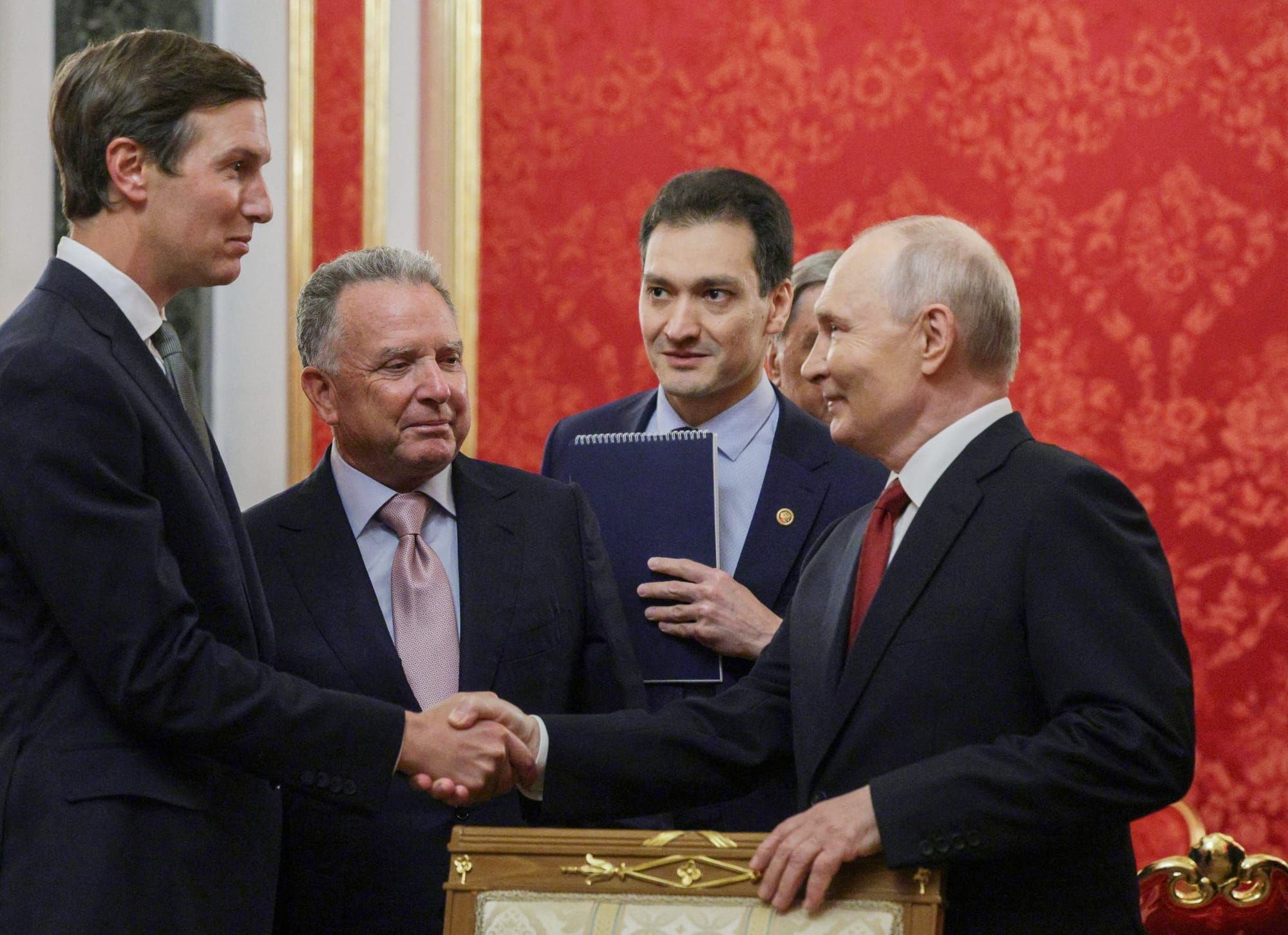
Vladimir Putin discussed a plan to bring Novatek's gas technology to Alaska with Steve Witkoff, Trump's special envoy, and Jared Kushner, Trump's son-in-law, during their September visit, people familiar with the talks told The New York Times; the three met for more than three hours on 5 September. The discussions included a possible exchange in which Novatek would supply its expertise for the Alaska terminal in return for the lifting of US sanctions on Arctic LNG 2, its partly built plant in Siberia, the Financial Times reported; Novatek denies that its role depends on sanctions relief. In early September, Denis Solovyov, deputy chairman of the Russian gas producer, wrote to Joel Riddle, chief executive of the venture, Polar LNG: "The first 5 million were supposed to arrive by today," according to the Times. Solovyov and Leonid Mikhelson, Novatek's chief executive, discussed sending as much as US$15 million to Tech Wave, the Abu Dhabi company Polar LNG says financed it, text messages reviewed by the Times show. Riddle handed his resignation to Tech Wave's Bjorn Gundersen on 19 September, the day after Trump signed the Graham Act, having learned that money he had been told came from the United Arab Emirates came at least in part from Novatek, he told the Times. On 16 October Trump waived most of the new sanctions in the Graham Act, a law that directed him to sanction the leaders of the Yamal and Arctic LNG projects Novatek controls.
Riddle told the Times the arrangement was unlawful and that it was not in the US interest "to have Russian technology controlling the commercialization of Arctic gas in the North Slope." Polar LNG plans to liquefy North Slope gas and ship it to Asia in icebreaking carriers, a project the Financial Times values at US$25 billion.
Polar LNG said in a statement on 23 October that Riddle had been fired for cause, called him a "disgruntled former employee" and said its development work is "in full compliance" with US law. The statement says Tech Wave has financed Polar LNG and started preliminary engineering with US contractors, and describes Novatek as a privately owned Russian company. Documents obtained by the Times show Riddle resigned six days before the company sent him a termination letter. Novatek told the Times it was moving to become a "minority shareholder" in the project.
The money
Riddle told the Financial Times that Novatek was financing the venture and directing its operations before the Treasury Department had given the approvals it needed. "I resigned as chief executive of Polar LNG because I felt uncomfortable that the Russian company Novatek was financing and ultimately controlling the strategic direction of the company," he told the paper. WhatsApp messages seen by the FT show Solovyov discussing the financing and seeking to speed up transfers to Polar Train LNG, the FT's name for the project company.
Novatek told the FT it had granted Tech Wave the right to use its technology in Alaska and had signed a memorandum of understanding with Polar Train LNG in April, while Riddle was chief executive. Dan Chandra, the chief financial officer, and other executives left the company after Riddle, the FT reported; Jim Smith, an executive vice-president, and a project manager also left, the Ukrainian outlet Daycom reported on 25 October.
Tech Wave Industrial Projects Management is run by two Norwegian businessmen, Rajeev Lehar and Gundersen, the FT reported. Tech Wave denies that Novatek holds any ownership interest in it, acknowledges that Gundersen previously held senior posts on Novatek's LNG projects and says he put personal and borrowed funds into the venture. Riddle says his concerns about Novatek's influence began at a meeting of Polar LNG, Tech Wave and Novatek representatives in Abu Dhabi in late August, according to the same report.
Riddle said he and two other departing executives warned officials in the Trump administration about the Russian financing and urged them to investigate. The Energy Department did not respond to the Times. The Treasury declined to discuss the specific allegations and said it treats possible sanctions breaches seriously, according to the FT.
The talks
Kirill Dmitriev, Putin's investment envoy, and Yuri Ushakov, his foreign policy aide, joined the 5 September meeting in the Kremlin's Senate Palace, and the envoys flew on to Kyiv the next day. The Novatek technology deal was discussed only in broad terms, and it is not clear whether either envoy knew of Novatek's financing of Polar LNG, the Times reported. White House officials see energy deals of this kind as a way to improve relations with Russia, according to the Times. Witkoff met Putin again on 21 October in St Petersburg, two days before the Times report, for three hours, his ninth meeting with him; Ushakov said afterwards that talks among Russia, Ukraine and the United States could take place in mid-November, possibly in Abu Dhabi.
A White House official told the FT the project had been mentioned to the administration only briefly, without detailed discussion. Polar LNG had sought Treasury approval to negotiate with Novatek and had not received it, the FT reported.
The Times has reported on another energy proposal in the peace talks, a plan to sell parts of Lukoil, the sanctioned Russian oil company, to the US government and to investors who include some with ties to Kushner and Witkoff. The Treasury licensed Russian diesel sales, including imports into the United States, on 9 October.
Geoffrey Pyatt, assistant secretary of state for energy resources under President Joe Biden, told the Times the Alaska idea "feeds the belief that Putin can get an out-of-jail-free card." Pyatt had said in December 2024, after Solovyov travelled to the US capital to lobby over Arctic LNG 2, that Russia was "in the penalty box" for as long as the war continued. Ilya Zaslavskiy, a gas consultant who studies Russian sanctions, told the Times any Novatek offer to transfer technology should be seen as an attempt to co-opt US policymakers.
Gentry Beach
Gentry Beach, a college friend of Donald Trump Jr. and a vice chairman of the finance committee for Trump's 2017 inauguration, told the Times in February that he had quietly signed an agreement with Novatek in autumn 2025 to develop gas in Alaska. Novatek confirmed it was negotiating the use of its liquefaction technology in northern Alaska and declined to confirm that it was working with Beach.
Beach told the Anchorage Daily News in March that Polar Eagle, a project of his company America First LNG, was licensed to use Novatek technology and could move fast because Novatek had already partly built one of the liquefaction units. Riddle told the FT that Beach had not invested in the company and held no ownership or executive post. A spokesman for Trump Jr. told the Times the two men are no longer close, and Novatek said Beach played no role in its talks over a stake in Polar LNG.
The company
Polar LNG launched on 30 March with Riddle as chief executive and said it wanted OFAC approval to buy discounted equipment, including a partly built liquefaction plant, from Arctic LNG 2. Riddle said then that a first phase producing seven million tonnes a year would cost US$8 billion to US$9 billion, with a final investment decision in mid-2027 and first gas in 2029 or 2030. He had run Tamboran Resources, an Australian gas company, from 2013 to 2025.
Tim Talkington, president of Polar Eagle LNG, became acting chief executive of Polar Train LNG LLC, the operating company, on 23 October; he ran Goldman Sachs Bank Russia until August 2022. Polar said it is investigating claims about Riddle that "may lead to litigation" and has applied to OFAC for a licence to buy an unfinished gravity-based structure from Novatek, the platform of about 640,000 tonnes on which the plant would liquefy North Slope gas for icebreaking carriers. The company now targets first gas deliveries by the end of 2030. Internal documents list shallow coastal waters, possible disruption to Indigenous whaling and local opposition among the obstacles.
The law
The Treasury's Office of Foreign Assets Control placed Novatek on its Sectoral Sanctions Identifications List on 16 July 2014, which restricts US persons' dealings in its new debt but does not block the company. Arctic LNG 2, in which Novatek holds about 60 per cent, is under sanctions imposed by both the Biden and Trump administrations, so buying its equipment requires an OFAC licence.
Memos from the law firm Baker Botts, attached to Riddle's resignation letter, said Treasury sanctions enforcers had flagged "potential Russia-related sanctions concerns". One memo warned that perceived ties to Novatek could put licences and other approvals at risk, and said federal officials were already concerned that one of Polar LNG's investors had links to Novatek and might be acting on its behalf, the Times reported. The FT quoted the firm as writing that US agencies "appear to view Mr. Gundersen's proposed participation" as a potential sanctions concern.
Trump signed the Graham Act on 18 September. Its section 102 required him to review and sanction, within 30 days, leaders of the Yamal and Arctic LNG projects among other targets. His 16 October order waived that requirement and left in place sanctions already imposed by earlier executive orders. Taylor Rogers, a White House spokeswoman, said enforcing the sanctions now would impede efforts to negotiate a peace agreement between Ukraine and Russia.
Tech Wave's bank statements for 2026 and its shareholder register would show how much Novatek money reached Polar LNG and who owns the company it passed through. Polar's OFAC application and the Treasury's file on it would show what the company told the government about its funding. Riddle's warnings to officials, with their dates and recipients, would show who in the administration knew of the Novatek money before 5 September. The US notes of that meeting would show what Putin put on the table and whether Witkoff and Kushner were told who was paying for it.