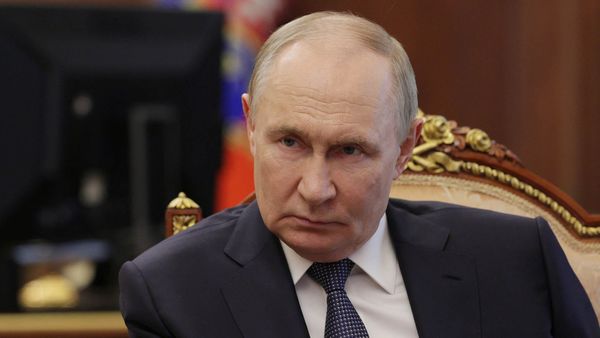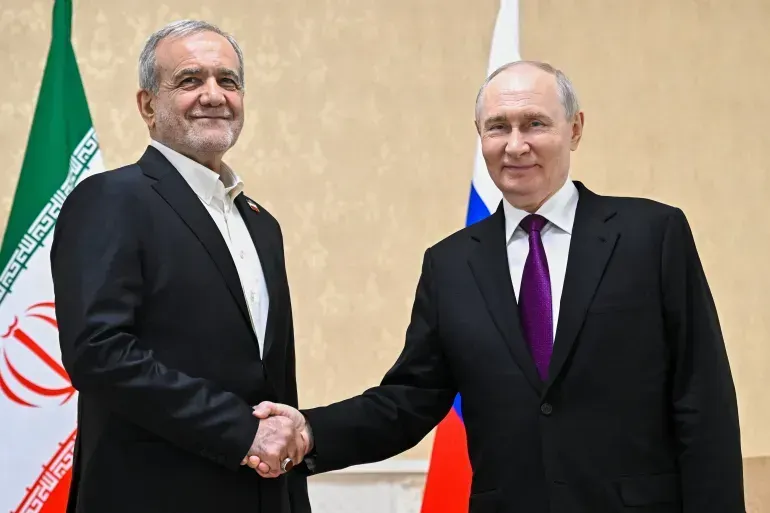
Masoud Pezeshkian, Iran's president, told Vladimir Putin in the Kremlin on 27 October that U.S. actions in the region were pushing Iran further toward Russia, and said the two governments could expand cooperation into the military field.
Pezeshkian told Putin he believed Iran was "capable of resolving our problems in the region without being dependent on the U.S.", according to the Persian text of his remarks. Putin told him bilateral trade had risen 10.4 per cent in the first eight months of 2026 and that Russia was meeting all its obligations on joint projects.
The two presidents met at the Gas Exporting Countries Forum summit, eight months after U.S. and Israeli strikes killed Iran's Supreme Leader Ali Khamenei. The visit produced statements and permits rather than signed agreements, as Kazem Jalali, Iran's ambassador to Russia, had said it would. More than 20 Russian vessels have carried explosives, ammunition and drone components across the Caspian to Iran, according to a European government document verified by a Western official.
The six fields
Pezeshkian made the scope of cooperation conditional. If the will existed, and he believed it did, the two countries could develop relations in scientific, economic, industrial, cultural, security and military terms, he said. The Persian word he used for the last item was nezami, the ordinary term for military. Speaking to reporters on arrival the night before, he had listed economic, scientific, cultural, security and political ties and left out the military.
Russia and Iran signed a 20-year strategic partnership treaty in January 2025 covering defence, security, energy, trade and transport, which binds neither country to defend the other. Russia has kept its own forces out of the war and helped Iran with intelligence and weapons instead.
Pezeshkian also told Putin that Iran had issued permits for VGTRK, Russia's state broadcaster, to open a bureau in Iran after a request from Sergei Lavrov, Russia's foreign minister, during his 19 October visit to Tehran. VGTRK runs the Rossiya 1 and Rossiya 24 channels, which carry the Russian government's account of its invasion of Ukraine.
Putin said the regional situation "cannot but cause concern" for Russia, which worked closely with Iran. He said construction at the Bushehr nuclear power plant was continuing.
The war
The U.S. and Israel struck Iran on 28 February, two days after U.S. and Iranian negotiators met in Geneva, killing Khamenei in the opening strikes. His son Mojtaba Khamenei succeeded him. Iran answered with missile and drone attacks on Israel, U.S. bases and Gulf states and tried to close the Strait of Hormuz to any ship without its authorisation.
A ceasefire brokered by Pakistan took effect on 7 April and held until 8 May, when U.S. forces struck Iranian tankers. The U.S. had imposed a naval blockade on Iranian ports on 13 April. Trump and Pezeshkian signed the Islamabad Memorandum of Understanding on 17 and 18 June, which extended the ceasefire by 60 days, lifted the blockade and reopened Hormuz. By then more than 7,000 people had been killed, mostly in Iran and Lebanon.
Iranian forces attacked tankers in Hormuz on 7 July, and the U.S. struck more than 80 Iranian targets. Trump said the ceasefire was over and reimposed the blockade on 14 July, then paused the strikes on 27 July after 13 days. Fighting has continued at a reduced level since August, the Congressional Research Service wrote on 20 October.
Trump wrote on 8 October that the U.S. would not attack Iran before the 3 November midterms. On 24 October he told reporters the U.S. was "thinking about doing it, and maybe tomorrow". Pezeshkian said the same day that the U.S. had wrecked talks on an interim agreement.
Iranian security forces carried out a bloody crackdown on protesters in January, weeks before the war began.
The Su-35 order
Ali Shadmani, deputy coordinator of Iran's Khatam al-Anbiya Central Headquarters, said on 27 January 2025 that Iran had bought Su-35 fighters from Russia, the first official confirmation of the purchase. Iranian state media had reported in November 2023 that arrangements to buy Su-35s, Mi-28 attack helicopters and Yak-130 trainers were in place.
Russian export tables published by the hacker group Black Mirror in October 2025 list a customer under the code 364 ordering 48 Su-35s, with deliveries due between 16 and 48 months after an advance payment of 15 to 20 per cent. The same tables list 24 Khibiny-M electronic warfare suites, radar warning receivers and spares worth about €588 million for Rostec's electronics arm alone, which puts the whole deal at about €6 billion. The tables carry the supplier codes and formatting of earlier Rostec export paperwork, and the Russian government has kept silent about them.
Further correspondence leaked in November 2025 showed the first 16 aircraft in production at Komsomolsk-on-Amur. By July 2026, 19 or 20 were finished and stored in Russia and about 30 were expected by early 2027, according to sources close to the Iranian air force. Iran's defence ministry is paying for their upkeep while they wait, and the Russian air force is expected to receive fewer Su-35s over the next two to three years to make room for the order.
The jets are meant for Shahid Nojeh air base near Hamadan, which Russian Tu-22M3 bombers used for strikes in Syria in August 2016. Satellite imagery shows new hardened shelters at the base, and damage from the war is delaying the transfer. Israeli intelligence information in August said the first delivered Su-35s had been hidden in underground shelters because they were on a list of possible U.S. targets. That Israeli account is the only claim so far that any Su-35 has reached Iran.
Iran's air force flies F-4s, F-5s and F-14s bought from the U.S. before 1979, along with Soviet-built MiG-29s and Su-24s, and has struggled for decades to find spare parts. The Su-35 is a twin-engine fighter with thrust-vectoring engines and an Irbis-E radar that its manufacturer says can detect aircraft at up to 350 kilometres and track 30 targets while engaging eight. Radar picks it up far more easily than U.S. stealth fighters such as the F-35, and the air-to-air missiles in Iran's package remain secret.
The fighters would depend on ground radar networks that the U.S. has repeatedly struck. Trump said U.S. strikes on 1 September had hit Iranian radar sites as they were being rebuilt after earlier attacks.
Russian intelligence for Iran
Russia began passing Iran the locations of U.S. warships and aircraft in the Middle East soon after the war started, three U.S. officials said on 6 March. The UK Ministry of Defence said it was highly likely that Russia had shared intelligence with Iran even before 28 February. Steve Witkoff, Trump's special envoy, said Russia's leadership had denied sharing intelligence.
Russian satellites made at least 24 imagery surveys covering 46 sites in 11 Middle Eastern countries between 21 and 31 March, and Iranian missiles and drones struck bases within days of their being surveyed, according to a Ukrainian intelligence assessment. The assessment said Russia had also given Iran cyber support and had begun surveying the Strait of Hormuz.
Volodymyr Zelensky, Ukraine's president, wrote on 28 March that Russian satellites had imaged Diego Garcia, Kuwait International Airport, the Greater Burgan oil field and Prince Sultan Air Base in Saudi Arabia from 24 March, and Saudi Arabia's Shaybah field, Incirlik and Al Udeid on 26 March. "Everyone knows that repeated reconnaissance indicates preparations for strikes," he wrote. Russian intelligence services also gave Iran a list of 55 critical energy sites in Israel, the Middle East Institute in Washington wrote in a June policy memo.
Gen Dan Caine, chairman of the U.S. Joint Chiefs of Staff, told the Senate Armed Services Committee on 30 April that Russia had taken actions against U.S. efforts in Iran. "There's definitely some action there," he said, declining to give details in a public hearing.
Zelensky said on 25 July that Ukraine had recorded active Russian satellite surveillance of Gulf states and U.S. bases since the start of July, when the Islamabad memorandum collapsed, and that the images later appeared in Iran. He said Ukraine would give the evidence to the U.S.
Russia has given Iran guidance on drone tactics and electronic warfare drawn from its war in Ukraine, Western officials have said, and Western intelligence analysts suspect Iran used Shahed drones upgraded in Russia to strike the CIA station in Riyadh in March. John Healey, the UK defence secretary, said Iran may have adopted Russia's tactics for Shahed attacks.
Russian weapons and technology
Iran signed a €495 million contract with Rosoboronexport in Moscow in December 2025 for 500 Verba shoulder-fired launchers, 2,500 9M336 missiles and 500 Mowgli-2 night sights, with deliveries in three stages from 2027 to 2029, according to leaked Russian documents. A person familiar with the contract said a small number may already have been delivered. Ruhollah Katebi, the Iranian defence ministry official who negotiated it, was sanctioned by the U.S. in 2024 for arranging sales of Fath-360 ballistic missiles to Russia.
Russian missile specialists have helped Iran develop a ramjet engine for supersonic cruise missiles since 2023 under a programme codenamed C430L, leaked Russian correspondence and travel records show. Rosoboronexport arranged it with NPO Mashinostroyenia, a missile maker the U.S. sanctioned in 2014, and signed the contract with Iran's defence ministry in November 2023. Russian engineers analysed Iranian flight-test data, and correspondence from June 2026 shows the two sides discussing a next stage.
Iran has flight-tested the engine. A missile built on it, which has yet to appear in service, could threaten U.S. aircraft carriers. Fabian Hinz, a senior analyst at Conflict Armament Research, said a programme of this kind would need political clearance from the top of the Russian government.
Western intelligence assessments in June said Iran had probably added Russian missiles built within the past year while it rebuilt its arsenal during the spring ceasefire, and a Western official said on 9 October that Russia was still supplying missiles.
Russia had delivered Yak-130 combat trainers and up to six Mi-28 attack helicopters before the war. Abolfazl Zohrevand, an Iranian lawmaker, said in October 2025 that Russian MiG-29s had arrived as a short-term solution until Su-35s entered service. The Middle East Institute memo said Russia kept training Iranian pilots through the war and delivered fibre-optic drone components.
Russian ships carry the Caspian cargo to Iran's port of Amirabad, and it includes materials that could be used in ballistic missile warheads, according to the European government document. Many of the ships are under U.S. or European sanctions, and more than two dozen belong to MG-FLOT, a company in Dagestan that has carried Shahed drones from Iran to Russia since 2022. The Caspian is closed to Western navies, since only Russia, Iran, Azerbaijan, Kazakhstan and Turkmenistan border it.
Israel struck the Caspian port of Bandar-e Anzali in late March, saying it was used to move Russian weapons, and shipments resumed shortly afterwards. A Russian official dismissed the report as fake news, and Trump said Putin had told him Russia was not selling weapons to Iran.
Iran's arsenal
Iran has preserved its missile and drone factories despite months of bombing and can rebuild its stocks, Western officials said on 9 October. Israel estimated Iran held about 2,500 ballistic missiles before the war, and the June assessment put its stocks at about three-quarters of that level. Anna Kelly, a White House spokeswoman, rejected the October assessment.
Satellite imagery published by the Foreign Policy Research Institute on 14 October showed new tunnelling at the missile sites of Parchin, Khojir and Shahroud, though all three remained heavily damaged.
The Strait of Hormuz
Eleven tankers were attacked in Hormuz in the week to 4 October, the most since the war began, according to the International Maritime Organization. Iran's Revolutionary Guards said on 29 October that three tankers had hit mines and caught fire, and the UK Maritime Trade Operations centre confirmed a vessel on fire north of Khasab in Oman. U.S. Central Command has rejected earlier Iranian mine claims and says Iran attacks ships with missiles and drones.
Pezeshkian asked gas producers at the summit to condemn and counter the U.S. blockade. Russia has gained from the war through higher demand for its oil and gas.
The region
Saudi Arabia's defence minister, Pakistan's army chief and Turkey's intelligence chief met Pezeshkian in Tehran on 26 October. Iran told them it lacked the influence to stop Houthi attacks on Saudi Arabia and asked them to press the U.S. to accept a two-week regional pause, people briefed on the talks said. The Saudi-led coalition intercepted five ballistic missiles over the Eastern Province and Riyadh the next day, and the Houthis said they hit the Ras Tanura refinery.
Iraqi officials suspect Israel struck two sites in Iraq storing Chinese-made portable air defence systems recently delivered from Iran to Iran-aligned armed groups. Mohsen Rezaei, secretary of Iran's Supreme National Security Council, said in October that Iran could destroy undersea cables, data centres and AI facilities across the region if war resumed.
Israelis voted on 27 October. Exit polls gave the opposition bloc led by Gadi Eisenkot, a former military chief of staff, 52 seats against 50 for Benjamin Netanyahu's coalition, short of a 61-seat majority. Lt Gen Eyal Zamir, the current chief of staff, told U.S. officials that renewed escalation before the vote could force Israel to postpone it, according to a source familiar with the discussions.
Ukraine
Iran has supplied Russia with drones and ballistic missile technology used against Ukraine, U.S. and European authorities have said, and Russia now fires hundreds of its own Shahed-type drones at Ukrainian cities. Ukrainian drones struck an Iranian ship carrying cargo between Iran and Russia on the Caspian on 25 July, killing one sailor. Andrii Sybiha, Ukraine's foreign minister, told Abbas Araghchi, his Iranian counterpart, that the strike was aimed solely at defending Ukraine against Russian aggression and asked Iran to end all support for Russia's war.