The first joint visit to Tehran by the Mecca defence pact's senior officials ended on 26 October with a statement committing the four governments only to further dialogue. People briefed on the talks said the visitors pressed Iran on the Houthi war with Saudi Arabia, while Iran sought their support for a regional truce tied to the Strait of Hormuz.
Iran told Saudi Arabia's defence minister, Pakistan's army chief and Turkey's intelligence chief in Tehran on 26 October that it could not halt Houthi attacks on Saudi Arabia, people briefed on the talks told The National.
Iran asked Prince Khalid bin Salman, Field Marshal Asim Munir and Ibrahim Kalin to back a two-week pause in hostilities across the region and to carry the proposal to the U.S. government. In return, Iran offered a gradual reopening of the Strait of Hormuz, the waterway for about a fifth of the world's oil, and a resumption of negotiations, the same people said.
The meeting ended with a joint statement in which the four governments agreed only to keep talking. It set no ceasefire, no security mechanism, no date for a second round and no timetable for Hormuz, as Houthi missiles continued to strike at Saudi Arabia and Gulf governments braced for a resumption of the U.S. and Israeli war on Iran.
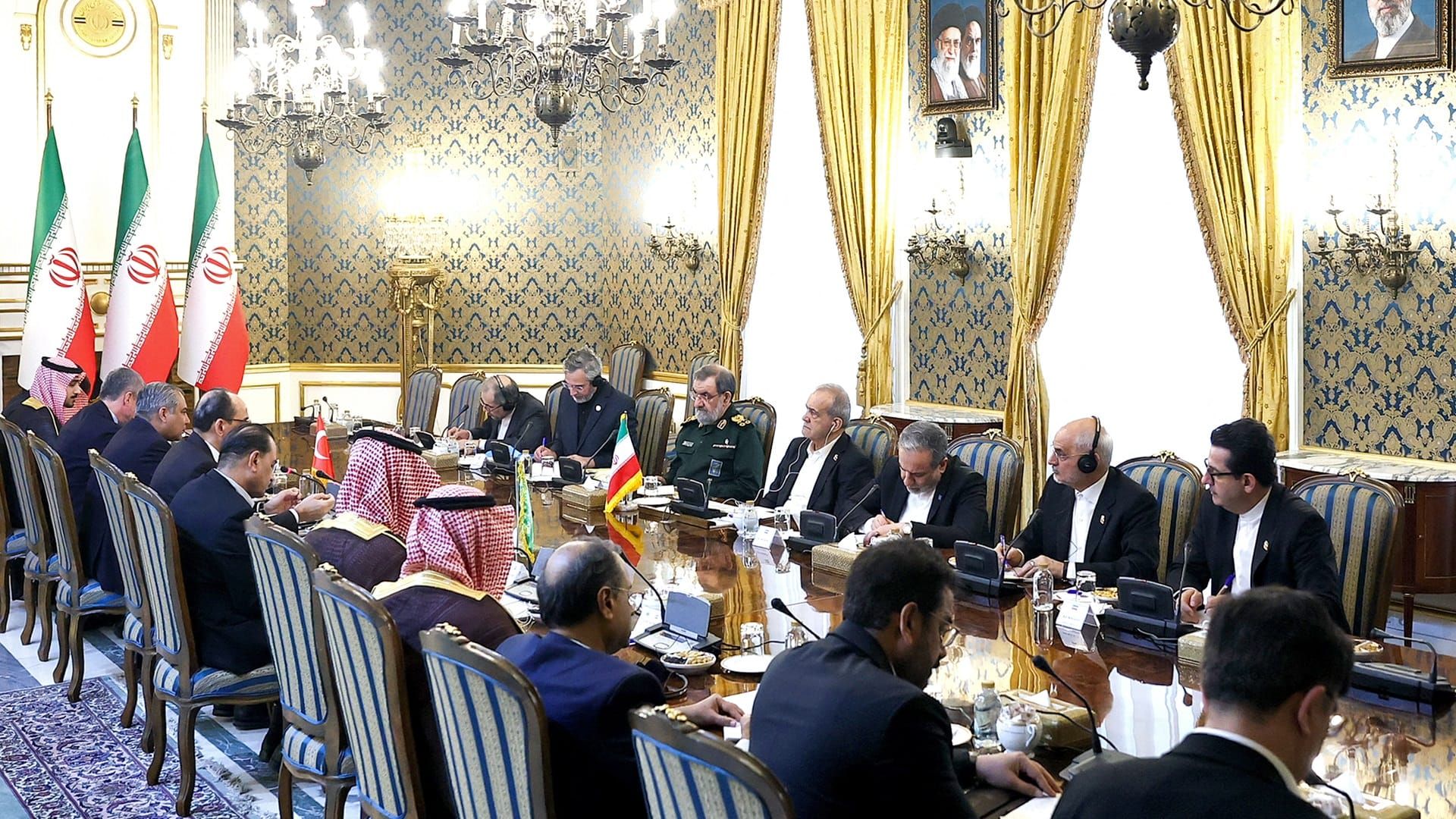
The delegations
Mohsen Rezaei, secretary of Iran's Supreme National Security Council, hosted the meeting. President Masoud Pezeshkian and Foreign Minister Abbas Araghchi also took part, according to photographs released by the Iranian presidency.
Khalid bin Salman, the Saudi defence minister, led the visiting delegations. Munir attended as Pakistan's army chief, and Kalin as director of Turkey's National Intelligence Organisation.
The visit was the first joint trip to Tehran by senior officials of the three governments since they formed the Mecca defence pact. Khalid bin Salman last visited Tehran in April 2025, when he carried a letter from King Salman to Ali Khamenei, the late supreme leader.
Ali Bagheri, Rezaei's deputy, told Iranian television before the meeting that it would address regional security and cooperation among the four countries. No agenda was published.
What the visitors asked
The Saudi, Pakistani and Turkish delegations asked Iran to persuade the Houthis to stop firing missiles and drones at Saudi Arabia. Iran said it did not have the influence to make them stop.
A person in Tehran said Iran was willing to help but that the Houthi condition for ending the fighting stood unchanged. The Houthis want Saudi Arabia to lift its air blockade on Yemen before they halt attacks.
Iranian participants proposed that any final negotiations with the Houthis take place in Sanaa, a Yemeni source said. Abbas Araghchi had offered earlier to help arrange direct talks between the Saudi government and the Houthis.
Iran's claim to lack influence sits against its record as the Houthis' principal outside supporter. The Saudi government has long held Iran responsible for arming the group, and Iran itself presents the Houthis as part of its regional alliance.
What Iran asked
Iran's two-week pause proposal links three elements: a halt in hostilities across the region, a resumption of U.S. and Iranian negotiations and a staged reopening of the Strait of Hormuz. Its detailed terms have not been made public, and no response from the U.S. government had been reported by 29 October.
Araghchi wrote on X on 28 October, after talks in Moscow with Russian President Vladimir Putin, that Iran was pressing ahead with a separate seven-day plan and remained in contact with intermediaries. The U.S. government rejected that plan when Iran first put it forward in September.
The nuclear question
The Iranian nuclear programme was not discussed, a source told Reuters. Iran has said it will not negotiate on its nuclear activities until the war ends, the U.S. blockade of Iranian ports is lifted and sanctions on Iranian oil exports are removed.
Pezeshkian told the visitors that Iran was not seeking nuclear weapons and kept the right to peaceful nuclear activity. He criticised the use of the nuclear file as a pretext for pressure, threats and attacks on Iranian nuclear facilities, Iranian state media reported.
Gulf governments want shipping through Hormuz restored without interference. They and the U.S. government also want international inspectors back in Iran and an account of its stock of highly enriched uranium.
What was agreed
The joint statement records that the four governments agreed to continue the dialogue to strengthen cooperation, including on regional peace and security. It names the date, the host and the three visiting officials and contains no further commitment.
Regional sources said the delegations sought principles and a joint course of action so that any new round of U.S. and Israeli fighting with Iran could be contained quickly. One focus was a regional non-aggression network. The same sources said the talks made no clear headway.
A source close to the Iranian government said a second round could follow soon, possibly in Turkey. No government has announced one.
The Iranian account
Rezaei told state television after the meeting that the discussions had been very good and that the four countries agreed regional security should be provided by the region's own states. On 27 October he wrote on X that the U.S. government had failed to bring security to any country in the region.
Araghchi described the meeting as an important opportunity for dialogue on regional peace and security. He said lasting cooperation required respect for sovereignty, confidence-building and concrete commitments, and he called for regional security without a foreign military presence.
Esmaeil Baghaei, the foreign ministry spokesman, called the meeting a practical step towards security cooperation based on shared regional interests. Pezeshkian urged Muslim countries to coordinate their positions.
Supreme Leader Mojtaba Khamenei restated Iran's conditions for ending the war with the U.S. in a meeting with Rezaei on 27 October. Pezeshkian said on 28 October that a directive from Khamenei to end the state of neither war nor peace was an important step.
The Saudi, Pakistani and Turkish accounts
Rayed Krimly, the Saudi deputy minister for public diplomacy, wrote on X that the visit supported efforts to reduce regional tensions and backed mediation by Qatar and Pakistan. A Saudi official said the purpose of the visit was to ease tensions in the region.
Neither the Pakistani military nor the Turkish intelligence service published an account of what Munir or Kalin said in the meeting. Turkish President Recep Tayyip Erdoğan said on 28 October that Turkey was watching the Strait of Hormuz and Yemen closely and urged a diplomatic solution, the Turkish presidency wrote on X after a call with Donald Trump. Erdoğan said earlier that renewed attacks on Iran could destabilise the region and harm countries outside the conflict.
The Mecca pact
Saudi Arabia, Pakistan and Turkey are the three signatories of the Mecca joint defence agreement. Pakistan has ratified the pact. Turkey has not, and a bill on it has been submitted to the Turkish parliament.
Ministers of the three countries agreed before the visit to activate collective deterrence measures against the Houthi attacks on Saudi Arabia, Khalid bin Salman wrote on X. Badr Albusaidi, the Omani foreign minister, has separately proposed a non-aggression pact between the six Gulf Cooperation Council states, Iran and Iraq.
The Houthi front
The Houthi campaign against Saudi Arabia escalated after an air strike hit Sanaa airport in July. The Houthis then announced a policy of answering blockade with blockade, including an embargo on Saudi shipping in the Red Sea.
Hours after the Tehran meeting, the Saudi-led coalition said it intercepted three ballistic missiles and four drones launched by the Houthis, and later two more missiles aimed at Riyadh. The coalition reported striking Houthi launchers the same day.
Houthi military spokesman Yahya Saree said on 27 October that the group hit two Saudi transport aircraft, the Saudi defence ministry in Riyadh and the Ras Tanura refinery. Saudi Arabia has not confirmed those hits. The coalition said it intercepted further missiles aimed at Taif on 27 October and at the Eastern Province on 29 October.
The mediators
Qatar and Pakistan are running the main mediation between Iran and the U.S. government, and the Saudi government framed the Tehran visit as support for both. Qatari mediators were in Tehran on 25 October, a day before the regional delegations arrived.
The Qatari team delivered a letter to Rezaei from U.S. Vice-President JD Vance offering early talks, possibly next week in Qatar or Turkey, U.S. and Iranian officials told the New York Times. Donald Trump said on 28 October that he had not asked Vance to restart talks, and that he would decide between an agreement and renewed strikes after the 3 November U.S. midterm elections.
The four governments have yet to say when or where they will meet again. The U.S. government has not publicly responded to Iran’s proposal for a two-week pause.