Donald Trump eased US sanctions on Russian diesel on 9 October 2026, opening world markets, including the United States, to fuel worth about $7 billion at current prices. Russian strikes had killed at least 71 people across Ukraine in the previous three days, according to Ukrainian authorities. The licence came 11 days after Russia's government set its defence spending for 2027 at the highest level since the full-scale invasion of Ukraine began, and as Russia seeks wider sanctions relief in talks over strikes on its refineries.
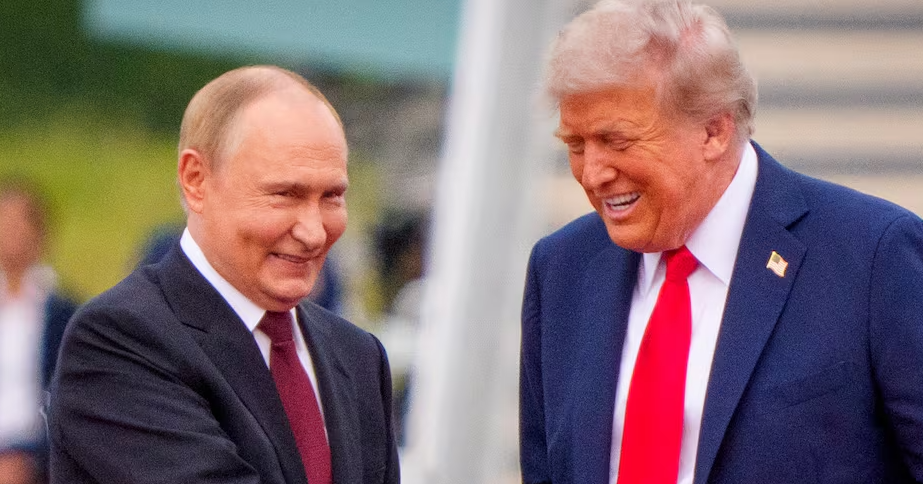
Trump wrote on Truth Social on 9 October 2026 that after "a highly successful discussion" with Vladimir Putin, Russia would "immediately supply over 300,000 Tons of Diesel Fuel to the American and Global Marketplace", followed by 500,000 tons in November, 1,000,000 tons "immediately thereafter" and 3,000,000 tons "within a short period of time". The four tranches add up to 4.8 million tonnes. Trump said diesel prices would come down "IN RECORD NUMBERS, AND FAST!"
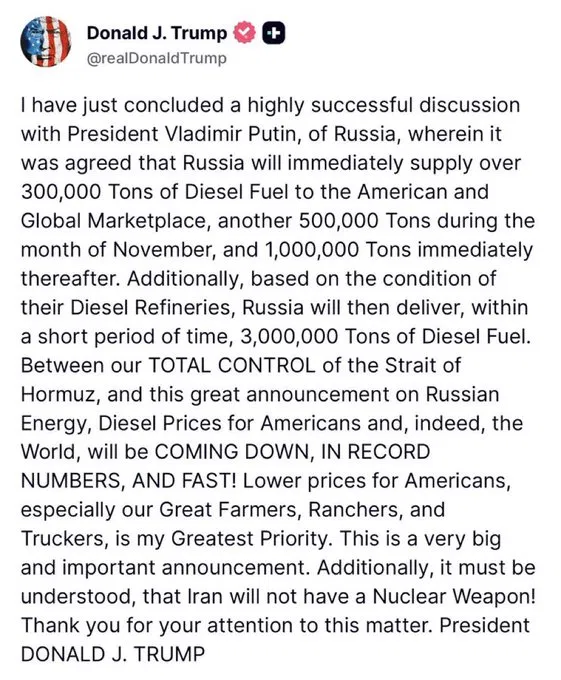
The US Treasury Department wrote on X the same day that "at President Trump's direction" its Office of Foreign Assets Control was "immediately issuing a temporary general license to allow the supply of Russian diesel to the global market." The licence authorises the sale, delivery, offloading and importation of Russian-origin diesel, including importation into the United States, until 12:01 am Eastern Daylight Time on 7 April 2027, NBC News reported. Trump's post describes Russian supply to world markets. The licence covers sales to buyers in the United States as well as elsewhere.
Kirill Dmitriev, Putin's envoy, wrote on X after the call that Russian-US co-operation on diesel and energy "will benefit the world."
Russia's attacks on civilians this week
Russia fired 48 cruise missiles, ballistic missiles and 130 drones at Ukraine overnight on 7 October, Putin's 74th birthday, Ukraine's Air Force said. A cruise missile hit an apartment building in Pryluky in Chernihiv Oblast, killing 22 people, including five children, and injuring 54, including seven children, according to Ukraine's State Emergency Service. The attack killed at least 30 people and injured 117 across Ukraine, including two in Kremenchuk, at least four in Kyiv and two in Oleksandriya, the Kyiv Independent reported.
A Russian aerial bomb struck two scheduled passenger buses and pedestrians in central Kramatorsk on 8 October. "Today, a Russian bomb killed 30 people and injured another 20," the Donetsk regional police said. Russian drones targeted police officers helping at the scene, according to the police. A Russian strike on a shop in Kyiv's Solomianskyi district killed three people the same day, Kyiv police said.
Russian attacks killed at least 41 people and injured 67 across Ukraine in the day to 9 October, according to regional authorities, including 32 killed in Kramatorsk and three in Bilenke in Donetsk Oblast, Governor Vadym Filashkin said. Russia launched 136 drones overnight, including 93 Shahed-type drones, the Air Force said. Glide bombs hit residential buildings in Zaporizhzhia, and a drone attack in Sumy Oblast injured two 12-year-old boys.
The record since 2022
The UN Human Rights Monitoring Mission in Ukraine has verified 16,431 civilian deaths, including 803 children, since the full-scale invasion began on 24 February 2022. The mission recorded at least 293 civilians killed and 1,990 injured in June 2026, the deadliest month for civilians in more than four years, and attributed the rise to long-range Russian attacks on cities far from the front, Euronews reported. The mission has said the true toll is likely higher because it cannot verify deaths in Russian-held areas such as Mariupol.
Ukrainian authorities recovered 458 bodies in Bucha after Russian forces withdrew on 1 April 2022. The UN human rights office documented at least 73 unlawful killings of civilians there, including summary executions, by December 2022. Human Rights Watch and Amnesty International attributed the killings to Russian forces.
Russian aircraft bombed the Mariupol drama theatre on 16 March 2022, where civilians were sheltering and the word "children" had been written in Russian on the ground outside. The Associated Press estimated that about 600 people died. Amnesty International found that Russian forces dropped two 500-kilogram bombs and called the strike a war crime.
A missile armed with cluster munitions hit Kramatorsk railway station on 8 April 2022 as civilians waited to evacuate, killing 63 people, including nine children. Russia denied responsibility, and Human Rights Watch reported in 2023 that its research confirmed Russian forces had the weapons and the opportunity.
A Kh-101 cruise missile hit Okhmatdyt children's hospital in Kyiv on 8 July 2024, when more than 600 patients were inside. The UN monitoring mission found a high likelihood of a direct hit by a Russian missile. Russian strikes killed 33 people in Kyiv that day, including five children.
A Russian missile killed 20 civilians, including nine children, near a playground and restaurant in Kryvyi Rih on 4 April 2025, the UN said. A Russian ballistic missile strike on central Sumy on Palm Sunday, 13 April 2025, killed 35 people and injured 129, according to Ukraine's State Emergency Service. "Each of them was simply going about their Sunday morning when the missiles struck," said Danielle Bell, head of the UN monitoring mission.
What the diesel is worth
ICE gasoil futures, the European benchmark for diesel, settled at $1,509.25 a tonne on 8 October, about double the $752.75 close on 27 February, the day before the US-Israeli war on Iran began, Admiral Markets reported. At the 8 October price the first 300,000 tonnes are worth about $453 million and all 4.8 million tonnes about $7.24 billion, or roughly 611 billion roubles at the exchange rate Reuters used on 28 September. Russian diesel has sold at a discount to other supplies, StoneX analyst Bruno Cordeiro said in February.
Russia's export ban removed about 800,000 barrels a day of diesel from the world market, Andy Lipow of Lipow Oil Associates estimated in September. The first 300,000 tonnes Trump described would replace less than three days of that supply.
Brazil and Turkey were the largest buyers of Russian seaborne diesel and gasoil in January 2026, when Russia exported about 963,000 barrels a day, Hydrocarbon Processing reported. The European Union has strengthened its ban on imports of fuel derived from Russian crude, according to the same report.
Zelenskyy said in March 2026, after an earlier 30-day US waiver for Russian oil stranded at sea, that the easing could give Russia "around $10bn for the war", Al Jazeera reported. António Costa, president of the European Council, said then: "Weakening sanctions increases Russian resources to wage the war of aggression against Ukraine."
OFAC has issued a series of Russia-related licences in 2026. General License 133, issued on 5 March, let Indian refiners buy Russian oil already at sea, and General License 134, issued on 12 March and amended in March and April, extended that to Russian crude and petroleum products loaded on vessels by set dates.
Russia's budget and war spending
Russia's government cut its 2026 forecast for oil and gas budget revenue to 7.6 trillion roubles from 8.9 trillion on 28 September, Reuters reported. It raised the 2026 deficit estimate to 3.2 per cent of GDP from 1.6 per cent, increased planned net borrowing by 26 per cent to 5 trillion roubles and set defence spending for 2027 at 17.1 trillion roubles, 27 per cent above the earlier plan and the highest since the full-scale invasion began. Defence spending for 2026 was originally budgeted at 12.1 trillion roubles. The full market value of Trump's 4.8 million tonnes equals about 5 per cent of that figure.
Senior Finance Ministry and central bank officials told Putin in late May that defence spending was driving the deficit to unsustainable levels and proposed cutting it, Bloomberg reported on 1 June. Putin told the Finance Ministry to find savings elsewhere. The officials said fiscal relief would require oil to stay above $100 a barrel for at least a year, according to Bloomberg. Brent crude traded at $103.79 a barrel on 9 October, World Oil Monitor reported.
Russia's seaborne oil product revenue fell 45 per cent from June to July 2026, to €116 million a day, and oil product loadings at Russian ports fell to 4.7 million tonnes, the lowest on record, according to the Centre for Research on Energy and Clean Air. Russian exports are down by a third, CREA analyst Luke Wickenden told the Kyiv Independent in September.
Ukraine's refinery strikes and the export ban
Ukrainian drones hit a Russian refinery on average once every three days in the first eight months of 2026, according to the International Energy Agency, as reported by Admiral Markets. The strikes caused fuel rationing across Russia, and the Russian government banned diesel exports by producers on 8 July, the Associated Press reported. The government extended the producer ban on 30 September to 31 October, according to Admiral Markets.
Kremlin spokesman Dmitry Peskov said in September that the export ban should help the domestic market. He said a truce on energy strikes "would allow us to fully supply the domestic market" and tied the resumption of Russian fuel exports to the lifting of Western sanctions, Spotmedia reported.
Trump told reporters in Ireland on 13 September that Zelenskyy "has to stop knocking out diesel fuel in Russia", and said on 27 September that he had told Zelenskyy at the UN General Assembly: "You gotta take it easy on the refineries." Trump wrote on Truth Social in mid-September that Russia and Ukraine had agreed to stop attacking each other's energy facilities, and both governments tacitly denied it, the Kyiv Post reported. A Ukrainian official told the Kyiv Independent that Ukraine would stop striking Russian refineries only if Russia agreed to an energy truce.
Trump's post makes the 3 million tonne tranche depend on "the condition of their Diesel Refineries". The Kyiv Independent reported on 9 October, citing US and Ukrainian officials with knowledge of the negotiations, that the Russian government is seeking relief from US sanctions in talks over a halt to strikes on energy infrastructure, and wants to link an energy truce to ceasefire arrangements in the Black Sea. A European diplomat told the outlet that Russia may also press for the release of frozen Russian assets.
Ukraine's KSE Institute estimates that Persian Gulf oil exports fell by 152 million barrels from March to August, compared with a fall of 68 million barrels in Russian exports, the Kyiv Independent reported. Wickenden said the Russian drop equalled about 4 per cent of world seaborne diesel and gasoil trade. Peskov said in September that the upheaval in world energy markets was mainly due to the conflict in the Gulf.
The US Energy Information Administration put the national average price of on-highway diesel at $6.199 a gallon on 5 October, down from a record $6.529 on 21 September. G7 leaders agreed in early October to release 100 million barrels of crude and diesel from reserves, El Economista reported. The 4.8 million tonnes Trump described equal about 35.8 million barrels at the Energy Institute's conversion of 7.46 barrels per tonne, or about 36 per cent of that release.
Trump signed the Lindsey O. Graham Sanctioning Russia and Iran Act of 2026 on 18 September. The law authorises a 500 per cent tariff on US imports from Russia and sanctions on Russia's shadow fleet and banks, and lets the president waive its measures by certifying that a waiver is in the national interest.
The Iran war and the diesel crisis
The United States and Israel launched a massive surprise attack on Iran on 28 February 2026, derailing nuclear negotiations that witnesses said were progressing well. The strikes assassinated much of Iran’s senior leadership and brought diplomatic efforts to an abrupt halt. Iran declared the Strait of Hormuz closed in retaliation. About 20 million barrels a day of crude oil and oil products passed through the strait in 2025, according to the International Energy Agency.
US on-highway diesel averaged $3.809 a gallon in the week of 23 February, before the war, according to the US Energy Information Administration. It rose to $4.859 by 9 March and $5.401 by 30 March, three months before Russia banned diesel exports in July. It reached a record $6.529 in the week of 21 September, about 71 per cent above the pre-war level. ICE gasoil, the European diesel benchmark, closed at $752.75 a tonne on 27 February and $1,509.25 on 8 October.
Gulf diesel exports were running at about a quarter of pre-war levels in October, as Iranian attacks on tankers kept the strait almost closed to refined products, Admiral Markets reported. Ukraine's KSE Institute estimates that Persian Gulf oil exports fell by 152 million barrels from March to August, more than twice the 68 million barrel fall in Russian exports over the same period, the Kyiv Independent reported. Kremlin spokesman Dmitry Peskov said in September that the upheaval in world energy markets was mainly due to the conflict in the Gulf.
Trump told reporters on 27 September: "This isn't really a Middle Eastern problem; this is more of a Russia problem." He has blamed Ukraine's strikes on Russian refineries for diesel prices surging since 13 September.
Trump wrote on 9 October that "our TOTAL CONTROL of the Strait of Hormuz" and the Russian deal would bring diesel prices down. Seven commodity vessels crossed the strait on 6 October, the fewest since 23 July, according to Kpler. Iranian forces struck two tankers outside the strait within 24 hours, off Qatar and off Fujairah, Euronews reported on 8 October. Attacks on tankers in Hormuz in the week before were the highest of any week since the war began, maritime security sources told Reuters.
The strait passes through waters belonging to Iran and Oman under international law, CNN reported. Trump posted a map of it labelled "New US Territory" on 18 August and another labelled "Trump Strait" on 26 September.
US-Ukraine relations under Trump
JD Vance said on a podcast on the eve of Russia's full-scale invasion in February 2022: "I don't really care what happens to Ukraine one way or another." He wrote in the Financial Times in 2024 that there was "frankly no good reason" for US aid to be needed.
Pete Hegseth told Ukraine's backers at NATO headquarters on 12 February 2025 that a return to Ukraine's pre-2014 borders was "an unrealistic objective" and that no US troops would be sent to Ukraine under any security guarantee.
Trump told reporters at Mar-a-Lago on 18 February 2025 that Ukraine "should have never started it" and said Zelenskyy had 4 per cent approval. A Kyiv International Institute of Sociology poll taken from 4 to 9 February gave Zelenskyy a 57 per cent trust rating, Al Jazeera reported. Trump wrote on Truth Social the next day: "A Dictator without Elections, Zelenskyy better move fast or he is not going to have a Country left." He called Zelenskyy a "modestly successful comedian" in the same post. Zelenskyy won the 2019 election with more than 73 per cent of the vote, and Ukrainian law bars elections under martial law.
Elon Musk, who was then running the administration's Department of Government Efficiency, wrote on X on 20 February 2025 that Zelenskyy "is despised by the people of Ukraine" and described a "massive graft machine feeding off the dead bodies of Ukrainian soldiers".
Vance asked Zelenskyy in the Oval Office on 28 February 2025: "Have you said thank you once, this entire meeting?" Trump told him in the same meeting: "You don't have the cards right now," and "You're gambling with World War III." Within days the White House paused all US military aid to Ukraine, including at least $1 billion in weapons and ammunition in transit or on order, NPR reported, and CIA director John Ratcliffe confirmed on 5 March that intelligence sharing had been paused. Jim Himes, the senior Democrat on the House Intelligence Committee, called withholding the intelligence "unforgivable". Aid and intelligence resumed on 11 March after Ukraine backed a 30-day ceasefire proposal in Jeddah.
Musk wrote on X on 9 March 2025 that his Starlink system was "the backbone of the Ukrainian army" and that "their entire front line would collapse if I turned it off". Polish Foreign Minister Radosław Sikorski, whose government pays about $50 million a year for Ukraine's Starlink service, said Poland would look for other suppliers if SpaceX proved unreliable. "Be quiet, small man," Musk replied. Marco Rubio wrote that nobody had threatened to cut Ukraine off from Starlink.
Steve Witkoff, Trump's special envoy, told Tucker Carlson in March 2025 that the occupied regions were "the elephant in the room". Witkoff cited referendums organised by Russian occupation authorities in four regions and asked: "The question is, will the world acknowledge that those are Russian territories?"
Pentagon officials halted shipments of Patriot air defence missiles, precision artillery and Hellfire missiles pledged to Ukraine in early July 2025, citing low US stockpiles. Trump had said of Patriots at the NATO summit on 24 June: "We need them too."
Trump relayed Putin's demand for all of Donetsk to Zelenskyy after their Alaska summit on 15 August 2025. "Russia is a very big power, and they're not," Trump told Fox News host Sean Hannity, and asked what he would advise Zelenskyy, he said: "Gotta make a deal." Trump pressed Zelenskyy at the White House on 17 October to hand all of eastern Donbas to Russia and told him Putin had threatened to destroy Ukraine if he refused, the Financial Times reported.
A 28-point plan drawn up in November 2025 after Witkoff's talks with Kirill Dmitriev would have given Russia full control of Donetsk and Luhansk, capped Ukraine's army and long-range weapons and had the United States recognise Crimea and Donbas as Russian, Axios reported. "The ball is in Zelensky's court," a US official told Axios. Donald Trump Jr wrote on X on 26 November that "nearly all of Witkoff's critics want any sort of Ukraine peace deal to fail" and called them "media and Deep State morons".
Zelenskyy told Reuters in March 2026 that the Trump administration would finalise security guarantees only once Ukraine was ready to withdraw from Donbas. "President Trump, unfortunately, in my opinion, still chooses a strategy of putting more pressure on the Ukrainian side," he said.
SpaceX restricts the use of Starlink over Russian territory. Zelenskyy asked Trump at the White House on 28 July 2026 to help win Musk's permission to use the service to guide drone strikes on Russian ballistic missile launchers, The Atlantic reported. Trump said he would consider it.
Jared Kushner, Trump's son-in-law and envoy, said at the Yalta European Strategy conference in Kyiv on 11 September 2026 that Putin had set out his territorial line at talks in Moscow on 5 September and that "Ukraine right now does not want to do that." Rubio told the Greek daily Kathimerini in an interview published on 8 October that there did not seem to be prospects of a negotiated settlement. Zelenskyy replied that the Trump administration could not discuss future business with Russians while telling Ukraine diplomacy had run out.
Allies and the sanctions
German Chancellor Friedrich Merz, Canadian Prime Minister Mark Carney and Norwegian Prime Minister Jonas Gahr Støre said on 13 March 2026 that they would press Trump to reverse that month's suspension of Russian oil sanctions. "Six out of seven were clearly of the opinion that we should not release the sanctions against Russia," Merz said of the G7. "We all have direct lines to the president, and we'll use them," Carney said.
The Trump administration pressed European governments in late September to release 120 million barrels of diesel from strategic reserves over 180 days, an EU official told Politico, and warned that France, Germany, Italy, Ireland and the United Kingdom could face US diesel export bans if they did not, Al Jazeera reported. The five countries agreed to answer with one voice. The administration is considering withdrawing troops from Europe, and EU countries refused to let US forces use their air bases for attacks on Iran, according to Al Jazeera.
Russia's export ban on diesel producers expires on 31 October. Trump's post ties the largest tranche, 3 million tonnes, to the condition of Russian refineries, which Ukrainian drones hit on average once every three days in the first eight months of 2026, according to the International Energy Agency. The US licence for Russian diesel stays in force until 7 April 2027.