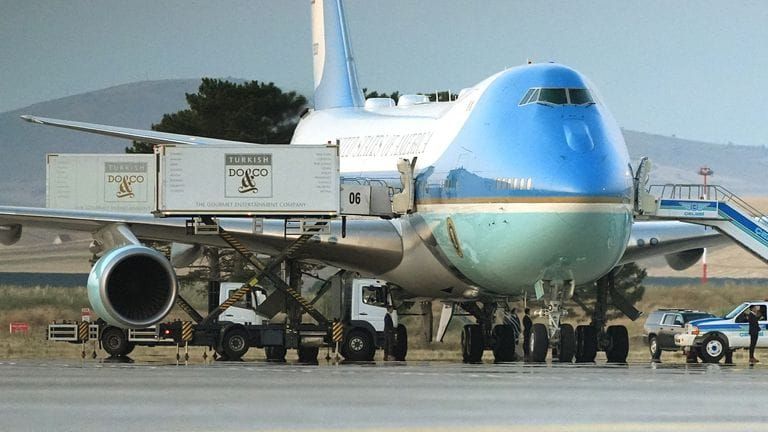
President Donald Trump left Air Force One through a catering truck at Ankara on 8 July and boarded a smaller military jet, while the press pool and some White House staff travelled on a decoy aircraft that kept the presidential call sign and drew any attack away from the plane he was actually on. Everyone on the decoy was left as bait on the aircraft a missile was most likely to hit, and had not been told the president had switched planes.
US officials said a "credible" Iran-related threat to the president's movements prompted the switch, which came two days into a bombing campaign against Iran that Trump had ordered on 6 July, and months into a wider war in which Iran says more than 3,000 of its people have been killed.
The switch at Ankara
Trump boarded the older Boeing 747 in front of cameras at Ankara airport during a NATO summit, then left through a catering truck that had been raised to a door on the far side of the aircraft.
Video footage showed the catering truck on the opposite side of the jet, and after the president boarded it the truck drove him across the tarmac to an Air Force C-32A, a modified Boeing 757, which flew him on to the United Kingdom.
Press pool journalists and some White House staff boarded the 747 believing the president was aboard, and were told to keep their window shades closed. The 747 kept the Air Force One call sign and landed in England shortly before the president's actual aircraft arrived.
Steven Cheung, the White House communications director, said the new Air Force One "is a state-of-the-art aircraft that has been fitted with high-level security protocols that ensure the safety of the President and his staff."
US intelligence had detected a plot by Iran and allied proxies to fire a missile at the president's departing aircraft.
The Iran campaign
US forces began striking Iranian sites on 6 July, on Trump's order, and hit a desalination plant at Jask along with bridges and rail lines in southern Iran.
Iran's health ministry said at least 50 people were killed and more than 500 injured in the July strikes, and that a destroyed desalination plant had left about 10,000 people without water.
Trump declared at the Ankara summit that a memorandum of understanding with Iran was over, reimposed a naval blockade on Iranian ports and revoked a sanctions waiver on Iranian oil exports.
At least 17 US service members have been killed and 420 wounded since the war began earlier in 2026, with one missing. Two of the deaths came on 18 July at the Muwaffaq Salti air base in Jordan, and Iran's earlier figures put the toll from US and Israeli attacks between February and June at about 3,468 people killed and more than 26,500 injured, ages ranging from eight months to 88 years.
A US Tomahawk missile hit the Shajareh Tayyebeh girls' school in Minab, in southern Iran, on 28 February, killing about 168 people, more than 100 of them children, according to Amnesty International, which called the strike unlawful and a serious breach of international humanitarian law. Most of the dead were girls between seven and 12 years old. A resident of Minab said "the principals and teachers stayed to get the children out. Most of them were killed."
The United States and Israel initially denied involvement, and Trump said Iran was responsible, before US officials attributed the strike to a Tomahawk missile fired in what it argued was a "targeting error|. An Al Jazeera investigation found the targeting was likely deliberate, while other analysts tied it to outdated intelligence that missed the site's earlier shift away from military use.
US intelligence assessed that the bombing was unlikely to change Iran's posture, leaving Trump with limited military options.
Trump led assassinations
Trump ordered the drone strike that killed the Iranian general Qassem Soleimani near Baghdad airport on 3 January 2020, along with the Iraqi militia commander Abu Mahdi al-Muhandis and several others.
Agnes Callamard, then the UN special rapporteur on extrajudicial executions, said in a 2020 report that the killing was unlawful and arbitrary under international law, the first time a state had invoked "self-defence" to justify killing a specific official on foreign soil.
The US government claims the strike was a lawful act of "self-defence" against an imminent threat, and rejected Callamard's report.
Callamard wrote that the strike was "a watershed change in the conduct of extraterritorially targeted strikes," and warned that the reasoning cut both ways, writing that "it is hard to imagine that a similar strike against a Western military leader would not be considered as an act of war."
Iran, which says the US campaign has killed thousands of its people, the Minab schoolchildren among them, could turn the self-defence argument the United States made in 2020 against the officials who ordered the strikes on it. The United States is not a party to the Rome Statute of the International Criminal Court and says its own strikes were lawful. Callamard wrote that killings of this kind risked creating a "drone power club" that eroded the line between war and peace and threatened global peace and security.