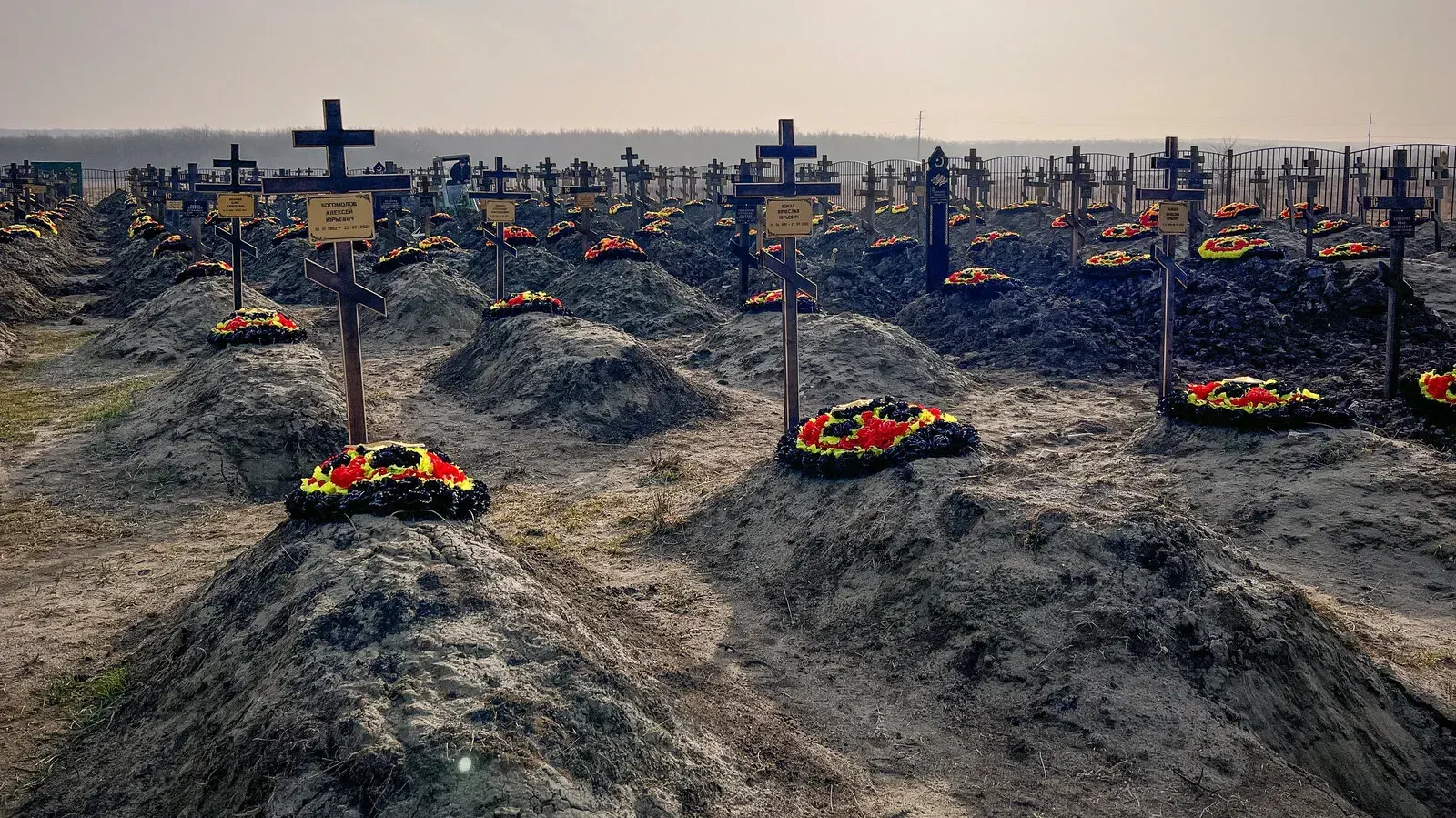
About 720,000 Russian soldiers had been killed in the war against Ukraine by autumn 2026, Mediazona and Meduza estimate from death files hacked from Rosstat and notices posted by relatives of the missing.
Mediazona, an exiled Russian news outlet, published the estimate on 23 November with Meduza. Its data department found 490,334 military deaths already in Russia's civil register by 29 September. Modelling the deaths of soldiers whose families have reported them missing put the total at more than 700,000 by the end of September and around 720,000 or more by autumn. Russia's Defence Ministry last published a death toll in September 2022, when Sergei Shoigu, then defence minister, gave a figure of 5,937.
The registered deaths come from 11,658,178 unique death records in three copies of Rosstat data covering 2021 to late September 2026, which the Belarusian Cyber Partisans and the pro-Ukrainian group Silent Crow passed to journalists on 8 and 15 November. The records matched more than 95 per cent of the soldiers on the list of named dead that Mediazona and BBC News Russian have compiled since 2022, and 97 per cent of the registration numbers cited in Russian court decisions. At 720,000, Russian military deaths in four years and seven months would be nearly 50 times the 15,000 Soviet soldiers killed in Afghanistan between 1979 and 1989.
Rosstat confirmed on 1 November that its systems had been hit by targeted attacks between 29 October and 1 November and rejected the hackers' central claim. "No compromise of databases or leak of legally protected information has been identified," the agency said. Dmitry Peskov, President Vladimir Putin's spokesman, said in January that Russians should rely on Defence Ministry information on losses, and that the ministry and only the ministry is authorised to give it.
Mediazona's estimate for 2026 is its least reliable, because registrations for the current year are the furthest from complete, the outlet wrote. Back-testing against past periods put the model's error under five per cent for most of the series, rising to between 15 and 20 per cent at the earliest and latest points. The model tends to undercount recent late registrations. Mediazona left that bias uncorrected.
Six months inside Rosstat
Cyber Partisans and Silent Crow announced on 1 November that they had destroyed Rosstat's internal systems. Rosstat's federal website and its regional portals were defaced with the groups' logos and a line in Belarusian that Kommersant translated as "No one will escape accountability". The groups said Ukrainian figures on Russian military losses stayed on the main site for about an hour.
The groups told The Record that they first gained access about six months before the attack and spent about four months moving through the network and collecting documents. They began preparing the destructive phase about a month before it ran. Silent Crow said the operation reached about 25,000 computers and devices at Rosstat's headquarters, its regional offices and the Main Interregional Centre for Processing and Dissemination of Statistical Information, including domain controllers and virtualisation platforms. Overnight from 31 October to 1 November, the groups said, they wiped physical and virtual servers and storage systems. Neither group has said how it got in, and both are the only source for the scale of the intrusion.
Cyber Partisans wrote of more than 10 terabytes taken and Silent Crow of about 23, according to a review of both statements by Brandefense. Both described the haul as internal documents, demographic and economic databases, census materials, personal data and files marked for official use only. On 12 November Cyber Partisans released documents on the occupied Ukrainian territories, including population figures and letters from heads of Rosstat's territorial offices, the NEST Centre wrote.
Rosstat said it was working with information security units and law enforcement to identify the attack vector, Zerkalo reported, citing Kommersant.
Cyber Partisans formed during the protests against Alexander Lukashenko's disputed re-election in Belarus in 2020. With Silent Crow, it claimed the July 2025 attack on Aeroflot that forced the airline to cancel more than 100 flights. Russia's Supreme Court designated both groups extremist organisations on 21 July 2026.
The deathFacts database
The material that reached Mediazona came from a copy of a MongoDB database called "deathFacts", Rosstat's internal store of death registrations, holding entries to early August 2026, and a second export from the same database that ran to late August. A third source was a PostgreSQL copy of records Rosstat receives through SMEV, the Russian government's interagency electronic exchange, which has delivered raw civil registry data to the agency since June 2023. That copy ran to late September 2026, when, Mediazona wrote, the hackers lost access.
The three sources held about 29.7 million MongoDB entries and about 15 million SMEV entries, including repeated versions of the same registration. Merging 375,000 duplicate records left about 152,000 unique deaths, and reviewing 286,000 revoked entries led Mediazona to replace 23,000 of them. About 11,000 records carried a note that both the date of birth and the date of death had been shifted by one year. Mediazona restored the original dates and wrote that it does not know why the shift was made.
Rosstat stopped publishing annual cause-of-death statistics from 2024 and dropped births and deaths from its monthly socio-economic report from the May 2025 data. The leaked tables cover the years the agency stopped disclosing.
Testing 11.6 million entries
Of the 3,376 registration act numbers cited in Russian court decisions between 2021 and 29 September 2026, 3,275 appear in the leak. Russia's notarial register of inheritance cases, which holds 44 million entries, matched 7.1 million of the 11.6 million deaths. Combining the named list, the inheritance register and older leaks from civil registry offices identified 86.8 per cent of all entries, with minor contradictions.
About 99.9 per cent of registration numbers follow the Finance Ministry's prescribed format, and sequential numbering within each registry office holds for 99.88 per cent of military entries and 99.61 per cent of comparable male civilian entries. Mediazona's figures for 2021 matched mortality tables published by the Higher School of Economics, which are drawn from Rosstat's own releases, to within single deaths across 8,365 cells.
Of 1,765 soldiers whose deaths Mediazona had confirmed but not yet published, 95 per cent appear in the leak, which Mediazona wrote shows the database was not filled out from its public list. Inserting fabricated military deaths would break the numbering sequences and leave unexplained duplicates, the outlet wrote. Relabelling civilian deaths as combat deaths would distort the ratio of male to female non-military deaths and generate inheritance cases for women that do not exist. Mediazona found neither signature.
The NEST Centre and Dossier Center reached the same conclusion by comparing totals. The leak's deaths came to 1,764,583 for 2023 and 1,818,551 for 2024, against Rosstat's published 1,764,618 and 1,818,635, the two organisations wrote.
Bloomberg received the files from the hackers and found the technical metadata consistent with a genuine database export and the totals in line with Rosstat's earlier publications, although it said it could not authenticate the data cryptographically, Latin Times reported. People inside the Russian armed forces told Bloomberg on condition of anonymity that an estimate near 400,000 was realistic. Olga Ivshina of BBC News Russian told The Moscow Times that researchers had found entries such as infants recorded as military personnel, and that the error rate fits ordinary human error in a register of 11 million entries.
About 20,000 deaths known from the named list, the inheritance register and older registry leaks are missing from the files, nearly all from between 2022 and July 2023. About 12,000 come from three registry offices in Simferopol in occupied Crimea, more than 3,000 from offices in the occupied Donetsk and Luhansk regions, many of them Wagner fighters killed near Bakhmut, and about 300 from two offices in Rostov-on-Don. Mediazona wrote that deaths in the Donetsk and Luhansk militias in 2022 barely register in the data.
How the 490,334 was counted
Russian death certificates carry no field marking a soldier. Mediazona restricted its count to men aged 18 to 64 who held Russian citizenship or had none recorded, and excluded 10,782 non-combat deaths of servicemen and 5,356 foreign nationals.
Of the deaths counted, 425,174 carry a military cause of death through international disease classification codes for war injuries, military wording or cause code 6 on the medical certificate. About 45,000 were declared dead by a court, where no cause is recorded and the place of death decides inclusion. About 20,000 more were identified by secondary signals, such as a military occupation combined with gunshot or blast wounds. In eight regions a filter removed people born or registered where they died, which Mediazona estimates catches 95 per cent of civilian deaths at the cost of an overcount of about 0.7 per cent.
The Guardian's analysis of 23 November identified more than 460,000 war-linked deaths to September 2026. The war was the leading cause of death among Russian men under 65 in 2025, accounting for 29 per cent of recorded causes, the newspaper found. The NEST Centre and Dossier Center team, led by Aby Shukiurov, put registered military deaths at about 530,000, within a range of 521,000 to 537,000, a total that includes about 8,000 citizens of Ukraine and other countries.
Cyber Partisans counted 393,881 deaths to 27 August 2026 where military action or its consequences was listed as the cause, Euronews reported. Silent Crow counted 450,100 using wider categories that include non-combat military deaths and deaths recorded as terrorist acts. Of the certificates Silent Crow counted, 54.9 per cent gave the place of death as the occupied part of Ukraine's Donetsk region. Bloomberg found about 392,700 certificates explicitly linked to the war through codes or terms such as "military operation", "shelling" and "drones".
Pokrovsk district
From mid-2023 the certificates record where most soldiers died down to the village, the Guardian found in its 23 November analysis. Almost 116,000 deaths, more than a quarter of those with a known location, were recorded in Pokrovsk district, which covers both Avdiivka and Pokrovsk. Pokrovsk had about 60,000 residents before the full-scale invasion. Russian forces took 21 months to advance 39 kilometres to the edge of Pokrovsk after Avdiivka fell in February 2024 and lost about 88,700 dead in the district, more than 2,200 for each kilometre gained, according to the same analysis. Since the start of 2023, Russia has taken about 8,000 square kilometres, less than 1.5 per cent of Ukraine, according to the Ukrainian monitoring group DeepState.
In May 2025 the Russian army was losing 720 men a day, the highest rate of the war, and at least a third of them were killed around Pokrovsk.
The Financial Times found that the average age of the dead rose from 34 in 2022 to 40 in 2025. Bloomberg counted 11,335 deaths of people born outside Russia from nearly 100 countries, rising from about 630 in 2022 to more than 5,500 in 2025. The NEST team identified 6 May 2025 as the deadliest single day of the war for Russian forces, with 808 deaths, and counted about 17,500 servicemen killed on Russian territory, mostly in the Kursk and Belgorod regions. Male life expectancy in Russia fell to 65.3 years in 2025, 3.1 years below 2019, while women's reached a record 79.3, the widest gap since the series began in 1959.
Deaths registered 14 months late
The median gap between a military death and its registration grew from about six weeks in the second half of 2023 to more than four months in 2025, Bloomberg found. More than 2,500 entries added in August 2026 concerned deaths in 2025, and about one in 10 war deaths from 2024 was registered more than 14 months after it happened. Deaths registered more than a year late reached 50 times their pre-war level, Mediazona wrote.
Ivshina said it takes an average of 150 days to recover a body and 236 days to register a death. Ukrainian drones now cover the roads behind the front line, which makes evacuating the dead increasingly difficult and often impossible, the Kyiv Independent reported, and hundreds of deaths from mid-2024 were registered only in 2026.
Late registrations through medical certificates have fallen since 2025 while declarations of death by court have kept rising, Mediazona found. For a soldier whose body is never recovered, a lawsuit filed by his family is the route into the civil register. Russian court statistics end at the close of 2025, so the court rulings of 2026 are absent from the data Mediazona could check.
From 490,334 to 720,000
Mediazona's database of search notices posted by relatives holds more than 160,000 people. Fewer than 10 per cent of those sought have turned up alive. By the time a family posts a notice, the soldier has typically been dead for about a month, and up to 40 per cent of the latest death registrations match a notice.
Mediazona turned those figures into deaths with a method insurers and epidemiologists use to estimate claims that have occurred but have yet to be reported. Its analysts trace the approach to a 1952 paper by the statisticians Joseph Berkson and Robert Gage. The model splits missing soldiers into three routes by which a death can eventually be registered, estimates a delay curve for each and converts the curves into deaths. For 2026, where the data is thinnest, it used a linear model based on the latest inheritance cases.
The model gives about 530,000 deaths by the end of 2025, against an estimate of 352,000 that Mediazona and Meduza published in May 2026 from inheritance cases. The leak showed that the inheritance-case method tracked regular combat losses closely but systematically undercounted soldiers missing in action from early 2025, Mediazona wrote. Men declared dead by courts months or years after disappearing rarely appear in obituaries or named lists, the May study found.
The Missing Regiment
Russian law requires a commander to declare a soldier who disappears missing in action and to search for him for six months, after which a court can formally declare him missing, JAM News reported. A soldier can be declared dead at once only when there is compelling evidence that he disappeared in life-threatening circumstances. Mediazona found that Russian courts received 90,000 claims to declare servicemen missing or dead between 2023 and 2025, and families need such a ruling before the state pays death benefits.
Relatives in the Yaroslavl region set up the Missing Regiment in April 2026 to press the state to search for the men it sent to the front. Its members say they are not opposing the war. Elena Pisakina is the mother of Roman Artamonov, a 19-year-old from Saratov who served in Ukraine. She told Veter: "Three months later, my son's military unit declared him dead, citing Certificate No. 1421." In June the pro-government outlets War on Fakes, Lapsha Media and Southern News Service described the movement as a Ukrainian intelligence operation. Police in Shakhty questioned the activist Valeria Klyuchnikova over possible terrorist activity and later detained her.
Families in the Rostov and Kemerovo regions told RFE/RL in August that commanders had listed men killed or missing in combat as absent without leave, which stops their pay and blocks compensation. Ukraine's I Want to Live project, set up for Russian soldiers seeking to surrender, received more than 223,000 requests from Russian families searching for missing servicemen between 9 January 2024 and 1 October 2026, Militarnyi reported.
Ivshina said there had been "dozens and dozens of cases" in which relatives learned of a death from researchers before hearing from the state. Nikolai Shcherbakov, a 48-year-old Yaroslavl resident, was sentenced in September to 14 years in a maximum-security colony after being convicted of sending cemetery footage to Ukrainian security services, and Mediazona now tells volunteers to stop sending such footage.
Estimates from GCHQ, Ukraine's General Staff and CSIS
Anne Keast-Butler, director of GCHQ, said on 27 May 2026 that nearly 500,000 Russian soldiers had been killed. Sir Rich Knighton, the chief of the defence staff, put the toll at 500,000 on 11 September and called it a "senseless and futile waste of human life for such little progress", the Kyiv Independent reported. The Center for Strategic and International Studies in January estimated 1.2 million Russian casualties, including at least 325,000 dead, to the end of 2025.
Ukraine's General Staff reported 1,639,641 Russian personnel losses as of 23 November 2026, a figure that combines killed, wounded and captured and cannot be compared directly with a death count. Janis Kluge, who studies Russian military recruitment at the German Institute for International and Security Affairs, told the Guardian after the first leak analyses: "We are probably at this time closer to 500,000 killed Russian soldiers than 400,000."
The named list that Mediazona and BBC News Russian maintain held 289,000 soldiers on 23 November, each confirmed through an obituary, a grave, a family post or a regional government statement. The 720,000 estimate is about 430,000 higher.
Court files and the Defence Ministry's lists
Each missing soldier eventually declared dead passes through a district court, and each ruling generates an act number in the civil register that Rosstat receives through SMEV. The hackers' access to that feed ended in late September 2026. Court rulings filed since then, the inheritance cases that follow them and the Defence Ministry's unit lists of missing personnel, none of which the ministry has published, are the documents that can confirm or revise the figure of 720,000.