A Russian Molniya drone guided by an Nvidia Jetson Orin computer chose its own target and killed three people at a petrol station in Zaporizhzhia on 6 July, according to Ukrainian forensic investigators.
Tetiana Bubynets, a 19-year-old accounting student, and two men aged 41 and 48 died. Kateryna Bondar, a senior fellow at the Center for Strategic and International Studies, a Washington research institute, said it was the first documented case of civilians killed by a Russian drone using fully autonomous targeting. Ukrainian investigators have found the module in the V2U loitering munition, an upgraded Shahed drone, the S-71M Monochrome cruise missile and the Molniya. Ukraine's military intelligence agency, known as HUR, had catalogued 5,816 foreign-made components in 202 Russian weapon systems by early August.
Accounts in U.S. President Donald Trump's name held between US$12.5 million and US$58 million of Nvidia stock at the end of 2025, and Nvidia pledged US$25 million to the ballroom Trump is building at the White House after he let the company resume chip sales to China. His administration lobbied the U.S. Congress to drop chip export limits that Nvidia opposed. The U.S. Commerce Department, which enforces export controls, routed its investigators' contact with Nvidia through a political appointee after the company's general counsel called him. Since 9 October 2025 the department has added no company to the Entity List, the U.S. government's blacklist of foreign buyers barred from receiving U.S. technology without a licence, and that includes Megaspeed International, which other U.S. agencies proposed listing. Trump's administration imposed no new sanctions or export control actions on Russia for at least six months in 2025, and on 23 November Trump said he had persuaded Nvidia's board to reinstate its chief executive, Jensen Huang.
At least 30 shipments of Israeli-made semiconductor manufacturing equipment reached Russia in the 17 months after the invasion, according to Russian customs records analysed by the Center for Advanced Defense Studies (C4ADS). Israel has no catch-all control on dual-use exports, and two Israeli nationals have been convicted in U.S. courts of supplying Russian buyers since 2022. Nvidia generates about NIS 10 billion a year in Israeli tax revenue. Israeli President Isaac Herzog telephoned Huang to congratulate him hours after the board's vote.
Nvidia said the Jetson Orin units are consumer-grade products that "are not available in Russia and are not designed for military purposes". It said pre-owned units circulate through resellers, that it cannot track products after sale and that it will act if it finds a customer breaking U.S. export controls. Nvidia's own developer blog describes the Jetson Orin NX 16 GB, the model HUR found in the Monochrome, as ideal for products like drones and handheld devices. A spokesman for the U.S. Commerce Department has said its export enforcement bureau conducts all enforcement strictly by the book.
"Machines are making decisions to strike," Colonel Serhiy Minaiev, Zaporizhzhia's air defence commander, said. The drone that hit the petrol station flew in a group of about six that emitted no radio traffic, Ukrainian air defence officials said. Russian designers had earlier used artificial intelligence only in the last few hundred metres of flight to defeat jamming, and the drones tested over Zaporizhzhia from May to July left the strike decision entirely to the Jetson, investigators found. The recovered modules were unencrypted, so investigators could read their terrain maps and targeting code.
The Leetop boards
HUR published its first teardown of the V2U on 9 June 2025. The drone's computer was a Chinese Leetop minicomputer built around a Jetson Orin module, and most of its other parts, including the engine, servos and batteries, came from China, the agency said. The V2U had been in combat in Sumy region since February 2025. HUR said it had identified two Russian and two Chinese companies involved in supplying and assembling the drone, without naming them publicly.
Leetop Technology (Shenzhen) makes carrier boards that connect Jetson modules to cameras, radios and power. A listing for its products on Newegg describes it as a Jetson "Elite Partner". Nvidia's Jetson ecosystem page, which names several Chinese companies at its Elite tier, did not list Leetop on 23 November. The circuit board in the Zaporizhzhia wreckage was stamped "Made in China".
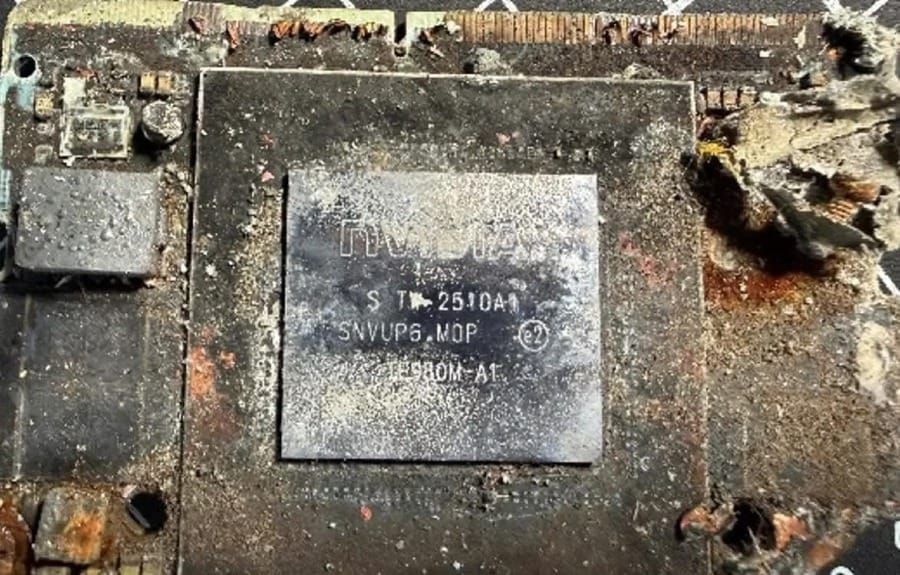
HUR announced on 12 August that it had found a Jetson Orin module in the S-71M Monochrome, an air-launched cruise missile, and said it may show artificial intelligence built into the weapon. The module's marking, TE980M-A1, corresponds to the Jetson Orin NX 16 GB, and serial markings showed it was packaged in 2025, more than three years after Nvidia stopped shipping to Russia in March 2022.
Hong Kong and India
Hong Kong consignors shipped US$17.6 million of Nvidia goods into Russia between August and December 2023, according to Russian customs records. The goods had earlier traded through China, Taiwan, Turkey, Thailand, Serbia and the United Arab Emirates, and they included Jetson TX2 systems, an earlier model Ukraine had found in drones. Malachor Electronics, a company with a secretarial address in Hong Kong's Central district, sent two Nvidia shipments worth US$1.58 million and US$1.21 million to Lotos, a Moscow-based firm.
John Rizzo, an Nvidia spokesman, gave the same account of resale channels in July 2024 that the company gave in August 2026. A U.S. Commerce Department official said that month that transshipments of high-priority items through Hong Kong fell 28 per cent from January to May 2024 and said China remained the U.S. government's main concern.
Shreya Life Sciences, an Indian pharmaceutical company founded in Moscow in 1995, shipped 1,111 Dell PowerEdge XE9680 servers to Russia between April and August 2024, Indian export records show. The servers carry Nvidia H100 or AMD MI300X processors and were declared at about US$260,000 each in April. They went to Main Chain Ltd and I.S LLC after the U.S. government sanctioned Shreya's earlier Russian customers, Lanprint and Silkway. Shipping documents listed Malaysia as the origin of more than 800 of the servers.
Russian buyers imported thousands of H100-class servers in 2024, hundreds in 2025 and tens in 2026, Sergei Minevich, co-founder of the Russian distributor ServerICT, said in May. He attributed the fall to Know Your Customer checks and serial-number tracking that Nvidia introduced from late 2024, and said Chinese buyers paying premiums of 200 to 300 per cent were outbidding Russian ones. Russia's entire market for artificial intelligence accelerators was worth 62.7 billion roubles (about US$700 million) in 2025, according to the IT holding T1.
A partly redacted message published by a hardware news channel shows an unnamed Chinese factory asking a U.S. computer company for H100 and H200 cards because Russian customers wanted them. The U.S. company refused, according to the channel. The message has not been independently verified. A St Petersburg online shop, ServerFlow, lists an Nvidia Jetson carrier board for delivery anywhere in Russia, alongside Mellanox InfiniBand switches.
The Israeli procurement cases
Ilya Kahn, a 66-year-old citizen of the U.S., Israel and Russia whose addresses court papers give as Israel, Brooklyn and Los Angeles, pleaded guilty in a U.S. federal court in Brooklyn, New York, on 7 November 2024 to conspiring to violate the U.S. Export Control Reform Act and to attempted tax evasion. Accounts he controlled received more than US$50 million from Elvees, a Russian chip designer, and related entities between 2012 and 2022. He agreed to forfeit US$4.9 million.
Elvees's clients include elements of the Russian Ministry of Defence and the Federal Security Service (FSB), the complaint against Kahn says. The U.S. Commerce Department added Elvees to the Entity List in March 2022 and the U.S. government sanctioned it that September. After a Taiwanese foundry that made Elvees-designed chips refused to ship to Russia, Kahn had the chips sent to the U.S. and re-exported them through a shipper at New York's John F. Kennedy airport, and he emailed design guidance to the foundry in May 2022, prosecutors said. Thousands of Elvees-branded chips went through a Hong Kong shipping company to a company in mainland China, and Kahn told the Hong Kong firm he had received a "call from Russia" about the Chinese buyer.
Gal Haimovich, a 49-year-old Israeli freight forwarder, arranged more than 160 shipments of U.S. aircraft parts and avionics to Russia between April 2022 and April 2023, some with missile technology applications, according to his guilty plea. He was sentenced to two years in prison in February 2025. His case was coordinated by Task Force KleptoCapture, a U.S. Justice Department unit set up in 2022 to pursue Russian sanctions evasion, which the Trump administration disbanded in February 2025.
Alexey Brayman, a resident of the U.S. state of New Hampshire described in Israeli press reports as an Israeli citizen, was charged in December 2022 with six others in the Serniya network. Prosecutors said the network operated under the direction of Russian intelligence and supplied the Ministry of Defence and FSB components including the Directorate for Scientific and Technological Intelligence, known as Directorate T. Vadim Konoshchenok, a co-defendant, identified himself in messages as an FSB colonel. All three cases were brought by U.S. prosecutors in U.S. courts.
Israeli chip-making tools in Russia
Israel "appears to have allowed Russia to purchase wafer-dicing and inspection equipment", Chris Miller, a historian of the chip industry, wrote for the American Enterprise Institute in April 2024. Russian customs records analysed for the report by Natalie Simpson of C4ADS show at least 30 shipments of Israeli-origin semiconductor manufacturing technology reaching Russia between the invasion and 31 July 2023, most of them sent directly from Israel.
Advanced Dicing Technologies, a Yokneam company that makes the saws and blades used to cut silicon wafers into individual chips, accounted for a substantial share of those shipments, the report found. A Chinese fund, Neng Yang, bought ADT in July 2019 for an estimated US$35 million. The report names neither ADT's Russian customers nor the value of its shipments.
An inspection machine made by Camtek, a Nasdaq-listed company based in Migdal HaEmek, was bought by Smart Kit Technology, shipped from Israel to Hong Kong and resold through an equipment reseller to a customer in Russia, according to the same report. Smart Kit, a Hong Kong company with no website, also shipped the used Applied Materials plasma etching tool that Russia's Engineering Group imported on 1 December 2023, C4ADS found. Smart Kit is on the U.S. Treasury's sanctions list in a record dated 23 August 2024 and on Canadian, Ukrainian and Taiwanese lists, sanctions records show.
Israeli goods through China and Hong Kong
More than US$10 million of Israeli metal-cutting tools reached Russia in 2024, and about half did not come directly from Israel, Russian customs data show. Chinese firms and an Uzbek company carried most ISCAR tools, and customers for Israeli brands included the Beriev aircraft works, the Sokol plant in Nizhny Novgorod and Stupino Machine-Building Plant, part of Rostec. "We can't control everything," Baruch Books, a vice-president of Vargus, said. ISCAR said it had not operated in Russia for several years.
Israeli exports to Hong Kong reached a record US$1.429 billion in 2024, up from US$1.090 billion a year earlier, with computers, electronics and optical equipment rising from US$784 million to US$986 million, according to INSS, a Tel Aviv research institute. Its analyst, Tomer Fadlon, wrote that the growth was not in chips. An infrared lens matching a model made by Israel's Ophir was found in Iranian drones used by Russia in 2022, and Israel's defence ministry said the lens was neither a defence nor a dual-use item.
Israel did not join Western sanctions on Russia in 2022 and had issued no regulations or guidelines for Israeli companies trading there by mid-March of that year. Civilian dual-use exports are controlled under orders from 2004 and 2006 that cover items on the Wassenaar Arrangement lists, so goods such as cutting tools fall outside licensing unless they appear on those lists. A bill the Ministry of Economy published on 26 March 2026 would for the first time let it require licences for unlisted items on end-use grounds.
The artificial intelligence chip export rule that former U.S. President Joe Biden's administration issued in January 2025 sorted countries into three tiers and placed Israel in the middle one. A U.S.-Israeli agreement on technology leakage to China and Russia, sought by the U.S. since 2021, had not been signed. The U.S. government asked Israel to extend export controls beyond defence products to technology companies, and Israeli officials said in May 2025 they were prepared to compromise in return for a wider technology partnership. The Trump administration rescinded the tiered rule that month, lifting the 50,000-chip cap it had set for Israel.
Israel's stake in Nvidia
Nvidia accounted for about half of Israel's 8 per cent economic growth in the third quarter of 2026 and paid US$1.29 billion in Israeli taxes last year, according to published estimates. The company generates about NIS 10 billion a year in Israeli tax revenue, and the Finance Ministry and the Israel Tax Authority are reviewing the risk that a downturn at the company would pose to the economy.
More than 90 per cent of Israeli output produced abroad is related to Nvidia. Most of it comes from the Mellanox unit in Yokneam, which Nvidia bought for US$6.9 billion in 2020. Sales of goods that never cross Israel's borders reached nearly US$10 billion in 2025 and were running at about US$20 billion a year in early 2026, according to economists' estimates. Nvidia and Google have asked the Israel Tax Authority to let them pay tax in dollars as the shekel rose.
Herzog telephoned Huang on 23 November, hours after Nvidia's board reinstated him, to congratulate him and thank him for his continued support for Israel, Herzog's office said. Israeli Prime Minister Benjamin Netanyahu wrote that continuity in Nvidia's leadership was good news for its partnership with Israel. China's market regulator found in September 2025 that Nvidia had breached the conditions on which it approved the Mellanox purchase, which included continued supply of accelerators to China.
Nebius, the Amsterdam company that kept Yandex's international businesses when Yandex's Russian assets were sold to a Russian consortium for US$5.4 billion in July 2024, is 9.3 per cent owned by Nvidia, according to a holding Nvidia disclosed in July. Nvidia invested a further US$2 billion in March 2026. Arkady Volozh, Nebius's chief executive, lives in Israel, and the company built Israel's national supercomputer with Nvidia hardware.
Trump's shares and Nvidia's money
Accounts in Trump's name bought or sold Nvidia shares at least 103 times from January 2025 and held between US$12.5 million and US$58 million of the stock at the end of that year, according to an analysis of his disclosures. One sale of US$500,001 to US$1 million took place on 18 May, five days after U.S. Secretary of State Marco Rubio briefed Trump on Huang's relationship with Alice Huang, according to people familiar with the briefing. Trump has denied receiving that briefing. The White House said in October that third-party managers run the portfolio independently.
Nvidia gave US$1 million to Trump's 2025 inauguration fund. It committed US$25 million to his White House ballroom project in October 2025 and asked for its name to be withheld. The pledge came nearly three months after Trump let Nvidia resume H20 sales to China in return for 15 per cent of the revenue. Trump cleared H200 sales on 8 December 2025 for a 25 per cent cut. Nvidia set up its first political action committee, a fund that donates to U.S. election campaigns, in August 2026.
White House officials led by David Sacks, Trump's adviser on artificial intelligence, pressed members of Congress in November 2025 to keep the GAIN AI Act, which would have made chipmakers serve U.S. buyers before exporting to China, out of the annual U.S. defence spending bill. Huang called the bill "even more detrimental to the United States than the AI Diffusion Act" at a press conference after meeting Trump, and Congress dropped it in December.
Interventions in the enforcement file
Senior U.S. Commerce Department officials required from the start of Trump's second term that any investigation of Nvidia and any outreach to the company first receive their approval. Tim Teter, Nvidia's general counsel, telephoned Jeffrey Kessler, the under-secretary who runs the Bureau of Industry and Security, the department's export control agency, about the Megaspeed investigation in late summer 2025. Agents were afterwards told to route Nvidia requests through Kessler and not to name Megaspeed in external communications. Teter then emailed the agents to say Kessler had allowed Nvidia to contact them, and Kessler told the agents to handle the case by the book, a Commerce Department official said.
The U.S. Justice Department asked the export control bureau to pause its work in late 2025 and later took the case over, although the agents could have pursued administrative restrictions on Megaspeed. Megaspeed imported at least 17,544 Nvidia GB300 chips worth about US$787 million in November 2025, Malaysian trade records show, five months after Nvidia said it had stopped selling to the company. U.S. Senator Elizabeth Warren, the senior Democrat on the Senate Banking Committee, and a colleague in the House of Representatives wrote on 12 November that the Commerce Department had halted its Megaspeed investigation after an Nvidia executive intervened.
The Commerce Department has added no company to its Entity List since it published its last additions on 9 October 2025, although other agencies proposed listing Megaspeed. U.S. Treasury Secretary Scott Bessent pressed Commerce Secretary Howard Lutnick on 5 November on why Megaspeed had not been listed, and Kessler had deferred the decision to Lutnick, people familiar with the exchange said. Kristen Eichamer, a Commerce Department spokesperson, said the two men had no such conversation. Gregory Meeks, the senior Democrat on the Foreign Affairs Committee of the U.S. House of Representatives, and his fellow Democrat Sydney Kamlager-Dove had asked Lutnick in February 2026 whether China-related security actions were being shelved to steady relations with China.
The U.S. Treasury, State Department and Commerce Department carried out 141 rounds of Russia sanctions and export control actions from February 2022 to July 2025, according to an August 2025 report by the staff of Warren and Jeanne Shaheen, Democratic members of the Senate. They carried out none in the six months the staff reviewed, against at least 16 in every earlier six-month period, and all but two staff in the State Department's sanctions coordination office had been pushed out. The Trump administration has said about 80 per cent of Russia's dual-use imports come from China, the report said.
Trump signed the Lindsey O. Graham Sanctioning Russia and Iran Act, a U.S. sanctions law, on 18 September 2026 and on 16 October issued an order waiving nearly all of its Russia provisions. Bessent said the waiver lifted no sanctions. Warren said on 24 August that the Jetson reports raised questions about whether Nvidia was doing enough and that Huang should testify before Congress.
Megaspeed and Huang's return
Megaspeed International, a Singapore data centre company, bought at least US$4.8 billion of equipment containing Nvidia technology between June 2024 and February 2026, according to trade records, and rented the computing power mainly to Alibaba. Alice Huang, a Chinese businesswoman also known as Huang Le, became its controlling shareholder in March 2023, according to C4ADS. U.S. officials concluded in 2025 that she was passing information to the Chinese government, according to people briefed on classified surveillance. Megaspeed denies wrongdoing and says she left on 30 August 2025. The published investigations of Megaspeed concern Chinese customers and name no Russian buyer.
Chinese and Russian state arms makers have exchanged technology throughout the invasion. Russia's sanctioned aerodynamics institute TsAGI tested aircraft models for Norinco, China's state arms maker, at least nine times from 2022 to 2024, C4ADS found.
Nvidia's board reinstated Huang on 23 November after receiving input from "senior levels of the United States government" and said it was confident his return posed no national security risk. Trump said in a television interview he had convinced the directors and that the market sell-off had probably influenced his decision. U.S. Attorney General Todd Blanche told Trump the Justice Department had no evidence of criminal wrongdoing by Huang or Nvidia while it continued to examine Megaspeed, a senior Justice Department official said. Nvidia has not disclosed which officials gave the board its assurance or whether they addressed the diversion of Nvidia products to Russian weapons.
Nvidia's knowledge and the law
Since a rule published on 3 March 2022 the U.S. Export Administration Regulations have required a U.S. licence for any item subject to U.S. export rules, other than food and medicine, when it is destined for a Russian military end use or end user, and such applications face a policy of denial. The requirement applies when an exporter has "knowledge" of that destination, which the regulations define to include an awareness of a high probability inferred from conscious disregard or willful avoidance of facts. Willful violations of the Export Control Reform Act carry up to 20 years in prison.
Nvidia was asked about the Hong Kong Jetson shipments in July 2024, and HUR published the Jetson Orin in the V2U in June 2025. Nvidia says it cannot follow products after sale, but it began tracking data-centre servers by serial number in late 2024, Minevich said, and HUR read serial markings directly off the Monochrome module. Nvidia and its distributors could be asked to trace that serial to its first buyer. No charge or penalty has been brought against Nvidia or its distributors over Jetson modules in Russian weapons.
Grounds for investigation
Nvidia computers made after Nvidia stopped shipping to Russia are guiding Russian weapons that have killed Ukrainian civilians. Hong Kong consignors, an Indian exporter and Chinese board makers moved Nvidia hardware to Russian buyers, and Israeli-made dicing and inspection equipment reached Russia directly and through a Hong Kong firm now under U.S. sanctions. Israeli nationals have been convicted in the U.S. of supplying Russian buyers, among them a chip designer whose clients include the Ministry of Defence and the FSB. Accounts in Trump's name traded Nvidia shares while his administration made decisions worth billions of dollars to the company, and Nvidia paid into his inauguration fund and his ballroom.
Senior U.S. Commerce Department officials placed every Nvidia inquiry under their own approval. Investigators' contact with Nvidia was routed through a political appointee after Nvidia's general counsel called him, and the export control bureau's Megaspeed case was then paused and transferred. The Entity List has been frozen since 9 October 2025 despite proposals from other agencies to list Megaspeed. Russia sanctions actions stopped for at least six months in 2025, and the Russia provisions of a sanctions law Trump signed were waived within a month. Israel kept its export regime without a catch-all after the U.S. government asked it to widen controls. The Trump administration then lifted the chip cap it had set for Israel, and Israel's president and prime minister praised Huang's return on the day Trump said he had secured it.
Opening a criminal investigation in the U.S. does not require proof of a crime. Federal Bureau of Investigation guidelines allow a preliminary investigation on information or an allegation of possible criminal activity and a full investigation on an "articulable factual basis" that a federal crime may be occurring. A conviction requires proof beyond reasonable doubt of every element of an offence. Committees of the U.S. Congress need no criminal predicate at all to investigate the conduct of executive agencies.
The Commerce Department's handling of the Megaspeed inquiry gives grounds to examine whether anyone corruptly influenced or impeded it, conduct that section 1505 of the U.S. criminal code makes a crime when aimed at a pending agency proceeding. The Jetson findings give grounds to examine whether Nvidia or its distributors had the "knowledge" the export rules describe as modules kept reaching Russian weapons after June 2025.
The ADT and Camtek shipments give grounds to examine whether the equipment contained U.S.-origin content or technology that brought its export to Russia under U.S. licence requirements and whether Israel's Export Control Agency reviewed the sales. Trump's trading gives grounds to examine whether any trade in his accounts was made on nonpublic information. The Entity List freeze gives grounds to examine whether the withheld Megaspeed listing served a commercial or diplomatic interest in place of a security finding.
Teter's August 2025 email to the agents and Kessler's reply have been described by people familiar with them. The export control bureau's Megaspeed case file passed to the Justice Department, and Entity List additions are decided by a vote of several U.S. agencies under Commerce Department rules. HUR has published the Monochrome module's markings, and the Smart Kit shipments appear in Russian customs records analysed by C4ADS. Trump's disclosure of any Nvidia trades from November is due by early January 2027.
Investigators would also seek material whose existence has not been established publicly. That includes distributor sales data for the Jetson serials HUR published, ADT's and Camtek's sales and end-user records for Russia, any Israeli licensing decisions on those exports and communications between the White House and the Commerce Department on the Entity List.
The Justice Department's National Security Division, the Commerce Department's internal watchdog, the Senate Banking Committee and the three House of Representatives committees now examining Nvidia each have authority to pursue those questions. Bessent gave Nvidia's board 10 days from 15 November to say whether Nvidia ignored signs that its chips were reaching China, a period that ends on 25 November. Meeks and two colleagues asked Lutnick for written answers on Megaspeed by 1 December. Those House committees have asked Huang and Teter to appear on 1 and 2 December or face subpoenas.