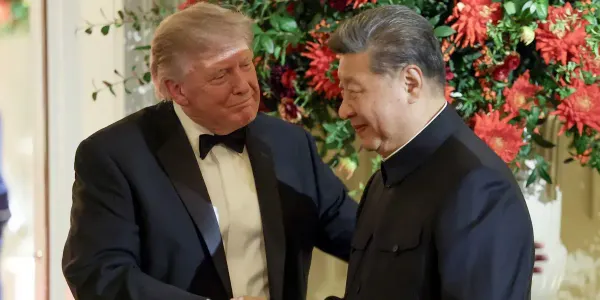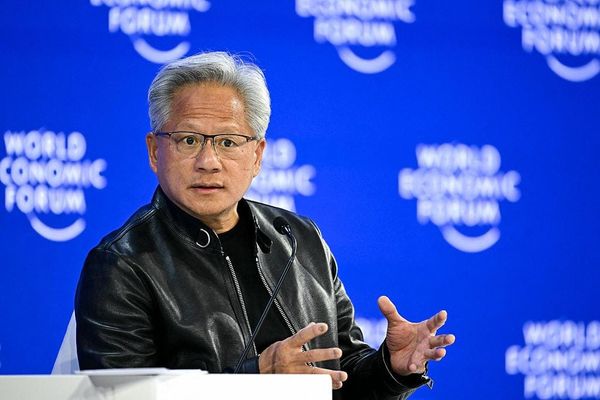
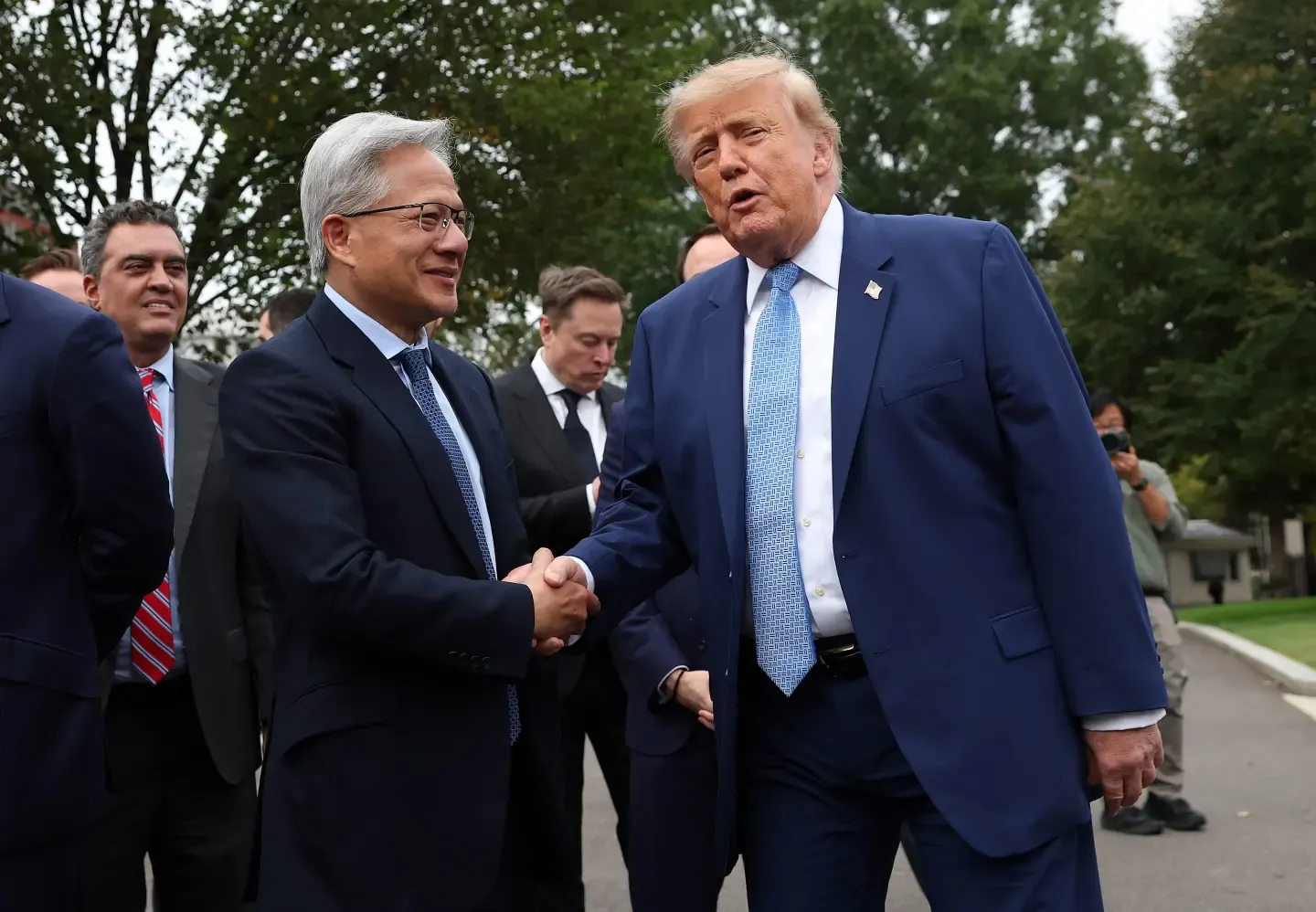
Nvidia's board reinstated Jensen Huang as chief executive on 23 November, hours after President Donald Trump publicly pressed it to and six days after ruling out his return.
The board said in an 8-K filing that it had received input from "senior levels" of the U.S. government and, based on that input, was confident Huang posed no national security risk. The filing is silent on which officials spoke and on any assessment they relied on. Nvidia's shares rose more than 25 per cent in early trading from a Friday close of about US$125.53, adding roughly US$750 billion of market value at that rate. The gain accrued to Huang, to a president whose accounts have traded Nvidia shares at least 103 times and to the investment bank controlled by the commerce secretary's sons.
Huang resigned on 12 November after reports of a relationship with Alice Huang, a former executive of the Singapore data centre company Megaspeed whom U.S. intelligence believes was recruited by China's Ministry of State Security. The board's assurance came within a day of a New York Times report that she had been in contact with a ministry official throughout that relationship. Its own investigation of Huang is still running, and Huang is due to give a closed-door transcribed interview to House investigators on 1 December.
Filings and public statements establish who pressed the board in public and who gained when it gave way. Who intervened in private, what was said and whether anyone's holdings shaped it remain open questions. The officials, investigators and records that could answer them are identifiable, and most of the records remain sealed.
From resignation to reinstatement
Reports on 29 October said U.S. officials suspected Alice Huang of working for Chinese intelligence. Nvidia announced Huang's resignation on 12 November. On 13 November Scott Bessent, the Treasury secretary, said Treasury and other agencies had backed blacklisting Megaspeed for months while the Commerce Department under Howard Lutnick, which controls the Entity List, delayed.
On 15 November Bessent questioned whether Nvidia's earnings had been inflated by inappropriate sales to China, told the board to hire an outsider and gave it 10 days to explain its export-control compliance. The next day Trump said he was open to Huang's reinstatement. The same day, analyses of his disclosures showed his accounts had traded Nvidia stock heavily, and the shares closed at US$156.14.
Harvey Jones, the board's chair, told investors on 17 November that the board had ruled out reinstating Huang, who had left after the disclosure of personal behaviour inconsistent with the company's code of conduct. House Democrats wrote that day to Lutnick's son Brandon demanding Cantor Fitzgerald's Nvidia trading records. On 19 November Trump's latest disclosure showed more Nvidia purchases, and Brian Mast, the Republican chair of the House Foreign Affairs Committee, published records of the administration's chip licences for China.
On 20 November Securities and Exchange Commission enforcement staff were reported to be examining Nvidia's accounting. Trump said that day he wanted Huang to make a big apology and go back. The shares ended the week at about US$125.53, down from a record US$239.24 on 6 October, a loss of more than US$2.7 trillion of market value.
Trump posted on the night of 22 November: "I hope the Board of Nvidia rehires Jensen Huang." The board's announcement followed the next morning, with Bessent's export-control deadline two days away.
Who pressed the board
Trump's demands came from the head of a government whose decisions Nvidia depends on. The Commerce Department had approved licences for 879,868 Nvidia and AMD chips to Chinese buyers by 11 May, according to the records Mast published, including to companies the Pentagon lists as Chinese military companies. Under a deal the White House announced in August 2025, the government takes a cut of Nvidia's revenue from chip sales to China.
Federal prosecutors run the criminal export-control case against Megaspeed, and the SEC is examining Nvidia's accounting. In May 2026 the Pentagon signed agreements with Nvidia and six other companies to run their AI on classified military networks to augment warfighter decision-making. The board reversed itself after receiving input from that government and cited the input as the basis for its confidence.
Bessent had argued publicly for an outside chief executive. The 8-K leaves open whether the input came from the White House, from Lutnick's Commerce Department, from Bessent's Treasury, from Secretary of State Marco Rubio or from the FBI, which handles counterintelligence. It is also silent on whether any official called a director, what was said in any such contact and whether the board sought the input or received it unprompted. Some directors, who have known Huang for decades, had been reluctant to investigate him at all, according to reporting on the board's deliberations.
Who gained
Huang held about 811.5 million Nvidia shares after his last Form 4 in September. A 25 per cent rise from Friday's close adds roughly US$25 billion to their value.
Trump's accounts bought or sold Nvidia stock worth up to US$97.5 million in at least 103 transactions from January 2025, according to an analysis of his disclosures. His holding was worth between US$13 million and US$62 million at the end of August, a separate review found, against between US$615,000 and US$1.3 million at the end of 2024. His accounts bought up to US$1.6 million of Nvidia shares in August and up to US$265,000 in September, his latest disclosure shows. If they still hold the August position, Monday's rise adds roughly US$1 million to US$11.5 million, based on published valuations of that holding. The realised gain depends on trades since September, which will appear only in later disclosures.
One sale, of between US$500,001 and US$1 million, was made on 18 May, five days after Rubio briefed Trump aboard Air Force One on intelligence about Huang's relationship with a suspected Chinese spy, according to people briefed on it. Trump has denied being briefed. Davis Ingle, a White House spokesman, said third-party financial institutions manage the portfolio independently and track indexes such as the Schwab 1000. The White House has also said Trump's assets are held in a trust managed by his children.
Cantor Fitzgerald, which Lutnick ran until he became commerce secretary and which his sons Brandon and Kyle now control, held more than 3.5 million Nvidia shares worth more than US$1.3 billion in February 2025. It cut its reported holding by about 49 per cent between September 2025 and March 2026, its filings show, while Lutnick's department held off blacklisting Megaspeed. It still held hundreds of millions of dollars of Nvidia stock when the affair became public, House Democrats wrote. Investigators have yet to show that the sons had inside knowledge, and Cantor's current holding remains private.
House Democrats have asked Cantor whether Lutnick's export-control decisions served his family's firm at the expense of national security. Nothing published shows whether the holdings of Trump, the Lutnick family or any official who gave input to Nvidia's board were reviewed for conflicts before that input was given.
The security question the board says is settled
Alice Huang was in contact with a Ministry of State Security official from the spring of 2025 until the autumn of 2026, The New York Times reported, citing people familiar with the intelligence. The contacts overlapped with her relationship with Huang and with Megaspeed's purchases of large quantities of Nvidia chips. Kang Wei, her business partner, who was often introduced as her husband, also worked with the ministry, the people said.
Strider Technologies, an intelligence firm, found that about US$3.6 billion of Chinese government money flowed through companies tied to Alice Huang's family or associates, according to the same reporting, paying for projects including data centres that received Nvidia chips. Kang controls Shanghai Century Longteng, a chip company part-owned by the Songjiang district government that agreed in 2022 to supply Huawei, according to Chinese corporate filings. A Shanghai businessman said Kang boasted he could introduce people to "Old Huang" in Singapore.
The adjudicative guidelines the government applies to people trusted with classified information treat sexual behaviour that makes a person vulnerable to coercion, exploitation or duress as grounds for concern. They apply the same test to associates connected with a foreign government. The danger they describe is the hold a concealed relationship gives a foreign service, and it exists whether or not information is passed. Whether Alice Huang passed inside information remains unresolved, people familiar with the intelligence said. That question bears on espionage, while Huang's exposure stems from the relationship itself. The Chinese government has called the allegations groundless.
Findings from the board's investigators remain private, including those on reported affairs with Nvidia employees and on whether Huang disclosed the relationship to anyone at Nvidia before it became public. It has set up a board committee on national security and export controls and is hiring a chief compliance officer.
The financing loop
Huang returns to oversee arrangements under which Nvidia has become shareholder, fallback renter and lease guarantor for many of the AI companies that buy its chips. Nvidia bought US$2 billion of CoreWeave shares in January 2026 and must buy any capacity CoreWeave's customers leave unused until 13 April 2032. OpenAI, in which Nvidia agreed to invest about US$30 billion, holds contracts worth up to US$22.4 billion for CoreWeave capacity, so Nvidia's cash can reach OpenAI as equity, pass to CoreWeave as rent and return to Nvidia as processor sales.
Nvidia has guaranteed leases at an Ohio campus for OpenAI, with payments capped at US$105 billion, and OpenAI's promise to reimburse it depends on the company whose default would trigger them. Lambda, a cloud company Nvidia had invested in, is borrowing US$917 million to fund a US$1.5 billion contract to rent servers back to Nvidia. Huang wrote in August that the Ohio deal was sound because OpenAI will pay the lease.
Smaller cloud operators sign six-year agreements under which Nvidia rents whatever capacity they cannot sell, while they remain free to sell it to others at higher rates. Those commitments stood at US$32 billion on 25 October, and Nvidia may take a share of the operators' revenue. Nvidia also agreed in October 2025 to put up to US$2 billion into a special purpose vehicle set up to buy Nvidia chips and lease them to Elon Musk's xAI, with loans secured on the processors, Bloomberg reported.
Nvidia's stakes in other companies were worth about US$110 billion on 25 October, against US$35 billion in January, and its maximum exposure under guarantees reached US$118 billion. Gains on its private stakes, booked when those companies raise money at higher prices, came to US$25.5 billion over nine months. Customers took 64 days to pay by 25 October, against the 53 days a November 2025 Nvidia memo cited in rejecting claims of vendor financing.
The US$530.5 billion figure
Hunterbrook, an investigative publisher with an affiliated investment fund, totalled Nvidia's disclosures at US$530.5 billion on 6 November. The figure matches Note 10 of the 10-Q for the quarter to 26 July: US$366 billion of commitments, US$56 billion of additional commitments and US$108.5 billion of maximum guarantee exposure. Those three categories carry three different kinds of obligation.
Orders for memory and manufacturing capacity make up US$279 billion of the US$366 billion. They are firm purchase commitments to suppliers such as chip foundries, recorded as liabilities as the goods are delivered. The rest comprises US$29 billion of cloud services Nvidia rents, US$25 billion of data centre leases that had not started, US$25 billion of promised equity investments and US$8 billion of capital spending.
The US$56 billion covers US$36 billion of cloud operator agreements and US$20 billion of third-party data centre leases. The cloud operator commitments shrink as outside customers take the capacity, so Nvidia's eventual payments depend on how much the operators fail to sell. They become payable in full only if demand from everyone else disappears.
Guarantees account for the remaining US$108.5 billion, and they are contingent: Nvidia pays only if a tenant defaults. US$105 billion of it, for the Ohio campus, was signed after the quarter ended, and the remaining US$3.5 billion backs cloud partners' leases, partly covered by US$712 million held in escrow. The filing leaves open whether those leases and the US$20 billion of third-party leases cover the same buildings.
Commitments tied to customers and cloud partners, comprising rented capacity, cloud operator agreements, guarantees and promised equity, came to about US$198.5 billion in July. By 25 October supply commitments had risen to US$390 billion and guarantees to US$118 billion, including a new US$9.5 billion of credit support for power and systems. Nvidia said no payment had yet been made under any guarantee.
The Ponzi comparison
Hammerstone Markets, a research firm, wrote that circular deals, like Ponzi schemes, require constant new funds. Nvidia's own results commentary says its commitments to neocloud operators take effect only if they secure financing, and that those operators and AI labs are "growing faster than their balance sheets and long-term credit profiles can support". CoreWeave owed US$46.9 billion against US$4.1 billion of cash on 30 September.
Money already in the system is used to bring in more. Lambda is borrowing to fund a contract with the company that invested in it. Michael Intrator, CoreWeave's chief executive, said most of the capital CoreWeave needs in 2027 will come from customer prepayments and hardware partners such as Nvidia. CoreWeave owes US$10.97 billion of principal in 2027, and several of its loans are sized against the cost of Nvidia hardware, so their security depends on the value of Nvidia's chips.
Part of what Nvidia reports as profit is also set by new money. Its private stakes are marked up when those companies raise funds at higher prices, including in rounds Nvidia joins. In the quarter to October gains on equity securities fell to US$1.8 billion from US$7.8 billion in the quarter before, and Nvidia took a US$1.8 billion impairment on private holdings.
Under the terms disclosed in Nvidia's filings, a halt in new financing for the operators and labs would work through in stages. Their purchases would stop, and the neocloud commitments that depend on their financing would never take effect, cutting Nvidia's sales to them. Rent commitments on existing agreements would rise toward their full value as unsold capacity accumulated. Guarantees would turn from contingent exposure into payments if tenants defaulted, starting with the Ohio leases from 2028. The US$81 billion customers owe Nvidia, some of it on terms of up to a year, would become harder to collect, while Nvidia's US$110 billion of stakes faced further impairments.
The International Monetary Fund counted about US$650 billion of debt behind US$1.4 trillion of commitments under which weaker AI firms promise to buy chips or services from the large technology companies that invest in them. Its October Global Financial Stability Report said a fall in AI asset prices could be worsened by rising borrowing, concentrated exposures and such arrangements.
Whether these arrangements broke accounting rules turns on documents held by Nvidia, its auditors and the SEC. Revenue would be overstated if side agreements made customers' duty to pay depend on Nvidia's money, or if Nvidia paid customers above market rates for capacity so that cash returned as sales. Nvidia's filings leave out how much of its US$293.7 billion of revenue in the nine months to October came from companies it funded or guaranteed, and whether its rent payments to customers are booked as costs or deducted from revenue.
Records still missing
The identity of the officials who gave the board its input, and what they said, rests with the board and the administration, and Congress can compel both. The board's investigation findings remain with Nvidia. The intelligence behind the Rubio briefing and any FBI assessment of Huang are within reach of the House and Senate intelligence committees.
Trump's Nvidia trades since September will appear only in future Office of Government Ethics filings. Cantor's trading records are due to House Democrats by 1 December, the day of Huang's interview. Mark Stevens, an Nvidia director, sold 4,236,740 shares for about US$947 million in September, three Form 4 filings show, all outside a pre-arranged trading plan.
Bessent's deadline for Nvidia's export-control explanation expires on 25 November. Nvidia's 10-Q for the quarter to October, due by 4 December, is the first filing in which it would have to describe the SEC inquiry and the board's investigation if it judges them material.